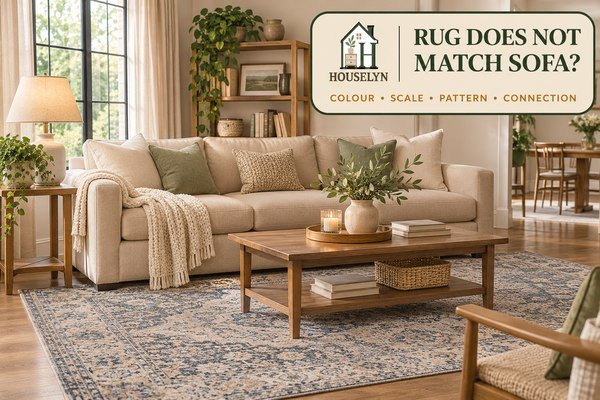




Rug Does Not Match Sofa? How to Make the Two Work Together

COLOUR • SCALE • PATTERN • CONNECTION

A rug and sofa can both be attractive on their own and still feel disconnected when colour, pattern, scale or visual weight does not create a clear relationship.

Affiliate Disclosure: Houselyn may earn a commission from qualifying purchases made through links on this page, at no extra cost to you. We only recommend products we genuinely believe add value to our readers.

When a rug does not match sofa colours, pattern or visual weight, the whole seating area can feel slightly off even when both pieces are attractive on their own. Because the sofa and rug are two of the largest surfaces in a living room, a weak relationship between them can influence how the entire room reads.

The answer is not necessarily to replace either one. A rug can be lighter, darker, more patterned or a different colour from the sofa and still work beautifully if there is enough connection through tone, undertone, pattern, scale or the surrounding materials.

The most useful rug does not match sofa fixes begin by reading what each piece is doing, finding the relationship they already share, balancing their visual weight, creating a bridge where needed and confirming whether the problem still remains before making a larger purchase.

HOUSELYN INSIGHT

The rug and sofa do not need to match each other. They need to make sense beside each other.

THE HOUSELYN APPROACH

Read → Relate → Balance → Bridge → Confirm

Use this sequence to understand whether the issue is colour, temperature, pattern, scale or visual weight before deciding that either the rug or sofa needs to be replaced.

SEE THE RELATIONSHIP IN CONTEXT

Connect the Rug and Sofa Through the Wider Room Palette

A rug and sofa can feel disconnected even when both pieces are attractive on their own. The missing relationship may come from colour, undertone, pattern, visual weight or the materials surrounding them.

Houselyn's Style and Color Planning guide helps you step back from the two pieces and see how the wider palette, finishes and repeating elements can support a more cohesive room.

CHAPTER 1

Read Why the Rug Does Not Match Sofa Before Changing Either One

When a rug does not match sofa colours or style, it is easy to assume that one of the two pieces must be wrong. In practice, the problem can come from several different relationships, and replacing the rug before identifying the real issue can simply exchange one mismatch for another.

Start by reading what each piece is contributing to the seating area. Look at colour, temperature, pattern, visual weight and scale separately. A rug may feel wrong because it is too cool beside a warm sofa, because its pattern is too dominant, or because it is simply too small to connect the furniture visually.

A rug and sofa can feel disconnected for several reasons, so colour should not be blamed before scale, pattern and visual weight are checked too.

Diagnose the Relationship Before You Shop

If the rug does not match sofa visually, separate the problem into categories rather than judging the whole pairing at once. This makes the correction much easier because each type of mismatch needs a different response.

A warm beige sofa beside a cool blue-grey rug presents a temperature problem. A quiet sofa beside a highly graphic rug presents a pattern problem. A large sectional sitting partly outside a small rug may have a scale problem even if the colours work perfectly together.

COLOUR

Check Whether the Hues Actually Conflict

Look for one shared or related colour before deciding the rug and sofa cannot work together.

TEMPERATURE

Compare Warm and Cool Direction

A noticeable warm-versus-cool split can make two otherwise suitable pieces feel more separate than they are.

PATTERN

Ask Which Piece Is Visually Louder

A strong rug may need a quieter sofa, while a visually busy sofa often works better with a calmer rug.

WEIGHT

Compare Darkness and Presence

One piece may be dominating the seating area because it is much darker, heavier or more visually dense.

SCALE

Check Whether the Rug Is Large Enough

A rug that sits too far from the sofa or supports too little of the seating group can make the two pieces feel unrelated.

HOUSELYN EXAMPLE

The Colours Work, but the Rug Still Feels Wrong

Imagine an oatmeal sofa with a cream-and-taupe rug. The colours clearly belong together, yet the rug still looks disconnected because it is too small and barely reaches the front legs of the seating. In this case, changing the colour would not solve the problem. The relationship is being weakened by scale.

HOUSELYN INSIGHT

The right fix depends on identifying which relationship is actually failing.

CONTINUE LEARNING

Check Whether the Rug and Sofa Are Part of a Wider Room Problem

If several furnishings and finishes feel disconnected rather than just these two pieces, diagnose the whole room before focusing only on the rug and sofa.

Read Room Feels Mismatched →

CHAPTER 2

Relate the Colours When the Rug Does Not Match Sofa

When a rug does not match sofa colours directly, the goal is not to force an exact match. A rug can be darker, lighter or more colourful than the sofa and still feel intentional if there is one visible colour relationship tying the two together.

Look first for a shared neutral, a repeated undertone or a related accent already present in the rug. Even a small colour echo can be enough to make the pairing feel considered rather than accidental.

A rug does not need to repeat the sofa colour exactly when one neutral or accent tone creates a visible connection between the two pieces.

Look for One Strong Relationship, Not a Perfect Match

A warm beige sofa can work with a rug that contains taupe, cream, muted rust, faded blue or several other colours. The important question is whether something in the rug relates back to the sofa or to another established colour in the seating area.

This is one of the simplest rug does not match sofa corrections because it shifts the goal from sameness to connection. Instead of asking whether the rug is the same beige as the sofa, ask whether the two pieces belong to the same wider palette.

MATCH

Share One Direct Colour

The rug includes a colour that clearly repeats the sofa, such as cream, beige, taupe or another dominant tone.

ECHO

Repeat a Related Tone

The rug uses a lighter, darker or more muted version of a colour already established by the sofa.

BRIDGE

Let a Third Element Connect Them

A cushion, throw or artwork can repeat one rug colour and one sofa colour when the two pieces do not connect strongly on their own.

HOUSELYN EXAMPLE

Warm Beige Sofa With a Cream, Taupe and Muted Rust Rug

The rug does not need to be beige overall. If cream or taupe already appears in its pattern, that shared colour can connect it to the sofa while the muted rust adds controlled interest. The result feels layered rather than matched as a set.

HOUSELYN INSIGHT

One repeated colour can create more cohesion than trying to make the whole rug match the sofa.

CONTINUE LEARNING

Check Whether the Sofa and Rug Belong to the Same Wider Palette

If the relationship still feels uncertain, step back from the two pieces and check whether the room's wider colour palette has enough repetition and hierarchy to support both.

Read Choosing a Color Palette →

CHAPTER 3

Balance Pattern and Visual Weight When the Rug Does Not Match Sofa

When a rug does not match sofa visually, the problem may have less to do with colour and more to do with which piece is demanding the most attention. A quiet sofa beside a highly graphic rug can work beautifully, but the same rug may feel overwhelming beside a sofa that already has a strong pattern, dark colour or heavy silhouette.

The goal is not to make both pieces equally noticeable. It is to decide which one should lead, which one should support and where the eye needs a quieter place to rest.

A patterned rug can lead successfully when the sofa is visually quieter and the room gives the eye somewhere else to rest.

Let One Piece Lead While the Other Supports

A plain oatmeal sofa can comfortably sit above a patterned rug when the rug contains colours related to the wider room and the pattern is given enough visual space. The sofa acts as the quieter anchor while the rug carries more movement.

If the sofa is already visually strong — perhaps deep in colour, heavily textured or patterned — the opposite approach usually works better. A calmer rug can support the sofa without forcing the seating area to manage two competing focal points.

LEAD

Choose the Stronger Visual Statement

Let either the rug or sofa carry the bolder pattern, deeper colour or more distinctive texture.

SUPPORT

Keep the Second Piece Quieter

Use simpler colour, pattern or texture so the supporting piece reinforces rather than competes.

REST

Leave Some Visual Breathing Room

Keep nearby cushions, curtains or accessories restrained so the seating area has space to settle.

HOUSELYN EXAMPLE

Plain Oatmeal Sofa With a Muted Geometric Rug

A plain oatmeal sofa can work with a rug that carries a muted geometric pattern in cream, taupe and faded blue. The rug becomes the stronger visual layer, while the sofa supports it through a quieter colour and simple form. Keep the surrounding cushions and curtains restrained so the two major pieces do not have to compete with additional pattern.

HOUSELYN INSIGHT

When both the rug and sofa demand attention, the room can feel competitive rather than connected.

CONTINUE LEARNING

Use Pattern Hierarchy When the Rug Is Doing More Visual Work

If pattern is the main source of tension, use Houselyn's wider pattern framework to decide which print should lead and how the surrounding room can support it.

Read Pattern Mixing Rules →

CHAPTER 4

Bridge the Gap When the Rug Does Not Match Sofa Directly

When a rug does not match sofa directly, the missing connection does not always need to come from either major piece. A carefully chosen third element can often create enough visual continuity for the two to feel intentional together.

The most effective bridge is usually simple: one cushion, throw, artwork detail or nearby material that relates to both the sofa and the rug. The goal is not to fill the room with coordinating accessories. It is to create one clear visual link.

A cushion, artwork detail or nearby material can connect a warm sofa and cooler rug without forcing either piece to match exactly.

Use One Deliberate Bridge Instead of Several Matching Accessories

A warm beige sofa and a cool blue-grey rug can feel slightly separated because their temperature directions are different. Instead of replacing either piece, look for an element that can repeat something from both sides of the relationship.

A cushion containing beige and muted blue can do this very efficiently. Artwork with warm neutral areas and blue-grey detail can do the same. Even a medium wood coffee table can soften the temperature difference by introducing a natural material that sits comfortably between the two.

SOFA

Identify What the Sofa Contributes

Note its dominant colour, warmth, texture and visual weight before choosing anything to connect it.

BRIDGE

Choose One Element That Relates to Both

Use a cushion, throw, artwork or material that repeats one useful characteristic from each major piece.

RUG

Let the Connection Reach the Floor

The bridge should make at least one rug colour, tone or material feel more intentional beside the sofa.

HOUSELYN EXAMPLE

Warm Beige Sofa With a Cool Blue-Grey Rug

Keep both major pieces, then introduce one cushion that combines beige with muted blue-grey and artwork that includes both warm neutral and cooler grey-blue detail. If the coffee table is natural or medium wood, it can further soften the temperature shift without becoming another strong colour statement.

HOUSELYN INSIGHT

A third element can connect two pieces that do not coordinate strongly on their own.

CONTINUE LEARNING

Check Whether Temperature Is Making the Rug and Sofa Feel Further Apart

If the main disconnect seems to come from a warm sofa beside a noticeably cooler rug, use Houselyn's temperature guide to understand the relationship before changing either piece.

Read Warm Versus Cool Paint →

HOUSELYN RECOMMENDED ESSENTIALS

Small Pieces That Can Connect a Rug and Sofa Without Replacing Either

If the rug and sofa are individually worth keeping, the smartest purchase is often a small bridge rather than another major anchor piece. Choose only after you know whether the missing connection is colour, temperature or material.

01

COLOUR BRIDGE

Two-Tone or Multi-Tone Cushion Covers

Best for: repeating one useful colour from the sofa and one from the rug.

Why Houselyn recommends it: one carefully chosen cushion can create a visible colour bridge between two major pieces without forcing either one to match exactly.

What to look for: restrained patterns or colour blocking that include one sofa-related tone and one rug-related tone, with a finish that suits the room's existing texture level.

Avoid if: the seating area already has several patterned cushions or the real problem is rug size rather than colour connection.


Browse Multi-Tone Cushion Covers →
02

SOFTENING LAYER

Textured Neutral Throw

Best for: softening a colour-temperature gap without introducing another dominant pattern.

Why Houselyn recommends it: a warm cream, oatmeal or taupe throw can make the sofa feel more connected to a rug that contains similar quieter neutrals while adding texture at the same time.

What to look for: a restrained neutral tone, visible texture and enough contrast from the sofa fabric to read as a deliberate layer.

Avoid if: the sofa already carries several throws or the rug and sofa need a clearer colour bridge rather than another neutral textile.

Browse Textured Neutral Throws →
03

CENTRE CONNECTION

Large Decorative Tray

Best for: creating a small material or colour bridge at the centre of the seating area.

Why Houselyn recommends it: a tray placed on the coffee table can introduce wood, bronze, black or another useful finish between the sofa and rug without cluttering the room with several accessories.

What to look for: a finish already present elsewhere in the room, practical scale and a shape that suits the coffee table rather than overwhelming it.

Avoid if: the coffee table is already visually busy or the central furniture is too small to support another decorative layer.

Browse Decorative Trays →

HOUSELYN BUYING RULE

Bridge the relationship before replacing the anchor pieces. One useful connection should be tested before you spend on another rug or sofa.

CHAPTER 5

Confirm the Relationship Before Replacing the Rug or Sofa

When a rug does not match sofa colours, pattern or visual weight, replacement should be the final decision rather than the first reaction. By this point, you should already know whether the real problem comes from colour, temperature, pattern, scale or the absence of a useful bridge between the two pieces.

Before buying anything major, test the smallest correction that addresses the actual problem. A repositioned rug, one connecting cushion, a quieter accessory arrangement or a clearer colour echo may be enough to make the relationship feel intentional.

A stronger rug-to-sofa relationship can often come from connection and placement rather than replacing either major piece.

Test the Smallest Correction Before Making the Largest Purchase

If colour is the issue, try one bridge first. If scale is the problem, test the rug position and how much of the seating it supports. If the room feels visually competitive, simplify the surrounding cushions or accessories before assuming the rug itself is too busy.

This matters because a rug and sofa are both expensive, visually dominant pieces. Changing one without understanding the relationship can create a new problem rather than solving the old one.

KEEP

Keep Both When the Basics Already Work

If scale, colour and visual weight are generally compatible, the pairing may only need a small adjustment elsewhere.

CONNECT

Add One Useful Bridge

Use one cushion, throw, artwork detail or material that creates a visible relationship between the two pieces.

REPOSITION

Check the Rug's Placement and Reach

A rug that sits too far from the sofa or supports too little of the seating group can make a good colour pairing feel disconnected.

REPLACE

Replace Only When the Conflict Is Fundamental

Consider replacement when colour, pattern, scale or material character remains strongly incompatible after simpler corrections have been tested.

WORKED EXAMPLE

Warm Beige Sofa With a Cooler Blue-Grey Rug

Imagine a living room with a warm beige sofa, a cool blue-grey rug, a natural oak coffee table, cream curtains, a brass floor lamp, muted artwork and several beige cushions. The room is attractive, but the rug initially feels more separate from the sofa than intended.

1

READ

The biggest difference is temperature: the sofa reads warm while the rug introduces a noticeably cooler blue-grey direction.

2

RELATE

The rug also contains cream, which already creates one useful connection back to the curtains and lighter neutral areas of the room.

3

BALANCE

The rug is slightly darker than the sofa but is not so patterned or heavy that it dominates the entire seating area.

4

BRIDGE

Replace one plain beige cushion with a cushion that combines warm beige and muted blue-grey, or use artwork that contains both temperature directions.

5

CONFIRM

Reassess the seating area after the bridge is in place. If the rug now feels intentional beside the sofa, there is no reason to replace either major piece.

THE RESULT

The sofa remains warm and the rug remains cooler, but the relationship no longer feels accidental. A small amount of repetition gives the eye enough evidence that the two pieces belong in the same room.

HOUSELYN INSIGHT

Replacement should be the last decision, not the first reaction.

CONTINUE LEARNING

Check Whether Rug Size Is Making the Sofa Relationship Feel Wrong

If the colours and materials now work but the seating area still feels disconnected, check whether the rug is large enough and positioned correctly for the furniture around it.

Use the Rug Size Calculator →

FREQUENTLY ASKED QUESTIONS

Rug Does Not Match Sofa FAQs

These quick answers can help you decide whether the issue is colour, pattern, scale or simply a missing visual connection between the two pieces.

Does my rug have to match my sofa?

No. A rug and sofa can be different in colour, pattern and texture as long as they share a clear relationship. That connection might come from one repeated colour, a related undertone, compatible visual weight or a third element that bridges the two.

What colour rug works with a beige sofa?

Cream, taupe, camel, muted blue, faded green, warm grey and restrained multi-tone rugs can all work with beige. The better question is whether the rug contains at least one tone that relates back to the sofa or the wider room palette.

Can a patterned rug work with a plain sofa?

Yes. A patterned rug often works especially well with a plain sofa because the rug can carry more visual interest while the sofa acts as the quieter anchor. Keep nearby cushions and curtains restrained if the rug already leads strongly.

What if my rug is darker than my sofa?

A darker rug can ground a lighter sofa very effectively. Check whether the rug feels proportionate to the room and whether its colours or undertones relate to the sofa. Darker does not automatically mean mismatched.

How do I connect a cool rug with a warm sofa?

Use one or two bridge elements that contain both temperature directions. A cushion, artwork or textile combining warm beige with muted blue-grey can help the eye understand why both pieces belong in the same seating area.

Should I replace the rug or the sofa first?

Replace neither until you know why the pairing feels wrong. Test colour connection, rug position, pattern balance and scale first. If the sofa is otherwise suitable, replacing a rug is usually the smaller decision, but only when the rug itself is genuinely incompatible.

FINAL THOUGHT

Create the Relationship Before You Replace the Furniture

When a rug does not match sofa colours, pattern or visual weight, the solution is usually to understand the relationship before changing either major piece. A shared colour, clearer hierarchy, stronger bridge or better rug placement can often make the seating area feel intentional without turning the room into a matched set.

The goal is not sameness. It is enough connection for the eye to understand why the rug and sofa belong together.

Create the relationship before you replace the furniture.

Houselyn Editorial Team

ABOUT THE AUTHOR

Houselyn Editorial Team

The Houselyn Editorial Team creates practical, design-led guidance for making real homes feel more balanced, comfortable and intentional. Our approach focuses on helping readers diagnose the relationship between furnishings, colour, scale and materials before assuming that every decorating problem requires a major purchase.

Meet the Houselyn Editorial Team →

HOUSELYN KNOWLEDGE LIBRARY

Explore More Practical Home Guidance