Dorm Room Essentials: What You Actually Need for College
A complete dorm room essentials setup begins with the
items needed for immediate routines while preserving room for later
decisions.
Dorm room essentials should support sleep, hygiene,
study, safety and everyday independence—not fill a compact college room
with products that may be duplicated, prohibited or rarely used.
Confirm the residence, prioritise genuine needs, measure available
spaces and coordinate with a roommate before completing the shopping
list.
A Smarter College Shopping System
Why Dorm Room Essentials Need a Better Buying System
A useful dorm room essentials checklist should reduce
uncertainty, wasted money and move-in stress. It should not treat every
convenient product, decorative accessory or popular online recommendation
as something every student must own.
1
Online Lists Often Confuse Useful With Essential
An item may solve a problem for one student without being necessary
for another. A printer, mattress topper, fan or mini fridge may be
valuable in the right room, but each depends on facilities, personal
routines and residence rules.
2
Dorm Rooms Have Limited Capacity
Supplied furniture, narrow walking routes and small wardrobes leave
little tolerance for unnecessary purchases. Every product requires a
place to live, enough clearance to operate and a realistic plan for
cleaning, storing or moving it.
3
Residence Rules Change the Shopping List
Bed dimensions, supplied appliances, electrical requirements,
decorating permissions and bathroom arrangements can vary. A product
should not enter the final list until the student knows whether the
accommodation permits and supports it.
4
Roommates Can Accidentally Buy the Same Things
Two rugs, two cleaning tools or two small appliances can consume money
and communal space unnecessarily. Shared products need an agreed
buyer, owner, maintenance plan and move-out decision before either
student completes the purchase.
5
The Houselyn Method Begins With Evidence
This guide classifies dorm room essentials according
to confirmed need, timing, dimensions, ownership and routine. Product
recommendations appear only after the reader understands the decision
that each item is meant to support.
6
The Goal Is a Personalised Essentials List
By the end of the guide, the reader should know what to buy before
arrival, what requires confirmation, what can wait until move-in and
what may never be necessary for their particular college room.
Part I • Verify the Room
Confirm Dorm Room Essentials Before You Start Shopping
Confirmed bed dimensions, supplied furniture, bathroom arrangements and
residence rules turn a generic packing list into a plan for the actual
room.
The right dorm room essentials depend on what the
accommodation already provides, what it permits and how the student will
sleep, study, bathe, wash clothes and share the available space.
A generic college list cannot know whether the student has a communal
bathroom, an en-suite shower, shared kitchen access, climate control or a
residence that supplies certain electrical equipment. Those differences
change what is necessary from the first evening.
Effective dorm room essentials planning therefore begins
with evidence rather than products. The housing portal, room assignment,
residence agreement and roommate conversation should shape the first
shopping decisions.
Another Student’s Checklist May Describe a Different Room
A recommendation can be sensible and still be wrong for a particular
student. Someone living with a communal bathroom may need a portable
shower routine, while a student with an en-suite may prioritise drying
space and bathroom cleaning supplies.
A warm building may make a permitted fan valuable. A cooler residence
may make breathable bedding and an additional approved blanket more
relevant. A campus with accessible printing may remove the need for a
personal printer entirely.
The first task is not to copy the longest available list. It is to
identify which assumptions behind that list are true for the assigned
accommodation.
Confirm the Bed Before Purchasing Bedding
Sheet size is only the first bed question. Mattress depth affects fitted
sheet pockets, while an existing padded cover can influence whether an
additional topper is practical. A raised bed may offer space beneath
it, but that space is not useful until its height and access are known.
Supplied furniture also limits what can be added. Residence furniture
may need to remain in the room even when the student prefers another
chair or storage unit. Purchasing replacement furniture without
checking the policy may create a second item that has nowhere to go.
Let the Bathroom and Laundry Route Shape the Kit
A communal bathroom may require toiletries to travel through a corridor,
while an en-suite bathroom keeps them close to the room but may offer
less drying space than expected. The student needs to know the complete
route before choosing a shower caddy, robe, towel quantity or toiletry
system.
Laundry access affects the type of carrier. A rigid basket may work when
machines are nearby and on the same floor. A backpack-style or flexible
bag may be easier when stairs, lifts or longer corridors are involved.
Check Climate Control and Ventilation
Room temperature can influence bedding weight, fan decisions and
moisture management. Confirm whether the room has air conditioning,
adjustable heating, opening windows or building-wide controls.
Avoid buying an electrical comfort product based solely on another
residence’s experience. Even when a fan or heated item appears useful,
the product must satisfy the current accommodation’s electrical and
appliance rules.
Part II • Control the Shopping List
Build a Dorm Room Essentials List by Priority, Not Popularity
A priority system helps students distinguish immediate-use items from
products that depend on the room, routine or roommate.
A useful dorm room essentials list ranks products by the
daily responsibility they support—not by how often they appear in
shopping guides, social-media hauls or retailer collections.
The word “essential” should describe a genuine need, not a persuasive
product description. Many items can make college life easier, but that
does not mean they must be purchased before arrival or owned by every
student.
The aim of this chapter is to reduce a broad collection of possible
purchases into a controlled sequence. The student first protects the
routines that must work immediately, then adds products only when their
value is clear.
Popularity Does Not Prove That an Item Is Necessary
A product may appear repeatedly because it photographs well, fits a
retailer’s seasonal campaign or solves a common problem. None of those
reasons confirms that the student has the same problem.
A bedside shelf may be useful when the bed is raised and the supplied
furniture is distant. It may be unnecessary when a nightstand is already
provided. A printer may seem convenient, but campus facilities can make
it an expensive object that occupies desk space and requires ink,
paper and maintenance.
Effective planning asks what task the item will perform, how often that
task occurs and whether an existing facility or simpler product already
supports it.
Prefer Multi-Use Products When the Functions Are Genuine
Small rooms benefit from products that complete more than one useful
task. A structured laundry bag can carry clothing and hold it between
wash days. A lidded mug can serve hot and cold drinks while reducing
spills near electronics.
Multipurpose claims still need scrutiny. A complicated product with
several weak functions may be less useful than one simple item that
performs a frequent responsibility reliably.
Consider Cost Per Use, Not Only Purchase Price
A slightly more durable item can offer better value when it is used
every day and can continue into later accommodation. A low-priced
novelty product may be poor value when it occupies space, breaks easily
or solves a task that occurs twice during the year.
Value also includes return difficulty. Bulky, personalised or
non-returnable items create more risk when the room has not been seen.
Delaying those purchases can be more valuable than securing a temporary
discount.
Part III • Protect Sleep First
Choose Dorm Room Essentials for Sleep and Bed Protection
A reliable dorm sleep setup protects the mattress, fits correctly and
supports temperature comfort before decorative layers are added.
Sleep-related dorm room essentials should protect the
supplied mattress, fit securely, regulate temperature and remain easy to
wash in a shared-laundry routine.
A college bed is used for more than sleeping. It may also become a place
to read, rest, talk with a roommate or sit when the desk chair is occupied.
That makes comfort important, but it also increases the need for washable,
manageable layers.
The most useful dorm room essentials for the bed are not
automatically the thickest, softest or most decorative choices. They are
the products that match the verified mattress, survive repeated washing
and can be reset without turning every morning into a long styling task.
Confirm the Mattress Before Ordering Any Fitted Product
Begin with the residence’s stated mattress width and length. Do not rely
on a general assumption about college beds, because properties may use
different sizes or provide specialised frames.
Mattress depth matters as well. A protector and topper add height, and
the fitted sheet must have enough pocket depth to hold the complete
combination. A sheet that technically matches the length and width can
still lift from the corners when its pocket is too shallow.
Also confirm whether the mattress already has a supplied cover. A
residence cover may serve an administrative purpose without replacing
the student’s washable protector, but the answer should be established
before another thick layer is added.
Understand the Difference Between Protection and Extra Comfort
Mattress Protector
A protector creates a washable layer between the student and the
supplied mattress. The most practical version should fit securely,
remain quiet during movement and tolerate the washing and drying method
available to the student.
Protection is generally a higher priority than additional cushioning
because it supports hygiene and helps keep the sleep surface easier to
maintain throughout the year.
Mattress Topper
A topper is a comfort upgrade rather than an automatic requirement. It
may be useful when the supplied mattress feels unsupportive or when the
student already knows the type of cushioning they prefer.
Thick toppers can be difficult to transport, store and clean. They also
increase the total mattress depth, which affects protector and sheet fit.
A student travelling by air or waiting for an unconfirmed room may be
better served by delaying the topper until after arrival.
Keep Decorative Bedding Below the Maintenance Limit
Decorative cushions and throws can help a plain room feel more personal,
but each one needs to be moved, stored and returned. When the bed serves
as seating during the day, too many layers may end up on the floor or
desk.
Start with the functional bedding and live with it briefly. One
decorative cushion or a single lightweight accent layer can be added
later when the student knows how the bed is actually used.
Part IV • Support Daily Routines
Plan Bathroom, Laundry, Cleaning and Personal-Care Essentials
Bathroom and laundry supplies become more useful when they are easy to
carry, dry, identify and return to one assigned place.
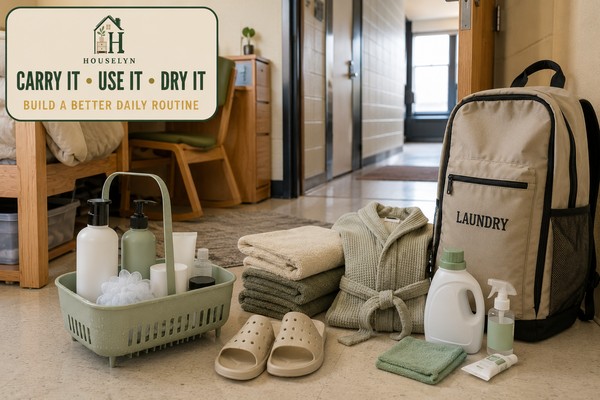
The most practical dorm room essentials for hygiene,
laundry and cleaning should support the complete routine—from leaving the
room to returning every item clean, dry and ready for its next use.
Hygiene and laundry products are often chosen as isolated objects. A
student buys a caddy because communal bathrooms require carrying
toiletries, or chooses a laundry basket because it stores clothing.
However, the product must also travel, fit the available space, dry
properly and return to a predictable location.
This part of the dorm room essentials checklist should be
designed around movement and maintenance. The correct choice depends on
the bathroom type, laundry route, drying conditions and frequency with
which the student completes each task.
Choose a Laundry Carrier for the Actual Journey
The best carrier depends on the distance to the machines, whether stairs
or lifts are involved and how the student prefers to sort clothing. A
rigid basket can be convenient when laundry is nearby, but it may be
awkward in a long corridor or when both hands are needed for doors.
A structured bag, backpack-style carrier or flexible hamper may suit
longer routes because it can be carried more securely and stored in a
smaller footprint. The base should remain stable enough to prevent the
contents from spilling during transport.
Part V • Study and Power Safely
Select Study, Tech and Power Dorm Room Essentials Safely
A useful dorm technology setup keeps the primary study tools accessible
while respecting electrical rules, socket limits and clear movement
routes.
Study and technology dorm room essentials should support
coursework, communication and everyday comfort without overcrowding the
desk or introducing unapproved electrical equipment.
Technology is central to college life, yet the essential list is usually
shorter than the number of available accessories suggests. Most students
need a dependable primary device, its correct charger, a practical way to
hear online material and a method for protecting important files.
Electrical products require an additional test. Even when an item would
be convenient, the residence may specify permitted power strips, ban
ordinary extension leads or restrict heating and cooking equipment.
Current written housing guidance should control the final choice.
Part VI • Coordinate Before Buying
Coordinate Shared Dorm Room Essentials With Your Roommate
Shared products work best when both roommates know who purchased them,
who maintains them and who will take them at the end of the year.
Shared dorm room essentials should reduce duplicate
spending and save communal space, but only when permission, ownership,
maintenance and move-out responsibility are agreed before purchase.
Roommate coordination is not limited to choosing colours or deciding
which side of the room each person will occupy. It is an important
financial and functional part of the packing process.
One suitable communal item may serve the room better than two competing
versions. However, sharing becomes less effective when ownership is
unclear, cleaning is avoided or one person purchases something the other
did not agree to use.
Part VII • Pack, Arrive and Adjust
Pack Dorm Room Essentials for Move-In and the First Week
A first-night kit keeps the documents, bedding, toiletries, medication
and chargers needed before the rest of the room is fully unpacked.
The final stage of planning dorm room essentials is not
simply fitting everything into bags. It is arranging arrival so the
student can sleep, wash, charge devices and locate important information
before the whole room is organised.
Move-in day combines travel, paperwork, unfamiliar procedures, limited
unloading time and a room that may contain less open space than expected.
The first priority is therefore access rather than perfect organisation.
Useful packing separates immediate needs from belongings that can wait.
It also preserves enough floor space to inspect the room, test furniture
and decide where each category should live before containers are opened.
Let the First Week Correct the Checklist
The first week provides information that no pre-move shopping guide can
fully predict. The student learns how warm the room becomes, how far the
laundry machines are, whether the desk lighting is adequate and which
surfaces collect everyday belongings.
Before buying more dorm room essentials, identify the
exact routine that is failing. A missing storage container is not always
the problem; the category may need to be reduced, relocated or returned
to a more convenient place.
Practical College Packing Answers
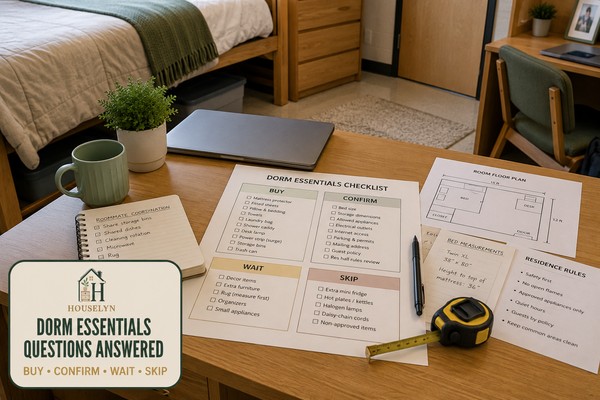
Frequently Asked Questions About Dorm Room Essentials
The best answers depend on the assigned room, supplied furniture,
residence rules, personal routine and roommate agreement.
These frequently asked questions clarify which
dorm room essentials students usually need first, which
purchases depend on accommodation rules and which products can wait
until the room has been used.
Beginner Dorm Essentials Questions
Start here when creating the first version of the college packing list.
1. What are the most important dorm room essentials?
The most important dorm room essentials support
immediate sleep, hygiene, medication, communication and study. Begin
with correctly sized bedding, a mattress protector, toiletries, a
towel, required medication, basic clothing, chargers and the
technology needed for coursework.
Bathroom footwear, a shower caddy and a laundry carrier become
immediate priorities when the residence has communal facilities.
Electrical accessories, appliances, rugs and large organisers should
remain conditional until the rules and measurements are confirmed.
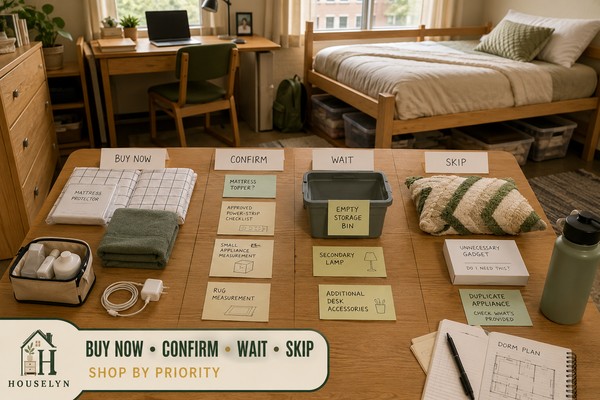
2. Which dorm room essentials should I buy first?
Purchase the items needed during the first 24 hours after confirming
the accommodation details. The first group normally includes bedding
that matches the assigned mattress, personal toiletries, a towel,
medication, essential chargers, identification and a practical
change of clothes.
Delay purchases that depend on the room’s dimensions, electrical
policy, supplied furniture or roommate. This protects the budget for
genuine needs discovered during move-in.
3. How do I make a personalised dorm room essentials checklist?
Begin with the residence profile rather than a retailer’s checklist.
Record the bed size, supplied furniture, room dimensions, bathroom
type, laundry access, electrical rules and roommate information.
Sort each proposed item into four groups:
Buy before arrival
Confirm before buying
Wait until move-in
Skip unless a real need appears
The final list should describe the student’s actual accommodation and
routine, not every product that could be useful in some dorm.
4. What size sheets do college dorm beds need?
Many college beds use longer single mattresses, but sizes vary
between institutions and buildings. Confirm the exact width, length
and depth through the housing portal or residence office before
ordering fitted bedding.
Include the thickness of the mattress protector and any topper when
selecting the fitted-sheet pocket depth. A sheet can match the length
and width but still slip if the pocket is too shallow.
Practical Sleep, Bathroom and Laundry Questions
5. Is a mattress topper a necessary dorm room essential?
A mattress topper is a comfort upgrade rather than a universal
necessity. It may help a student who already knows they prefer
additional cushioning or who finds the supplied mattress
uncomfortable.
Confirm the mattress dimensions first and consider transport,
storage, ventilation and fitted-sheet depth. Students travelling by
air or uncertain about the mattress may prefer to assess it after
arrival.
6. Do I need a shower caddy for college?
A shower caddy is useful when toiletries must travel to a communal
bathroom or when several people share limited bathroom storage. Look
for comfortable handles, stable construction and drainage that allows
the caddy to dry after use.
Students with secure private bathroom storage may not need a
portable caddy. The decision should follow the complete
carry–use–dry–return routine.
7. How many towels should a student bring to a dorm?
Two practical bath towels are often enough for one to be used while
the other is washing or drying. Add smaller hand or face towels only
when they match the student’s routine.
Bringing several large towel sets increases storage and laundry
demands. Drying speed and available hanging space matter more than
owning a large quantity.
8. Is a laundry bag better than a laundry basket?
The better option depends on the journey to the machines. A rigid
basket may work well when laundry is nearby and on the same floor. A
flexible or backpack-style bag is often easier when stairs, lifts,
long corridors or outdoor routes are involved.
Choose a carrier that fits its assigned storage location when empty
and remains comfortable when carrying a realistic load.
9. What cleaning supplies belong on a dorm room essentials list?
Keep the cleaning kit compact: one suitable surface cleaner,
reusable cloths, correctly sized waste bags and one approved
floor-cleaning method when communal equipment is unavailable.
Avoid large chemical collections and bulk quantities. Roommates
should agree who replaces shared supplies and who completes recurring
cleaning tasks.
Technology, Power and Appliance Questions
10. Does a college student need a personal printer?
Not always. Check the distance, price and availability of campus
printing and determine whether the student’s course still requires
frequent paper submissions.
A printer occupies desk space and requires ink, paper, power and
maintenance. Delay the purchase when accessible campus facilities
already provide the function.
11. Can students use extension cords or power strips in dorm rooms?
Residence electrical rules vary. Some accommodations permit only
particular protected power strips and restrict or prohibit ordinary
extension leads. Read the current written policy before purchasing
or connecting anything.
Never connect one power strip or extension device into another.
Cables should remain away from moisture, doors, chair wheels and
walking routes.
12. Are a mini fridge and microwave dorm room essentials?
They are conditional rather than universal
dorm room essentials. The residence may supply
appliances, offer a rental programme, permit only approved
combinations or prohibit certain appliances inside bedrooms.
Confirm permission, dimensions, wattage, ventilation clearance and
roommate ownership before purchasing. Students with convenient
shared-kitchen access may not need either item.
13. Which appliances are commonly restricted in college housing?
Restrictions commonly affect products with open flames, exposed
heating elements, high heat or unapproved electrical connections.
Examples may include candles, incense, hot plates, some cooking
appliances and ordinary extension cords.
Do not assume a product is prohibited everywhere. Use the current
residence handbook as the controlling source and ask housing staff
when the wording is unclear.
Budget, Roommate and Move-In Questions
14. How much should I budget for dorm room essentials?
There is no single correct budget because students begin with
different belongings and residences provide different furniture and
equipment. Divide the available money into core needs, routine
support and a move-in reserve.
Fund bedding, hygiene, medication, study and communication first.
Keep part of the budget unspent so a genuine first-week need does not
compete with money already used on optional decor or gadgets.
15. Which dorm room essentials should roommates share?
Potentially shareable categories include a permitted appliance, one
cleaning tool, a central rug, basic food-storage containers and
agreed cleaning consumables.
Bedding, towels, medication, primary technology and personal-care
products should usually remain personal. For every shared purchase,
record the buyer, cost split, owner, maintenance responsibility and
move-out plan.
16. Which dorm room essentials should I buy before move-in?
Buy confirmed first-night items before arrival: correctly sized
bedding, toiletries, a towel, medication, chargers, basic clothing
and any portable bathroom supplies known to be necessary.
Wait on large storage, secondary lighting, rugs, appliances and
additional desk accessories until the room has been measured and the
roommate’s belongings are known.
17. Which dorm purchases are commonly unused?
Products are more likely to remain unused when they solve an
unconfirmed problem. Examples include duplicate appliances,
unmeasured organisers, a personal printer when campus facilities are
convenient, excessive decorative cushions, single-purpose gadgets
and bulk supplies that exceed available storage.
“Wait until move-in” is a valid decision. It is easier to add a
proven need than to recover space and money after an unnecessary
purchase.
18. How should students pack dorm room essentials when flying?
Prioritise identification, residence documents, medication,
chargers, familiar personal-care items, essential clothing and
lightweight first-night bedding. Keep these items accessible rather
than placing all of them in checked luggage.
Delay bulky products such as large toppers, organisers and permitted
appliances until the room is verified and local purchasing or
delivery options are understood. Also confirm plug and voltage
compatibility when travelling internationally.
Houselyn Framework Question
19. How does the Houselyn Dorm Essentials Buying Map work?
The framework follows seven stages:
Confirm, Prioritise, Measure, Choose, Coordinate, Pack and
Review.
Confirm what the residence supplies, permits and restricts.
Prioritise immediate needs before comfort upgrades.
Measure beds, furniture gaps and operating clearances.
Choose products that support real routines.
Coordinate shared purchases and ownership.
Pack first-night items for immediate access.
Review the remaining list after the first week.
This sequence turns a generic collection of
dorm room essentials into a personalised purchasing
plan for the student’s actual room.
Final Planning Guide
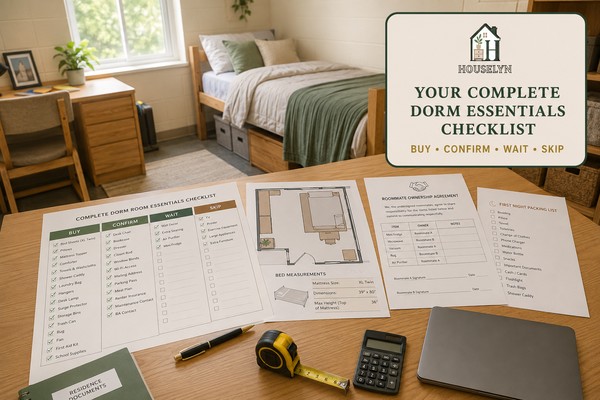
Complete Dorm Room Essentials Checklist and Buying Map
The finished checklist combines verified room information, immediate
needs, shared responsibilities and purchases reserved for after move-in.
A dependable dorm room essentials plan does not end
when the shopping is complete. It remains flexible enough to respond to
the assigned room, the roommate’s belongings and the routines students
discover during their first week.
Final Dorm Room Essentials Decision Checklist
Use this summary to review the shopping and packing plan. An item can
move between categories when new information becomes available.
Immediate and Confirmed
Buy Before Arrival
Residence documents and identification
Correctly sized fitted bedding
Washable mattress protection
Sleeping pillow and practical top layer
Daily toiletries and one towel
Required medication and personal-care supplies
Primary phone and study-device chargers
Basic first-night clothing and sleepwear
Confirmed communal-bathroom supplies
Rules or Measurements Required
Confirm Before Buying
Mattress topper and deep-pocket sheets
Surge-protected power equipment
Desk lamp or compact fan
Mini fridge, microwave or another appliance
Large rug or shared floor covering
Wall-mounted and adhesive products
Drying rack or over-door equipment
Room-owned cleaning equipment
Furniture-dependent organisers
Let the Room Answer First
Wait Until Move-In
Additional storage containers
Secondary desk accessories
Extra lighting
Decorative bedding layers
Bulk toiletries or cleaning supplies
Large food quantities
Printer and printing supplies
Additional seating
Products intended for an untested routine
No Verified Role
Skip Unless Needed
Duplicate shared appliances
Large replacement furniture
Unmeasured storage systems
Excess cushions and decorative textiles
Single-purpose novelty gadgets
Irreplaceable or highly valuable decor
Products already provided by the campus
Social-media-haul purchases without a defined task
Discover practical dorm room organization ideas that help you organize clothes, desks, storage and daily routines for a calm, clutter-free college room.
Discover college dorm decor ideas for colour, bedding, walls and personal touches that turn a plain student room into warm, stylish place that feels like home
Learn how to decorate a stylish and comfortable living room with practical design advice, timeless styling ideas, and expert inspiration from Houselyn.
Discover dorm bedding ideas that make small rooms feel like home. Learn how to create a cosy, stylish, and practical college dorm with smart bedding, storage, and decorating tips.
Use these dorm desk organization ideas to create a clear college study space with better drawer systems, vertical storage, cable control and simple resets.