- Home
- free home tools
- Room Refresh Cost Planner
Room Refresh Cost Planner
Room Refresh Cost Planner decisions become easier when the likely cost of each planned change is visible before shopping begins.
Choose the improvements you are considering, set the level of finish and tell the planner where professional help may be needed. Houselyn will build a realistic cost range, separate products from labour and extras, and show which parts of the refresh could be simplified or phased.
Build a realistic room-level estimate instead of pricing isolated purchases one at a time.
See how preparation, fitting, hardware and professional help can change the real refresh cost.
Identify costs that could be reduced or delayed without weakening the improvement that matters most.

Start with the example refresh, then change the items, finish level and installation choices to match your room.
Build a Realistic Room Refresh Estimate
Choose the improvements you are planning, set the finish level and tell the planner where fitting or professional help may be needed.
See the Full Refresh Before You Spend
The estimate separates product costs, labour, extras and a sensible planning buffer rather than pretending the project has one exact price.
Estimate the balanced example or adjust the scope, finish and labour choices to match your own room.
—
Scope → Standard → Labour → Extras → Buffer
Which parts of the room are actually changing?
What level of finish are you planning overall?
Which costs involve fitting or professional help?
What delivery, hardware or preparation costs are easy to miss?
How much uncertainty should the plan reasonably allow?
—
—
—
Itemised Cost Plan
| Refresh Item | Products | Labour / Extras | Estimated Range |
|---|
—
—
—
Estimates are UK planning ranges rather than quotations. Product prices, delivery and professional labour vary by retailer, location, room condition and installation requirements. Electrical or specialist work should be assessed by an appropriately qualified professional.
What Does a Room Refresh Really Cost?
A room refresh can mean replacing a few finishing layers or changing several parts of the space at once. The cost depends less on the room label itself and more on what is actually being changed, the standard of the products, and whether fitting or professional work is involved.
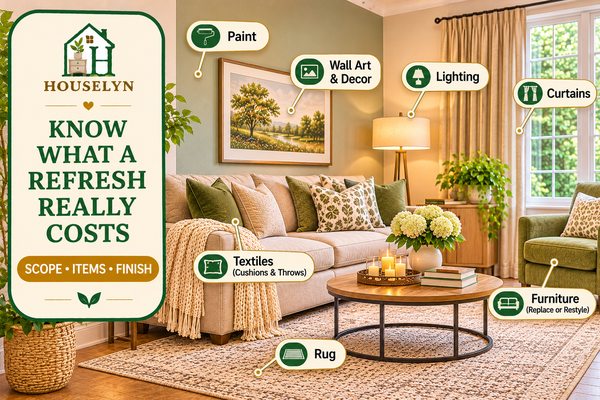
Textiles, wall art, a mirror or plug-in lighting can change the feel of a room without creating many installation or preparation costs.
Paint, a rug, curtains, lighting and textiles begin to interact, so both product costs and hidden extras become more important.
Furniture, fitted window treatments, electrical work or professional decorating can increase the project significantly without turning it into a full renovation.
There Is No Useful Single Price for Every Room Refresh
Two living-room refreshes can have completely different costs. One may involve a new rug, cushions and a lamp. Another may include painting, curtains across several windows, new lighting, an accent chair and fitted shelving. Calling both projects a “living-room refresh” does not make their budgets comparable.
This is why the Room Refresh Cost Planner begins with scope. It prices the improvements you actually select rather than applying a flat estimate to the room type.
Product Standard Changes the Range Quickly
The difference between an Essential, Balanced and Elevated refresh is not simply a higher price tag. Materials, size, construction, finish and the number of pieces can all change. A simple ready-made curtain treatment can cost far less than a larger, heavier or more premium option. The same is true of rugs, lighting, mirrors, tables and seating.
Adding more categories increases cost even when every individual purchase remains modest.
Multiple windows, several light sources, larger rugs and bigger furniture naturally create wider cost ranges.
Professional painting, curtain fitting, shelving installation and electrical work can materially change the cost of the refresh.
Delivery, hardware, fixings, wall preparation and disposal often sit outside the obvious product price.
Labour Can Change the Project More Than the Product
A relatively modest light fitting can become a more significant cost when electrical work is required. Curtains may need poles, tracks and fitting. Painting costs change sharply when professional preparation and application replace a DIY approach. Separating product and labour costs makes these differences visible instead of hiding them inside one total.
A Cost Range Is More Useful Than a False Exact Number
Retailer choice, room condition, delivery and professional quotations can all move the final figure. A planning range acknowledges that uncertainty. The lower end shows what a leaner version of the selected plan might look like, while the upper end allows for stronger finishes and higher project costs.
Estimate the room you actually plan to refresh, not an imaginary “average room.” Scope, finish, labour and extras should explain the cost before the total does.
Once the scope is clear, the planner can do something more useful than simply produce a number. It can show which category is driving the cost, what part of the plan could be simplified and where professional or preparation costs should remain protected.
How to Read Your Room Refresh Cost Planner Results
Your Room Refresh Cost Planner result is designed to show more than a single total. The range, expected plan, product costs, labour, extras and buffer each answer a different question about what the refresh may require.

The realistic lower-to-upper range for the selected plan, including the suggested planning buffer.
A useful working figure based on the middle of the chosen product, labour and extra-cost assumptions.
The estimated cost of the refresh items themselves before labour and project-level extras are added.
Fitting, professional help, preparation, hardware, delivery and other applicable project costs.
Start With the Range, Not the Middle Number
The expected plan is useful for comparing versions of your refresh, but it should not be treated as a quotation. Retailer choice, product size, delivery and professional rates can all move the final figure. The estimated range is therefore the stronger planning number because it shows how much movement the selected project can reasonably absorb.
Product Cost and Project Cost Tell Different Stories
A room may appear affordable when you look only at the products. Once curtain hardware, professional painting, fitting, preparation or electrical work is included, the project can look very different. The planner keeps these categories separate so you can see whether the cost is being driven by what you are buying or by what is required to install and complete it.
Shows which selected category currently contributes the largest individual share of the expected refresh cost.
Identifies a flexible category where reuse, a smaller scope or a later purchase may reduce cost without weakening essential work.
Describes whether the selected project behaves more like a Light, Layered or Full Room Refresh.
Adds room for uncertainty based on the complexity of the plan rather than applying the same percentage to every refresh.
Protect, Simplify and Phase Are Actions, Not Price Labels
The three result guardrails are designed to help you respond to the cost. Protect identifies costs that should not be cut carelessly, such as necessary preparation or professional electrical work. Simplify points toward a flexible part of the refresh where reuse or a smaller purchase may work. Phase identifies a category that could reasonably wait until the stronger decisions are complete.
A Higher Estimate Does Not Automatically Mean the Plan Is Wrong
Cost should be interpreted against scope. A refresh with several windows, professional painting and an accent chair will naturally cost more than one involving textiles and wall art. The useful question is whether every selected cost contributes to the room you are trying to create.
Use the estimate to understand the plan, not to chase one exact number. Keep necessary costs visible, question flexible ones and compare a smaller scope before assuming the entire refresh is unaffordable.
If the result is higher than expected, change one decision at a time. Try a lower finish level, reduce quantity, reuse an existing layer or phase one category. Recalculating after each change shows which decision actually moves the project cost instead of cutting several useful elements at once.

The Houselyn Room Refresh Cost Planner Framework
The Houselyn Room Refresh Cost Planner uses five layers to turn a list of decorating ideas into a more realistic project estimate: Scope, Standard, Labour, Extras and Buffer. Each layer answers a different question, and each one can materially change the final range.

Define exactly which parts of the room are changing.
Set the overall level of finish before pricing the plan.
Separate fitting and professional work from the product price.
Add hardware, preparation, delivery and other project costs.
Allow for uncertainty without pretending every project has the same risk.
Scope: Price the Refresh You Are Actually Planning
Scope is the starting point because every additional category changes the project. A rug-and-textiles update is fundamentally different from a plan involving paint, curtains, lighting, storage and an accent chair. The planner therefore begins by defining the selected improvements before it estimates anything else.
Scope also includes quantity. Two windows cost differently from one. A gallery wall is not the same purchase as a single framed piece. A large storage unit creates a different cost profile from a small basket or side cabinet.
Standard: Decide the Quality Level Before Comparing Totals
The planner uses Essential, Balanced and Elevated rather than assuming one universal product price. Essential represents practical, attractive choices with value in mind. Balanced allows more choice in finish, construction and materials. Elevated gives room for stronger statement pieces and more premium finishes.
This layer is important because a smaller refresh at a higher standard can cost more than a broader refresh made with simpler products. The total only makes sense once the intended standard is visible.
The estimate follows the selected improvements instead of assuming every living room, bedroom or office has the same refresh cost.
A value rug and a premium rug may solve the same design problem while creating very different cost ranges.
Professional painting, fitting and electrical work remain visible instead of disappearing inside the price of the item.
Hardware, preparation, delivery and uncertainty are acknowledged before the project reaches the checkout or installation stage.
Labour: Separate What You Buy From What It Takes to Complete It
Labour can change the economics of a refresh more dramatically than a modest change in product price. Plug-in lighting may have no installation cost, while replacing a fitting can require an electrician. DIY painting has a different structure from professional decorating. Curtains may need fitting even when the fabric itself is affordable.
The planner keeps those costs separate so a cheaper product does not create the illusion of a cheaper completed improvement.
Extras: Complete the Cost of the Improvement
Extras cover the expenses that sit around the main purchase: curtain hardware, delivery, preparation, fixings, disposal and other project-level needs. These costs are not necessarily large individually, but across several categories they can materially affect the plan.
Buffer: Match the Allowance to the Uncertainty
The planner does not add the same contingency to every project. A decorative update involving artwork and textiles has relatively little uncertainty. A plan involving professional decorating, fitted curtains or electrical work has more variables and therefore deserves a wider allowance.
The buffer is not an invitation to spend more. It is planning room for a project whose final retail, delivery or labour costs may differ from the starting estimate.
Scope defines what is changing. Standard defines the level of finish. Labour reveals what it takes to complete the work. Extras capture the overlooked costs. Buffer acknowledges uncertainty. The result is a range built from the actual refresh rather than a generic room price.
The value of the framework is not only the final total. Because every layer remains visible, you can see exactly what changes when the plan is simplified. Reducing scope, changing the finish level or phasing one purchase produces a more meaningful comparison than cutting the entire estimate by an arbitrary percentage.
How to Reduce Room Refresh Costs Without Making the Room Look Cheap
Lowering the cost of a room refresh does not have to mean choosing the cheapest version of every item. A stronger approach is to protect the changes that create the most value, reuse what already works and simplify the parts of the plan that add less.

Furniture, lamps, artwork and textiles that still work can support the refresh without becoming replacement costs.
Fewer well-chosen changes often look more considered than many low-cost purchases competing for attention.
Complete the stronger room decisions first, then reassess whether the remaining decorative layers are still necessary.
Keep What Is Already Doing Its Job
The easiest way to increase a refresh cost is to treat every existing item as part of the problem. A sofa that is comfortable and appropriately scaled does not need replacing simply because the room needs a new rug or better lighting. The same applies to usable tables, lamps, frames and storage.
Protecting strong pieces concentrates spending on the parts of the room that are actually limiting the result.
Buy Fewer Things at a Better Level
When a plan becomes too expensive, reducing every product to the cheapest possible option can weaken the entire refresh. A better decision may be to remove one lower-impact category and keep a more appropriate rug, curtain treatment or light fitting.
The result is a smaller scope with stronger individual choices rather than a room filled with purchases chosen primarily because they were inexpensive.
Test whether an existing item can be moved, restyled, regrouped or combined differently before adding a replacement cost.
One strong artwork piece, fewer decorative objects or one useful lamp may be enough to solve the intended problem.
Move selected categories from Elevated to Balanced or Essential where the material or finish difference is not important to the room.
Delay finishing layers until paint, lighting, rugs or other stronger decisions have been completed and reassessed.
Use Second-Hand Where Condition Matters More Than Newness
Mirrors, side tables, artwork, storage, chairs and some decorative pieces can be strong second-hand candidates. The important test is condition, scale and suitability rather than age. A well-proportioned second-hand piece can contribute more than a new item bought only because it was inexpensive.
The cost planner applies second-hand savings only to suitable purchase categories. It does not reduce labour, paint, hardware or professional work simply because second-hand shopping has been selected.
DIY Where It Is Sensible, Not Where It Creates Risk
DIY painting, simple curtain hanging and restyling existing decor can reduce labour costs when the work is within your capability and the installation is straightforward. That principle should not be extended to specialist or safety-sensitive work merely to force the total lower.
Electrical work, difficult installations and jobs where poor preparation would damage the final result should remain protected when professional help is appropriate.
Do Not Spend the Saving Automatically
A successful saving does not have to become permission to add something else. If reusing artwork saves money, the room does not automatically need another accessory. If one lamp solves the lighting problem, a second may no longer be necessary.
Let the revised room determine whether the remaining budget still needs to be spent.
Reduce cost by removing unnecessary scope before reducing the quality of every choice. Reuse what works, simplify what can be smaller, and protect the improvements that make the room function and feel better.
This is why the planner's Simplify recommendation should be treated as a decision prompt rather than an instruction to buy the cheapest alternative. The goal is a more efficient refresh, not simply a lower checkout total.
When to Refresh Now and When to Phase the Cost
A room does not have to be refreshed in one shopping trip. Phasing can make the cost easier to manage while also improving the quality of later decisions, because each completed change gives you more information about what the room still needs.

Prioritise preparation, lighting, paint or other changes that affect how later layers will look or function.
Rugs, curtains, useful storage or carefully chosen furniture can follow once the underlying room decisions are stable.
Artwork, textiles and decorative accessories can be reassessed after the room has changed instead of being purchased automatically.
Phase the Refresh When Later Decisions Depend on Earlier Ones
Some purchases are easier to judge after another part of the room has changed. Paint can alter how artwork and textiles read. Better lighting can change the apparent colour of walls, fabrics and furniture. A properly scaled rug can make the seating group feel more complete before any additional accessories are introduced.
When one decision influences several others, completing it first can prevent later purchases from being chosen for a room that no longer exists in the same form.
Complete Necessary Work Before Decorative Finishing
Preparation, professional painting, electrical work or required hardware should generally happen before fragile or purely decorative finishing layers. This is partly practical and partly financial: decorating around unfinished work can create duplicated effort, damaged items or purchases that have to be moved and reconsidered.
Delay the purchase when paint, lighting, layout or another larger decision may change the colour, scale or position you need.
Artwork, cushions and accessories are easier to judge once the main structure and visual anchors of the refresh are settled.
A non-essential purchase can move into a later phase if keeping it now would force cuts to preparation, fitting or a stronger improvement.
Waiting gives the updated room a chance to show whether the missing item is genuinely necessary or was only part of the original idea.
Phasing Should Not Mean Buying the Same Project Twice
A good staged plan still considers the final direction. Buying an undersized rug as a temporary solution, installing unsuitable curtain hardware or purchasing furniture that will soon be replaced can cost more than waiting for the appropriate version.
Phase by timing the decisions differently, not by repeatedly buying weaker substitutes for the same role.
Let the Completed Room Cancel Purchases
One of the advantages of phasing is that the original list can become shorter. A new rug may provide enough colour and connection that additional textiles are no longer urgent. Better lighting may make the wall feel more complete. Painting may remove the need for several decorative distractions.
This is why “Later” should mean reassess later, not “buy later no matter what.”
Use the Cost Planner to Compare Phases
If the complete estimate feels too large, remove one flexible category and recalculate. Compare that result with the original plan. Continue until the first phase contains the changes that make sense together and the amount is realistic for the project.
The items removed from the first calculation can become a second phase, but they should be assessed again after the first work is complete.
Finish the changes that shape the room, reassess the changes that depend on them, and delay finishing layers until the room proves they are still needed.
A phased refresh is successful when it creates better decisions as well as smaller stages of spending. The goal is not merely to postpone the same shopping list; it is to give each later purchase another chance to justify itself.
Room Refresh Cost Planner FAQ
These answers explain how to interpret common room-refresh costs, where extra expenses usually appear and when reducing, reusing or phasing the plan may be more useful than lowering every product choice.
How much does it cost to refresh a room?
There is no single useful price because a room refresh can range from a few decorative changes to paint, curtains, lighting, furniture and professional work. The most useful estimate starts with the exact scope, quantities, finish level and labour involved rather than the room name alone.
What should I include in a room refresh budget?
Include the products themselves, any fitting or professional labour, preparation, delivery, hardware, fixings, disposal and a sensible planning buffer where the project contains uncertainty. These supporting costs are often what makes a product-only total too low.
How much should I allow for paint and decorating?
Allow for both paint materials and the condition of the surfaces. A DIY refresh may mainly involve paint, brushes, rollers, protection and filler, while professional decorating can include preparation and labour. Room size and the amount of repair needed can change the cost significantly.
How much do curtains add to a room refresh?
Curtain cost depends on the number of windows, fabric and finish level, plus whether new poles, tracks or professional fitting are needed. Price the complete window treatment rather than comparing only the curtain pair.
Is lighting expensive to upgrade?
Plug-in lamps can be relatively straightforward because the cost is mainly the product. Replacing fixed fittings can add electrician costs, while new electrical work is more variable and should be treated as a professional quote rather than a simple decorating purchase.
How much should I budget for a rug?
Rug cost changes substantially with size, fibre, construction and retailer. Start by identifying the size the room actually needs, then compare suitable options within your intended finish level rather than choosing a smaller rug simply to reduce the price.
How much extra should I allow for hidden costs?
The amount should reflect the complexity of the refresh. Decorative-only plans usually need little contingency, while projects involving preparation, installation or professional work deserve more room for variation. The planner therefore changes its suggested buffer according to the selected project rather than applying one percentage to every room.
Can I refresh a room cheaply without replacing furniture?
Yes. Keeping furniture that is functional, appropriately scaled and in reasonable condition can free the refresh budget for lighting, paint, rugs, curtains or textiles. Moving and restyling existing pieces can also reveal that fewer purchases are required.
Is DIY always cheaper than professional decorating?
Not automatically. DIY can reduce labour costs when the job is straightforward and within your capability, but poor preparation, unsuitable installation or repeated corrections can create additional expense. Specialist or safety-sensitive work should not be treated as a DIY saving simply to lower the estimate.
Should I refresh a room all at once or in stages?
Stage the refresh when earlier decisions will influence later ones or when flexible finishing purchases can wait. Complete the changes that shape the room, reassess the result, then decide whether the remaining items are still necessary rather than treating every original idea as a guaranteed future purchase.
Strengthen the Room Before You Add More Cost
Use these Houselyn guides to diagnose the room and improve its underlying layout before assuming every problem needs another purchase.
Identify scale, placement, lighting and visual-balance problems before turning an uncomfortable room into a longer shopping list.
Arrange Living Room Layout BasicsImprove furniture placement, circulation and seating relationships before spending on decorative layers intended to compensate for a weak layout.

Houselyn Editorial Team
The Houselyn Editorial Team creates practical guides for improving the way homes look, feel and function, with a focus on realistic decorating decisions, usable organization systems and attainable interior styling.
Meet the Houselyn Editorial Team →Plan the Improvement Before the Spending
A useful room-refresh estimate should make the project easier to understand, not encourage every possible purchase. Define the scope, protect essential work, simplify flexible layers and reassess the room as it changes. Better homes are built through thoughtful decisions, not constant replacement.
You might like these
Gallery Wall Planner: Create the Right Layout for Your Wall | Houselyn
Use the Houselyn Gallery Wall Planner to create a balanced layout, preview frame spacing and size, and plan your wall before hanging
Living Room Layout Planner | Arrange Furniture & Flow | Houselyn
Use the Houselyn Living Room Layout Planner to test sofa placement, seating, coffee table spacing, focal points and clear walking routes.