Decor Upgrade Priority Calculator
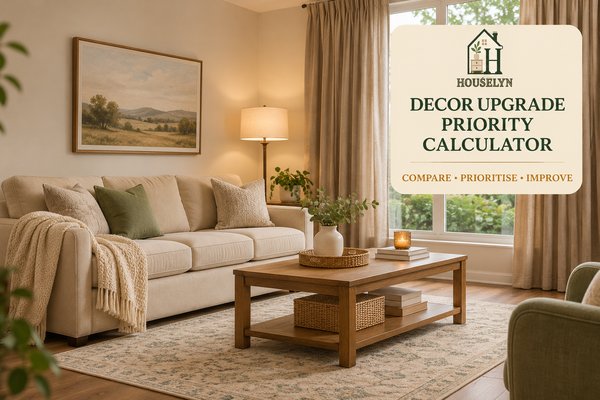
Decor Upgrade Priority Calculator decisions become easier when each improvement is judged by what it solves, how much impact it can create and what should happen first.
Instead of upgrading several parts of a room at once, compare the changes you are considering and see which one deserves attention first. The Houselyn calculator weighs room problems, expected impact, functional value, existing condition, effort and sequencing so the strongest improvement rises to the top.
See which upgrade offers the strongest return before several projects begin competing for the same attention and budget.
Give priority to improvements that affect the whole room rather than automatically starting with the easiest decorative change.
Hold lower-value upgrades until the stronger room relationships are resolved and easier to judge.
Compare the Upgrades Before You Commit
Choose the improvements you are considering, describe the room problem and rate each option. The calculator will rank what deserves attention first, what can follow and what should wait.
See What Deserves Attention First
Your result compares room relevance, expected impact, functional need, condition, effort and upgrade timing.
Rank the four example upgrades or change the room, problems and upgrade candidates before calculating.
—
Impact → Need → Fit → Effort → Timing
How much visible or practical improvement could it create?
Does it solve a current room problem rather than simply add something new?
Does it work with the room and what you intend to keep?
How much cost, work or disruption does the improvement require?
Should another decision logically happen before this one?
Your Ranked Upgrade Plan
—
—
—
This calculator ranks decorating priorities rather than providing structural, electrical or installation advice. Check measurements, suitability and installation requirements before purchasing or fitting home products.
Decide What Your Room Actually Needs Before You Upgrade It
A decor upgrade is easier to prioritise when it is tied to a clear room problem. Before comparing rugs, lighting, artwork, textiles or storage, separate what the room genuinely needs from what simply looks appealing in isolation.

Start with the room issue you want to improve: darkness, clutter, disconnection, weak colour, poor function or another specific problem.
A useful upgrade should solve something measurable in the room rather than simply introduce another attractive object.
An upgrade can be worthwhile and still not deserve to happen first if another change would improve more of the room.
Start With the Room Problem, Not the Product
It is easy to begin with a solution: a larger rug, new curtains, another lamp or different artwork. The stronger starting point is to describe the problem without naming the purchase. “The seating feels disconnected” is more useful than “I need a new rug.” “The room feels dark in the evening” is more useful than “I need another lamp.” This keeps the upgrade open to testing rather than treating the purchase as predetermined.
Ask Whether the Upgrade Solves One Problem or Several
The strongest upgrades often improve more than one relationship at the same time. Better lighting can improve function, atmosphere and colour perception. A correctly scaled rug can add warmth while connecting the seating. Storage can improve function and reduce visual clutter when the remaining belongings genuinely need a home.
If you cannot identify a clear room issue, the upgrade may be a preference rather than a priority.
Changes affecting scale, light, function or a large visual area often have more reach than small finishing pieces.
Good condition lowers urgency. An item can look familiar without being the thing that needs replacing.
Paint, lighting, layout or another anchor decision may need to settle before later decorative choices can be judged properly.
Do Not Confuse Easy With Important
Small accessories are often quick to buy and easy to style, which can make them feel like productive progress. But an easy improvement is not always the highest-value one. If the room is dark, disconnected or functionally awkward, a minor decorative purchase may change very little while a better lighting or scale decision could influence the whole space.
Protect Improvements That Are Already Good Enough
The calculator asks about existing condition because priority should fall when an item is already working well. A perfectly usable curtain treatment, rug or table does not need to become a project simply because another version is available. Keeping strong elements allows attention and budget to move toward the parts of the room with clearer weaknesses.
Do not ask only whether an upgrade could improve the room. Ask whether it solves a stronger problem than the other upgrades competing for your attention.
Once the room problem and purpose of each candidate are clear, comparison becomes much easier. The calculator can then weigh impact, need, fit, effort and timing instead of rewarding whichever idea happens to feel most exciting.
How to Read Your Decor Upgrade Priority Calculator Results
The Decor Upgrade Priority Calculator does more than place your ideas in a numbered list. It separates the improvement that deserves attention now from the upgrades that are useful later, poorly timed or not strongly connected to the room problem you selected.
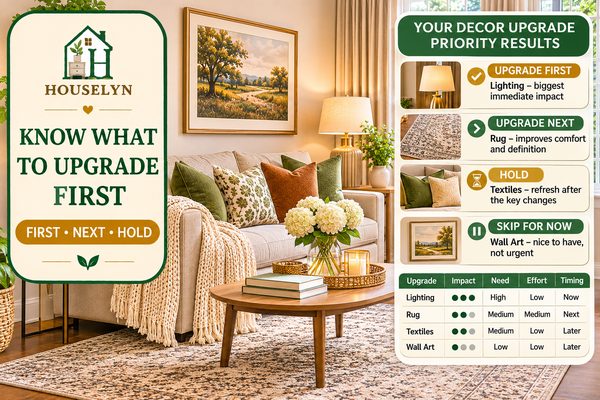
This option has the strongest combination of room relevance, impact, need and timing among the upgrades you selected.
This improvement is still valuable, but it becomes easier to judge after the first priority has been tested or completed.
The upgrade may help, but its impact, condition, effort or sequencing makes it less urgent than the options above it.
The current room problem is better solved elsewhere first, or the selected limits make this upgrade unsuitable for the present plan.
Start With Upgrade First, Not With the Easiest Purchase
The first recommendation is the candidate that performs best against the room you described, not necessarily the cheapest or most decorative option. A lighting improvement may outrank cushions because it solves darkness, warmth and practical use at the same time. A rug may rise above artwork when it has greater influence on scale and furniture connection.
Upgrade Next Is a Sequence, Not a Second Shopping Command
The second-ranked option should be reassessed after the first priority changes the room. If better lighting makes the existing palette look warmer, a textile upgrade may become less important. If a larger rug connects the furniture, additional wall decor may no longer be needed to make the room feel complete.
This identifies the strongest selected improvement with relatively low effort. It is useful when you want progress without confusing ease with overall priority.
This highlights the candidate most likely to be premature because a stronger decision should happen before it.
Use this as a pause point. Complete or test the higher-priority change, then decide whether the next upgrade is still necessary.
Hold Does Not Mean the Upgrade Is a Bad Idea
A useful improvement can still rank lower because the existing item is in acceptable condition, another option solves more problems, the effort is disproportionately high or the room is not ready for the decision yet. Holding that upgrade protects it from being judged against an unfinished backdrop.
Skip for Now Is Deliberately Temporary
The calculator uses Skip for Now rather than a permanent rejection because room priorities change. Paint may be excluded because you selected no painting. Shelving may conflict with a no-drill or renter-friendly limit. An accent chair may be inappropriate when major furniture is being kept or when the room has limited floor space.
Complete the strongest upgrade first, reassess the room it creates, and only then decide whether the next ranked improvement still deserves the same priority.
Use Try Before Buying to Test the Assumption Behind the Upgrade
Each result includes a lower-commitment test because the ranking identifies a priority, not proof that a purchase is required. Move an existing lamp, tape out a rug footprint, regroup artwork or test textiles already in the home. If the test does not improve the problem, the planned purchase may not be the right solution.
The strongest result is therefore not the one that gives you the longest shopping list. It is the one that makes the order of decisions clearer and allows lower-value upgrades to disappear when they are no longer needed.
Why High-Impact Decor Upgrades Should Come Before Small Finishing Touches
Not every decor change influences the room equally. Upgrades that affect scale, light, function or a large visual area often deserve attention before small accessories because they shape the conditions that later finishing choices need to work with.

Rugs, curtains, large wall treatments and furniture relationships occupy enough visual area to influence how the whole room is perceived.
Lighting, storage and usable surfaces can improve how the room works as well as how it looks.
One well-chosen upgrade can improve proportion, warmth and cohesion at the same time, reducing the need for several smaller corrections.
Start With the Upgrade That Changes the Conditions Around It
Some improvements create a new foundation for everything that follows. Better lighting changes how paint, textiles and artwork appear. A larger rug can alter the perceived scale of the sofa, chairs and coffee table. Curtains can change wall height, softness and colour balance. When one decision affects several later choices, it should usually be considered earlier in the sequence.
Small Accessories Cannot Correct a Large-Scale Problem
Cushions, candles, trays and decorative objects can add personality, but their influence is limited when the room's stronger relationships are unresolved. A collection of small objects will not make an undersized rug anchor the furniture, brighten a dark room or improve a window treatment that is weakening the wall proportion.
If the room is dark, improve or test lighting before deciding that paint, textiles or artwork need different colours.
When the seating lacks connection, solve the floor relationship before trying to create cohesion with several small decorative items.
When both upgrades are planned, settle the wall backdrop before choosing artwork for colour, scale and contrast.
When clutter is the problem, reduce what the room needs to hold before adding another cabinet, shelf or set of containers.
High Impact Does Not Automatically Mean High Cost
Impact describes how much of the room an improvement can influence, not how expensive the item is. Repositioning a lamp can have more effect than buying several decorative accessories. Restyling existing curtains or regrouping artwork may alter a large visual area without requiring a major purchase.
Cost Should Modify Priority, Not Define It
A low-cost upgrade is useful when it solves a real problem, but cheap does not automatically mean worthwhile. Likewise, an expensive change should not rank highly simply because it feels substantial. The calculator uses effort as one part of the comparison while keeping room relevance, impact and functional need ahead of price alone.
Prioritise the upgrade that changes the strongest room relationship, then use smaller finishing choices to support the room that remains.
This order also makes later purchases easier to judge. Once the larger relationship is corrected, you can see whether the room still needs more colour, another accessory or additional wall decor. Often, some of those smaller upgrades stop being necessary.
The Houselyn Decor Upgrade Priority Calculator Framework
A decor upgrade deserves priority when it can make a meaningful difference, solve a real room problem, work with what you already own, justify the effort required and happen at the right point in the decorating sequence. The Houselyn framework compares those five questions before deciding what should come first.
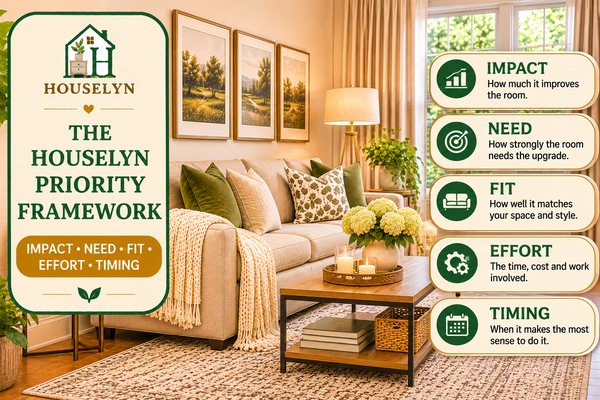
Consider how much of the room the upgrade can influence visually, functionally or atmospherically.
Give more weight to upgrades that address an actual weakness rather than simply adding another desirable object.
The upgrade should support the furniture, colours, architecture and practical requirements you intend to keep.
Compare cost, installation, disruption and difficulty without allowing cheap or easy to become the only reason for acting.
Delay an otherwise useful upgrade when another decision needs to settle first.
Impact Asks How Much of the Room Can Actually Improve
A major-impact upgrade does not have to be physically large or expensive. It simply needs the ability to change an important part of the room. Better lighting can affect atmosphere, function and colour perception at once. A correctly scaled rug can improve warmth, proportion and furniture connection. The calculator gives those broader effects more weight than a change that influences only one small decorative area.
Need Separates a Room Problem From a Decorating Preference
An attractive upgrade becomes a stronger priority when it addresses something the room is currently failing to do. Storage has greater value when everyday items genuinely lack a home. Lighting becomes more urgent when the room is difficult to use after dark. Artwork carries more weight when the room lacks a focal point than when the wall is already visually balanced.
Fit Protects What Is Already Working
Every upgrade enters an existing room. It therefore needs to work with the furniture, proportions, palette and constraints that remain. If major furniture is being kept, an upgrade should improve its surroundings rather than create pressure to replace it. If the room is renter-friendly or drilling is unavailable, solutions that depend on permanent installation should not rise to the top simply because they score well elsewhere.
Look beyond the object itself and consider whether it improves scale, atmosphere, connection, function or several of these together.
Strong priority depends on a clear relationship between the upgrade and something the room currently needs.
Check the upgrade against existing furniture, colours, dimensions, everyday use and non-negotiable constraints.
Compare the likely improvement with the cost, disruption and work required to achieve it.
Hold the upgrade when another choice could change its ideal size, colour, placement or necessity.
Effort Should Refine the Ranking, Not Control It
Low effort is valuable when two upgrades solve similar problems, but it should not make a weak decorative idea outrank a more important functional correction. The calculator therefore treats cost and effort as part of the comparison rather than the main definition of value.
Timing Prevents a Good Upgrade From Happening Too Early
This final layer is what turns a ranking into an actual sequence. Artwork may be worthwhile but should often follow a planned wall-colour change. New storage can be useful but should follow editing when clutter is the original problem. Textiles may need to wait until improved lighting shows what the existing colours really look like.
The best upgrade is not simply the one with the most impact. It is the improvement with enough impact, genuine need, good fit, reasonable effort and the right timing to deserve attention now.
These five layers allow the calculator to distinguish between an upgrade that is merely attractive and one that is genuinely well timed. The result can therefore recommend an inexpensive improvement, a larger anchor change or no immediate purchase at all when that is the stronger decision.
Decor Upgrade Mistakes That Waste Time and Money
Decor upgrades become expensive when the wrong improvement happens first. A purchase can be attractive, affordable and still be poorly timed if it does not solve the room's strongest problem or creates another decision that has to be revisited later.
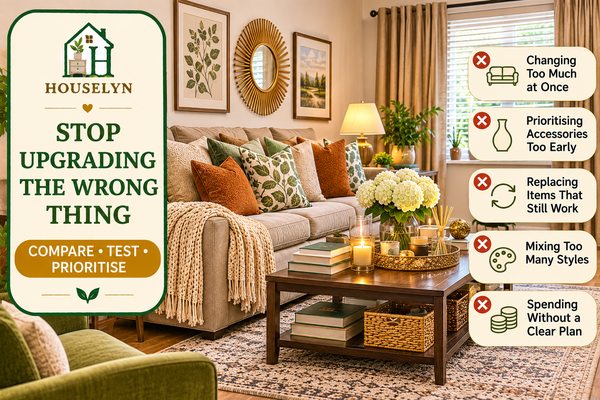
Upgrading What Is Easiest Instead of What Matters Most
Quick accessories can feel productive, but they may do very little when the room's main weakness is lighting, proportion, clutter or another larger relationship.
Starting Several Major Upgrades at Once
Changing paint, rug, curtains and artwork together makes it harder to judge which improvement actually solved the room problem and which one created another dependency.
Prioritising Accessories Before Scale or Lighting
Decorative objects cannot compensate for a room that is badly lit or visually disconnected by an undersized anchor element.
Replacing Something That Is Already Working
Familiar does not mean inadequate. An item in good condition should lose priority when another upgrade solves a clearer room need.
Assuming High Price Means High Impact
Cost and influence are different. An expensive decorative piece may change less than repositioning lighting or correcting a large visual relationship.
Ignoring Effort and Installation
An upgrade may look worthwhile until drilling, disruption, fitting or other practical requirements are considered. The improvement should justify the commitment it creates.
Buying Storage Before Editing Clutter
Storage should house what genuinely needs to remain. Buying it before editing can turn an excess-item problem into a furniture problem as well.
Finishing Before the Room Is Ready
Artwork, cushions and accessories are easier to choose once lighting, large colour decisions and other anchor relationships are settled.
Upgrade Drift Happens When Every Idea Becomes a Project
One improvement can easily create a chain of unnecessary decisions. A new rug suggests different cushions, the cushions make the curtains feel less suitable, and the curtains suddenly make the wall colour look wrong. The original room problem can disappear beneath a growing list of purchases that were never part of the initial goal.
Compare Against the Original Problem After Every Major Change
A stronger process is to complete or test the first-ranked upgrade and then return to the problem you originally wanted to solve. If the room now feels warmer, more connected or easier to use, some lower-ranked ideas should lose urgency rather than automatically moving up the shopping list.
Return to the room need, reassess what the previous change already improved and remove any project that has become decorative momentum rather than a useful next step.
Do Not Reward an Upgrade Simply Because You Already Like It
Preference matters, but prioritisation asks a different question. You may love a particular piece of art or want new curtains, yet lighting could still deserve attention first because it changes function and how the existing room is perceived. The calculator is designed to separate desire from order without dismissing either.
Good Prioritisation Can Remove Purchases From the Plan
The purpose of ranking is not to create a sequence in which every selected upgrade eventually happens. Some ideas should disappear after the stronger correction is made. If improved lighting restores warmth, new textiles may no longer be urgent. If editing reduces clutter, additional storage may no longer be needed.
That is one of the clearest signs that the priority process is working: the room improves while the list of necessary upgrades becomes shorter rather than longer.
When to Upgrade, Restyle or Keep What You Already Own
Not every item that feels familiar needs replacing. A better decorating decision begins by separating pieces that are genuinely limiting the room from those that simply need a new relationship, different styling or no change at all.
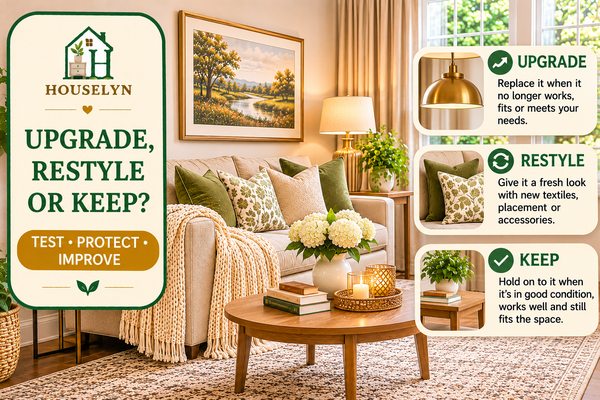
Upgrade when an item is physically unsuitable, functionally weak, damaged, badly scaled or unable to solve the room need after reasonable adjustments have been tested.
Restyle when the piece is usable but its position, grouping, colour relationship or surrounding layers are making it feel weaker than it is.
Keep items that are functional, appropriately scaled and visually compatible so budget and attention can move toward clearer weaknesses.
Upgrade When the Existing Item Cannot Meet the Need
Replacement becomes more defensible when the existing item has a physical or functional limitation. Lighting may genuinely be inadequate for the activities taking place in the room. A rug may remain too small even after repositioning. Storage may lack the capacity required for the belongings that remain after editing. In those cases, the upgrade solves something the current version cannot.
Restyle When the Item Works but the Relationship Does Not
Many pieces look wrong because of what is happening around them. Curtains can feel weak because of hanging height. Artwork can lose impact when it is scattered across several walls. A lamp may be useful but poorly positioned. Textiles can feel mismatched because their colours are not repeated elsewhere. Testing these relationships first can improve the room without replacing the object itself.
Check size, condition, comfort, capacity and whether it performs the job the room actually requires.
Movement can change the effectiveness of rugs, lamps, tables, artwork, chairs and other decor without replacing them.
Lighting, colour, scale or nearby objects may be weakening an item that would otherwise work perfectly well.
Name the improvement you expect. If the answer is only “it will be newer,” the upgrade may not deserve high priority.
Keep Is an Active Decorating Decision
Keeping an existing item is not the absence of a design decision. It can be the most efficient choice when the piece is doing its job and supports the direction of the room. Protecting strong elements reduces unnecessary decisions and gives upgrades elsewhere a clearer purpose.
Existing Condition Should Change Priority
This is why the calculator asks whether each candidate is in poor, acceptable or good condition. A high-impact idea should lose urgency when the current version already performs well. By contrast, a poorly functioning item that also solves one of the room's main problems deserves stronger consideration.
Replace what cannot do the job, restyle what can work better, and protect what already supports the room.
This approach prevents the priority list from becoming a replacement list. Some selected upgrades may move forward, others may be improved without a purchase, and strong existing pieces may remain exactly as they are.
Decor Upgrade Priority Calculator FAQ
Use these answers alongside your Decor Upgrade Priority Calculator result when deciding whether an improvement deserves attention now, should follow another change or can remain on hold.
What decor should I upgrade first?
Start with the upgrade that solves the clearest room problem and affects the largest useful relationship. Lighting, scale, function and large visual anchors often deserve attention before minor decorative details.
Which home decor upgrades make the biggest difference?
The strongest upgrade depends on the room problem. Lighting can improve function and atmosphere, rugs can strengthen scale and furniture connection, curtains can influence wall proportion and softness, and storage can improve function when a genuine storage need remains.
How do I prioritise decorating projects?
Compare each project by impact, actual need, fit with what you are keeping, cost or effort and whether another decision should happen first. The project with the strongest combined case should lead rather than the one that is simply easiest to buy.
Should I replace furniture or decor first?
Replace furniture first only when the existing piece has a genuine functional, condition or scale problem. If the main furniture works, improving lighting, rugs, curtains, colour or other surrounding relationships may make a larger difference with less disruption.
Is lighting worth upgrading before decor?
Often, yes, when the room feels dark, flat or difficult to use. Better lighting can change atmosphere and how colours, artwork and textiles appear, making later decorative decisions easier to judge.
Should I buy a rug before artwork?
If the room has a weak furniture connection or scale problem, the rug may deserve priority because it affects a larger visual relationship. Artwork may come first when the floor layer already works and the main problem is a weak focal wall.
How do I know if a decor upgrade is worth the money?
A worthwhile upgrade should solve something specific, improve enough of the room to justify its cost or effort and work with what you intend to keep. Testing the idea before purchasing can reveal whether the expected improvement is realistic.
What should I upgrade first in a small room?
Prioritise changes that improve function or visual space without adding unnecessary floor area. Lighting, well-planned storage, mirrors and better use of existing furniture can often offer more value than adding another decorative or furniture piece.
Can I improve a room without buying anything?
Yes. Move lighting, reposition a rug, regroup artwork, edit clutter, restyle textiles or remove competing objects before assuming a purchase is necessary. These tests can sometimes solve the problem or clarify what is genuinely missing.
When should I stop upgrading a room?
Stop when the original problems are resolved, the room functions well and the remaining upgrade ideas no longer solve a clear need. A lower ranked idea does not have to become a future purchase simply because it once appeared on the comparison list.
Make the Next Decorating Decision With More Context
Use these Houselyn guides to diagnose the room, strengthen the underlying design and decide whether another decorative layer is actually needed.
Identify the relationship that is actually weakening the room before turning the problem into another shopping decision.
Arrange Living Room Layout BasicsImprove furniture placement, circulation and seating relationships before asking decorative layers to compensate for a weak arrangement.
Design Living Room Design IdeasPlan function, proportion, balance, materials and light before relying on final styling details to make the room feel complete.
Prioritise Blank Wall DecorDecide whether a wall truly needs more visual weight and choose scale and placement before adding extra wall decoration.
Edit Coffee Table StylingRefine the finishing layer while keeping everyday function and useful empty surface ahead of decorative excess.
Simplify Small Space Decorating IdeasPrioritise light, function, organisation and visual breathing room when every added object has a greater effect on a compact space.

Houselyn Editorial Team
The Houselyn Editorial Team creates practical guides for improving the way homes look, feel and function, with a focus on realistic decorating decisions, usable organization systems and attainable interior styling.
Meet the Houselyn Editorial Team →Prioritise the Improvement, Not the Purchase
Houselyn tools and editorial guides are designed to help you compare what a room genuinely needs, protect what already works and make improvements in a useful order. Better homes are built through thoughtful decisions, not constant replacement.
You might like these
Gallery Wall Planner: Create the Right Layout for Your Wall | Houselyn
Use the Houselyn Gallery Wall Planner to create a balanced layout, preview frame spacing and size, and plan your wall before hanging
Room Refresh Cost Planner | Estimate Your Decorating Costs | Houselyn
Use the Houselyn Room Refresh Cost Planner to estimate realistic costs for paint, lighting, rugs, curtains, furniture, storage and decor before you refresh a room.