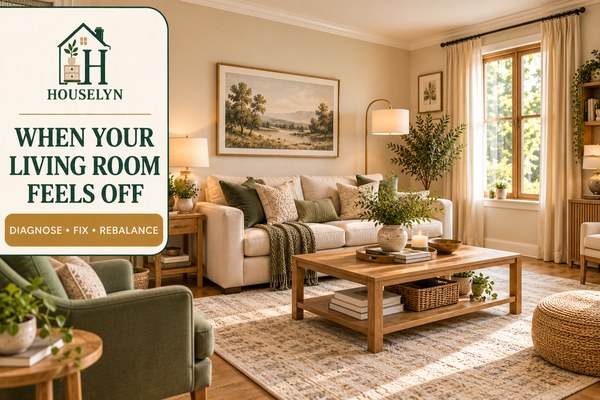
Living Room Feels Off? 15 Fixes That Make the Room Feel Balanced Again
Houselyn Living Room Troubleshooting Guide
If your living room feels off, the answer is usually not to buy more
decor. A room can contain attractive furniture, a good sofa and carefully chosen
accessories yet still feel unfinished because the scale, placement, visual weight or
relationship between those elements is not working.
When a living room feels off, start by looking at the room as one
connected system. The rug affects the sofa, the sofa affects the artwork, curtains
affect vertical proportion, lighting changes how colours read, and even a well-styled
coffee table can feel wrong when the surrounding furniture is poorly scaled.
Disclosure: Houselyn may earn a commission from qualifying purchases
made through selected affiliate links in this article, at no additional cost to you.
When a room feels wrong, diagnose the relationships between furniture, scale,
lighting and decoration before adding anything new.
Why the Room Can Feel Wrong Even When the Decor Is Attractive
When Your Living Room Feels Off, Diagnose the Relationship Before the Style
One of the most useful questions in home styling is not simply
why does my living room feel off, but which relationship is making
it feel that way. If the rug is too small, the furniture may appear to float. If
artwork is undersized, the sofa can visually overpower the wall. If curtains begin
too low, the whole room can feel shorter.
A living room feels off when important elements stop supporting one
another. The problem may be scale, position, proportion, circulation, visual weight,
lighting, colour repetition or simply too much decoration competing at once.
Scale
The sofa, rug, artwork, coffee table or lamps may be too large or too small for
one another.
Placement
Furniture may technically fit while still sitting too far apart, too close to
walls or disconnected from the focal point.
Visual Weight
One side of the room may carry darker, taller or more visually dominant objects
than the other.
Vertical Balance
Curtains, artwork, shelving and lighting may be positioned in ways that make the
room feel visually too low or top-heavy.
Lighting & Colour
Dark corners, one-dimensional lighting or colours that appear only once can make
the room feel disconnected.
Too Much Decoration
When every surface and wall is filled, the room can lose the negative space that
allows its strongest features to stand out.
If your living room feels off, avoid changing everything at once.
Identify the strongest problem first. A room that seems to need new furniture may
simply need a larger rug. A wall that appears empty may need correctly scaled artwork,
not more pieces. A room that feels cold may need better lighting distribution rather
than more accessories.
This is also why asking why does my living room feel off is more useful
than asking what else you should buy. Diagnosis reduces unnecessary decorating and
helps you correct the part of the room that is actually creating the imbalance.
When the living room feels off after several decorating attempts,
step away from individual objects and compare the largest elements first: sofa, rug,
chairs, coffee table, curtains and wall treatment. These establish the room's visual
structure before smaller accessories contribute anything meaningful.
A living room feels off surprisingly often because several small
errors are happening together. The rug may be slightly too small, the artwork slightly
too high and the coffee table slightly too narrow. None looks disastrous alone, but
together they weaken the composition.
The same principle applies when a living room feels off because it
seems cluttered. The problem may not be the total number of possessions. Instead,
several visually heavy items may be concentrated in one corner while another part of
the room remains empty.
If a living room feels off because it seems unfinished, check whether
the major furniture pieces belong to one another visually before adding cushions,
artwork or tabletop decor. Styling should finish the composition rather than compensate
for a weak foundation.
When a living room feels off in a compact home, scale becomes even
more important. Oversized furniture can interrupt movement, but filling the room with
undersized furniture can also make it look fragmented and temporary.
And when a living room feels off even though the layout appears
reasonable, lighting and colour may be the missing connection. Repeated colour,
varied light sources and balanced contrast can make separate furniture pieces feel
as though they belong to the same room.
By the end of this guide, you should be able to look at a
living room feels off problem as a diagnosis rather than a shopping
problem: observe what the room is doing, identify the weakest relationship and make
the smallest correction capable of improving the whole space.
Chapter 1 — Observe
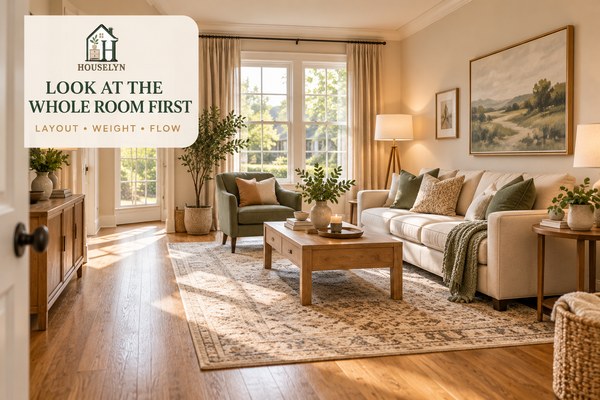
When Your Living Room Feels Off, Look at the Whole Room First
When your living room feels off, the first useful step is not rearranging cushions,
buying new accessories or changing the wall colour. Start by observing the room as
one complete composition and identifying what feels disconnected before making any
changes.
A living room feels off when several parts of the room stop supporting one another.
The problem may come from furniture scale, circulation, visual weight, lighting or
something as simple as one large object drawing attention away from the intended focal
point.
Step back and judge the whole room before focusing on individual accessories or
decorative details.
Stand at the Entrance Before You Start Fixing Anything
The doorway gives you one of the most useful views of the room because it reveals the
first impression created by the furniture, rug, wall decor and lighting together.
If the living room feels off from the entrance, notice what your eye sees first. A
television may dominate when the fireplace was supposed to be the focal point. A large
dark cabinet may make one side of the room feel much heavier than the other.
Identify the First Thing Your Eye Notices
Every room benefits from some degree of visual hierarchy. The strongest element might
be a fireplace, sofa, artwork, window view or media wall, but several equally dominant
features can make the room difficult to read.
A living room feels off when the intended focal point is weaker than secondary objects.
Before buying anything new, ask whether the room already has too many elements trying
to lead.
Look at the Room From the Main Seating Position
A room can look balanced from the doorway but awkward from the sofa. Sit where you
normally spend time and observe the wall opposite, nearby furniture, lighting and
pathways.
If the living room feels off while seated, look for objects that appear too high, too
small, too far away or visually disconnected from the furniture around them.
Check Whether the Room Has One Clear Furniture Zone
The sofa, chairs, rug and coffee table should usually read as one connected seating
group. If each item seems to occupy its own isolated patch of floor, the room may feel
unfinished even when the individual pieces are attractive.
When a living room feels off, this lack of connection is often more important than the
colour or style of the furniture.
Notice Where Empty Space Is Helping and Where It Feels Accidental
Empty space is essential for circulation and visual rest, but there is a difference
between intentional negative space and an area that feels abandoned.
A living room feels off when one corner is crowded while another large area has no
visual relationship to the rest of the room. The goal is not to fill every empty area,
but to distribute furniture and visual weight more deliberately.
Photograph the Room Instead of Relying Only on Memory
A photograph can make scale and visual imbalance easier to notice because it flattens
the room into one composition. Objects you have become accustomed to may suddenly look
obviously too small, too crowded or poorly positioned.
If your living room feels off but you cannot identify why, take one photograph from
the doorway and another from the main seating position. Compare where the visual weight
sits in each image.
Temporarily Remove Everyday Clutter Before Diagnosing the Design
Remote controls, chargers, paperwork, toys, bags and other temporary items can obscure
the underlying layout. Clear those first so you can judge the permanent furniture and
decor rather than reacting to everyday mess.
Sometimes a living room feels off because temporary clutter is hiding a sound design.
In other rooms, removing clutter reveals that the real problem is scale or placement.
Look for Visual Weight, Not Just Physical Size
A black cabinet may feel heavier than a larger pale wood cabinet. A dense gallery wall
may carry more visual weight than one oversized neutral artwork. A dark patterned rug
can dominate more strongly than a larger plain one.
When a living room feels off, compare colour, contrast, texture and height as well as
physical dimensions.
Check Whether Movement Through the Room Feels Natural
Furniture can look attractive in a photograph but still make the room uncomfortable
if walking routes are awkward. Watch whether people need to squeeze behind chairs,
step around the coffee table or cut directly through conversations.
If the living room feels off during everyday use, circulation may be the problem even
when the decorative styling looks finished.
Do Not Diagnose Five Problems at the Same Time
Once you notice several issues, resist the temptation to change everything in one day.
Fixing the strongest relationship first makes it easier to see whether the other
problems still exist afterwards.
A living room feels off surprisingly often because one structural mistake is creating
several secondary symptoms. A rug that is too small can make the sofa, chairs and
coffee table all appear disconnected at once.
By the end of this observation stage, you should be able to describe the problem more
specifically than simply saying the living room feels off. You may notice that the
furniture feels too small for the room, the rug does not anchor the seating or one side
carries most of the visual weight.
The next chapter focuses on the first major diagnosis: scale. It will help determine
whether the sofa, rug, coffee table, artwork, lamps or smaller objects are making the
room feel visually out of proportion.
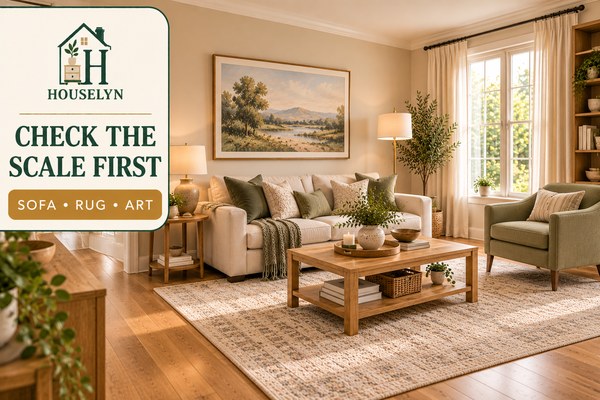
Your Living Room May Feel Off Because the Scale Is Wrong
A living room feels off when the major pieces do not feel proportionate to one another.
The sofa may be too dominant, the rug may be too small, the coffee table may look
insignificant or the artwork may lack enough visual weight to support the furniture.
Scale problems are especially easy to miss because each item may look attractive on
its own. The issue appears only when those pieces are viewed together as one composition.
A room feels more settled when its largest elements step down in scale instead of
competing or looking disconnected.
The largest furniture piece usually establishes the visual scale for everything around
it. In many living rooms, that means the sofa or sectional.
If the living room feels off, compare the sofa first with the room itself. A deep,
bulky sectional can dominate a compact room, while a very small sofa can look temporary
or under-scaled in a large open space.
Check Whether the Rug Is Supporting the Sofa
The rug is one of the strongest visual connectors in a seating area. If it is too
small, the sofa and chairs may appear to sit around it rather than belong to it.
When a living room feels off, a floating rug is often part of the problem because it
weakens the connection between the largest pieces of furniture.
Compare the Coffee Table to the Seating Group
A coffee table can look beautifully styled but still feel wrong if its physical and
visual size is too weak for the sofa. A tiny table in front of a wide sofa creates an
obvious scale gap.
A living room feels off when the coffee table seems like an accessory rather than a
functional part of the seating zone.
Do Not Let Wall Art Shrink Against Large Furniture
Wall art that looked substantial before hanging can appear surprisingly small over a
three-seat sofa or long console. The furniture changes the reference point.
If the living room feels off above the sofa, test whether the artwork simply needs a
larger total footprint before changing the artwork style.
Check Whether Too Many Pieces Have the Same Visual Weight
A room can become strangely flat when the sofa, chairs, side tables, lamps and artwork
all appear to demand the same amount of attention.
When the living room feels off, ask which element is supposed to lead and which pieces
should visually support it.
Remember That Visual Weight Is More Than Physical Size
A dark velvet chair may feel heavier than a larger pale linen chair. A thick black
frame can visually outweigh a wider light-oak frame. Pattern, contrast, colour and
texture all affect how large an object appears.
This is why a living room feels off even when the measurements appear reasonable.
The physical sizes may work while the visual weights do not.
Use Tape to Test Scale Before Buying a Replacement
If the artwork seems small, tape a larger rectangle around it and look again from the
sofa. If the rug appears weak, mark the footprint of a larger rug on the floor. These
temporary outlines can make scale differences obvious.
When a living room feels off, this test helps separate a genuine size problem from a
styling problem.
Small Rooms Do Not Need Everything to Be Small
A compact living room filled with tiny furniture and tiny decor can look fragmented.
A properly scaled sofa, substantial rug or one larger artwork may create more calm than
many undersized pieces.
A living room feels off when every item seems temporary or visually disconnected
simply because the room owner was afraid to use anything with enough presence.
Large Rooms Need Stronger Anchors, Not Necessarily More Furniture
An expansive room may feel empty even when it contains several pieces. The problem can
be that none of those pieces is substantial enough to anchor the scale of the room.
If the living room feels off in a large space, look for one or two stronger anchors
before filling additional corners with smaller furniture.
Too Many Small Accessories Can Distort the Scale of a Room
Numerous small objects create many points for the eye to process. That can make the
larger furniture feel less confident and the whole room appear busier than necessary.
When a living room feels off after styling, remove several small accessories and see
whether the room's larger proportions become easier to read.
Once you know the scale is working, the next question is whether the furniture is
positioned as one connected zone. A room can contain perfectly proportioned pieces and
still feel awkward when the sofa, chairs, rug and coffee table do not relate spatially.
The next chapter focuses on layout and explains why a living room feels off when the
furniture follows the walls instead of forming a clear, functional seating arrangement.
Chapter 3 — Layout
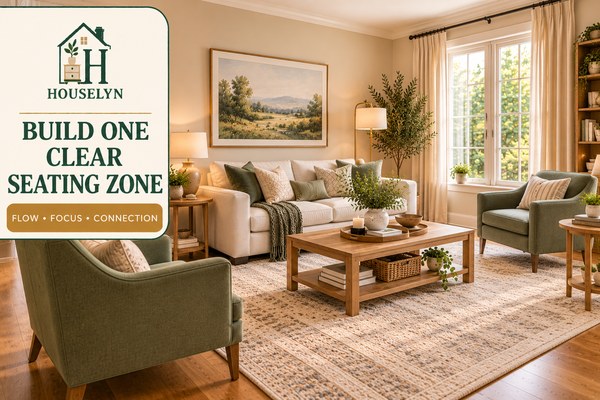
A Living Room Feels Off When the Furniture Does Not Form a Clear Zone
A living room feels off when the sofa, chairs, rug and coffee table occupy the same
room but do not read as one connected seating arrangement. Good layout creates clear
relationships between furniture, pathways and the room's focal point.
Even well-scaled furniture can look awkward when every piece follows the perimeter of
the room. The goal is not simply to fit furniture inside the available space, but to
make the main pieces belong to the same functional zone.
A clear seating zone helps the sofa, chairs, rug and coffee table feel connected
rather than scattered around the room.
Stop Treating Every Wall as a Furniture Parking Space
Pushing every piece against a wall can create a large empty centre while leaving the
seating too far apart for comfortable conversation. The room may technically feel open,
but the furniture can look disconnected.
If the living room feels off, look at whether the layout was designed around the walls
rather than around the people using the space.
Bring Seating Into a Clear Conversation Zone
Sofas and chairs should feel as though they belong to the same group. They do not need
to be perfectly symmetrical, but the spacing should allow people to interact without
feeling unusually distant.
A living room feels off when one chair sits far outside the main rug or when the sofa
and chairs seem to face different activities rather than each other.
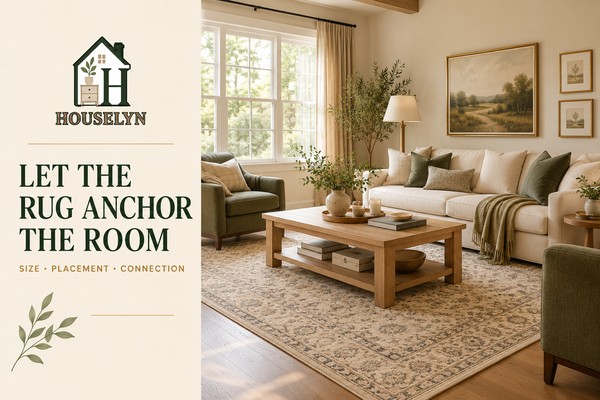
Let the Rug Define the Main Furniture Group
A correctly placed rug creates a shared floor boundary for the seating arrangement.
When only the coffee table sits on the rug, the rest of the furniture can appear to
orbit a small decorative island.
If the living room feels off around the centre of the room, check whether the rug is
reinforcing the seating zone or separating it.
Check Whether the Coffee Table Belongs to the Seating
The coffee table should feel accessible from the main sofa and visually connected to
the rug. If it is too far away, very small or positioned off-centre without purpose,
the middle of the seating group can feel weak.
A living room feels off when the coffee table appears placed in empty floor space rather
than serving as the functional centre of the seating arrangement.
Do Not Let Walkways Cut Through the Main Conversation Area
People should be able to move through the room without repeatedly stepping between the
sofa and coffee table or squeezing between chairs.
When a living room feels off during daily use, poor circulation may be the hidden
problem even if the furniture looks acceptable from one camera angle.
Check Whether the Sofa Is Facing the Right Thing
A sofa does not always need to face a television or fireplace directly, but the layout
should make the room's priority understandable. Conflicting focal points can make the
furniture seem undecided.
A living room feels off when the television pulls attention in one direction, the
fireplace in another and the chairs appear arranged around neither.
Do Not Block Windows Just to Create Symmetry
Symmetry can be useful, but it should not come at the cost of natural light, opening
windows or comfortable circulation. A room may work better with a slightly asymmetrical
arrangement that respects the architecture.
If the living room feels off beside a window, check whether furniture is visually or
physically crowding the opening.
Give Floating Furniture a Reason to Float
Moving a sofa away from the wall can improve a room when it creates a better conversation
zone, defines an open-plan area or establishes a walkway behind it.
A living room feels off when furniture floats without a clear relationship to the rug,
other seating or surrounding architecture.
Use Dead Corners Carefully
An empty corner does not automatically need a chair, plant, floor lamp or table.
Adding furniture simply to occupy the corner can weaken the main seating arrangement.
When a living room feels off because one corner seems empty, first ask whether that
emptiness is actually giving the room useful breathing space.
Open-Plan Rooms Need an Invisible Boundary
In an open-plan home, the living room may not have four architectural walls defining
it. The sofa position, rug, lighting and furniture orientation must create that boundary
visually instead.
A living room feels off in an open-plan space when the seating area leaks into dining
or circulation zones without a clear visual edge.
Do Not Correct Layout by Adding More Furniture
When the room feels empty, the instinct may be to add an occasional chair, console or
side table. But additional furniture will not fix a main seating group that is simply
too spread out.
If the living room feels off, reposition the existing large pieces before deciding
that another object is necessary.
Once the furniture forms a clear seating zone, the room usually begins to feel more
intentional. The sofa, chairs and coffee table have a shared purpose, while circulation
happens around that group rather than breaking through it.
The next chapter looks closely at the rug because even a strong furniture arrangement
can feel unfinished when the floor anchor is too small or positioned incorrectly.
The Rug May Be Why Your Living Room Feels Unfinished
A living room feels off when the rug looks like a separate decorative object instead
of the floor anchor for the seating group. The sofa, chairs and coffee table should
feel connected by the rug rather than arranged around a small rectangle in the centre.
A rug influences much more than the floor. Its size, orientation and placement affect
how large the seating zone appears, whether the furniture feels grounded and how clearly
the room reads as one composition.
A properly scaled rug creates a shared floor boundary that visually connects the
sofa, chairs and coffee table.
Check Whether the Rug Is Only Serving the Coffee Table
One of the easiest rug problems to recognise is a small rug sitting entirely beneath
the coffee table while every seat remains outside it. The rug becomes an island rather
than an anchor.
If the living room feels off around the centre, look at whether the rug actually
participates in the furniture arrangement or merely fills some empty floor.
Let the Sofa Have a Clear Relationship With the Rug
The main sofa should usually feel visually connected to the rug, whether through the
front legs, a fuller furniture-on-rug arrangement or another deliberate configuration
that suits the room.
A living room feels off when there is a narrow strip of bare floor separating the sofa
from a rug that otherwise appears intended to anchor it.
Check Whether the Chairs Belong to the Same Floor Zone
An armchair placed well beyond the rug boundary can feel like a separate seating area
even when it is meant to participate in the same conversation group.
If the living room feels off because one chair appears isolated, the solution may be
a larger rug or a tighter chair position rather than another side table or accessory.
Match the Rug Orientation to the Seating Arrangement
A rectangular rug has a strong directional effect. If the long side runs against the
main furniture direction, the seating group can appear compressed or strangely narrow.
A living room feels off when the rug orientation fights the sofa and room geometry
instead of reinforcing them.
A Rug Can Be Too Narrow Even When It Is Long Enough
Length is only part of the measurement. A rug may extend far enough across the room
but still look too narrow beneath a wide sofa and two chairs.
When the living room feels off, compare rug width with the complete seating arrangement,
not just the coffee table.
Pattern and Colour Affect How Large the Rug Feels
A high-contrast pattern can carry more visual weight than a quiet neutral rug of the
same dimensions. A very dark rug may also become the strongest feature in a pale room.
A living room feels off when the rug physically fits but visually dominates everything
resting on or around it.
Do Not Use a Smaller Rug Simply to Show More Floor
Visible flooring can be beautiful, but shrinking the rug to expose more of it can weaken
the seating composition. The room may gain more visible floor while losing the boundary
that ties the furniture together.
If the living room feels off after choosing a smaller rug, test a larger footprint
before assuming the furniture arrangement itself is the problem.
Make Sure the Rug Supports the Largest Furniture
The sofa carries more visual weight than the coffee table, so the rug should be judged
primarily against the seating rather than against the table sitting in the middle.
A living room feels off when the rug seems perfectly sized for the coffee table but
obviously undersized for everything else.
Use the Rug to Connect Different Furniture Styles
The sofa and chairs do not need to match exactly. A shared rug can visually connect
different upholstery colours, shapes and materials by giving them one common base.
When the living room feels off because furniture styles seem unrelated, a rug that
bridges their colours or textures may help create cohesion without replacing the furniture.
Do Not Let a Strong Rug Compete With Every Other Pattern
Patterned rugs can add character, but a busy rug combined with patterned curtains,
patterned cushions and highly detailed artwork may create too many competing focal points.
A living room feels off when every patterned surface asks for equal attention. In that
situation, simplifying one or two surrounding elements may work better than changing
the rug itself.
Once the rug properly anchors the seating group, the next diagnostic layer is vertical.
Curtains, artwork and lighting can make an otherwise balanced floor plan feel visually
too low, too high or unfinished.
The next chapter moves from floor level to the walls and windows to diagnose why the
living room feels off when its vertical proportions are not working.
Chapter 5 — Height & Vertical Balance
Curtains, Wall Art and Lighting Can Make the Room Feel Visually Too Low or Too High
A living room feels off when the upper and lower halves of the room do not feel
connected. Curtains may begin too low, artwork may float above the sofa or lighting
may sit at one repeated height, leaving the vertical composition unfinished.
Vertical balance is easy to overlook because most furniture sits close to the floor.
Once the sofa, rug and tables are in place, the windows, walls and lighting need to
carry enough visual weight upward without making the room top-heavy.
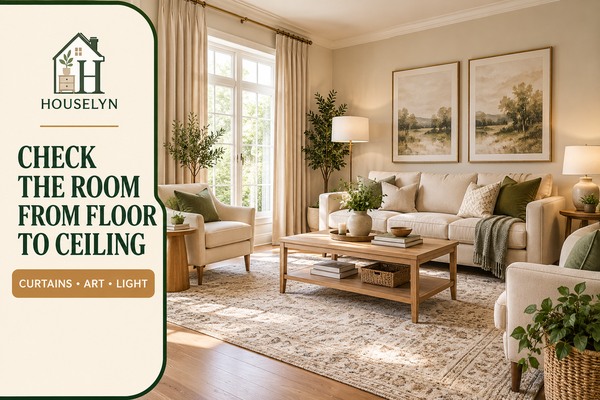
Curtains, artwork and lighting help connect floor-level furniture to the upper half
of the room when their scale and height are coordinated.
Check Whether the Curtains Are Visually Cutting the Wall Short
Curtains that begin only slightly above the window can emphasise the window opening
rather than the height of the room. The result can make the wall feel lower and more
compressed than necessary.
If the living room feels off around the windows, check whether the curtain position
is visually shortening the wall before replacing the fabric itself.
Look at Curtain Width as Well as Curtain Height
A curtain rod that barely extends beyond the window can make the opening feel narrow.
It can also reduce the amount of glass visible when the curtains are open.
A living room feels off when the window treatment appears squeezed into the exact
dimensions of the window rather than supporting the wider wall composition.
Check Whether Wall Art Is Floating Too High
Artwork placed far above a sofa or console can make the lower furniture and upper wall
feel like separate design zones.
If the living room feels off above the sofa, compare the gap between the furniture and
artwork before deciding that the wall needs additional pieces.
Make Sure the Artwork Has Enough Scale for the Furniture
Height and size work together. A small frame hung too high is especially likely to
look disconnected because it lacks both scale and proximity.
A living room feels off when wall decor occupies the upper wall without providing
enough visual weight to relate to the furniture below.
Layer Lighting at Different Heights
A ceiling light alone illuminates from above but does little to connect the upper and
lower areas of the room visually. Floor lamps and table lamps introduce useful light
and visual interest closer to the seating.
When the living room feels off after dark, look at whether every light source is
concentrated at one height or in one part of the room.
Do Not Use Tall Ceilings as a Reason to Hang Everything Higher
A high ceiling creates more wall, but that does not mean artwork should be pushed
upward or curtains should stop well below the ceiling without purpose.
A living room feels off when its tall architecture is treated as empty space to fill
rather than as proportion that should support the furniture zone below.
Low Furniture Can Leave the Upper Wall Feeling Empty
Low sofas and media units can create a calm modern profile, but they may leave a large
amount of unused wall above them. That empty area is not automatically a problem, but
it should feel deliberate.
If the living room feels off because everything appears concentrated close to the
floor, introduce vertical interest through curtains, appropriately scaled artwork or
lighting rather than filling every wall with small objects.
Do Not Make the Upper Half of the Room Too Heavy
Tall shelves, dark wall units, oversized artwork and substantial curtain treatments can
collectively make the top half of the room feel visually dense.
A living room feels off when heavy vertical elements dominate while the lower furniture
appears comparatively light or fragmented.
Use Floor Lamps to Bridge Low Furniture and Tall Walls
A floor lamp can create an intermediate visual height between a sofa and a tall ceiling.
It can also distribute light where a ceiling fixture alone leaves the seating area flat.
When the living room feels off beside a low sofa, a well-proportioned lamp may create
better vertical rhythm without requiring additional wall decor.
Keep Shelves From Becoming a Heavy Band Across the Wall
Several shelves stacked closely together can create a dense horizontal band at eye
level. The problem becomes stronger when every shelf is completely filled.
A living room feels off when shelving consumes most of the available wall while leaving
little visual breathing room around the displayed objects.
Once floor-level furniture and vertical elements feel connected, the next issue to
diagnose is visual weight. A room can have good scale, layout and height yet still feel
unbalanced because too much contrast, furniture or clutter is concentrated in one area.
The next chapter explains why a living room feels off when one side or one corner
visually dominates the rest of the space.
Your Living Room May Feel Off Because One Area Is Visually Too Heavy
A living room feels off when one side of the space carries most of the visual weight.
A dark cabinet, tall shelving, large plant, patterned rug and clustered accessories
may all be attractive individually, yet together they can make one part of the room
dominate everything else.
Visual balance does not require perfect symmetry. It requires enough distribution that
the eye can move around the room without becoming trapped by one dense corner, one dark
furniture group or one highly decorated surface.
Visual balance comes from distributing colour, height, contrast and decorative
density rather than making both sides of the room identical.
Check Whether One Side of the Room Is Doing Too Much
Stand at the doorway and compare the left and right sides of the space. One side may
contain the television, a large cabinet, shelves and several dark accessories while
the opposite side has only a pale chair and lamp.
If the living room feels off, that imbalance may be easier to correct by redistributing
visual weight than by buying another large item for the lighter side.
Dark Colour Carries More Visual Weight
Black, deep brown, charcoal and other dark finishes naturally attract attention in a
pale room. Several dark objects grouped together can make one section feel much denser
than its actual physical size suggests.
A living room feels off when the darkest furniture, artwork and accessories all occupy
the same visual zone without a lighter counterbalance.
Height Can Make One Corner Dominate
A tall bookcase, floor lamp and large plant positioned together can create a strong
vertical mass. That may work intentionally, but it can also leave the rest of the room
looking visually underdeveloped.
When a living room feels off in one corner, compare the combined height and contrast
of everything in that area rather than assessing each object separately.
Too Many Small Objects Can Become One Large Visual Problem
A collection of frames, candles, books, bowls, small plants and decorative objects can
accumulate into substantial visual weight even though no single item is large.
A living room feels off when every surface contains multiple small objects and there
is no quieter area to give the eye a place to rest.
Check Whether Open Shelving Has Become Too Dense
Open shelves contribute visual weight through the shelf lines themselves and through
every object displayed on them. Completely filling each shelf can turn a useful feature
into the heaviest part of the room.
If the living room feels off around shelving, remove several objects before adding
baskets, artwork or another decorative layer.
Look at Cushions as a Group, Not One at a Time
Cushions add colour, softness and pattern, but a sofa packed with many sizes, textures
and prints can become visually busy. The sofa may lose its shape beneath the styling.
A living room feels off when the cushions carry more pattern and colour variation than
the rest of the furniture zone can comfortably support.
Reduce Visible Clutter Before Redecorating
Everyday clutter can exaggerate design problems. Cables, remotes, paperwork, toys and
loose objects may make a balanced room look visually heavier than it really is.
If the living room feels off, temporarily clear those items and reassess before changing
furniture, artwork or colour.
Balance Does Not Mean Mirroring Both Sides
You do not need two identical lamps, two matching chairs or perfectly symmetrical
shelves. One substantial object can balance several lighter elements if their combined
visual presence feels comparable.
A living room feels off when one side clearly dominates, not simply because the two
sides are different.
Use Negative Space as Part of the Balance
Empty floor, blank wall and open tabletop space can counter areas that contain stronger
furniture or more decorative detail. Negative space is not unfinished space when it
has a clear purpose.
When a living room feels off because it seems crowded, the most effective change may
be removing something rather than moving it to another surface.
Repeat Strong Colours Instead of Concentrating Them
A deep green chair may look isolated if no similar tone appears elsewhere. Repeating a
small amount of that colour in artwork, cushions or another distant detail can help the
eye move across the room.
A living room feels off when one strong colour exists as a single visual event with no
relationship to anything around it.
Once visual weight is more evenly distributed, the room should feel calmer without
becoming empty. Strong elements can remain, but they no longer compete from the same
corner or surface.
The next chapter looks at lighting and colour, two less physical relationships that can
still explain why a living room feels off even when the furniture arrangement and
visual balance are working.
Chapter 7 — Lighting & Colour
Flat Lighting or Disconnected Colour Can Make a Living Room Feel Wrong
A living room feels off when the room has good furniture and reasonable layout but
still lacks warmth, depth or cohesion. Lighting and colour often create that final
connection because they influence how every other surface in the room is perceived.
A room can be technically bright and still feel flat. It can also contain attractive
colours that never feel related because each one appears only once. The goal is not to
add more light or more colour, but to distribute both more intentionally.
Layered lighting and repeated accent colours help separate furniture pieces read as
part of the same room.
A central ceiling light may provide enough general illumination, but it often leaves
the room with one direction of light and little variation around the seating area.
If the living room feels off at night, switch off the ceiling light for a moment and
notice which corners, surfaces and seating positions disappear into shadow.
Build Lighting in Layers Rather Than Adding More Brightness
A useful lighting scheme combines broader ambient light with more focused light at
seating or reading level and smaller accent light where atmosphere or emphasis is useful.
A living room feels off when every light source performs the same job from the same
height. More bulbs do not necessarily create more depth.
Look for Dark Corners That Break the Room Apart
A dark corner can visually disappear after sunset, making the usable room feel smaller
and leaving furniture in that area disconnected from the rest of the composition.
When a living room feels off after dark, a floor lamp or table lamp may reconnect that
area more effectively than another decorative object.
Make Sure Lamps Have Enough Scale
A very small lamp beside a substantial sofa or armchair may provide some light while
adding almost no visual presence. The lighting needs to fit the furniture as well as
illuminate it.
A living room feels off when lamps appear like tiny accessories beside furniture that
needs stronger vertical balance.
Repeat Accent Colours Instead of Using Them Only Once
One deep green chair can feel isolated in a cream room if that green appears nowhere
else. Repeating a small amount in artwork, cushions or another distant detail can make
the colour feel intentional.
If the living room feels off because one piece seems unrelated, look for a subtle way
to repeat its colour rather than trying to match every item exactly.
Do Not Repeat Colour in Equal Amounts Everywhere
Repetition creates connection, but equal quantities of the same accent throughout the
room can feel overly coordinated. One larger colour moment and several smaller echoes
usually create more natural rhythm.
A living room feels off when an accent colour becomes a formula rather than a visual
thread connecting separate areas.
Check Whether the Room Is Too Tonally Flat
An all-beige or all-grey room can still be beautiful, but similar values across every
surface may reduce visual depth. Texture helps, but tonal variation is also important.
When a living room feels off despite a coordinated palette, compare the light, medium
and darker values rather than introducing a completely unrelated new colour.
Too Many Unrelated Colours Can Fragment the Room
The opposite problem occurs when every cushion, artwork and accessory introduces a
different strong colour with no repetition elsewhere.
A living room feels off when the eye moves from one isolated colour event to another
instead of reading the room as one palette.
Use Artwork and Textiles as Colour Bridges
Artwork, rugs, cushions and throws can connect furniture finishes that do not match.
A piece containing cream, wood tones, green and a small warm accent can make those
colours feel more deliberately related across the room.
If the living room feels off because furniture was purchased at different times, look
for a bridge between the existing pieces before assuming they need to be replaced.
Natural Light Changes the Palette Throughout the Day
Wall colour, fabrics and wood finishes can look significantly different in morning
daylight, afternoon sun and artificial evening light.
A living room feels off only at certain times of day when the lighting changes the
contrast or undertone of key surfaces. Observe the room before making a permanent colour
correction.
Once lighting and colour connect the room, most major relationships have been tested:
scale, layout, rug anchoring, vertical balance, visual weight, light and colour.
The final diagnostic step is editing. The next chapter brings the entire system together
and identifies the most common problems to check when the living room feels off even
after several decorating attempts.
If Your Living Room Still Feels Off, Remove Before You Add
A living room feels off surprisingly often because several small issues are happening
at the same time. By this stage, the most useful final step is not more decorating.
It is a deliberate edit of the relationships you have already tested.
The room may not need a new sofa, another lamp or more artwork. It may simply need one
dominant problem corrected and one unnecessary element removed so the stronger parts of
the room can become easier to see.
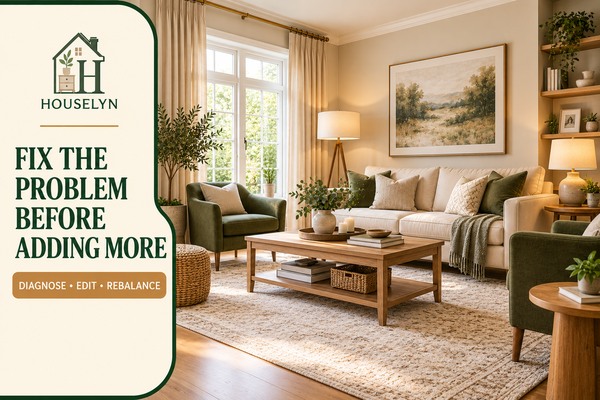
The final edit is about correcting the strongest imbalance and removing what no
longer improves the room.
If the living room feels off but you still cannot identify the cause, work through the
following problems one at a time. Do not assume that all fifteen apply. The purpose is
to find the smallest number of issues responsible for the largest visual effect.
The rug is too small.
The seating appears to surround the rug instead of being anchored by it.
Furniture is pushed against every wall.
The room has empty space in the middle but weak connection between seats.
The seating is too far apart.
Chairs and sofas occupy the same room without forming a comfortable conversation zone.
The coffee table is too small.
It lacks enough scale to visually support the sofa and surrounding seating.
The artwork is too small.
The wall treatment appears weak compared with the furniture beneath it.
The artwork is hung too high.
It floats separately from the sofa, console or other furniture it should relate to.
The curtains are mounted too low.
The window treatment visually shortens the wall and can make the room feel more compressed.
The curtain rod is too narrow.
Curtains crowd the glass and make the window appear smaller than it needs to.
Lighting comes from one main source.
The room may be bright enough but still lack depth, atmosphere and useful light near seating.
There are too many small accessories.
Numerous decorative objects create visual noise and weaken the larger shapes in the room.
One side of the room is visually heavier.
Dark furniture, shelving, pattern or tall objects may be concentrated in the same area.
The furniture styles have no connecting element.
Different pieces need some shared colour, material, rug, artwork or textile relationship.
A strong colour appears only once.
One isolated colour can make an otherwise cohesive room feel disconnected.
There is no clear focal point.
The television, fireplace, artwork, window and shelving may all compete for equal attention.
Every surface is decorated.
Without negative space, even attractive objects can lose impact and make the room feel crowded.
Start With the Problem That Changes the Largest Area
If the rug is dramatically too small, correcting it may improve the sofa, chairs and
coffee table relationship at the same time. If the curtains are mounted too low,
repositioning them may change the apparent height of the whole room.
A living room feels off when a major structural relationship is wrong, so those larger
corrections usually deserve attention before decorative details.
Do Not Fix a Scale Problem With More Accessories
If artwork is too small, surrounding it with unrelated objects may only create more
visual noise. If the coffee table is undersized, styling it more heavily does not give
it the physical presence the seating group needs.
When a living room feels off because of scale, the solution should address scale rather
than disguise it.
Remove One Item and Reassess the Whole Room
Editing does not mean stripping the room bare. Choose one object that feels redundant,
overly small, overly decorative or visually competitive and remove it temporarily.
If the living room feels off because too many elements are competing, one subtraction
can reveal which pieces actually deserve attention.
Correct One Relationship at a Time
Change the rug placement and look again. Adjust the art and look again. Move a chair
and look again. This slower process prevents one correction from creating a new problem
elsewhere.
A living room feels off for identifiable reasons, but changing five things at once can
make those reasons harder to understand.
Recheck the Room From the Doorway and the Sofa
The final arrangement should work from more than one viewpoint. Return to the same
doorway and seating positions you used during the observation stage.
If the living room feels off from one view but balanced from another, the remaining
problem may be directional: furniture orientation, wall placement or visual weight
could still need a minor adjustment.
Do Not Expect Perfect Symmetry
Real rooms contain doors, windows, radiators, televisions and architecture that prevent
perfect mirror-image arrangements. Balance should respond to those realities rather than
fight them.
A living room feels off when symmetry is forced at the expense of function, circulation
or the architecture itself.
Stop When the Room Feels Complete, Not Full
A blank corner can remain blank. A coffee table does not need objects across its entire
surface. A wall does not require artwork simply because there is available space.
When a living room feels off after repeated decorating, the missing ingredient can be
restraint rather than another finishing touch.
Once you can identify the strongest problem, correct it and stop adding unnecessary
layers, the room becomes much easier to understand. The final goal is not perfection.
It is a space in which scale, position, visual weight, lighting and negative space
support one another.
The main diagnostic chapters are now complete. The next section answers the most common
practical questions homeowners ask when their living room feels off, unfinished,
awkward, cluttered or visually unbalanced.
Frequently Asked Questions
Living Room Feels Off? Common Questions and Practical Fixes
If your living room feels off, the cause is usually easier to identify when you
separate the room into specific relationships: furniture scale, rug size, layout,
wall placement, curtain height, lighting, colour and visual weight.
These answers cover the most common questions homeowners ask when a room feels
unfinished, awkward, cluttered or visually unbalanced.
1
Why does my living room feel off?
A living room feels off when one or more important relationships are out of balance.
Common causes include a rug that is too small, furniture positioned too far apart,
undersized artwork, low curtains, poor lighting distribution, uneven visual weight
or too many small decorative objects competing for attention.
2
Why does my living room feel unfinished?
An unfinished feeling often comes from weak connection rather than missing decor.
Check whether the rug anchors the seating, the artwork relates to the sofa, the
curtains support the height of the room and the lighting reaches more than one
area. Adding accessories should come after those larger relationships are working.
3
Why does my living room feel unbalanced?
The room may have too much visual weight on one side. Dark furniture, tall shelving,
large plants, patterned textiles or clusters of accessories can make one area feel
heavier. Balance does not require symmetry, but the strongest elements should be
distributed so one corner does not dominate the entire room.
4
Why does my living room look awkward?
Awkward rooms often have furniture that fits physically but does not form a clear
functional zone. Check whether the sofa and chairs relate to one another, whether
the coffee table belongs to the seating group and whether people can move around the
furniture without cutting through the centre of the conversation area.
5
How do I know if my sofa is too big for my living room?
A sofa may be too large if it dominates the room, restricts major walkways, crowds
doors or windows, or leaves too little usable space for the rest of the seating
arrangement. Judge the sofa against both the architecture and the furniture zone,
not simply whether it fits between two walls.
6
How do I know if my rug is too small?
The rug is probably too small if it serves only the coffee table while the sofa and
chairs sit completely outside its visual boundary. A stronger rug arrangement
should help the main seating pieces read as one connected group rather than several
separate objects.
7
Why does my furniture look like it is floating?
Furniture often looks as though it is floating when the rug is too small, the seats
are too far apart or there is no strong central relationship between the sofa,
chairs and coffee table. If the living room feels off in the middle, check the floor
anchor before adding more furniture around the perimeter.
8
Should living room furniture touch the walls?
It can, but it does not have to. The better question is whether wall placement
supports the seating arrangement and circulation. In some compact rooms, furniture
near a wall is practical. In larger rooms, pulling seating inward can create a
stronger conversation zone and prevent the room from feeling scattered.
9
How far apart should living room seating be?
There is no single distance that suits every sofa and chair combination. The
spacing should allow comfortable conversation, practical movement and access to
tables without making the seats feel isolated. Test the arrangement in the actual
room rather than relying on a rigid universal measurement.
10
Why does my coffee table look too small?
A coffee table looks undersized when its visual presence is weak compared with the
sofa or seating group. This can happen because it is physically too narrow, too far
from the sofa or visually lightweight. If the living room feels off around the
centre, compare the table with the seating rather than the rug alone.
11
Why does my wall art look wrong?
Wall art usually looks wrong because of scale, height or relationship to nearby
furniture. A small artwork can look weak above a wide sofa, while artwork hung too
high can appear detached. Judge the wall treatment together with the furniture
beneath it rather than as an isolated object.
12
How high should wall art hang?
The correct height depends on what is beneath the artwork and how the composition
is viewed. Artwork above a sofa or console should normally feel connected to that
furniture rather than floating high on the wall. Test the grouping from normal
standing and seated viewpoints before fixing it permanently.
13
Can curtains make a living room look wrong?
Yes. Curtains mounted too low can visually shorten the wall, while a rod that barely
extends beyond the window can make the opening feel narrow. If your living room
feels off around the windows, check the height, width and fullness of the treatment
before replacing the curtain fabric.
14
Why does my living room feel dark even with the lights on?
The problem may be light distribution rather than total brightness. One ceiling
light can leave corners, reading areas and wall surfaces visually flat or dark.
Layering ambient, task and accent lighting at different heights often creates more
depth than simply increasing the brightness of a single fixture.
15
Why does my living room feel cluttered?
Clutter can come from quantity, but it can also come from distribution. Too many
small objects on every surface, crowded open shelving, visible cables and heavily
patterned accessories can make the room feel busy. Group useful objects, clear
selected surfaces and preserve intentional negative space.
16
Why does my living room feel empty?
An empty feeling does not always mean the room needs more furniture. The existing
pieces may be too small, spread too far apart or poorly anchored. A larger rug,
stronger artwork or tighter furniture grouping may make the room feel complete
without filling additional corners.
17
How do I make a living room feel more cohesive?
Connect existing pieces through repeated colour, related materials, a shared rug,
coordinated lighting and consistent visual scale. If the living room feels off
because furniture was purchased at different times, look for a common thread rather
than trying to make every item match.
18
How do I balance furniture on both sides of a room?
Compare visual weight rather than matching object for object. One tall cabinet on
one side might be balanced by a chair, floor lamp and artwork on the other. Colour,
height, pattern and contrast all contribute to perceived weight, so exact symmetry
is rarely necessary.
19
Should every surface in a living room be decorated?
No. Clear surfaces give stronger objects space to stand out and keep everyday life
practical. A console, shelf or coffee table can look more considered with fewer
well-chosen objects than with every available area filled.
20
What should I fix first when my living room feels off?
Start with the problem affecting the largest part of the room. That may be the
seating layout, rug size, sofa scale, curtain position or lighting distribution.
Correct one major relationship, step back and reassess before changing smaller
decorative details.
Practical Action Plan
The 5-Step Living Room Reset Plan
If your living room feels off, use this five-step reset before buying anything new.
The aim is to identify the strongest problem, correct it in the right order and then
reassess the whole room before making another change.
1
Photograph and Observe the Whole Room
Take one photograph from the doorway and another from the main seating position.
Look at the room as a complete composition rather than focusing on cushions,
accessories or individual pieces of furniture.
Check: focal point, furniture zone, visual weight, walkways, empty
areas and anything that immediately appears too large, too small or disconnected.
2
Identify the Single Strongest Problem
Decide which issue is affecting the largest part of the room. It might be a rug
that is too small, furniture that is too spread out, artwork that lacks scale,
curtains that visually shorten the wall or lighting that leaves important areas flat.
Check: ask which single correction would improve the greatest
number of relationships at once.
3
Correct Scale or Placement Before Styling
Move, measure or resize the major elements before changing decorative details.
Reposition the chairs, test a larger rug footprint, lower or resize artwork, adjust
curtain placement or move the coffee table into a stronger relationship with the sofa.
Check: do not use cushions, trays, plants or extra artwork to hide
a problem that is really caused by scale or position.
4
Rebalance Lighting, Colour and Visual Weight
Once the furniture relationships are stronger, look at the softer connections.
Distribute light across more than one level, repeat important colours subtly and
reduce any corner or surface that feels much heavier than the rest of the room.
Check: dark corners, isolated accent colours, crowded shelves,
concentrated dark furniture and areas with too much decorative density.
5
Remove One Unnecessary Element and Reassess
Finish by removing one object that no longer improves the composition. It may be
an extra cushion, a small accessory, a redundant side table, an overcrowded shelf
object or decor that competes with the room's stronger features.
Check: return to the doorway and sofa. If the room now reads more
clearly, stop before adding another layer.
Conclusion
When Your Living Room Feels Off, Fix the Relationships Before Adding More Decor
When your living room feels off, the problem is rarely that the room simply needs
more things. More often, the sofa, rug, coffee table, artwork, curtains, lighting and
decorative details are not supporting one another strongly enough.
The most reliable way to improve the room is to work from large relationships to small
ones. Start with the overall composition, then check scale, furniture placement, rug
anchoring, vertical balance, visual weight, lighting and colour before making decorative
adjustments.
A living room feels off when one of those relationships breaks down. A small rug can
make furniture float. Artwork that is too high can detach from the sofa. Low curtains
can shorten the wall. Flat lighting can make an otherwise well-designed room feel dull.
The Houselyn troubleshooting framework keeps that process simple:
Observe → Diagnose → Correct → Rebalance → Edit.
Observe the entire room before changing anything. Diagnose the strongest problem.
Correct the relationship that affects the largest area. Rebalance the surrounding
elements and then edit anything that no longer earns its place.
If the living room feels off after one correction, reassess before making another.
A larger rug may suddenly make the coffee table look correctly scaled. Moving the
furniture inward may make a previously empty wall feel intentional. Better lighting
may make the existing colour palette feel warmer without changing it.
This is why the order matters. Fixing symptoms instead of causes often leads to more
purchases, more accessories and more visual noise while the original problem remains.
If most of those answers are yes, the room should begin to feel much more settled.
It does not need perfect symmetry, matching furniture or decoration on every available
surface. It needs clear relationships.
When a living room feels off in a small home, those relationships become especially
important because every piece has more visual influence. One oversized item can restrict
circulation, while too many undersized pieces can make the room feel fragmented.
In a larger living room, the challenge is often the opposite. Furniture can become too
dispersed, leaving weak connections between the seats, rug and focal point even though
there appears to be plenty of space.
A living room feels off when the design follows the available space instead of the way
people actually use the room. Comfort, conversation and circulation should remain part
of every visual decision.
The same applies to styling. Cushions, books, trays, plants and decorative objects work
best when they support an already coherent room. They should not be expected to solve
an undersized rug, disconnected furniture arrangement or poorly positioned artwork.
If your living room feels off, make the smallest correction capable of improving the
largest relationship. Then stop, step back and look again.
Continue Learning
Build on the Living Room Fixes That Matter Most
If your living room feels off because one particular relationship still needs work,
use these deeper Houselyn guides to focus on layout, furniture scale and wall balance
without changing the parts of the room that are already working.
The Houselyn Editorial Team creates practical home styling and organization guides
designed to help readers make rooms feel more balanced, functional and visually
cohesive. Our approach focuses on usable layouts, realistic proportions, thoughtful
decorating decisions and solutions that work in everyday homes.
Use these dorm desk organization ideas to create a clear college study space with better drawer systems, vertical storage, cable control and simple resets.
Discover dorm bedding ideas that make small rooms feel like home. Learn how to create a cosy, stylish, and practical college dorm with smart bedding, storage, and decorating tips.
Learn how to decorate a stylish and comfortable living room with practical design advice, timeless styling ideas, and expert inspiration from Houselyn.
Discover college dorm decor ideas for colour, bedding, walls and personal touches that turn a plain student room into warm, stylish place that feels like home
Discover practical dorm room organization ideas that help you organize clothes, desks, storage and daily routines for a calm, clutter-free college room.