- Home
- Home Organization
- Small Space Organization Ideas
Small Space Organization Ideas: Complete Guide for Any Home
Small Space Organization Ideas can help you maximize storage, reduce clutter, and create a more functional home regardless of square footage.
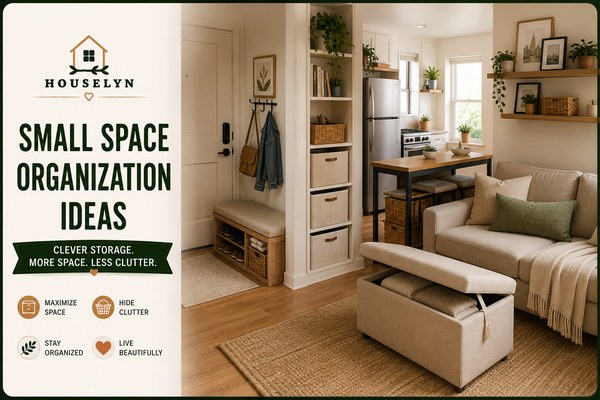 Beautifully organized small apartment featuring smart storage solutions, vertical organization, and multi-functional furniture for compact living.
Small space organization ideas can completely transform the way a home looks, feels, and functions. Whether you live in a studio apartment, a compact house, a small bedroom, or a space with limited storage, organization often matters more than square footage.
Many people assume they need a larger home when they begin to feel overwhelmed by clutter. In reality, the problem is often not the amount of space available but how that space is being used. A well-organized small apartment can feel more functional than a poorly organized home that is twice the size.
The challenge with smaller spaces is that every item competes for valuable room. A single cluttered countertop, overcrowded closet, or poorly planned storage area can make an entire home feel cramped. When storage systems fail, clutter becomes visible much faster than it does in larger homes.
The good news is that small spaces can be organized successfully using proven systems and practical strategies. The goal is not to create a perfect home. The goal is to create a home that works efficiently for the people living in it.
In this guide, you will learn how to organize small spaces strategically, maximize storage, reduce visual clutter, and build systems that are easy to maintain long term. Whether you are organizing a small apartment, a compact bedroom, a tiny kitchen, or an entire home, these methods can help you make the most of every square foot available.
Why Small Spaces Feel Cluttered Faster
One of the biggest frustrations of living in a smaller home is how quickly clutter seems to appear.
In a larger house, clutter can often be hidden behind closed doors or spread across multiple rooms. In a small apartment or compact home, there is far less room for error. Every surface, shelf, cabinet, and storage area plays a larger role in the overall appearance of the home.
A pair of shoes left by the door, a stack of mail on the counter, or a few items placed on a bedroom chair can immediately make a small space feel crowded.
The reason is simple.
Small spaces have a much higher visibility ratio.
In a large home, one cluttered area may affect only one room.
In a small home, one cluttered area can affect the feeling of the entire space.
Several factors contribute to this problem:
- Limited storage capacity
- Fewer closets
- Reduced cabinet space
- Multi-purpose rooms
- Higher visibility of belongings
- Lack of designated storage zones
Many people respond by purchasing additional storage products. While organizers can help, they rarely solve the root problem.
The most successful small-space organization systems focus on creating structure, reducing unnecessary belongings, and ensuring that every item has a logical place to live.
Understanding why clutter accumulates is the first step toward creating a home that feels larger, calmer, and easier to maintain.
Affiliate Disclosure: As an Amazon Associate, Houselyn earns from qualifying purchases. Some links on this page may be affiliate links, which means we may earn a small commission at no extra cost to you if you make a purchase through Amazon. We only recommend products that support the organization, storage, and home improvement solutions discussed in this guide.
The Houselyn Small Space Framework
Small space organization ideas work best when they follow a consistent system rather than relying on random storage products or quick fixes.
Many people approach organization by purchasing bins, baskets, shelves, and organizers whenever clutter appears. While these products can be useful, they rarely solve the root cause of the problem.
The Houselyn Small Space Framework is built around five principles that help small homes feel larger, calmer, and easier to maintain.
These principles apply whether you live in:
- A studio apartment
- A one-bedroom flat
- A compact family home
- A tiny house
- A small bedroom
- A home with limited storage
Principle 1: Every Item Must Earn Its Space
In a large home, it is possible to store items that are rarely used without feeling the impact immediately.
Small spaces do not offer that luxury.
Every item occupies valuable real estate.
When evaluating belongings, ask:
- Do I use this regularly?
- Does this add value to my life?
- Would I buy it again today?
Items that fail these tests should be reviewed carefully.
One of the fastest ways to improve a small space is often removing items that no longer deserve space in the home.
Principle 2: Storage Must Follow Daily Habits
Many organization systems fail because they are built around ideal behavior rather than real behavior.
For example:
If shoes always accumulate near the front door, create storage near the front door.
If mail consistently lands on the kitchen counter, create a mail station nearby.
If blankets are always left on the sofa, place a storage basket beside the sofa.
The best organization systems work with your habits rather than against them.
Principle 3: Vertical Space Is Prime Real Estate
Most people focus on floor space.
Organized homes focus on wall space.
Examples include:
- Floating shelves
- Tall bookcases
- Wall-mounted cabinets
- Hanging organizers
- Over-door storage
Vertical storage allows small homes to increase capacity without increasing clutter.
This principle becomes increasingly important as square footage decreases.
Principle 4: One Space Should Perform Multiple Jobs
Small homes often require rooms to serve multiple purposes.
A living room may also function as:
- A home office
- A reading room
- A guest room
- A play area
A bedroom may also include:
- A workspace
- Storage area
- Dressing area
The key is creating clearly defined zones while allowing the space to remain flexible.
Principle 5: Simplicity Beats Perfection
Many organization systems fail because they become too complicated.
Examples include:
- Excessive categories
- Overly detailed labels
- Difficult-to-access storage
- Storage systems that take too long to maintain
Simple systems are more likely to survive real life.
A practical system used consistently will always outperform a perfect system that nobody follows.
A Real Houselyn Example
A couple living in a compact two-bedroom apartment believed they needed additional furniture to solve their storage problems.
After evaluating their space, the real issue became clear.
The apartment contained:
- Duplicate household items
- Unused decorative pieces
- Inefficient closet shelving
- Poorly utilized wall space
Instead of buying more furniture, they applied the Houselyn Small Space Framework.
They decluttered first.
They reorganized storage around daily habits.
They installed vertical shelving.
They added multi-functional furniture.
The result was a home that felt significantly larger without increasing square footage.
Houselyn Takeaway
Small space organization is not about fitting more things into a home.
It is about making better use of the space that already exists.
When every item earns its place, storage follows daily habits, vertical space is used effectively, rooms serve multiple functions, and systems remain simple, even the smallest homes can feel organized and comfortable.
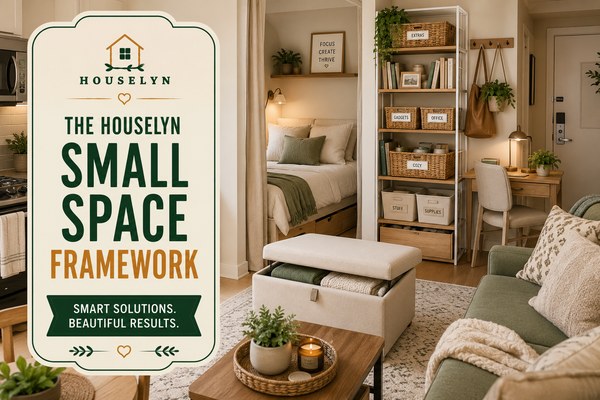 A practical small space organization framework showing vertical storage, multi-functional furniture, and organized apartment living.
Related Houselyn Guides
How to Assess a Small Space Before Organizing
Many people start organizing by purchasing storage products.
This is usually a mistake.
The most successful small space organization projects begin with assessment rather than shopping.
Before buying shelves, baskets, containers, or furniture, it is important to understand how the space is currently functioning.
A proper assessment often reveals that the real problem is not a lack of storage. Instead, it may be:
- Poor storage placement
- Unclear categories
- Unused vertical space
- Inefficient furniture
- Excess belongings
- Missing organization systems
A small amount of planning can prevent expensive mistakes and create better long-term results.
Step 1: Identify Your Biggest Frustrations
Start by walking through the space and identifying the areas that create the most daily frustration.
Ask yourself:
- What area feels cluttered most often?
- What items never seem to have a home?
- Which storage areas overflow constantly?
- What is difficult to find?
- What creates stress when entering the room?
The answers usually reveal the highest-priority organization opportunities.
Step 2: Evaluate Current Storage
Next, review every existing storage area.
Examples include:
- Closets
- Cabinets
- Drawers
- Shelves
- Under-bed space
- Furniture with storage
- Wall-mounted storage
Many small homes contain hidden storage opportunities that are simply underutilized.
Look for:
- Empty vertical space
- Half-used shelves
- Deep cabinets
- Unused corners
- Furniture that could serve multiple purposes
Step 3: Analyze Daily Habits
Organization systems should support real-life behavior.
Observe where items naturally collect.
Examples:
- Shoes by the door
- Mail on the kitchen counter
- Blankets on the sofa
- Bags near an entryway
- Chargers on nightstands
These patterns reveal where storage should be located.
The goal is to reduce the distance between use and storage.
Step 4: Categorize Your Belongings
Before organizing, group similar items together.
Examples include:
- Electronics
- Office supplies
- Cleaning products
- Kitchen tools
- Seasonal items
- Personal care products
Categorization helps reveal:
- Duplicates
- Excess inventory
- Missing storage zones
It also makes future maintenance easier.
Step 5: Measure Before Purchasing
One of the most common small-space mistakes is buying organizers that do not fit properly.
Before purchasing any storage solution:
- Measure width
- Measure depth
- Measure height
- Measure door clearances
- Measure shelf spacing
A few minutes spent measuring can prevent wasted money and frustration.
A Real Houselyn Example
A renter living in a compact apartment believed she needed an additional storage cabinet.
Before purchasing one, she completed a full assessment.
The review revealed:
- Half-empty closet shelves
- Unused wall space
- A bed with no under-bed storage
- Duplicate kitchen items
- Overcrowded decorative shelves
Instead of purchasing new furniture, she reorganized existing storage and removed unnecessary items.
The result was a significant increase in usable space without adding another piece of furniture.
Common Assessment Mistakes
Avoid these common errors:
- Buying organizers before measuring
- Organizing before decluttering
- Ignoring daily habits
- Focusing only on floor space
- Overlooking vertical storage opportunities
These mistakes often create more clutter rather than solving it.
Houselyn Takeaway
The best organization projects begin with understanding the space before making changes.
A thorough assessment helps identify the true causes of clutter and ensures that future storage solutions solve real problems rather than simply hiding them.
Recommended Small Space Planning Essentials on Amazon
These Amazon products can help you measure, plan, categorize, and organize your space before starting an organization project.
- Laser Measuring Tools
- Label Makers
- Storage Bins With Labels
- Drawer Organizers
- Measuring Tapes
- Stackable Storage Containers
Shop Small Space Organization Essentials on Amazon →
Small Apartment Organization Ideas
Small apartment organization ideas are often less about finding more space and more about making better use of the space that already exists.
Apartments typically present several challenges:
- Limited storage
- Smaller closets
- Multi-purpose rooms
- Restricted floor space
- Fewer built-in cabinets
The good news is that apartments often respond extremely well to intentional organization systems.
A well-organized apartment can feel dramatically larger, calmer, and easier to maintain than a larger home with poor storage habits.
Create Functional Storage Zones
One of the biggest mistakes apartment dwellers make is allowing belongings to spread across multiple areas without clear boundaries.
Instead, create dedicated zones.
Examples include:
- Entryway zone
- Living zone
- Work zone
- Dining zone
- Storage zone
- Relaxation zone
Even in a one-bedroom apartment, clear zones help reduce visual clutter and improve functionality.
Control Entryway Clutter Immediately
Apartment entryways often become clutter hotspots.
Common offenders include:
- Shoes
- Bags
- Keys
- Packages
- Jackets
Creating an apartment drop zone helps stop clutter before it spreads.
A simple system may include:
- Shoe storage bench
- Wall hooks
- Mail organizer
- Key tray
- Storage basket
The goal is to create an organized transition point between outside life and home life.
Maximize Underutilized Space
Many apartments contain valuable storage opportunities that are frequently overlooked.
Examples include:
- Under-bed space
- Space above cabinets
- Closet doors
- Empty wall sections
- Furniture interiors
Every square foot matters in a small apartment.
Identifying these opportunities can significantly increase storage capacity without making the apartment feel crowded.
Reduce Visual Noise
A major challenge in apartment living is visual clutter.
Because rooms are often connected, clutter in one area affects the perception of the entire home.
Reduce visual noise by:
- Limiting countertop items
- Using closed storage when possible
- Grouping similar objects together
- Hiding cords and electronics
- Maintaining clear surfaces
An apartment that feels visually calm often feels larger.
Use Furniture That Earns Its Space
Every piece of furniture should justify its footprint.
High-performing apartment furniture includes:
- Storage ottomans
- Storage beds
- Lift-top coffee tables
- Nesting tables
- Storage benches
- Expandable dining tables
Furniture that performs multiple jobs helps maximize functionality without increasing clutter.
Create a One-In, One-Out Rule
Apartments benefit from stronger item-management habits than larger homes.
A simple rule is:
For every new item entering the apartment, one item leaves.
This habit prevents gradual overcrowding and helps maintain balance over time.
A Real Houselyn Example
A renter living in a 650-square-foot apartment felt overwhelmed by constant clutter.
The apartment lacked storage, and belongings frequently accumulated on counters, tables, and chairs.
Rather than purchasing multiple storage cabinets, the solution focused on zoning.
An entryway drop zone was created.
A storage ottoman replaced a standard coffee table.
Under-bed storage containers were introduced.
Wall-mounted shelving was installed above existing furniture.
The apartment gained significantly more usable storage while feeling more open and less crowded.
Common Apartment Organization Mistakes
Avoid these common apartment organization errors:
- Buying oversized furniture
- Using too many open shelves
- Ignoring vertical space
- Keeping rarely used items in accessible locations
- Allowing entryway clutter to spread
- Purchasing storage products before decluttering
Small changes in these areas often create noticeable improvements.
Houselyn Takeaway
The best apartment organization systems focus on efficiency rather than quantity.
When zones are clear, furniture works harder, visual clutter is reduced, and storage opportunities are fully utilized, even a modest apartment can feel spacious and highly functional.
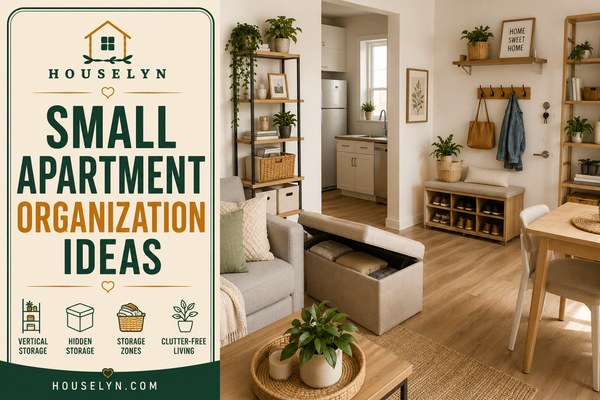 Smart apartment organization ideas featuring storage zones, vertical shelving, hidden storage furniture, and clutter-free apartment living.
Studio Apartment Organization Ideas
Studio apartment organization ideas require a different approach than traditional home organization.
In a studio apartment, nearly every activity takes place within a single open space.
The same room may function as:
- Bedroom
- Living room
- Dining area
- Home office
- Storage area
Without a clear organization strategy, a studio can quickly feel overcrowded and chaotic.
The goal is not simply to fit more belongings into the apartment.
The goal is to create structure, separation, and functionality while maintaining an open and comfortable atmosphere.
Create Distinct Functional Zones
One of the most effective studio apartment organization ideas is dividing the space into zones.
Examples include:
- Sleeping zone
- Living zone
- Work zone
- Dining zone
- Storage zone
These zones do not require walls.
Instead, they can be defined using:
- Area rugs
- Furniture placement
- Shelving units
- Room dividers
- Lighting
Creating visual boundaries helps the apartment feel larger and more organized.
Use Furniture as Room Dividers
Furniture can help separate spaces while providing valuable storage.
Examples include:
- Open shelving units
- Storage bookcases
- Console tables
- Wardrobes
- Storage cabinets
These pieces create division without making the apartment feel enclosed.
Whenever possible, choose furniture that provides both separation and storage.
Prioritize Closed Storage
Open storage often works against studio apartments.
Because the entire space is visible at once, visual clutter becomes much more noticeable.
Closed storage helps maintain a cleaner appearance.
Examples include:
- Storage cabinets
- Storage ottomans
- Storage beds
- Drawer units
- Lift-top coffee tables
A studio apartment often feels larger when fewer belongings are visible.
Maximize Vertical Storage
Wall space is one of the most valuable resources in a studio apartment.
Examples include:
- Floating shelves
- Wall-mounted desks
- Tall bookcases
- Hanging storage systems
- Over-door organizers
Using vertical storage helps preserve limited floor space.
Build a Hidden Storage Strategy
The most organized studio apartments often contain hidden storage opportunities.
Examples include:
- Under-bed storage
- Furniture with compartments
- Storage benches
- Ottoman storage
- Hidden closet organizers
The less visible clutter becomes, the more open the apartment feels.
Create a Daily Reset Routine
Studio apartments benefit greatly from daily maintenance.
Because all activities occur within one room, small amounts of clutter can have a large visual impact.
A simple five-minute evening reset can include:
- Returning items to storage
- Clearing surfaces
- Organizing work materials
- Putting away clothing
- Resetting the kitchen area
Consistency prevents clutter from accumulating.
A Real Houselyn Example
A young professional living in a 500-square-foot studio apartment struggled to balance work, relaxation, and storage.
The apartment felt crowded despite containing relatively few belongings.
The solution focused on creating zones.
A shelving unit separated the sleeping area from the living area.
A storage ottoman provided hidden storage.
A wall-mounted desk reduced furniture bulk.
Under-bed storage containers created additional capacity.
The apartment immediately felt more structured because every activity now had a dedicated location.
Common Studio Apartment Organization Mistakes
Avoid these common studio apartment mistakes:
- Using oversized furniture
- Allowing storage to remain visible everywhere
- Failing to define zones
- Ignoring vertical space
- Accumulating duplicate items
- Overdecorating small surfaces
These issues can make a studio feel significantly smaller than it actually is.
Houselyn Takeaway
The best studio apartment organization ideas focus on creating structure within a single open space.
When zones are clearly defined, storage is integrated into furniture, and clutter remains controlled, even a small studio can feel comfortable, functional, and surprisingly spacious.
More Small-Space Organization Guides
Continue organizing your home with these related Houselyn resources:
Small Bedroom Organization Ideas
Small bedroom organization ideas can make the difference between a room that feels cramped and stressful and one that feels calm, functional, and restful.
Bedrooms often become storage areas for many categories of belongings, including:
- Clothing
- Shoes
- Accessories
- Bedding
- Electronics
- Books
- Personal items
When storage systems are not intentional, clutter quickly takes over valuable space.
The goal is not to fit more belongings into the bedroom.
The goal is to create a room that supports relaxation while still meeting storage needs.
Start With the Bed Area
The bed is usually the largest piece of furniture in the room.
Because it occupies so much space, it should contribute to storage whenever possible.
Effective options include:
- Under-bed storage containers
- Storage beds with built-in drawers
- Vacuum-sealed seasonal storage
- Rolling storage bins
Many homeowners overlook the significant storage potential beneath the bed.
Reduce Nightstand Clutter
Nightstands often become catch-all surfaces.
Common items include:
- Chargers
- Books
- Glasses
- Medications
- Jewelry
- Personal electronics
Limiting the nightstand to essential items helps maintain a cleaner and more relaxing environment.
Consider:Optimize Closet Capacity
- Small drawer organizers
- Cable management systems
- Dedicated charging stations
Small bedrooms frequently have limited closet space.
Instead of adding additional furniture immediately, maximize existing closet storage.
Useful strategies include:
- Double hanging rods
- Shelf dividers
- Slim hangers
- Hanging organizers
- Seasonal clothing rotation
Many closets can increase capacity significantly without increasing physical size.
Use Vertical Storage Around the Room
When floor space is limited, walls become valuable storage assets.
Examples include:
- Floating shelves
- Wall-mounted hooks
- Tall narrow bookcases
- Over-door organizers
Vertical storage helps preserve open floor space while increasing storage capacity.
Choose Furniture With Storage
Every piece of furniture should contribute to the room's functionality.
Examples include:
- Storage benches
- Storage ottomans
- Bed frames with drawers
- Lift-top storage furniture
Multi-functional furniture often provides the greatest storage gains in small bedrooms.
Minimize Visual Clutter
A bedroom should feel restful.
Visual clutter works against this goal.
Reduce visual noise by:
- Limiting decorative accessories
- Keeping surfaces clear
- Using concealed storage
- Maintaining consistent categories
A visually calm room often feels larger than it actually is.
A Real Houselyn Example
A homeowner struggled with a small bedroom that constantly felt crowded.
The room contained:
- Overflowing closets
- Seasonal clothing
- Shoes stored on the floor
- Multiple charging cables
- Decorative clutter
Rather than purchasing another dresser, the solution focused on maximizing existing space.
Under-bed storage was introduced.
Closet shelving was reconfigured.
A storage bench replaced a standard bench.
Cable management reduced surface clutter.
The room immediately felt more open and organized.
Common Small Bedroom Organization Mistakes
Avoid these common errors:
- Blocking natural pathways
- Using oversized furniture
- Ignoring under-bed storage
- Overdecorating surfaces
- Allowing closets to overflow
- Using open storage for everything
These mistakes often make a bedroom feel smaller than necessary.
Houselyn Takeaway
The best small bedroom organization ideas focus on maximizing hidden storage, improving closet efficiency, and reducing visual clutter.
When every piece of furniture serves a purpose and storage is integrated thoughtfully, even a compact bedroom can feel spacious and relaxing.
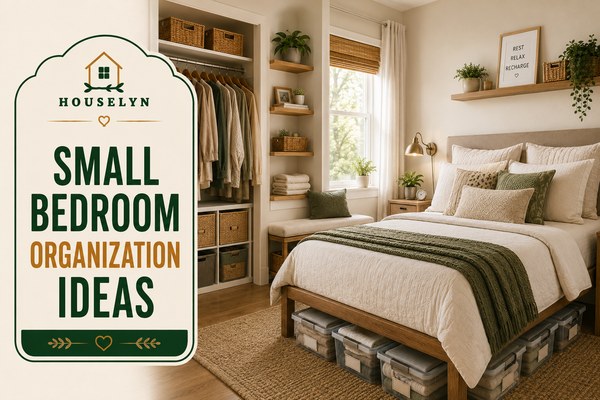 Space-saving bedroom organization ideas featuring under-bed storage, organized closets, vertical shelving, and clutter-free bedroom design.
Small Closet Organization Ideas
Small closet organization ideas can dramatically improve the functionality of an entire home.
Many people assume their closet is too small.
In reality, most closets suffer from inefficient organization rather than insufficient size.
A properly organized closet should make it easy to:
- Find clothing
- Store shoes
- Access accessories
- Rotate seasonal items
- Maintain organization long term
When closet systems are designed well, they reduce bedroom clutter and eliminate the need for unnecessary furniture elsewhere in the room.
Create Closet Zones
One of the most effective closet organization strategies is zoning.
Rather than storing items randomly, create dedicated categories.
Examples include:
- Everyday clothing
- Work clothing
- Formal wear
- Shoes
- Accessories
- Seasonal clothing
Grouping similar items together reduces searching and makes maintenance easier.
Use Vertical Closet Space
Many closets waste valuable vertical storage.
Look for opportunities above existing rods and shelves.
Examples include:
- Additional shelving
- Hanging organizers
- Seasonal storage bins
- Labeled containers
Using the full height of the closet can significantly increase capacity.
Replace Bulky Hangers
Hangers have a larger impact than many people realize.
Slim velvet hangers often create noticeably more hanging space compared to bulky plastic or wooden alternatives.
Benefits include:
- Increased capacity
- Uniform appearance
- Reduced slipping
- Better visibility
Small changes like this often create immediate improvements.
Rotate Seasonal Clothing
Keeping all clothing accessible year-round can create unnecessary overcrowding.
Instead:
- Store winter clothing during summer
- Store summer clothing during winter
- Move rarely used items to upper shelves
This approach frees valuable daily-use space.
Optimize Shelf Storage
Closet shelves often become cluttered because categories are unclear.
Use:
- Shelf dividers
- Labeled bins
- Storage baskets
- Folded clothing zones
Structured shelving prevents piles from collapsing and becoming difficult to maintain.
Organize Shoes Intentionally
Shoes often become one of the largest sources of closet clutter.
Effective solutions include:
- Shoe shelves
- Stackable shoe organizers
- Over-door shoe storage
- Clear shoe containers
The best system depends on available space and shoe volume.
Create an Accessory System
Accessories frequently become disorganized because they lack dedicated storage.
Examples include:
- Jewelry organizers
- Belt hangers
- Scarf organizers
- Sunglasses trays
- Handbag shelves
Giving accessories permanent homes prevents them from spreading throughout the closet.
A Real Houselyn Example
A homeowner complained that her closet was too small for her wardrobe.
After assessment, the actual problem was organization.
The closet contained:
- Bulky hangers
- No categories
- Out-of-season clothing
- Shoes stored randomly
- Wasted upper shelf space
By introducing zoning, seasonal rotation, shelf dividers, and slim hangers, closet capacity increased dramatically without any structural changes.
Common Small Closet Organization Mistakes
Avoid these common closet mistakes:
- Keeping all seasons accessible
- Using mismatched hangers
- Storing shoes randomly
- Ignoring upper shelves
- Mixing categories
- Allowing shelves to become overflow zones
These issues often make closets feel much smaller than they actually are.
Houselyn Takeaway
The best small closet organization ideas focus on maximizing existing space rather than expanding it.
When categories are clear, vertical storage is fully utilized, seasonal rotation is practiced, and every item has a designated location, even a compact closet can function efficiently.
Recommended Closet Organization Essentials on Amazon
These Amazon organization products can help maximize closet space, improve clothing storage, and create a more efficient closet system.
- Slim Velvet Hangers
- Closet Shelf Dividers
- Hanging Closet Organizers
- Stackable Shoe Organizers
- Storage Bins With Lids
- Over-Door Shoe Organizers
Shop Closet Organization Essentials on Amazon →
Small Kitchen Organization Ideas
Small kitchen organization ideas can significantly improve the functionality of one of the busiest rooms in the home.
A small kitchen does not necessarily need more cabinets.
It often needs better systems.
Many kitchen organization problems occur because storage space is not aligned with how the kitchen is actually used.
Common issues include:
- Overcrowded cabinets
- Cluttered countertops
- Overflowing drawers
- Pantry spillover
- Duplicate kitchen tools
- Poorly organized food storage
When these problems are addressed strategically, even a compact kitchen can become highly efficient.
Create Kitchen Storage Zones
One of the most effective organization methods is zoning.
Store items where they are used.
Examples:
Cooking Zone
- Pots
- Pans
- Cooking utensils
- Oils
- Spices
Food Preparation Zone
- Cutting boards
- Knives
- Mixing bowls
- Measuring tools
Food Storage Zone
- Containers
- Foil
- Wraps
- Storage bags
Cleaning Zone
- Dish soap
- Cleaning cloths
- Trash bags
- Dishwasher supplies
This system reduces movement and improves workflow.
Reduce Countertop Clutter
Countertops have a major influence on how large a kitchen feels.
The more items visible on counters, the smaller the room appears.
Keep only frequently used essentials visible.
Examples:
- Coffee machine
- Toaster (if used daily)
- Fruit bowl
Everything else should have a designated storage location.
Maximize Cabinet Space
Many kitchen cabinets contain unused capacity.
Improve cabinet efficiency with:
- Shelf risers
- Pull-out organizers
- Stackable storage bins
- Lazy Susans
- Cabinet door organizers
These solutions help increase usable storage without adding new cabinets.
Organize Drawers by Function
Kitchen drawers often become clutter magnets.
Instead of storing miscellaneous items together, assign specific purposes.
Examples:
- Utensil drawer
- Baking tools drawer
- Food storage drawer
- Kitchen gadget drawer
Drawer dividers help maintain categories.
Control Pantry Overflow
Small kitchens often struggle with food storage.
A pantry system should prioritize visibility.
Use:
- Clear containers
- Labels
- Category zones
- First-in-first-out rotation
When food is easy to see, waste decreases and shopping becomes easier.
Store Appliances Strategically
Small appliances consume valuable space.
Evaluate each appliance honestly.
Ask:
- How often do I use it?
- Does it deserve prime storage space?
Daily-use appliances should remain accessible.
Occasional-use appliances can be stored higher or deeper within cabinets.
A Real Houselyn Example
A family kitchen felt overcrowded despite having adequate cabinetry.
The kitchen contained:
- Duplicate utensils
- Unorganized food storage
- Cluttered countertops
- Random appliance placement
The solution focused on zoning.
Cooking tools moved closer to the stove.
Food storage containers were consolidated.
Countertops were simplified.
Cabinet organizers increased storage efficiency.
The kitchen became easier to use without adding a single cabinet.
Common Small Kitchen Organization Mistakes
Avoid these common errors:
- Storing items randomly
- Keeping duplicate tools
- Overcrowding countertops
- Ignoring cabinet height
- Failing to label pantry categories
- Giving equal space to rarely used items
These habits often reduce kitchen efficiency.
Houselyn Takeaway
The best small kitchen organization ideas focus on workflow, visibility, and accessibility.
When storage zones are clear, cabinets are optimized, countertops remain uncluttered, and pantry systems stay organized, even a compact kitchen can feel larger and function better.
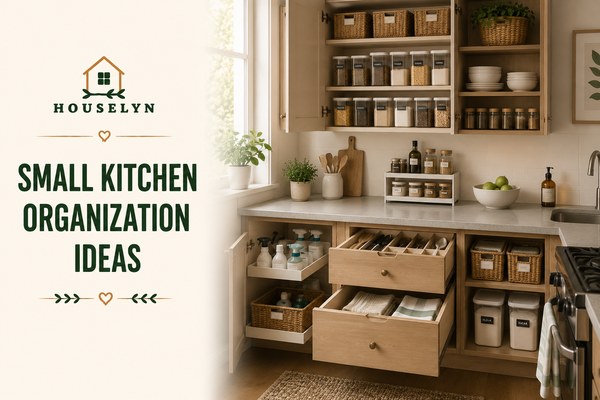 Space-saving kitchen organization ideas featuring organized cabinets, pantry storage, clear containers, and clutter-free countertops.
Kitchen & Storage Organization Guides
Explore more Houselyn guides to improve storage, organization, and functionality throughout your home.
Small Bathroom Organization Ideas
Small bathroom organization ideas are often overlooked, yet bathrooms are among the hardest-working spaces in any home.
A typical bathroom must store:
- Toiletries
- Skincare products
- Hair tools
- Cleaning supplies
- Towels
- First-aid items
- Personal care products
When storage systems are not intentional, countertops become crowded, cabinets overflow, and daily routines become frustrating.
The good news is that even the smallest bathroom can function efficiently with the right organization strategy.
Maximize Under-Sink Storage
The cabinet beneath the sink is often the most valuable storage area in a bathroom.
Unfortunately, it is also one of the most cluttered.
Create categories such as:
- Cleaning products
- Hair care
- Backup toiletries
- First-aid supplies
- Daily essentials
Use:
- Pull-out bins
- Clear containers
- Stackable organizers
- Turntables
This makes items easier to access and maintain.
Use Vertical Bathroom Storage
Wall space is especially valuable in small bathrooms.
Examples include:
- Floating shelves
- Wall-mounted cabinets
- Towel ladders
- Over-the-toilet storage
- Hanging baskets
Vertical storage helps preserve precious floor space.
Control Countertop Clutter
Bathroom countertops quickly become clutter magnets.
Common offenders include:
- Makeup
- Toothbrushes
- Hair products
- Skincare products
- Daily-use toiletries
Limit visible items to true daily essentials.
Everything else should have a dedicated storage location.
A clear countertop instantly makes a bathroom feel larger.
Create Towel Storage Zones
Towels often consume more space than expected.
Effective solutions include:
- Rolled towel baskets
- Floating shelves
- Wall-mounted racks
- Over-door towel storage
Keeping towels organized improves both functionality and appearance.
Organize by Frequency of Use
Store items according to how often they are used.
Examples:
Daily-use items:
- Toothbrushes
- Face wash
- Moisturizers
Weekly-use items:
- Hair tools
- Specialty products
Rarely used items:
- Backup supplies
- Travel products
- Bulk purchases
This simple strategy improves accessibility and reduces clutter.
Minimize Product Overload
Bathrooms frequently become storage locations for products that are no longer used.
Review:
- Expired products
- Duplicate items
- Unused samples
- Empty containers
Regular editing prevents storage systems from becoming overwhelmed.
A Real Houselyn Example
A family bathroom felt constantly overcrowded despite having adequate cabinetry.
The problem was not lack of storage.
The problem was lack of organization.
Toiletries were mixed together.
Cleaning supplies had no category.
Backup products occupied prime storage locations.
By creating dedicated zones and assigning every category a permanent home, the bathroom became easier to maintain and significantly less cluttered.
Common Small Bathroom Organization Mistakes
Avoid these common mistakes:
- Overcrowding countertops
- Ignoring wall space
- Storing products without categories
- Keeping expired items
- Mixing daily-use and backup products
- Failing to use vertical storage
These habits often make a small bathroom feel much smaller than it actually is.
Houselyn Takeaway
The best small bathroom organization ideas focus on visibility, accessibility, and simplicity.
When products are categorized, countertops remain clear, and vertical storage is utilized effectively, even a compact bathroom can feel spacious and highly functional.
Small Entryway Organization Ideas
Small entryway organization ideas can have a surprisingly large impact on the overall organization of a home.
The entryway is the first space people see when they enter.
It is also one of the hardest-working areas in the house.
Every day, it handles:
- Shoes
- Bags
- Keys
- Jackets
- Packages
- Sports equipment
- Pet supplies
Without a system, these items quickly spread into other rooms and create clutter throughout the home.
A well-organized entryway acts as a control center that prevents clutter from moving beyond the front door.
Create a Dedicated Drop Zone
The most effective entryways have a designated drop zone.
A drop zone is a specific area where everyday items are stored immediately upon entering the home.
Examples include:
- Keys
- Wallets
- Handbags
- Backpacks
- Sunglasses
The goal is to eliminate the habit of placing items on random surfaces.
Even a small tray or basket can create significant improvements.
Control Shoe Clutter
Shoes are often the biggest source of entryway disorder.
When footwear accumulates near the door, the entire space can feel crowded.
Solutions include:
- Shoe benches
- Narrow shoe cabinets
- Stackable shoe organizers
- Vertical shoe storage
- Storage baskets
The best solution depends on available space and household size.
Use Wall Space Efficiently
Wall storage is particularly valuable in small entryways.
Examples include:
- Coat hooks
- Floating shelves
- Mail organizers
- Key holders
- Wall-mounted baskets
These solutions keep frequently used items accessible without consuming floor space.
Create Family Storage Zones
In family homes, entryway clutter often comes from multiple people sharing the same space.
Creating individual zones can help.
Examples:
- One basket per family member
- Individual hooks
- Dedicated backpack storage
- Assigned shoe areas
This reduces confusion and improves accountability.
Manage Mail Before It Spreads
Mail frequently becomes clutter because it lacks a destination.
A simple mail station can include:
- Incoming mail tray
- Action folder
- Recycling container
Processing mail immediately prevents paper accumulation throughout the home.
Keep the Entryway Simple
Many homeowners try to solve entryway clutter by adding more furniture.
This can create the opposite effect.
The best entryways prioritize:
- Accessibility
- Simplicity
- Clear pathways
- Easy maintenance
Every item should have a purpose.
A Real Houselyn Example
A busy family struggled with constant clutter near the front door.
Shoes accumulated daily.
Backpacks were dropped on the floor.
Keys regularly went missing.
The solution involved creating a dedicated drop zone with:
- Wall hooks
- A narrow shoe bench
- Individual storage baskets
- A small mail station
Within a few weeks, entryway clutter decreased dramatically because every frequently used item now had a designated home.
Common Entryway Organization Mistakes
Avoid these common mistakes:
- Storing too many shoes near the door
- Using oversized furniture
- Ignoring wall space
- Allowing mail to accumulate
- Failing to assign storage locations
- Blocking walkways
These issues often make a small entryway feel much smaller than it actually is.
Houselyn Takeaway
The best small entryway organization ideas focus on preventing clutter before it enters the rest of the home.
When shoes, bags, keys, jackets, and mail have designated storage locations, the entire home becomes easier to maintain and more welcoming.
Small Living Room Organization Ideas
Small living room organization ideas are essential because the living room often serves multiple purposes.
In many homes, the living room functions as:
- A relaxation area
- Entertainment space
- Family gathering area
- Reading room
- Play space
- Occasional workspace
Without intentional organization systems, these overlapping functions can quickly create clutter.
The goal is not to remove comfort from the room.
The goal is to create storage systems that support daily life while maintaining an open and inviting atmosphere.
Use Hidden Storage Furniture
One of the most effective living room organization strategies is choosing furniture that provides concealed storage.
Examples include:
- Storage ottomans
- Lift-top coffee tables
- Storage benches
- Side tables with drawers
- Media consoles with cabinets
Hidden storage reduces visual clutter while increasing functionality.
Create Zones for Common Activities
Even small living rooms benefit from organization zones.
Examples include:
Entertainment Zone
- Remote controls
- Gaming accessories
- Media devices
Reading Zone
- Books
- Reading glasses
- Blankets
Family Zone
- Toys
- Board games
- Activity supplies
Grouping related items together simplifies maintenance and improves accessibility.
Control Cable Clutter
Electronics often create visual noise.
Examples include:
- Television cables
- Charging cords
- Speaker wires
- Gaming accessories
Simple cable management solutions can dramatically improve the appearance of a living room.
Consider:Limit Open Storage
- Cable boxes
- Cord sleeves
- Cable clips
- Furniture-based cable management
Open shelving can look beautiful when carefully curated.
However, excessive open storage often contributes to visual clutter.
Aim for a balance between:
- Open display storage
- Closed concealed storage
A room with too many visible items often feels smaller than it actually is.
Organize Blankets and Soft Furnishings
Blankets frequently migrate throughout the living room.
Effective storage solutions include:
- Decorative baskets
- Storage ottomans
- Blanket ladders
- Built-in furniture storage
Keeping soft furnishings organized helps maintain a tidy appearance.
Create a Toy Management System
Families with children often struggle with living room toy clutter.
A practical system should allow:
- Easy access
- Easy cleanup
- Clear categories
Examples include:
- Labeled bins
- Storage baskets
- Storage benches
- Modular cube storage
The goal is making cleanup simple enough to maintain consistently.
Reduce Surface Clutter
Coffee tables, side tables, and consoles often become clutter magnets.
Keep surfaces limited to:
- Functional items
- Decorative essentials
- Frequently used objects
Less visible clutter helps the room feel larger and more relaxing.
A Real Houselyn Example
A family living room felt overcrowded despite being reasonably sized.
The room contained:
- Toys spread throughout the space
- Excessive decorative accessories
- Unmanaged cables
- Blankets stored on furniture
- Media equipment without organization
The solution focused on hidden storage.
A storage ottoman replaced the existing coffee table.
Decorative baskets stored blankets.
Cable management systems reduced visual clutter.
Cube storage created toy zones.
The room became significantly easier to maintain while retaining its comfortable family atmosphere.
Common Small Living Room Organization Mistakes
Avoid these common mistakes:
- Using furniture without storage
- Allowing cables to remain visible
- Overcrowding shelves
- Ignoring toy management
- Filling every surface with decorations
- Choosing oversized furniture
These habits can make a living room feel smaller and less functional.
Houselyn Takeaway
The best small living room organization ideas combine hidden storage, functional furniture, and intentional zoning.
When clutter is controlled and storage is integrated into everyday furniture, a small living room can feel spacious, comfortable, and highly functional.
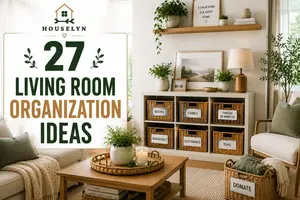
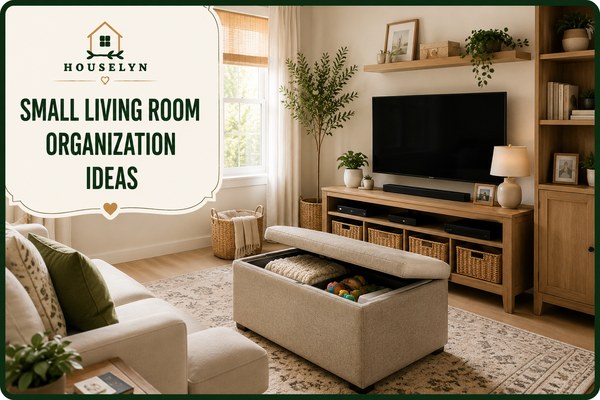 Practical living room organization ideas featuring hidden storage furniture, organized media storage, baskets, and clutter-free family living.
Small Home Office Organization Ideas
Small home office organization ideas have become increasingly important as more people work, study, and manage household responsibilities from home.
The challenge is that many small homes do not have a dedicated office.
Instead, workspaces are often integrated into:
- Bedrooms
- Living rooms
- Dining rooms
- Spare corners
- Multi-purpose rooms
Without proper organization, these workspaces can quickly become cluttered and negatively affect both productivity and relaxation.
The goal is to create a workspace that remains efficient without allowing work materials to spread throughout the home.
Create a Dedicated Work Zone
Even if a separate office is not available, a dedicated work zone is essential.
This zone should contain:
- Computer equipment
- Office supplies
- Work documents
- Charging stations
Keeping work-related items together prevents them from taking over other parts of the home.
Maximize Vertical Workspace Storage
Desk space is limited in most small home offices.
Using vertical storage helps preserve valuable work surfaces.
Examples include:
- Floating shelves
- Wall-mounted organizers
- Pegboards
- Vertical file holders
- Monitor risers with storage
The less clutter on the desk, the easier it becomes to focus.
Control Paper Clutter
Paper is one of the biggest sources of home-office clutter.
Common examples include:
- Bills
- Receipts
- Notes
- School paperwork
- Reference documents
Create simple categories such as:
- Action Required
- To File
- Reference
- Recycle
This prevents paperwork from accumulating in piles.
Organize Technology and Cables
Technology clutter can make a workspace feel chaotic.
Examples include:
- Charging cables
- Power strips
- USB devices
- Headphones
- External drives
Simple cable management solutions often create a cleaner and more professional workspace.
Use Multi-Functional Furniture
Small home offices benefit from furniture that performs multiple functions.
Examples include:
- Desks with storage
- Fold-down desks
- Storage cabinets
- Filing ottomans
- Wall-mounted workstations
This allows workspaces to remain efficient without consuming excessive square footage.
Maintain a Daily Reset Routine
A five-minute reset at the end of the day can dramatically improve workspace organization.
Examples include:
- Filing documents
- Clearing the desktop
- Returning supplies to storage
- Organizing cables
- Preparing for the next work session
This habit prevents clutter from accumulating.
A Real Houselyn Example
A homeowner worked from a small desk located in the corner of a bedroom.
The workspace constantly felt cluttered.
Office supplies mixed with personal belongings.
Paperwork accumulated on the desk.
Cables remained visible and disorganized.
The solution focused on creating clear categories, installing floating shelves, introducing cable management, and using vertical storage.
The workspace became easier to maintain while occupying the same amount of space.
Common Small Home Office Organization Mistakes
Avoid these common mistakes:
- Allowing paperwork to accumulate
- Storing unrelated items in the workspace
- Ignoring vertical storage
- Keeping excessive supplies on the desk
- Neglecting cable management
- Failing to establish categories
These issues often reduce productivity and increase stress.
Houselyn Takeaway
The best small home office organization ideas focus on creating structure, reducing distractions, and maximizing efficiency.
When work materials have designated homes and clutter is controlled consistently, even a compact workspace can feel productive and professional.
🏡 Houselyn Observation
One of the most common mistakes we see in small home offices is treating storage as an afterthought. People often focus on the desk itself while ignoring what happens to paperwork, chargers, notebooks, and office supplies after they are used. The most successful small workspaces usually have simple storage systems located within arm's reach of the desk.
⚡ Quick Win
Remove everything from your desk except the items you use daily. Most people can instantly free up 30–50% of their workspace by relocating rarely used items to nearby storage.
Explore More Houselyn Organization Guides
The Multi-Functional Furniture Framework
Small space organization ideas become dramatically more effective when furniture is chosen strategically.
In larger homes, furniture often serves a single purpose.
A sofa provides seating.
A table provides a surface.
A bed provides a place to sleep.
In small homes, every piece of furniture should work harder.
The Houselyn Multi-Functional Furniture Framework helps homeowners maximize functionality without increasing clutter.
The goal is simple:
Every major furniture piece should ideally provide at least two benefits.
In some cases, the best furniture pieces provide three or four.
Why Multi-Functional Furniture Matters
Small homes have limited square footage.
Every item added to a room consumes valuable space.
When furniture performs multiple functions, fewer pieces are required overall.
Benefits include:
- Reduced clutter
- Increased storage
- Improved functionality
- Better space utilization
- Greater flexibility
This approach is especially useful in:
- Apartments
- Studios
- Small bedrooms
- Compact living rooms
- Multi-purpose spaces
The Houselyn Furniture Evaluation Formula
Before purchasing furniture, ask:
Function 1
What primary purpose does this furniture serve?
Function 2
What secondary purpose does it provide?
Storage Value
Does it add storage?
Space Efficiency
Does it save space?
Maintenance Value
Will it make organization easier?
Furniture that scores highly in multiple categories is often the better choice.
High-Performing Multi-Functional Furniture
Storage Ottomans
Benefits:
- Seating
- Footrest
- Hidden storage
Ideal for:
- Living rooms
- Bedrooms
- Apartments
Storage Beds
Benefits:
- Sleeping
- Clothing storage
- Seasonal storage
Ideal for:
- Small bedrooms
- Apartments
Lift-Top Coffee Tables
Benefits:
- Coffee table
- Work surface
- Hidden storage
Ideal for:
- Living rooms
- Studio apartments
Storage Benches
Benefits:
- Seating
- Hidden storage
Ideal for:
- Entryways
- Bedrooms
Expandable Dining Tables
Benefits:
- Daily dining
- Guest seating
- Space efficiency
Ideal for:
- Apartments
- Small dining areas
Wall-Mounted Desks
Benefits:
- Workspace
- Space saving
Ideal for:
- Small home offices
- Bedrooms
🏡 Houselyn Insight
A small home office does not need more storage than a large office. It needs more intentional storage. When every item has a designated location and only current projects remain visible, productivity often increases because visual distractions are reduced.
Furniture That Often Causes Problems
Not all furniture supports small-space living.
Common mistakes include:
- Oversized sectionals
- Decorative furniture with no function
- Large coffee tables without storage
- Bulky entertainment units
- Multiple small furniture pieces creating visual clutter
These items consume valuable space while providing limited benefit.
A Real Houselyn Example
A small apartment living room contained:
- Standard coffee table
- Separate blanket basket
- Side storage cabinet
Three separate pieces served different purposes.
The solution was replacing them with a storage ottoman.
The room immediately gained:
- Hidden storage
- Additional seating
- Reduced visual clutter
One piece of furniture replaced three separate storage solutions.
Common Multi-Functional Furniture Mistakes
Avoid:
- Buying furniture before measuring
- Choosing storage furniture that is difficult to access
- Prioritizing appearance over functionality
- Ignoring hidden storage opportunities
- Filling rooms with unnecessary pieces
The most effective furniture is often the furniture that solves multiple problems simultaneously.
Houselyn Takeaway
The best small-space furniture choices provide more than one benefit.
When furniture contributes to storage, organization, flexibility, and daily functionality, a home can feel significantly larger without adding additional square footage.
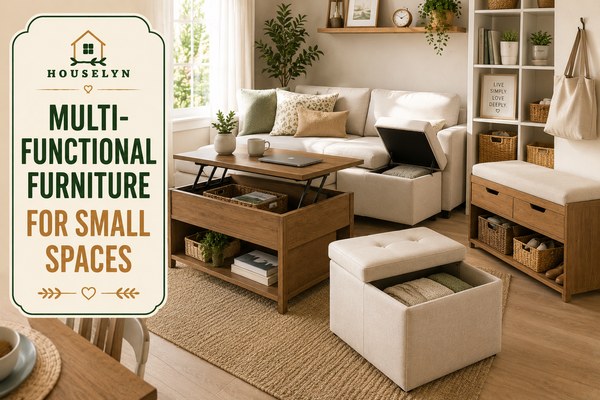 Smart multi-functional furniture featuring storage ottomans, storage beds, lift-top coffee tables, and space-saving solutions.
🏡 Houselyn Observation
Many homeowners try to solve storage problems by adding more furniture. In small spaces, the opposite is often true. The most successful rooms typically contain fewer furniture pieces, but each piece performs multiple jobs.
Recommended Multi-Functional Furniture on Amazon
These Amazon furniture solutions help maximize storage, reduce clutter, and improve functionality in small homes and apartments.
- Storage Ottomans
- Lift-Top Coffee Tables
- Storage Benches
- Storage Bed Frames
- Wall-Mounted Desks
- Expandable Dining Tables
Shop Multi-Functional Furniture on Amazon →
Small Space Storage Systems That Stay Organized Long Term
Small space organization ideas are most successful when they are supported by storage systems rather than one-time cleaning efforts.
Many people organize a room, enjoy the results for a few weeks, and then slowly watch clutter return.
The reason is simple.
Organization projects succeed when systems exist.
Without systems, clutter eventually wins.
The goal is to create repeatable processes that make staying organized easier than becoming disorganized.
Build Storage Around Categories
One of the most effective organization principles is category-based storage.
Every major category should have a dedicated home.
Examples include:
- Cleaning supplies
- Office supplies
- Electronics
- Seasonal décor
- Kitchen tools
- Personal care products
When categories have assigned locations, items become easier to find and return.
Use the Container Method
A container naturally creates limits.
Examples include:
- Storage bins
- Baskets
- Drawers
- Cabinets
- Shelves
The container determines how much of a category can remain in the home.
If the container becomes overcrowded, it is a signal to edit rather than expand.
This prevents categories from growing indefinitely.Create Prime, Secondary, and Deep Storage Zones
Not all storage should be treated equally.
Prime Storage
For daily-use items.
Examples:
- Kitchen utensils
- Everyday clothing
- Frequently used toiletries
Secondary Storage
For weekly-use items.
Examples:
- Small appliances
- Hobby supplies
- Backup household products
Deep Storage
For infrequently used items.
Examples:
- Seasonal decorations
- Travel equipment
- Holiday supplies
This system improves efficiency and accessibility.
Label for Maintenance
Labels are not just for appearance.
They help maintain organization over time.
Labels:
- Reduce confusion
- Improve consistency
- Encourage family participation
- Make cleanup easier
Simple labels are often more effective than highly detailed systems.
Create Return Paths
Every item should have an obvious path back to storage.
Ask:
- Where does this item live?
- How easy is it to return?
If returning an item takes too much effort, the system may need improvement.
Schedule Small Maintenance Sessions
Even excellent organization systems require maintenance.
A simple approach is:
- Five-minute daily reset
- Fifteen-minute weekly reset
- Monthly review of problem areas
Small maintenance sessions prevent overwhelming decluttering projects later.
The Houselyn Storage Pyramid
A useful way to think about storage is as a pyramid.
Top Layer
Rarely used items
Middle Layer
Occasionally used items
Bottom Layer
Daily-use items
The closer an item is to daily use, the more accessible it should be.
This framework helps allocate storage space efficiently.
A Real Houselyn Example
A homeowner repeatedly reorganized the same storage closet every few months.
The issue was not effort.
The issue was the lack of a storage system.
Cleaning supplies mixed with tools.
Seasonal items occupied prime shelves.
Labels were missing.
By introducing categories, storage zones, and simple labels, the closet remained organized far longer than previous attempts.
Common Storage System Mistakes
Avoid:
- Creating categories that are too broad
- Using containers without labels
- Storing daily items in hard-to-reach locations
- Keeping duplicate products unnecessarily
- Expanding storage without reducing inventory
These mistakes often cause organization systems to fail.
Houselyn Takeaway
The best small space organization ideas are supported by systems that are easy to maintain.
When categories are clear, storage zones are intentional, and maintenance becomes routine, organization can remain sustainable for years rather than weeks.
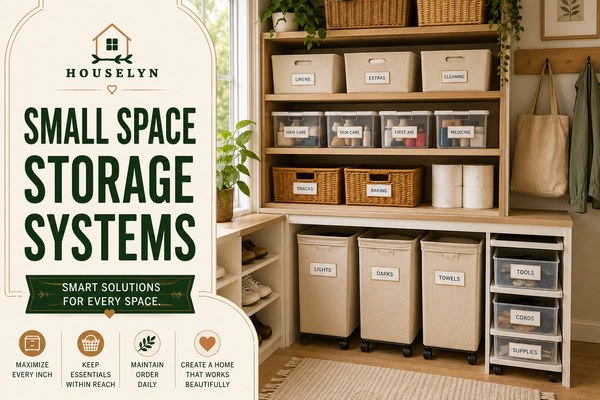 Practical storage systems featuring labeled bins, organized shelves, category zones, and long-term organization solutions for small homes.
Common Small Space Organization Mistakes
Small space organization ideas can produce remarkable results when applied correctly.
However, many homeowners unknowingly make mistakes that undermine their efforts.
These mistakes often create frustration because they make organization feel temporary rather than sustainable.
Understanding what not to do can be just as valuable as knowing what works.
Mistake #1: Buying Organizers Before Decluttering
This is one of the most common organization mistakes.
People often purchase:
- Storage bins
- Shelving
- Baskets
- Containers
before determining whether they actually need them.
The result is often organized clutter rather than an organized home.
The better approach is:
- Declutter first
- Categorize belongings
- Measure the space
- Purchase storage only when needed
Mistake #2: Treating Every Item as Equally Important
Not every belonging deserves prime storage space.
Daily-use items should receive the most accessible locations.
Rarely used items should move into secondary or deep storage.
Many homes become inefficient because seasonal or rarely used items occupy the most convenient storage areas.
Mistake #3: Ignoring Vertical Space
Small homes cannot rely solely on floor space.
Failing to use walls often leaves significant storage potential untapped.
Examples include:
- Floating shelves
- Wall hooks
- Over-door organizers
- Tall shelving units
Vertical storage is one of the most effective tools for organizing compact homes.
Mistake #4: Creating Complicated Systems
Overly complex systems frequently fail.
Examples include:
- Excessive categories
- Complicated labeling schemes
- Difficult-to-access storage
- Systems requiring constant maintenance
The best systems are often the simplest.
If a system is difficult to maintain, it is unlikely to survive daily life.
Mistake #5: Using Furniture That Doesn't Contribute
Every major furniture piece in a small home should ideally provide multiple benefits.
Furniture that offers only one function often wastes valuable space.
Examples include:Mistake #6: Allowing Flat Surfaces to Become Storage
- Coffee tables without storage
- Decorative cabinets with limited utility
- Oversized seating
- Bulky furniture that blocks movement
Flat surfaces naturally attract clutter.
Examples include:
- Kitchen counters
- Dressers
- Entryway tables
- Nightstands
- Coffee tables
Without intentional boundaries, these surfaces quickly become overflow zones.
Mistake #7: Organizing Once and Never Maintaining
Organization is not a one-time event.
Even excellent systems require:
- Daily resets
- Weekly maintenance
- Periodic reviews
Small maintenance efforts prevent major clutter problems.
Mistake #8: Keeping Too Many Duplicates
Many households accumulate unnecessary duplicates.
Examples include:
- Kitchen tools
- Cleaning products
- Water bottles
- Storage containers
- Office supplies
Duplicates consume valuable space and often create disorganization.
A Real Houselyn Example
A homeowner repeatedly purchased new organizers every few months.
Despite spending money on storage solutions, clutter continued to return.
The problem was not a lack of organizers.
The problem was:
- Too many duplicate items
- No maintenance routine
- Poor category management
- Furniture without storage
Once these issues were addressed, organization became significantly easier to maintain.
Houselyn Takeaway
Most organization failures are not caused by a lack of storage.
They are caused by ineffective habits, poor systems, and unnecessary complexity.
Avoiding these common mistakes can often produce greater results than purchasing additional storage products.
🏡 Houselyn Insight
The most organized small homes are not necessarily the homes with the most storage. They are the homes with the fewest decisions. When every item has an obvious home and every category has clear boundaries, maintaining organization becomes almost automatic.
Recommended Organization Essentials on Amazon
These Amazon products support long-term organization systems and help maintain clutter-free small spaces.
- Label Makers
- Clear Storage Bins
- Drawer Organizers
- Stackable Storage Containers
- Storage Baskets
- Over-Door Organizers
Shop Organization Essentials on Amazon →
The Houselyn Small Space Planning Method
Small space organization ideas are most effective when they follow a clear plan.
Many people jump directly into organizing a room without understanding the root causes of clutter.
This often leads to temporary improvements that disappear within a few weeks.
The Houselyn Small Space Planning Method was created to provide a repeatable process that works in apartments, small homes, compact rooms, and multi-purpose spaces.
Instead of focusing on products first, this method focuses on creating systems that support long-term organization.
Step 1: Define the Purpose of the Space
Before organizing anything, determine exactly what the space needs to accomplish.
Ask:
- What activities happen here?
- What storage needs exist?
- What frustrations occur most often?
Examples:
A living room may need to support:
- Relaxation
- Entertainment
- Toy storage
- Reading
A bedroom may need to support:
- Sleeping
- Clothing storage
- Workspace functions
Clarity helps prevent unnecessary purchases and poor storage decisions.
Step 2: Remove What No Longer Serves the Space
The fastest way to improve a small space is often to reduce what it contains.
Review:
- Duplicates
- Broken items
- Rarely used belongings
- Expired products
- Items stored out of habit
Every item removed creates more flexibility for the items that remain.
Step 3: Categorize Everything
Group similar items together.
Examples:
- Electronics
- Office supplies
- Clothing
- Kitchen tools
- Cleaning supplies
Categorization reveals:
- Duplicates
- Storage requirements
- Missing systems
This step creates the foundation for all future organization decisions.
Step 4: Establish Storage Zones
Create:
Prime Storage Zones
Daily-use items.
Secondary Storage Zones
Weekly-use items.
Deep Storage Zones
Rarely used items.
This framework ensures the most frequently used belongings remain easy to access.
Step 5: Optimize Vertical Space
Evaluate:
- Empty wall sections
- Door backs
- Shelf height
- Vertical storage opportunities
Most small homes contain significantly more vertical storage potential than homeowners realize.
Step 6: Introduce Multi-Functional Furniture
Review existing furniture.
Ask:
- Does this provide storage?
- Does this save space?
- Does this serve multiple purposes?
Replacing one inefficient furniture piece often creates substantial improvements.
Step 7: Build Maintenance Into the System
The final step is maintaining the results.
The Houselyn maintenance formula is simple:
Daily
5-minute reset
Weekly
15-minute review
Monthly
Category audit
This prevents clutter from rebuilding.
The Houselyn Small Space Success Formula
The most successful small homes consistently follow this sequence:
- Define the purpose.
- Declutter.
- Categorize.
- Create storage zones.
- Maximize vertical space.
- Use multi-functional furniture.
- Maintain consistently.
When these steps are followed, organization becomes sustainable rather than temporary.
A Real Houselyn Example
A family living in a compact three-bedroom home struggled with recurring clutter despite repeated organization projects.
Instead of reorganizing room by room, they followed the Houselyn Small Space Planning Method.
They:
- Defined room functions
- Removed unnecessary items
- Created categories
- Established storage zones
- Added vertical storage
- Improved furniture choices
- Implemented maintenance routines
The result was not just a cleaner home.
The result was a home that stayed organized.
Houselyn Takeaway
Small space organization ideas work best when they are supported by a plan.
The Houselyn Small Space Planning Method provides a practical framework that helps homeowners create organized, functional spaces that remain manageable long after the initial organization project is complete.
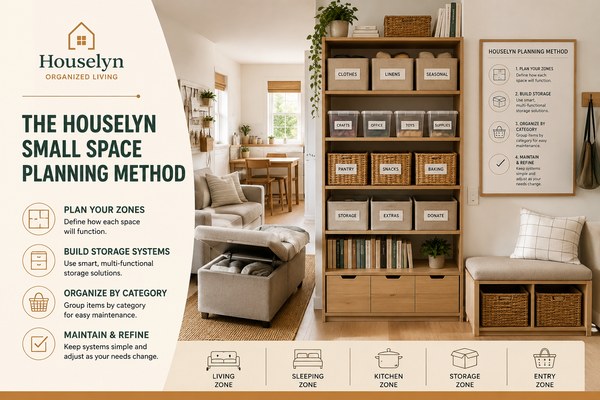 A step-by-step small space planning method featuring storage zones, organization systems, and practical frameworks for long-term success.
⚡ Quick Win
Choose one room today and identify three items that no longer support the purpose of that space. Removing them immediately creates momentum and helps reinforce the organization process.
🏡 Houselyn Insight
Organization becomes sustainable when systems are easier to follow than to ignore. The best storage solution is not necessarily the most attractive or expensive one—it is the one that naturally supports the way people actually live every day.
CONCLUSION
Small space organization ideas are not about squeezing more belongings into limited square footage.
They are about creating systems that allow a home to function efficiently while supporting everyday life.
Throughout this guide, we explored how clutter develops in compact spaces, why storage systems matter, and how strategic organization can transform apartments, bedrooms, kitchens, bathrooms, entryways, living rooms, and home offices.
The most successful small homes share several common characteristics:
- Clear categories
- Defined storage zones
- Effective use of vertical space
- Multi-functional furniture
- Consistent maintenance habits
Most importantly, they focus on simplicity.
A simple system that is easy to maintain will almost always outperform a complicated system that requires constant effort.
The Houselyn Small Space Planning Method provides a practical framework for creating lasting organization. By defining the purpose of each space, reducing unnecessary belongings, creating intentional storage zones, maximizing vertical storage, and maintaining simple routines, homeowners can create spaces that feel larger, calmer, and more functional.
Organization is not about perfection.
It is about creating a home that works better for the people who live in it.
When thoughtful systems replace clutter and every item has a purpose and a place, even the smallest home can feel comfortable, beautiful, and easy to maintain.
FREQUENTLY ASKED QUESTIONS
What are the best small space organization ideas for beginners?
What are the best small space organization ideas for beginners?
The best starting point is to focus on decluttering before purchasing storage products. Once unnecessary items have been removed, create simple categories, establish storage zones, and use vertical storage wherever possible. Small improvements in these areas often produce significant results.
How can I make a small room feel bigger without renovating?
How can I make a small room feel bigger without renovating?
A room often feels larger when visual clutter is reduced. Focus on:
- Keeping surfaces clear
- Using hidden storage
- Choosing multi-functional furniture
- Maximizing natural light
- Maintaining open floor space
These changes can improve the perception of space without structural modifications.
What is the biggest mistake people make when organizing small spaces?
What is the biggest mistake people make when organizing small spaces?
One of the most common mistakes is buying organizers before understanding the problem. Many homeowners purchase bins, baskets, and shelves without first decluttering or assessing how the space functions. This often results in organized clutter rather than a truly organized home.
How often should small spaces be reorganized?
How often should small spaces be reorganized?
A complete reorganization should not be necessary frequently if effective systems are in place.
The Houselyn recommendation is:
- Daily: 5-minute reset
- Weekly: 15-minute maintenance session
- Monthly: Category review
- Quarterly: Larger decluttering session if needed
This approach prevents clutter from becoming overwhelming.
What type of furniture works best in small spaces?
What type of furniture works best in small spaces?
Furniture that serves multiple functions generally performs best.
Examples include:
- Storage ottomans
- Storage beds
- Lift-top coffee tables
- Storage benches
- Wall-mounted desks
- Expandable dining tables
These pieces help maximize functionality without consuming additional space.
How do I organize a small apartment with very little storage?
How do I organize a small apartment with very little storage?
Focus on:
- Vertical storage
- Under-bed storage
- Furniture with hidden storage
- Closet optimization
- Category-based storage systems
Many apartments contain more usable storage opportunities than people initially realize.
Is open shelving good for small spaces?
Is open shelving good for small spaces?
Open shelving can work well when used carefully.
However, too much open shelving often increases visual clutter.
For most small spaces, a combination of:
- Open display storage
- Closed hidden storage
creates the best balance between appearance and functionality.
How can families keep small homes organized?
How can families keep small homes organized?
Families benefit from:
- Individual storage zones
- Clear categories
- Labeled containers
- Daily reset routines
- Multi-functional furniture
The simpler the system, the more likely every family member will use it consistently.