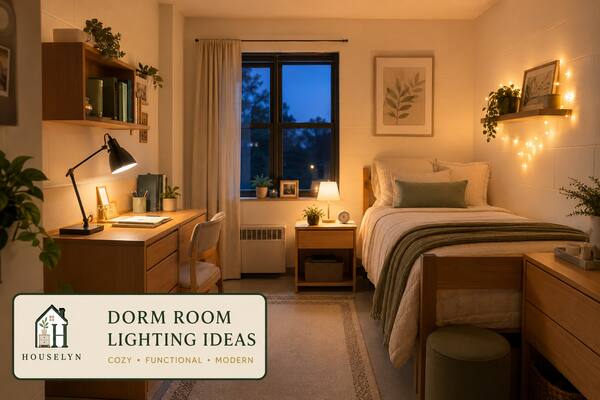
Dorm Room Lighting Ideas for a Cozy, Functional College Space
A layered dorm-lighting plan gives study, rest and everyday routines
separate sources without overwhelming a compact shared room.
Dorm room lighting ideas work best when they improve
specific activities—studying, reading, relaxing and moving around the
room—rather than simply adding more glowing objects to a small space. This
guide will help you evaluate the supplied light, position useful lamps,
soften harsh contrasts, add a modern decorative glow and create a system
that remains practical throughout the semester.
Understand the Room Before Choosing the Glow
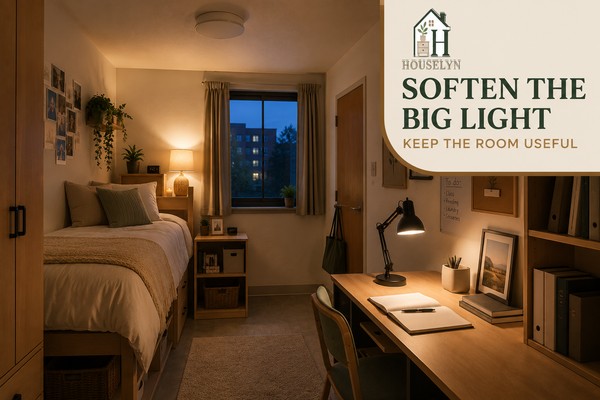
Why a Dorm Room Needs More Than One Type of Light
A dorm room is expected to support several visually different
activities inside one compact footprint. The student may study at a
desk, read in bed, dress beside a wardrobe, search for belongings in a
shadowed storage area and relax without wanting the full ceiling fixture
switched on. Useful dorm room lighting ideas must
recognise those different demands before introducing products or
decorative effects.
PART 1
One Supplied Fixture Cannot Optimise Every Routine
The central ceiling light provides broad visibility, which may be
helpful when cleaning, unpacking, dressing or looking across the whole
room. Its position is fixed, however, and its direction may create
shadows on the desk, produce reflections on a screen or illuminate a
sleeping roommate unnecessarily.
This does not make the supplied fixture useless. It means the fixture
should be treated as one component rather than the complete lighting
plan. Smaller local sources allow the room to respond to individual
tasks without making every corner equally bright.
PART 2
More Light Is Not Automatically Better Light
Adding brightness does not guarantee a more comfortable or useful
space. A powerful lamp positioned in the direct sightline can feel
harsher than a smaller source placed near the task. A decorative strip
may create atmosphere while still leaving the notebook difficult to
read.
Direction, proximity, contrast and reflection matter. The light should
reach the activity without producing a distracting shine in the laptop
screen, a dark shadow across the page or a bright point that remains
visible from the bed.
PART 3
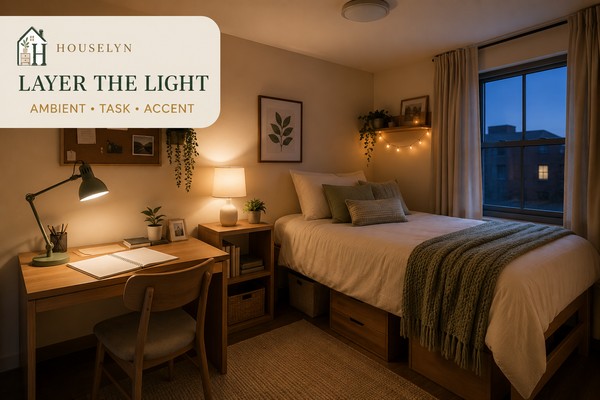
Use Three Lighting Layers With Separate Responsibilities
A layered plan separates broad visibility, focused activity and visual
atmosphere. These roles can be supported by modest fixtures; the goal
is not to reproduce a large home-lighting scheme inside a dorm.
General Light
Supports whole-room visibility for cleaning, dressing and moving
around the space.
Task Light
Directs useful light towards studying, reading, grooming or finding
stored belongings.
Accent Light
Adds atmosphere, highlights a small decorative area or supports a
calmer evening setting.
Three sources performing the same job create repetition. A successful
layer should solve a lighting problem that the existing sources do not
already address.
PART 4
Every Light Uses More Than Electrical Power
In a compact room, each fixture also consumes physical and visual
capacity. A lamp may take part of the writing surface, occupy a bedside
shelf, use the only nearby socket or require a cord path through a
narrow area.
Surface Footprint
The base must leave enough desk or bedside space for the related
activity.
Wall and Height
Hanging or raised lighting must respect attachment rules, headroom
and furniture movement.
Socket Access
A plug-in source affects how other approved devices can be powered
and switched.
Visual Attention
Several bright or coloured sources can make a small room feel
busier even when the floor remains clear.
Modern dorm room lighting ideas should improve the
room without competing with the desk, bed, storage or existing décor.
PART 5
Shared Rooms Need Local Control and Clear Boundaries
Roommates may have different class times, sleep schedules and opinions
about coloured or decorative lighting. One student may need to study
after the other has gone to bed, while an early riser may need enough
light to prepare without switching on the full overhead fixture.
Localised desk and bedside sources can reduce unnecessary spill, but
fixture position still matters. A lamp aimed across the room or a
flashing decorative effect may disturb another person even when the
source sits inside one student’s allocated area.
Agree on switching times, brightness expectations and decorative-light
use before installing a permanent-looking arrangement. A shared room
becomes easier to manage when both students understand which lights are
functional, optional and temporary.
PART 6
Build the Lighting Plan in a Deliberate Sequence
Product-first planning often creates several attractive fixtures
without resolving the room’s darkest or most inconvenient areas. The
Houselyn approach begins with the supplied space, then adds only the
lighting layers required by the student’s routines.
This sequence also creates a natural safety checkpoint. Electrical
access, accommodation restrictions, ventilation, attachment methods
and cord paths are considered before lights are installed around the
bed, desk or walls.
Part I • Verify the Supplied Space
Verify the Room Before Choosing Dorm Room Lighting Ideas
Record the supplied fixtures, daylight, furniture positions and approved
power points before deciding which additional lights the room needs.
The first stage of useful dorm room lighting ideas is
verification. The real room—not a listing photograph or inspiration
board—determines which areas need light, which fixtures will fit and which
installation methods are permitted.
Start With the Light the Room Already Provides
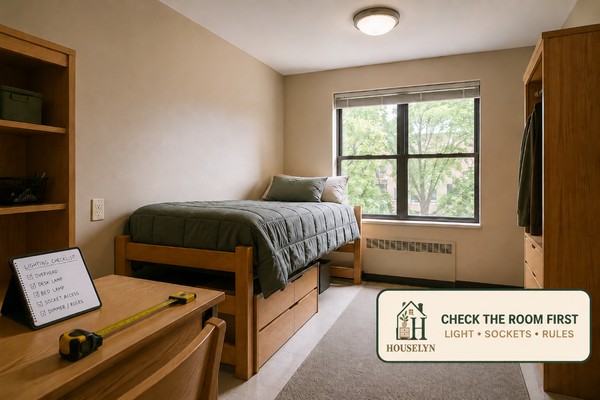
Switch on every supplied fixture and observe what each one can actually
do. The ceiling light may provide enough visibility for unpacking and
cleaning while still creating a shadow across the desk. A built-in
bedside fixture may appear useful until the bed is raised or repositioned.
Record where the switches are located and whether a fixture can be
controlled independently. A light that requires crossing the room to
switch it off may not suit a late-night reading routine, even when its
brightness is adequate.
Notice the direction of the light rather than judging brightness alone.
Look for screen reflections, exposed bulbs or panels, strong shadows and
areas that remain difficult to see when furniture is in its normal
position.
Identify Lighting Gaps by Activity
A dark corner does not automatically require a lamp. First ask what
happens there. A wardrobe used twice a day may need local visibility,
while an empty corner beside a storage box may not need additional light
at all.
Separate practical gaps from aesthetic preferences. The desk may need
clearer task lighting, while the bed may already be bright enough for
reading but still feel visually cold. Those are different problems and
should not be solved with the same product.
Effective dorm room lighting ideas begin with a named
activity. “The wardrobe is difficult to use after sunset” is a stronger
planning statement than “this wall needs something.”
Part II • Build Purposeful Lighting Layers
Layer Dorm Room Lighting Ideas for Study, Rest and Daily Living
Separate lighting layers allow a compact dorm to support focused study,
broad visibility and a calmer evening atmosphere.
Layered dorm room lighting ideas give each fixture a clear
responsibility. A focused task light supports detailed work, a modest
ambient source reduces dependence on the ceiling fixture and one restrained
accent creates atmosphere without trying to illuminate the whole room.
Build Layers Around Activities, Not Lamp Categories
A student does not need three lamps simply because a design guide names
three lighting layers. The room needs enough sources to support its real
activities without duplicating function or consuming unnecessary
surfaces, sockets and visual attention.
Begin with the Dorm Light Profile from Chapter 1. Review the desk, bed,
wardrobe, entry route and any other area where the supplied light does
not support a specific task. Each verified gap can then be assigned to a
general, task or accent layer.
Some rooms may already have useful general lighting and need only one
adjustable desk lamp. Others may benefit from a small local ambient lamp
because the ceiling fixture feels visually harsh during the evening. The
correct number of sources depends on the room rather than a fixed formula.
Start With the Most Important Task Light
Task lighting usually deserves the first additional position because it
supports a specific activity that may be difficult under the supplied
fixture. For many students, that activity is reading, writing or working
on a laptop at the desk.
The task source should direct light towards the work rather than towards
the student’s eyes. Its base, arm or clip must also fit outside the area
required by the notebook, keyboard, course materials and normal hand
movement.
Do not assume the largest or brightest desk lamp will be more useful. A
compact adjustable model may provide better control while preserving more
of the supplied desktop.
Add Ambient Light to Reduce Dependence on the Ceiling Fixture
Once the essential task area works, consider whether the room needs a
smaller general source for evenings. A compact shaded or rechargeable
lamp can provide enough local spread for relaxing, talking or preparing
for bed without requiring the full overhead fixture.
Ambient light should support broad visibility rather than point directly
at one page or object. Placing the source near a light-coloured wall may
help distribute the glow, provided the fixture remains stable, ventilated
and consistent with its manufacturer’s placement guidance.
The goal is not to make the entire dorm equally bright. It is to reduce
extreme contrast so the room remains usable beyond the narrow beam of the
desk lamp.
Recognise When the Room Already Has Enough Layers
Stop adding fixtures when study, broad evening visibility and the chosen
decorative effect are already supported. An unused corner does not need a
lamp simply because the existing lights are positioned elsewhere.
Extra sources increase charging, switching and cord-management demands.
They may also create several bright focal points competing with one
another inside a small room.
Well-layered dorm room lighting ideas often use fewer
fixtures than an unplanned setup because each source is selected for a
distinct role.
Part III • Position Light Around Real Activities
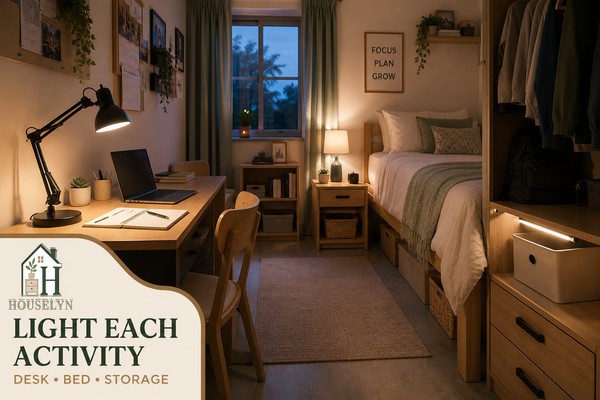
Position Task Lighting at the Desk, Bed and Storage Zones
Task lighting works best when it reaches the activity directly while
remaining outside the surface, sightline and movement route the activity
needs.
The position of a fixture often matters more than its size. Practical
dorm room lighting ideas place light close enough to
support study, reading or storage access while keeping the lamp, beam and
cord outside the space required by the activity.
Position the Light Where the Work Actually Happens
A lamp can be bright and still perform poorly when it sits behind the
laptop, shines directly into the student’s eyes or creates a strong
shadow across the notebook. Position should be tested with the normal
study materials in place rather than judged from an empty desk.
Set up the laptop, notebook, current textbook and writing tools. Sit in
the normal chair position and switch on the proposed task source. Check
whether the page is visible, whether the screen reflects the light and
whether the lamp base reduces comfortable hand movement.
Repeat the same process at the bed and storage zones. A bedside lamp
should be judged from the actual reading position, while a wardrobe light
should be tested with the door open and clothing in place.
Position the Dorm Desk Lamp Around Writing and Screen Use
Place the lamp to one side of the active working zone rather than directly
behind the laptop or in front of the student. The head should direct light
towards the notebook and reference material while remaining outside the
central sightline.
A lamp placed behind a screen can create a bright point around its edge.
A source aimed directly towards the display may produce reflections.
Moving the fixture slightly to one side and adjusting the beam is often
more effective than increasing brightness.
Preserve enough room for the keyboard, notebook, calculator and normal
hand movements. A wide lamp base may be unsuitable even when the light
itself performs well.
Keep Bedside Light Local, Reachable and Clear of Bedding
A bedside source should illuminate reading or a short evening routine
without requiring the student to leave bed to reach the switch. The
fixture must remain stable and positioned according to its manufacturer’s
clearance and ventilation guidance.
Do not rest a lamp against bedding, suspend a plug-in fixture by its cable
or place a charging product on a soft surface. Confirm that any clip,
attachment or wall-mounted arrangement is permitted by the residence.
The beam should face the book or bedside surface rather than the opposite
bed. In a shared room, a narrower local source may be more considerate
than a brighter lamp with broad uncontrolled spread.
Improve Placement Before Buying a Brighter Fixture
When a task remains difficult to see, first move or redirect the current
source. Raise or lower the adjustable head, change its side of the desk
or move the object being illuminated.
A repositioned light can reduce glare, improve page visibility and limit
roommate spill without adding another product. This makes placement one
of the most efficient dorm room lighting ideas available
in a small room.
Part IV • Soften Glare and Extreme Contrast
Soften Harsh Dorm Lighting Without Making the Room Too Dark
Softer dorm lighting reduces direct glare and extreme contrast while
preserving enough visibility for study, movement and everyday routines.
Softer dorm room lighting ideas do not require switching
off every practical source or making the room permanently dim. The goal is
to control direction, reflection and contrast so useful light reaches the
activity without creating unnecessary visual harshness.
Diagnose What Feels Harsh Before Changing the Lighting
A room can feel visually uncomfortable for several different reasons.
The supplied fixture may expose a bright panel directly overhead, the
desk lamp may reflect in the screen or one small area may be brightly lit
while the rest of the room remains almost black.
These conditions need different corrections. Turning every light down
may reduce brightness, but it can also make reading, dressing and moving
around the room more difficult. Begin by identifying whether the problem
is direct visibility, uneven contrast, reflection or poor direction.
Observe the room from the desk, bed, doorway and roommate’s side. A source
that appears gentle from one position may become a bright exposed point
from another.
Use Indirect Light to Broaden the Glow
Indirect lighting allows a wall, shade or nearby surface to spread part
of the light before it reaches the room. This can create a broader,
gentler effect than leaving a small bright source fully exposed.
A compact lamp placed beside a pale wall may help soften an evening
setting when its manufacturer permits that position and the fixture
remains stable and ventilated. A shaded lamp can also reduce direct
visibility of the bulb while directing useful light through its opening.
Do not cover a fixture with fabric, paper or improvised material to create
diffusion. Use only the shade, diffuser and placement methods designed
for that product.
Balance the Task Zone With the Rest of the Room
A focused desk lamp may perform its task well while making the surrounding
room feel much darker by comparison. The answer is not always a brighter
task source. A small ambient layer may reduce the contrast and help the
student see beyond the immediate desk area.
Keep enough general visibility for the chair, bed edge, doorway and
nearby storage to remain understandable. This is especially important
when the student regularly stands, reaches or moves between activities
while the ceiling fixture is off.
Balanced dorm room lighting ideas allow the task area to
remain the brightest practical zone without making everything around it
disappear.
Keep the Light Appearance Cohesive
Two nearby fixtures can make the room feel visually disjointed when one
produces a very warm glow and the other appears noticeably cooler. The
difference may be useful when the sources support separate activities,
but it should feel intentional rather than accidental.
Use a consistent general appearance for lights switched on together.
Task lighting may remain more neutral when it improves visibility, while
evening ambient and accent sources can feel warmer. Avoid presenting one
exact setting as universally correct because fixtures, room finishes and
personal preferences differ.
Reduce Screen Glare Before Adding Another Desk Light
Screen reflections often come from the relationship between the lamp,
display and student rather than insufficient lighting. Move the fixture
to one side, lower its head or change the screen angle before increasing
brightness.
A bright source directly behind the laptop may remain visible around the
screen edge, while a lamp aimed towards the display can create a reflected
hotspot. Keep the beam on the notebook, keyboard or surrounding work area
instead.
Part V • Personalize With Controlled Decorative Light
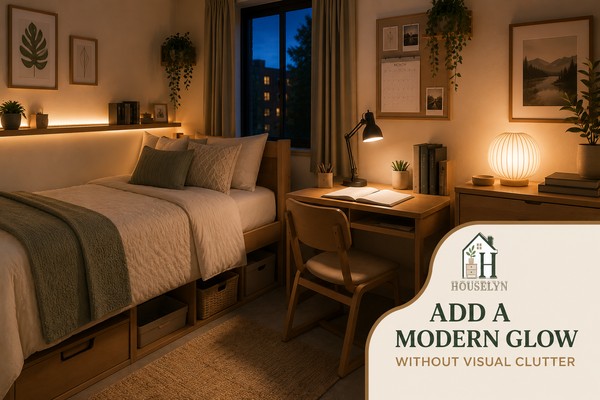
Personalize Dorm Room Lighting Ideas With a Modern Decorative Glow
One controlled decorative-lighting direction can add atmosphere and
personality without covering every wall, shelf and furniture surface.
Decorative dorm room lighting ideas should complete the
room rather than compete with it. Once study, bedside and general visibility
work properly, one restrained glow can reinforce the colour palette,
introduce atmosphere and help the dorm feel more personal.
Choose One Decorative-Lighting Story
A small dorm can quickly become visually crowded when fairy lights,
coloured strips, illuminated signs, projector effects and several
rechargeable lamps are added together. Each product may look attractive
individually, yet the combined result can compete with the bedding, wall
décor, storage and practical lamps already present.
Select one primary decorative direction. A warm minimal glow may use a
short run of warm-white lights or one sculptural lamp. A colour-changing
accent might appear only behind a small shelf or on one approved surface.
Photo-display lighting may become the decorative feature without adding a
second illuminated wall.
The chosen direction should support the room’s existing materials and
colours. Warm cream, natural wood, taupe and sage usually need only a small
caramel or warm-white glow to feel visually complete.
Decide Whether the Light Is Decorative or Functional
A decorative source may contribute a little general visibility, but it
should not be expected to replace a suitable desk lamp or bedside reading
light. String lights spread a low glow across a wall; they rarely direct
enough controlled light towards detailed study.
A rechargeable table lamp may serve both decorative and ambient roles
when its output, shade and position support the room. Its primary
responsibility should still be clear. When the product must be moved
beside the notebook for every study session, the task layer probably
needs a more appropriate source.
Use String Lights as a Limited Accent
String or fairy lights can add a gentle decorative line when the
residence permits them and the product is installed according to current
manufacturer guidance. The effect usually looks more modern when the
lights define one small area instead of tracing every wall, shelf and bed
frame.
Before buying, measure the intended section rather than ordering the
longest available set. Excess length often creates loops, sagging sections
or a second wall installation that was never part of the room plan.
Keep the lights away from bedding, moving furniture, doors and other
obstructions. Confirm the approved attachment method and avoid relying on
assumptions that a removable-looking adhesive will leave every supplied
surface undamaged.
Treat LED Strips as a Room-Dependent Choice
Flexible LED strips are common in dorm inspiration, but they are not
universally permitted or suitable. Their adhesive, length, power
arrangement and removal process depend heavily on the supplied room and
current accommodation rules.
A full perimeter installation may visually lower the room, highlight
uneven walls and introduce a long cable or controller route. A shorter,
more controlled placement can create a cleaner accent when permission,
surface condition and ventilation all support it.
Do not route strips through pinched furniture gaps, across openings or
over vents. Do not assume that adding painter’s tape beneath the product
guarantees safe removal. Ask residence staff when the handbook does not
clearly address the proposed installation.
Use Rechargeable Lamps to Add Flexible Style
A compact rechargeable lamp can provide a sculptural decorative feature
without requiring a permanent socket beside its display position. It may
move from a shelf to the bedside or become a small ambient source during
an evening routine.
Portability does not remove the need for a safe charging process. Follow
the manufacturer’s instructions, charge the lamp on an appropriate hard
surface and keep the cable, battery and ventilation areas clear.
The lamp should have a normal return position. A portable product that is
constantly left on the bed, desk or floor can create more disruption than
a stable plug-in source.
Edit the Decorative Lighting Before It Becomes Visual Clutter
Step into the doorway and view the complete room with every planned light
switched on. If several sources compete for attention, remove one effect
before changing the furniture or purchasing another organizer.
Strong dorm room lighting ideas make the room feel
intentional when the lights are on and visually calm when they are off.
Controllers, battery boxes and charging cables should not become the most
noticeable features of the wall or shelf.
Part VI • Route Power and Cords Deliberately
Route Dorm Lighting Cords and Power Without Creating New Problems
Lighting cords should reach approved power points through short,
inspectable routes that preserve furniture access and clear movement.
Practical dorm room lighting ideas must include the route
between every fixture and its approved power or charging point. A lamp is
not fully positioned until its cable, switch, charger and surrounding
furniture can all be used without creating an obstruction.
Plan Power at the Same Time as Fixture Placement
A lamp may fit neatly on the desk while its cord fails to reach the
available socket without crossing the chair area. A bedside light may
feel convenient until the charger must pass behind the bed or through a
drawer route.
Review the Dorm Light Profile and match each fixture to its intended
power arrangement before installation. The residence handbook and
manufacturer’s guidance should determine which electrical accessories,
charging methods and placement conditions are acceptable.
Do not treat electrical advice from a general decorating guide as a
substitute for current accommodation rules. Ask residence staff when a
socket, extension arrangement or product type is unclear.
Use the Shortest Practical Inspectable Route
The shortest route is not always a straight line. A cable may need to
follow the rear edge of a desk rather than pass across the front where the
chair moves. The correct route keeps the cord visible enough to inspect
while avoiding regular contact with feet, drawers and furniture.
The cable should not become a structural support for the fixture. Do not
allow a plug-in light to hang from its cord, and do not stretch a cable so
tightly that normal furniture movement pulls against the connection.
Protect the Routes Used by Furniture and People
Dorm furniture moves even when the overall layout remains unchanged.
Chairs roll or slide, drawers open, wardrobes swing out and storage boxes
are pulled from beneath the bed. A safe-looking cable can become trapped
when those ordinary actions are ignored.
Sit at the desk, open every nearby drawer and move the chair through its
usual range. Repeat the check at the bedside and wardrobe. The light
should remain connected without the cable rubbing, tightening or entering
the path of the furniture.
Do Not Hide a Cable Problem for Appearance
A cord should remain neat, but visual concealment is not the primary
goal. Pushing a cable beneath a rug, tightly behind furniture or under
bedding can hide wear and make routine inspection more difficult.
If the approved route cannot be made practical, reconsider the lamp
position or select a different lighting approach. The desire to preserve
a decorative arrangement should not override the room’s normal movement
and access.
Give Rechargeable Lighting a Defined Charging Routine
Rechargeable lamps can reduce the need for a permanent cable at the
display position, but they move the power requirement to another part of
the routine. A lamp that is never charged reliably will not support
bedside or ambient lighting when it is needed.
Choose a stable hard-surface charging location that follows the
manufacturer’s instructions. The lamp should return to its normal
position when charging is complete so the desk, bedside or shelf does not
become a collection of loose devices and cables.
Coordinate Socket Access With a Roommate
Shared rooms may have limited conveniently positioned sockets. Discuss
which lights need permanent access, which devices charge occasionally and
which sources can operate independently.
Avoid claiming an outlet or power area through an oversized arrangement
that prevents the roommate from supporting their essential devices.
Residence guidance should determine whether any shared electrical
accessory is permitted.
Coordinated dorm room lighting ideas reduce conflict by
making switching, charging and socket expectations clear before both
students establish permanent routines.
Part VII • Reset and Maintain the System
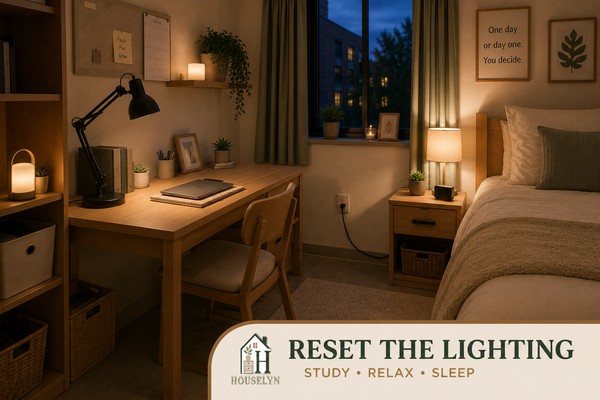
Maintain Dorm Room Lighting Ideas Through Study, Sleep and Semester Changes
A reliable reset changes the room from study mode to evening mode without
leaving unused lamps, chargers and decorative effects operating together.
Maintainable dorm room lighting ideas change with the
student’s routine. The same room may need focused desk light during study,
local bedside light after a roommate sleeps and broad visibility during
cleaning, dressing or packing.
Create Lighting Modes Instead of Switching Everything On
A layered system becomes easier to use when the student knows which
sources belong to each activity. This removes the habit of switching on
every lamp simply because the room initially feels dark.
Give each routine a simple lighting combination. Study mode may use the
desk lamp and a modest ambient source. Evening mode may use one bedside
lamp. Cleaning mode may rely on the supplied general fixture because the
whole floor and furniture layout need to remain visible.
These dorm room lighting ideas should remain easy enough
to repeat without rearranging furniture, moving several chargers or
searching for remote controls.
Reset the Lighting After Each Routine
A short reset prevents portable lamps, charging leads and decorative
controls from spreading across the desk or bedside area. It also ensures
that the next routine begins with the correct source ready to use.
The reset should take less than a few minutes. Switch off lights that are
no longer needed, return portable products to their designated places and
reconnect only the approved devices required for the next mode.
Complete a Weekly Lighting Inspection
Daily use gradually changes a dorm setup. A lamp may move towards the
laptop, a charging cable may enter the chair route and a decorative
attachment may begin to loosen. A weekly inspection identifies these
changes before they become permanent habits.
Review every installed and portable light, including products that are
rarely switched on. An unused fixture still occupies space, requires
maintenance and may leave a cord or attachment in the room.
Simplify the Lighting During Exam Periods
Exam weeks increase the importance of reliable study light, clear desk
access and predictable late-evening routines. Decorative complexity
becomes less valuable when it introduces several controllers, charging
tasks or reflections around the screen.
During demanding study periods, prioritise the dorm room lighting
ideas that make the desk dependable: one effective task source,
one modest supporting ambient layer and a local light that respects the
roommate’s sleep schedule.
Revisit the Plan When Roommate Routines Change
Class schedules, employment, societies and sleep routines may shift during
the semester. A lighting arrangement agreed during move-in may need
adjustment when one student begins studying later or waking earlier.
Discuss the change before conflict develops. Moving a lamp, reducing
cross-room spill or establishing a clearer switching schedule may solve
the problem without buying another product.
Remove Lighting Carefully at Move-Out
Move-out should be considered when lights are first installed. Long
adhesive runs, difficult-to-reach controllers and fragile arrangements
can become time-consuming to remove from a nearly empty room.
Follow the accommodation’s removal instructions and the product guidance.
Do not pull attachments rapidly or assume every surface will respond in
the same way. Ask residence staff when removal creates uncertainty or
visible surface concerns.
Review which dorm room lighting ideas genuinely supported
the semester before packing. Useful lamps can move to the next room,
while failed products, depleted batteries and damaged cables should be
handled through appropriate local recycling or disposal routes.
Frequently Asked Questions
Dorm Room Lighting Ideas FAQs
These dorm room lighting ideas FAQs answer the practical
questions students often face when choosing lamps, reducing harsh
overhead light, decorating a shared room and managing power. Residence
policies differ, so the accommodation handbook and current manufacturer
instructions should always take priority over general design advice.
Beginner Questions
Planning the Basic Dorm Lighting Setup
1. What lighting should I bring to a college dorm?
Bring only the lighting that supports a confirmed need before
move-in. For many students, this means a compact adjustable desk lamp
and possibly a small bedside or rechargeable light. The best
dorm room lighting ideas begin with the supplied
fixtures, desk size, socket positions and accommodation rules rather
than a large collection of decorative products.
Delay wall-length string lights, LED strips, floor lamps and
furniture-dependent clip lights until the actual room has been
inspected. The
Houselyn Dorm Room Essentials guide
can help separate confirmed move-in needs from products that should
wait.
2. How do I make a dorm room feel brighter?
Start by keeping the window and main light paths clear. Move tall
organisers away from the useful part of the window, use lighter
bedding or nearby surfaces to reflect available light and position
task lamps close to the activities that remain difficult to see.
A brighter room does not always require a more powerful fixture. One
focused desk lamp and a small ambient source may improve practical
visibility more effectively than several decorative lights. Check the
desk, wardrobe, bedside area and walking route separately because each
zone may need a different solution.
3. How do I make harsh dorm lighting feel softer?
Reduce direct glare and extreme contrast rather than making the
entire room dark. Use a designed lamp shade or diffuser, redirect an
adjustable source towards the task or a pale wall and keep the bright
bulb or panel outside the normal sightline.
A modest ambient lamp may also help when one desk area is bright and
everything around it appears much darker. Do not cover a light with
fabric, paper or an improvised material. Use only the components and
placement methods intended by the manufacturer.
4. How many lamps does a dorm room need?
There is no fixed number. Most dorm room lighting
ideas can be achieved with the supplied general fixture, one
effective task lamp and, where useful, one smaller ambient or bedside
source. A decorative accent is optional.
Stop adding lamps when studying, broad evening visibility and the
selected atmosphere are already supported. Extra fixtures use
surfaces, sockets and charging time, so three lamps performing the
same function are less useful than two sources with clearly different
responsibilities.
Study and Bedside Questions
Positioning Light for Reading and Coursework
5. What kind of desk lamp is best for a dorm room?
A compact adjustable lamp is usually more practical than a large
fixed model. Look for a stable base, a controllable head, an
accessible switch and dimensions that preserve enough desk space for
a laptop, notebook and writing movement.
Test the lamp position for screen reflections and hand shadows. A
dimming function may provide useful control in a shared room, but it
does not replace correct placement. The
Dorm Desk Organization Ideas guide
explains how to integrate the lamp with the complete study surface.
6. Where should I place a dorm desk lamp?
Place the lamp to one side of the active work zone and direct the
light towards the notebook or keyboard. Keep the illuminated part of
the fixture outside the direct sightline and away from the screen’s
reflection angle.
A right-handed student may prefer the lamp on the left to reduce the
hand shadow across the page, while a left-handed student may prefer
the opposite arrangement. Treat this as a starting point and test the
student’s normal writing position before deciding.
7. What is the best light for reading in bed?
Use a stable local source with a controlled beam and a switch that can
be reached from the normal reading position. A compact bedside lamp,
rechargeable reading light or permitted clip light may work when the
fixture fits the furniture and follows current accommodation rules.
Keep the source clear of bedding, do not suspend a plug-in light by
its cable and avoid charging rechargeable products on soft surfaces.
The light should illuminate the book without pointing across the
roommate’s bed.
8. How can I study late without disturbing my roommate?
Use a local desk lamp angled downwards towards the work surface and
switch off unnecessary ambient or decorative lights. View the lamp
from the roommate’s bed to identify exposed glare or cross-room spill.
Agree on a late-study mode before it becomes necessary. This may
include a time when the main light is switched off, the permitted
desk source that may remain on and the position of the lamp after
furniture changes. Headphones do not solve a lighting conflict, so
the visual boundary still needs to be discussed.
Decorative Lighting Questions
Adding Atmosphere Without Visual Clutter
9. Are string lights a good idea for a dorm room?
String lights can create a restrained decorative glow when the
residence allows them and the installation follows the product
instructions. Decorative dorm room lighting ideas
usually look more intentional when a short set defines one photo
display, shelf or wall section instead of tracing the entire room.
Measure the intended space, confirm the permitted attachment method
and keep the lights away from bedding, curtains, doors and moving
furniture. Do not assume that a removable-looking adhesive guarantees
damage-free removal.
10. Are LED strip lights allowed in dorm rooms?
LED strip-light rules vary between universities and accommodation
providers. Some residences restrict the strips themselves, while
others focus on electrical specifications, adhesives, wall damage or
installation locations.
Check the current housing handbook before purchasing or attaching a
strip. Confirm the surface, controller position, power route,
ventilation and removal method. Do not route strips across doors,
through pinched furniture gaps or over vents, and do not assume that
placing tape beneath the adhesive makes the installation acceptable.
11. How do I make dorm lighting look modern instead of childish?
Choose one decorative-lighting direction and limit the number of
glowing effects. A small sculptural lamp, a short warm-white light
feature or one controlled colour accent usually looks more deliberate
than several unrelated strips, signs and fairy-light arrangements.
Repeat the room’s existing palette through cream, natural wood, taupe,
sage or warm metallic details. Keep controllers, battery boxes and
cables visually controlled. The
College Dorm Decor Ideas guide
can help coordinate lighting with bedding, wall displays and texture.
12. What colour lighting makes a dorm room feel cozy?
Many students find a restrained warm or warm-neutral glow visually
comfortable for evening use, particularly with cream, beige and
natural-wood décor. However, the fixture, wall colour, room size and
personal preference affect the result.
Use the light appearance that supports the room mode. Clear task
visibility matters at the desk, while a warmer ambient source may suit
relaxation. Coloured lighting should remain an optional accent rather
than the only source used for studying, dressing, cleaning or moving
around the room.
Small-Space and Product Questions
Preserving Surfaces, Storage and Movement
13. How can I light a small dorm room without using floor space?
Small-space dorm room lighting ideas should use
existing surfaces and verified vertical positions carefully. A
compact desk lamp, narrow bedside fixture, rechargeable table lamp or
permitted wardrobe light can add function without occupying the
floor.
Avoid treating wall-mounted products as automatically space-free.
They still require permission, attachment space, a power or charging
route and clear headroom. Review the
Small Dorm Room Ideas guide
for wider furniture and circulation planning.
14. Are rechargeable lamps useful in dorm rooms?
Rechargeable lamps can be useful when a bedside, shelf or temporary
activity zone lacks convenient approved power access. They may also
reduce the need for a permanent visible cable at the display
position.
Portability creates a charging responsibility. Choose a stable
hard-surface charging location, follow the manufacturer’s battery
instructions and return the lamp to its assigned position after
charging. Skip the product when it would duplicate an existing source
or become another device that is rarely ready when needed.
15. How can I light a dark dorm wardrobe or under-bed area?
First confirm that the area supports a repeated activity and remains
genuinely difficult to use after dark. A permitted battery or
rechargeable sensor light may help inside a wardrobe, beneath a
raised bed or near frequently used storage.
Check the attachment method, sensor range, battery access and
clearance for doors, drawers and stored belongings. Do not add a light
to an area that the supplied fixture already reaches adequately. The
Dorm Room Storage Ideas guide
can help organise the zone before lighting is added.
Safety and Framework Questions
Managing Cords and the Complete Lighting System
16. How should I manage cords for dorm room lights?
Match each plug-in fixture to an approved socket and use the shortest
practical route that avoids chair movement, drawers, doors, bedding
and walking paths. Keep plugs, adapters, switches and charging
connections accessible for inspection.
Do not place cords beneath rugs, pinch them behind furniture, cover
adapters for appearance or suspend a fixture by its cable. Inspect the
route after normal use because chairs, storage boxes and beds can
gradually shift the arrangement. Follow the residence handbook and
manufacturer’s electrical guidance whenever an accessory or power
arrangement is uncertain.
17. What is the Houselyn Dorm Lighting Blueprint?
The Houselyn Dorm Lighting Blueprint organises dorm room
lighting ideas into seven stages:
Verify → Layer → Position → Soften → Personalize → Route →
Reset.
Verify the supplied room and current rules.
Layer general, task and accent light.
Position sources around real activities.
Soften glare and extreme contrast.
Personalize with one controlled glow.
Route power and cords deliberately.
Reset the system as routines change.
Final Framework and Action Plan
Turn Dorm Room Lighting Ideas Into a Complete Dorm Lighting System
Individual dorm room lighting ideas become more useful
when they are connected through one repeatable process. The final goal is
not a room filled with lamps, but a verified system that supports study,
rest, storage, movement, roommate boundaries and semester changes.
Apply the Seven Stages in Order
01
Verify the Supplied Room
Record the existing fixtures, switches, daylight, dark zones,
furniture positions, sockets and residence restrictions. The room
should determine which dorm room lighting ideas are
realistic before a new lamp or decorative effect is selected.
Result: a documented Dorm Light Profile based on the actual room.
02
Layer the Essential Functions
Separate general visibility, focused task lighting and optional
decorative atmosphere. Choose the task layer first, add ambient light
only when it improves the surrounding room and keep the accent layer
secondary.
Result: each source receives one clear primary responsibility.
03
Position Around Real Activities
Test the desk lamp with the notebook and screen in place, assess the
bedside source from the reading position and illuminate storage only
where a repeated activity remains difficult. Position-based
dorm room lighting ideas often improve function
without requiring additional brightness.
Result: light reaches the activity without occupying the activity.
04
Soften Glare and Contrast
Redirect exposed light, reduce screen reflections and balance a
bright task zone with enough surrounding visibility. Use only shades,
diffusers and placement methods intended for the fixture.
Result: a calmer room that remains useful rather than becoming dark.
05
Personalize With One Decorative Story
Choose one approved decorative direction, such as a warm minimal
glow, a sculptural rechargeable lamp or a controlled colour accent.
Keep decorative sources optional so practical visibility does not
depend on them.
Result: visible personality without competing illuminated features.
06
Route Power Deliberately
Match every fixture to an approved power or charging point. Keep
cords short, inspectable and clear of bedding, rugs, drawers, chair
movement, doors and walking routes.
Result: the fixture and its power route operate as one planned unit.
07
Reset as the Routine Changes
Establish modes for study, evening use, roommate sleep, dressing and
cleaning. Inspect positions, attachments, cords and charging routines
weekly, then revise the arrangement when the semester or furniture
layout changes.
Result: a maintained lighting system rather than a fixed installation.
Conclusion
Build Dorm Room Lighting Ideas Around the Life the Room Must Support
The strongest dorm room lighting ideas do more than make
a college room look warm in a photograph. They help the student read,
study, dress, find belongings, move through the room and relax without
expecting one fixture to perform every job.
Let Dorm Room Lighting Ideas Follow the Room
A dorm room begins with supplied furniture, fixed fixtures, limited
surfaces and accommodation rules that the student did not choose. Useful
lighting therefore starts with observation. The ceiling fixture, window,
desk, bed, wardrobe and approved power points establish the boundaries
within which every later decision must work.
When dorm room lighting ideas are selected before those
boundaries are understood, students can arrive with lamps that do not
fit, decorative lights they cannot install and charging arrangements that
compete with the room’s normal movement.
Verification changes the question from “Which lamp looks best?” to
“Which activity remains difficult in this actual room?” That single shift
protects the budget, reduces clutter and makes every purchased source
easier to justify.
Choose Fewer Sources and Give Each One a Clear Job
A small dorm rarely improves when several fixtures repeat the same
responsibility. A directional desk lamp, a modest ambient source and one
optional decorative accent may provide more control than a collection of
lights selected without a shared plan.
Purposeful dorm room lighting ideas distinguish between
a task problem and a mood preference. The desk needs visibility. The bed
may need a reachable local source. The decorative wall may need nothing
more than one short, approved warm glow.
Giving every source a primary responsibility also makes editing easier.
When a lamp duplicates another fixture, consumes an important surface or
remains unused, the room has permission to let it go.
Houselyn Knowledge Library
Dorm Room Lighting Ideas Knowledge Library
Continue beyond these dorm room lighting ideas with
Houselyn’s premium dorm-room guides. Each resource below expands one part
of the room, helping students connect lighting with furniture placement,
storage, bedding, decoration, study routines and everyday organization.
Plan the Functional Room
Organization, Storage and Study-Space Guides
Use these resources when your dorm room lighting ideas
depend on better furniture access, a clearer desk, more efficient
storage or a simpler daily routine.
Whole-Room System
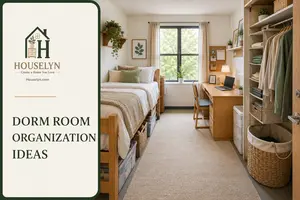
Dorm Room Organization Ideas
Organize the desk, bedside area, wardrobe, under-bed zone and daily
belongings so lamps, switches and movement routes remain accessible.
Best for: students who need the lighting plan to work
with the complete room rather than one isolated surface.
Use these pages when your dorm room lighting ideas
need to coordinate with the colour palette, bedding, decorative wall,
textiles and overall atmosphere of the room.
Comfort Foundation
Dorm Bedding Ideas
Coordinate cream, beige, taupe, sage and accent colours with the
warm, neutral or decorative lighting direction selected for the room.
Best for: creating a comfortable bed area that looks
cohesive in daylight and under evening lamps.
Add personality through coordinated accessories, textiles, colour and
small decorative moments while preserving useful surfaces and clear
room function.
Best for: building a softer, more expressive room
without allowing décor to overwhelm the limited space.
Use these dorm desk organization ideas to create a clear college study space with better drawer systems, vertical storage, cable control and simple resets.
Discover college dorm decor ideas for colour, bedding, walls and personal touches that turn a plain student room into warm, stylish place that feels like home
Learn how to decorate a stylish and comfortable living room with practical design advice, timeless styling ideas, and expert inspiration from Houselyn.
Discover practical dorm room organization ideas that help you organize clothes, desks, storage and daily routines for a calm, clutter-free college room.
Discover dorm bedding ideas that make small rooms feel like home. Learn how to create a cosy, stylish, and practical college dorm with smart bedding, storage, and decorating tips.