1
Long Tape Measures
Useful for measuring sofa width, full rug spans and larger seating zones
without repeatedly repositioning a short tape.
Best for: accurate room-scale measurements
View on Amazon UK
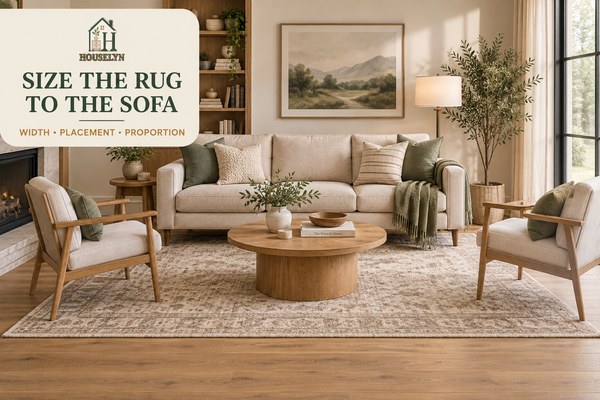
A successful rug size for sofa arrangement starts with the sofa width, but it should not stop there. Chairs, sectionals, coffee tables, walkways and the amount of exposed flooring all affect whether the rug looks properly scaled to the seating zone.
The most common sofa and rug size match problem is a rug that is technically large enough for the coffee table but too small to connect the sofa and surrounding seating. When that happens, the furniture appears to float around the rug instead of belonging to one intentional group.
A better approach is to measure the seating first, choose a rug that extends far enough beyond the sofa, decide which furniture legs will sit on it, and then check the remaining floor margins.
Room dimensions matter, but they are only the outer boundary. The more useful question is whether the rug visually anchors the furniture that people actually use together.
This is especially important in open-plan rooms, large living rooms and spaces with sectionals. A rug can be large relative to the floor and still be too small for the seating footprint.
Good rug size for sofa planning also depends on the placement model. A front-legs-on arrangement needs less rug depth than an all-legs-on layout, while a large sectional may require a considerably bigger rug simply to keep the sofa footprint balanced.
This guide uses practical starting ranges rather than treating one rug size as correct for every sofa. Sofa width, sectional shape, chair position, room scale and rug orientation all change the final answer.
The goal of the framework is not to force every room into the same rug formula. It is to stop the most common scale error: choosing the rug before understanding how much floor the seating group actually occupies.
This page also stays tightly focused. Furniture circulation belongs in Living Room Layout Basics, whole-room proportion belongs in Living Room Design Ideas, and decorative layering belongs in Living Room Decor. Here, the job is precise sofa-to-rug sizing, placement and proportion.
Chapter 1 — Measure
The most reliable rug size for sofa planning begins by measuring the furniture that the rug needs to connect. The room dimensions still matter, but they should define the available boundary rather than determine the rug size on their own.
Start with the sofa because it is usually the largest and most visually dominant piece in the seating area. Measure the full outside width from arm to arm, then measure the sofa depth from its furthest back point to the front edge.
These two dimensions establish the basic footprint that the rug needs to relate to. A rug size for sofa calculation based only on the coffee table can easily produce a rug that looks too small once the sofa is viewed as part of the complete seating group.
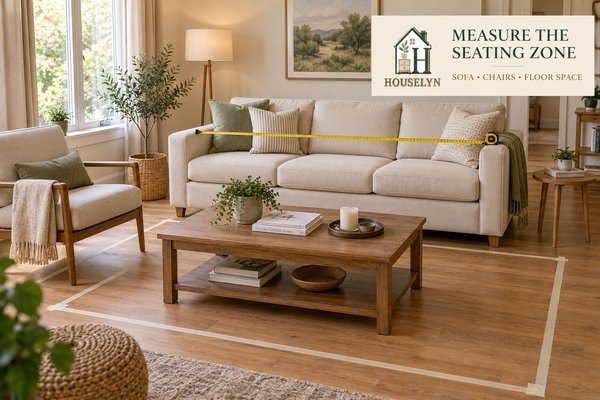
Measure from the outermost edge of one arm to the outermost edge of the other. Do not measure only the seat cushions, because the rug must visually relate to the complete sofa footprint.
If the sofa has wide rolled arms, oversized side panels or a deep frame, those dimensions can materially change the correct rug size for sofa placement.
Sofa depth becomes important when deciding whether only the front legs will sit on the rug or whether the whole sofa will be positioned on it.
A deep sofa or modular design needs more rug depth than a compact shallow sofa even when the two pieces have similar widths.
For an L-shaped or chaise sectional, measure the full longest run and the full projection of the chaise or return. Those two dimensions form the footprint that the rug needs to balance.
This matters because a sofa and rug size match that looks correct against the main sofa run can still fail if the chaise projects far beyond the rug or leaves one side visually unsupported.
If one or two chairs face the sofa, measure their width, depth and distance from the sofa. A successful rug size for sofa decision should consider whether those chairs will also sit partly or fully on the same rug.
The rug does not necessarily need to support every chair leg, but it should make the chairs feel intentionally connected to the sofa rather than positioned outside a separate boundary.
Record the coffee table width and depth because it should sit comfortably within the rug area. However, the table is a secondary measurement.
A small table placed on a small rug can look perfectly centred while the sofa and chairs remain visually detached around it. The rug needs to serve the seating zone first.
Architectural features can reduce the practical rug zone. Fireplace hearths, projecting radiators, built-in cabinetry, floor vents, door swings and narrow circulation routes may all reduce the usable floor area.
That is why the room's total dimensions should not be treated as the final rug size for sofa measurement. The meaningful dimensions are the floor area the seating group can actually occupy without obstructing the room.
Once you have recorded the furniture measurements, look at the seating footprint as a single rectangle or zone. Imagine the smallest rug that could connect the sofa, chairs and table without creating awkward edges.
At this stage, do not choose a rug size yet. The goal is simply to understand the area that needs to be anchored. The next stage will determine how far the rug should extend beyond the sofa.
This approach also prevents one of the most common mistakes in a sofa and rug size match: buying a standard rug because it seems suitable for the room, then discovering that the sofa extends beyond it on both sides or that the chairs cannot connect to the same rug.
Accurate measuring does not mean the final rug has to be huge. It simply gives you enough information to make the next decisions deliberately instead of guessing.
Chapter 2 — Extend
A reliable rug size for sofa arrangement usually needs the rug to extend beyond the sofa's outer edges rather than stop inside them. That extra width is what helps the sofa and rug read as one balanced composition.
When the rug is noticeably narrower than the sofa, the furniture can look too large for its foundation. The rug begins to resemble a mat beneath the coffee table instead of the visual base of the seating zone.
For many living rooms, a useful starting point is to allow approximately 15–30 cm (6–12 inches) of rug beyond each side of the sofa. This is not a universal rule, but it provides a practical minimum range for testing the proportions.
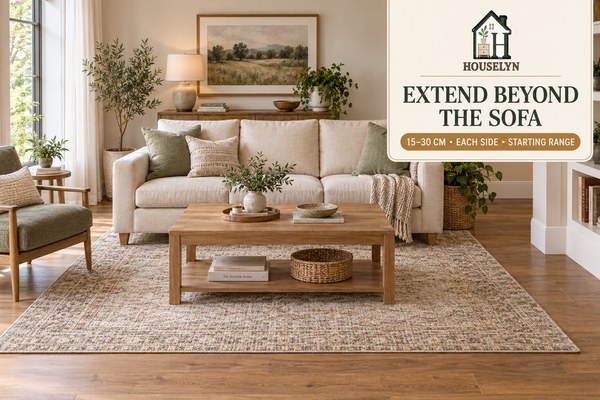
Start with the full outside sofa width measured in Chapter 1. Then add the desired extension on the left and right.
For example, a sofa measuring 200 cm wide with 20 cm of rug extending beyond each side would need a rug dimension of roughly 240 cm across that direction before other seating is considered.
That calculation gives you a starting rug size for sofa width, but chairs, sectional returns or room constraints may require a larger rug.
A compact loveseat or apartment sofa can tempt you to choose a very small rug. That often saves floor area on paper but creates weak proportions in the room.
Even with a smaller sofa, the rug should normally remain visibly wider than the furniture if it is intended to anchor the seating group. This helps a compact sofa and rug size match look deliberate rather than undersized.
Standard rug dimensions do not increase in tiny increments. A wide sofa may fall between two common rug sizes, and the smaller option can technically fit while still looking visually weak.
When choosing between two sizes, test the larger footprint whenever the room allows. A better rug size for sofa is often the size that gives the furniture a generous base rather than the smallest rug that can be made to fit.
Coffee tables are usually much narrower than sofas. If the rug extends only a modest distance beyond the table, it may still end well inside the sofa arms.
That creates the classic floating-rug effect. The table looks supported, but the larger furniture does not.
If chairs sit at the ends of the sofa or angle inward toward the coffee table, the rug may need to extend much farther than the sofa-only calculation suggests.
This is why the final rug size for sofa should be checked against the entire seating footprint rather than treated as a simple sofa-width formula.
In a narrow living room, extending 30 cm beyond both sofa ends may leave too little clearance near walls, radiators, doors or circulation routes.
In that situation, reduce the extension carefully rather than automatically forcing a larger rug into the space. The rug should still look connected to the sofa, but practical room clearance takes priority.
A rectangular rug has two dimensions, and the longer side does not always need to run in the same direction as the longest wall.
Orient the rug according to the seating group. In many conventional arrangements, the wider rug dimension runs parallel to the sofa because that allows the rug to extend past both arms and connect supporting chairs.
The best sofa and rug size match therefore comes from combining the sofa width with the furniture around it. The 15–30 cm extension range is a starting point, not the final answer for every room.
Once the rug width feels proportionate, the next decision is how much of the sofa should actually sit on it. That anchoring choice determines the rug depth and can change the final rug size for sofa significantly.
Recommended Essentials
These simple tools make it easier to measure, mark and compare rug footprints without committing to a size too early.
Chapter 3 — Anchor
The correct rug size for sofa depends heavily on how much of the sofa you want the rug to support. Front-legs-on and all-legs-on arrangements can both work well, but they create very different rug-depth requirements.
Think of anchoring as the point where furniture and rug become one visual group. The rug should make the sofa feel attached to the seating zone rather than sitting behind an unrelated rectangle of fabric.
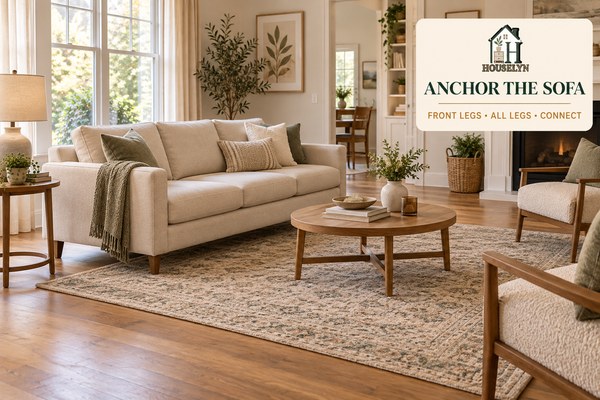
For many living rooms, placing the front sofa legs on the rug creates a strong connection without requiring the rug to extend beneath the full sofa depth.
This can be especially useful when the sofa sits against a wall or when the room cannot comfortably accommodate a much deeper rug.
The important detail is that enough rug remains beneath the sofa front to make the placement look deliberate. A few centimetres of accidental overlap is not the same as a planned rug size for sofa arrangement.
In larger rooms, open-plan spaces or formal seating areas, positioning the entire sofa on the rug can make the seating group feel more substantial and clearly defined.
The rug should extend behind the rear sofa legs rather than finishing directly beneath them. Otherwise, the sofa can appear squeezed onto the rug.
Because this model uses more rug depth, the final rug size for sofa may need to increase significantly compared with a front-legs-on layout.
A rug can sit entirely in front of a sofa, particularly in a very compact room, but the relationship is harder to balance.
If there is a wide strip of exposed flooring between sofa and rug, the rug can look disconnected. If the rug is also small, it may appear to belong only to the coffee table.
Where no sofa legs sit on the rug, keep the visual gap controlled and make sure the rug remains substantial enough to support the rest of the seating zone.
A sofa pushed against a wall may not need rug behind its rear legs, but the rug still needs enough width and depth to connect the front of the sofa to the coffee table and nearby chairs.
The wall position changes the anchoring method, not the need for proportion.
A sofa positioned away from the wall is visible from more directions. In this case, a larger rug often helps establish a clear seating zone and prevents the furniture from appearing stranded in the middle of the room.
This is one reason a floating sofa can need a larger rug size for sofa than an otherwise identical sofa placed against a wall.
The sofa may be the largest piece, but the chairs should not appear excluded from the rug zone. In many layouts, placing at least the front chair legs on the rug creates a more connected composition.
This matters for a successful sofa and rug size match because a rug that anchors only the sofa but misses the chairs can still look too small for the complete conversation area.
Avoid positions where sofa or chair legs sit half on and half off a thick rug edge. That can look accidental and may also leave furniture less stable.
Either commit the intended legs clearly to the rug or leave them fully off it.
The right rug size for sofa therefore depends on the placement model you choose. Front-legs-on can work beautifully with a medium-sized rug, while all-legs-on usually calls for a larger footprint.
Once the sofa itself is anchored, the next task is to make sure the rest of the seating group belongs to the same rug zone. That includes chairs, loveseats, ottomans and the coffee table.
Recommended Essentials
These products help keep the rug flat, reduce movement and protect furniture where sofa or chair legs sit partly or fully on the rug.
Chapter 4 — Include
A good rug size for sofa can still look wrong if the chairs, loveseat, ottoman or other supporting pieces sit outside the visual boundary. The rug should connect the furniture that belongs to the same conversation area.
The sofa gives you the first major measurement, but the seating group determines the final rug footprint. Once several pieces of furniture face one another around the same coffee table, they should usually feel as though they share one visual base.
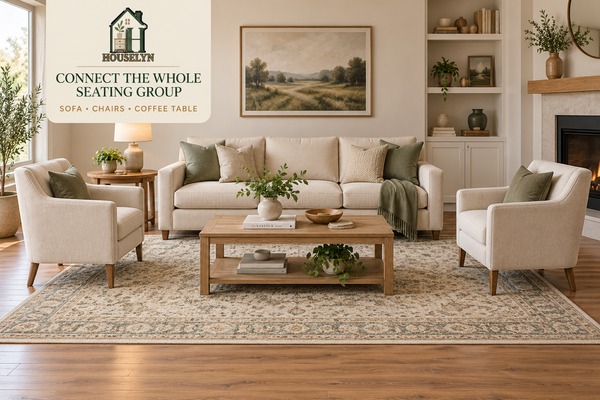
If your living room contains only one sofa and one coffee table, the sizing process is relatively straightforward. As soon as chairs or another sofa are added, the correct rug size for sofa becomes a seating-group calculation.
The rug does not need every piece of furniture fully on it, but each major seating piece should have a clear relationship to the same rug.
A common layout places one chair at each end of the sofa, often angled slightly toward the centre. In this arrangement, a rug that works only beneath the sofa can leave both chairs visually detached.
Ideally, the rug should be wide enough for the sofa and chairs to overlap it in a consistent way. That may mean the sofa front legs and the front legs of both chairs sit on the rug.
Consistency is one of the easiest ways to make the arrangement look deliberate. If the sofa has its front legs on the rug, aim for a similar relationship with the chairs where the room allows.
One chair fully on the rug, another completely off and the sofa barely touching the edge can make the composition feel accidental even when the individual measurements seem reasonable.
When a sofa faces or sits perpendicular to a loveseat, the smaller piece should not be treated as an afterthought. Both are major pieces of seating.
In this type of sofa and rug size match, the rug often needs to reach farther into the room or span more width so the two seating pieces share one foundation.
Ottomans can serve as footrests, extra seating or coffee-table substitutes. If the ottoman stays permanently within the seating zone, include its working position when testing the rug size for sofa.
A movable pouffe or occasional footstool does not always need to determine the rug size, but a large fixed ottoman often does.
The coffee table normally belongs fully on the rug, with enough visible rug around it that the table does not appear to occupy the entire central area.
This is different from sizing the rug to the coffee table. The table should fit within the rug that has already been sized for the larger seating group.
One of the most awkward arrangements occurs when the sofa connects well to the rug but the supporting chairs sit clearly beyond it.
If those chairs participate in the same conversation zone, either move them slightly inward or test a larger rug. The better rug size for sofa is the size that makes the entire seating relationship feel intentional.
A compact room does not need every piece fully on the rug. In fact, forcing an all-legs-on arrangement into a small room can demand an unnecessarily large rug.
Instead, use consistent front-leg contact to connect the sofa and chairs while keeping enough visible floor around the seating area.
In a generous living room, a small rug beneath the central table can make the seating pieces feel scattered even when the room is beautifully furnished.
A larger rug size for sofa that includes surrounding chairs can establish a clearer visual zone and make the furniture feel more substantial within the room.
The strongest sofa and rug size match is therefore not simply a sofa sitting on an appropriately wide rug. It is a rug footprint that supports the complete conversation area and gives every major piece a clear visual relationship.
Once all of the seating pieces feel included, the next question is where the rug should sit within the room. That does not always mean centring it on the room itself. In many spaces, the rug should follow the seating zone instead.
Chapter 5 — Centre
A correct rug size for sofa can still look unbalanced if the rug is centred to the room while the sofa and chairs form a different visual centre. In most living rooms, the rug should follow the furniture zone first.
It is easy to assume that a rectangular rug should sit exactly in the middle of the floor, parallel to every wall. That works in symmetrical rooms, but many real homes contain fireplaces, doorways, bay windows, media units, open-plan connections or furniture arrangements that shift the seating area away from the architectural centre.
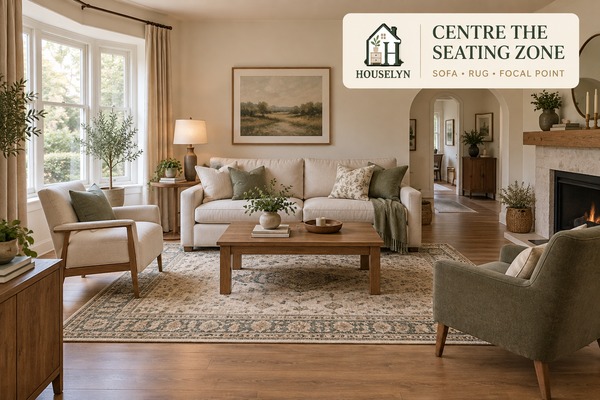
In a conventional living room, the sofa is often the strongest horizontal element. Aligning the rug with the sofa usually creates a clearer relationship than aligning it with an unrelated wall or empty floor area.
This does not mean every rug size for sofa must be perfectly centred beneath the sofa. Sectionals, offset chairs and architectural features can justify a deliberate shift, but the relationship should still look intentional.
Many living rooms are not symmetrical. One side may contain a doorway, fireplace, built-in cabinet or opening into another space. If you force the rug into the exact architectural centre, the seating zone can become visibly misaligned.
Instead, establish the furniture arrangement first and centre the rug on the conversation area that people actually use.
The coffee table should usually appear naturally centred within the seating zone and comfortably contained by the rug.
If the table looks centred but the sofa sits noticeably to one side of the rug, check whether the entire rug size for sofa arrangement has been aligned to the wrong reference point.
A fireplace often acts as a focal point, but the rug still needs to work with the furniture gathered around it. The rug does not have to be centred precisely on the fireplace if doing so disconnects it from the sofa and chairs.
The strongest solution is usually the one where the focal point, sofa, coffee table and rug feel related without forcing any one element into an awkward position.
In media-focused rooms, the sofa may align with the television rather than the room itself. In that case, centring the rug on the sofa-and-TV relationship can make more sense than centring it on the floor plan.
This is another reason the best sofa and rug size match should respond to the furniture zone instead of following empty-room symmetry by default.
Bay windows can make the architectural centre difficult to read, particularly when the sofa sits partly in front of the bay or is deliberately shifted away from it.
Treat the rug as the foundation of the seating area. Do not rotate or shift it simply to mirror an irregular wall if that makes the furniture relationship weaker.
In an open-plan home, the living area may occupy only one part of a much larger floor. Centring the rug on the entire open space would make little sense.
Instead, use the rug to define the living zone. The correct rug size for sofa should create a visual boundary around the seating without trying to fill or centre the whole open-plan room.
Rectangular rugs usually work best when their longest dimension supports the main direction of the seating group. In many rooms, this means the longer rug edge runs parallel to the sofa.
Turning the rug ninety degrees simply because it matches the room shape can leave the sofa wider than the rug and weaken the whole composition.
Recommended Essentials
These tools can help you mark, adjust and test the proposed rug centre before committing to the final position.
Once the rug position is marked, look at the room from the entrance and from the main circulation path rather than judging it only from directly in front of the sofa.
A well-centred rug size for sofa should make the seating area read clearly from several viewpoints. If the rug seems to drift toward one wall or away from the chairs, adjust the furniture-zone alignment before buying or fixing it in place.
A successful sofa and rug size match therefore depends on more than getting the dimensions right. The rug also needs to sit in the correct visual position so the sofa and supporting furniture feel intentionally grouped.
With the rug centred to the seating zone, the next stage is to check how much floor remains around it. The room still needs breathing space, circulation and sensible clearance around walls, doors and fixed features.
Chapter 6 — Clear
Choosing the right rug size for sofa is not only about making the rug large enough. The rug also needs enough exposed flooring around it to preserve circulation, reveal the room boundary and keep the seating zone from feeling squeezed against walls or fixed features.
Once the sofa, chairs and coffee table feel properly connected, step back and look at what happens outside the rug. The remaining floor is part of the composition too.
Too much exposed flooring can make the rug look like a small island. Too little can make an area rug resemble fitted carpet or cause awkward conflicts with doors, hearths and circulation routes.
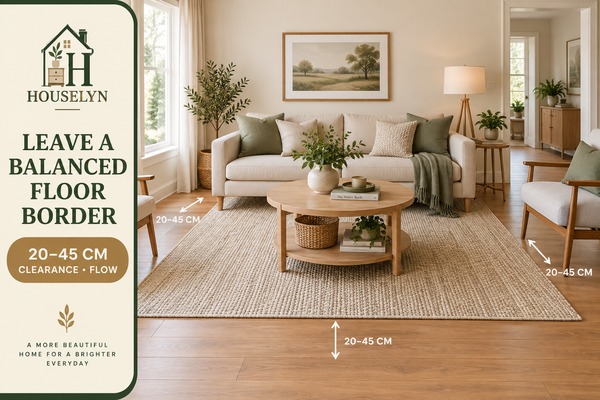
In many living rooms, somewhere around 20–45 cm (8–18 inches) of exposed flooring can be a useful planning range around an area rug where the room allows.
This is not a rigid rule. Smaller rooms may need less visible floor, while generous rooms can support more. The important point is that the border should look deliberate rather than accidental.
In a compact living room, forcing a wide border around the rug can make you choose a rug that is too small for the sofa and chairs.
A better rug size for sofa may leave only a modest strip of floor near some walls while still keeping doors and walkways clear.
A larger room has more visual space around the seating group, so the rug does not need to stretch close to every wall.
However, increasing the floor border should not come at the cost of weakening the seating zone. If the sofa and chairs begin to sit mostly outside the rug, the border has become too generous for that arrangement.
Check every nearby door before settling on rug dimensions. A thick rug or rug pad can interfere with a door even when the floor plan suggests enough clearance.
Where a door opens across the rug area, confirm both the rug footprint and the finished pile height before buying.
Do not force a rug beneath or against a fireplace hearth simply to maintain a symmetrical margin. The rug should respect the hearth boundary and any applicable heat or fire-safety guidance for the fireplace or appliance.
The same principle applies to floor vents, fixed heaters and built-in cabinetry. A practical rug size for sofa must fit the room that actually exists rather than an idealised rectangle.
Rug edges positioned directly across a heavily used route can create an awkward transition, especially if they curl, shift or sit considerably higher than the surrounding floor.
Where possible, avoid placing a rug edge exactly where people repeatedly turn, enter the room or move between major furniture pieces.
Recommended Essentials
Once the rug footprint is correct, these practical products can help keep exposed edges neat and easier to manage in everyday living areas.
Before purchasing, tape out the proposed rug size and walk naturally around the room. Open doors, sit in every chair, move between the sofa and surrounding spaces, and look at the exposed floor from several viewpoints.
A suitable rug size for sofa should feel generous enough to anchor the furniture without creating awkward edges in the places where the room needs to function.
In an open-plan living area, the rug may be nowhere near a wall on one or more sides. In that case, judge the clear floor around the living zone rather than trying to maintain an equal wall border.
The rug should help establish where the seating area begins and ends while leaving obvious routes into adjoining dining, kitchen or circulation spaces.
Sizing up often fixes an undersized sofa and rug size match, but there is a practical limit. A rug that nearly fills the room can weaken the visual distinction between area rug and fitted flooring and may interfere with doors or fixed features.
The strongest solution balances two goals: enough rug to anchor the furniture and enough clear floor for the room to retain structure.
A balanced sofa and rug size match therefore needs both connection and clearance. The rug should be substantial enough to organise the seating zone while still respecting doors, hearths, circulation and the architecture around it.
With the basic sizing framework now complete, the next stage addresses the furniture type that most often changes the rules: the sectional sofa. Its chaise, return or U-shaped footprint needs to be measured as a complete form rather than treated like a conventional straight sofa.
Chapter 7 — Sectionals
A sectional changes the usual rug size for sofa calculation because the furniture has more than one dominant direction. Instead of measuring only the longest sofa edge, treat the sectional as a complete footprint.
L-shaped, chaise and U-shaped sectionals project farther into the room than a conventional straight sofa. That extra depth changes the rug size, rug orientation and the amount of exposed floor needed around the seating zone.
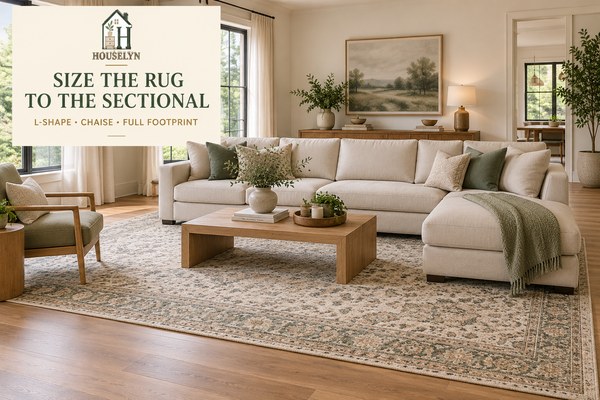
Start by measuring the sectional from one outside end to the other along its longest straight run. Then measure how far the chaise, return or second side projects into the room.
Those two dimensions describe the sectional footprint much more accurately than sofa width alone and give you a stronger starting point for the final rug size for sofa.
An L-shaped sectional creates one long side and one shorter return. If the rug is centred only to the long sofa run, the return can appear to fall off the rug or dominate the uncovered floor on one side.
Instead, assess the full L shape. The rug should feel substantial enough to support the main sofa run while also relating clearly to the return.
A chaise often projects much farther into the room than the standard seat depth. That makes rug depth especially important.
A sofa and rug size match that works across the main sofa width can still look undersized if the chaise extends well beyond the rug's front edge.
Not every sectional needs to sit fully on the rug. A front-legs-on arrangement can work well where the rug extends far enough beneath the main run and chaise to create a consistent connection.
The key is consistency. If the main sofa front legs rest comfortably on the rug but the chaise barely touches it, the rug may still be too shallow.
A large rug supporting the entire sectional can create a strong, finished seating zone in open-plan rooms or larger living spaces.
This typically requires a much larger rug size for sofa, but it can make a substantial sectional feel more proportionate to the room rather than visually dominating the floor.
Sectionals often tempt people to run the rug parallel with the longest sofa section and ignore everything else. That can leave the chaise, return or additional chairs looking disconnected.
Centre the rug to the sectional's usable seating zone rather than one straight line.
Standard rug dimensions can be useful for narrowing your options, but sectional sizes vary dramatically. Always compare the actual furniture footprint with the proposed rug before buying.
| Sectional Type | Useful Rug Starting Point | What to Check |
|---|---|---|
| Compact chaise sectional | About 200 × 300 cm | Confirm that the chaise and main sofa front legs both connect comfortably. |
| Small L-shaped sectional | About 200 × 300 cm or larger | Check whether the return feels supported and the rug extends beyond the main run. |
| Large L-shaped sectional | About 240 × 340 cm or larger | Confirm full seating-group connection and balanced floor margins. |
| Large U-shaped sectional | About 300 × 400 cm or larger | Test whether the rug supports the enclosed seating zone without crowding the room. |
These dimensions are planning examples, not universal rules. Actual sectional size, chair placement, room width, rug orientation and clearance requirements should determine the final choice.
If a sectional is paired with one or two occasional chairs, the rug may need to be larger than the sectional alone suggests.
This is because the correct rug size for sofa should define the whole conversation zone rather than simply match the sectional footprint.
Sectionals are often used to divide open-plan living spaces. A properly scaled rug strengthens that zoning effect by giving the sectional a clear visual base.
If the rug is too small, the large sectional may appear to spill beyond the living zone and weaken the separation between living, dining and circulation areas.
A chaise sectional is asymmetrical by design. The rug does not have to show exactly the same amount beyond every sofa edge.
Instead, aim for visual balance. The main sofa run, chaise, table and any supporting chair should feel connected even if the exposed rug margins are not identical.
The strongest sofa and rug size match for a sectional comes from balancing the complete furniture footprint with the available room. The rug should support the sectional's shape without forcing it into a rectangular formula that ignores the chaise or return.
With sectional sizing resolved, the final chapter turns the framework into a diagnostic tool by identifying the common rug mistakes that make sofas look too large, seating zones feel disconnected or living rooms appear smaller than they are.
Chapter 8 — Common Mistakes
Even a good rug size for sofa can fail if the placement makes the seating zone feel disconnected, cramped or visually fragmented. Most common rug problems come back to scale, anchoring and proportion.
The easiest way to diagnose a rug problem is to ignore colour and pattern for a moment and look only at the boundaries. Ask where the rug starts and stops in relation to the sofa, chairs, coffee table and remaining floor.
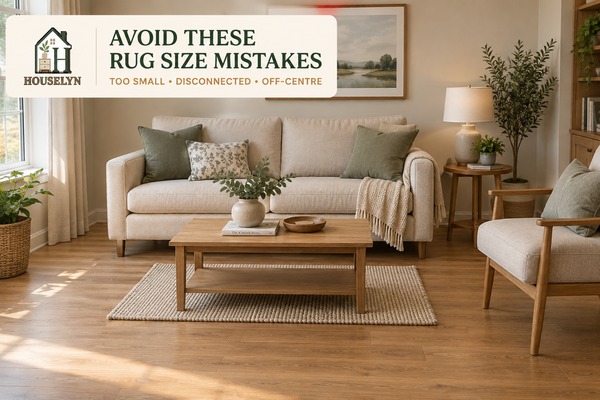
This is one of the clearest scale problems. When both rug edges finish inside the sofa arms, the sofa can appear oversized and the rug can look like a small platform beneath the coffee table.
Test a wider rug size for sofa before changing anything else.
A rug that comfortably holds the coffee table may still be much too small for the furniture surrounding it.
The rug should support the seating zone first. The coffee table then sits inside that larger footprint.
A no-legs-on arrangement can work in a compact room, but a wide strip of floor between the sofa and rug can make the two elements appear unrelated.
Either bring the rug closer to the sofa or test a deeper size.
Furniture legs balancing on the very edge of the rug can look accidental and may be less stable on thicker rugs.
Commit clearly to front-legs-on, all-legs-on or fully off rather than leaving the placement visually undecided.
The correct sofa and rug size match should normally support the whole conversation zone, not one piece of furniture in isolation.
If the sofa feels grounded but nearby chairs appear stranded outside the rug, adjust the chair positions or test a larger footprint.
Turning a rectangular rug in the wrong direction can make an otherwise adequate rug look too narrow.
In many layouts, the longer rug dimension should run parallel to the sofa so there is enough extension beyond both arms.
A rug can be mathematically centred on the floor and still look visibly wrong if the sofa, chairs and coffee table sit off to one side.
Align the rug with the lived-in furniture zone first unless a strong architectural feature clearly requires another solution.
Sectionals expose undersized rugs quickly because the chaise or return projects beyond the standard sofa depth.
A suitable rug size for sofa in this situation must account for the full sectional footprint, not only the longest straight edge.
If the main sectional seats connect to the rug but the chaise extends far beyond it, the arrangement can look unbalanced.
Test a deeper rug or adjust the placement so the chaise remains visually attached to the same foundation.
Homeowners sometimes choose a smaller rug because they want to keep more wood or other flooring visible.
If that decision causes the sofa and chairs to lose their connection, the proportion usually suffers more than the extra exposed floor helps.
The opposite problem is choosing an area rug so large that almost no floor remains visible. This can make the rug behave more like fitted carpet and may create conflicts with doors or fixed features.
Keep enough floor visible to preserve the room boundary where practical.
The largest rug that fits the furniture is not automatically the correct choice. Doors still need to open, and fireplace hearths or fixed heating features need appropriate clearance.
Multiple small rugs can divide a single conversation area into competing zones. Unless there is a clear functional reason for separate rugs, one appropriately scaled rug usually creates stronger cohesion.
Buying by room impression alone is risky because two sofas in the same room can require very different rug dimensions.
Measure the sofa, chairs and available floor first, then choose the rug size for sofa.
When furniture dimensions fall between two common rug sizes, the smaller option can technically fit while still looking weak.
Tape out both sizes. If the larger rug anchors the sofa and chairs more convincingly without interfering with the room, it is often the better proportional choice.
When the rug feels wrong, it is tempting to blame colour, pattern or texture. Those choices matter, but a beautifully styled rug will not solve a weak furniture-to-rug relationship.
Recheck the rug size for sofa, extension, anchoring, seating-group coverage and floor margins first. Once the scale works, decorative choices become much easier to judge.
A successful sofa and rug size match should make the furniture feel calmer and more connected. The sofa should not overpower the rug, the chairs should not appear stranded and the rug should not look like an isolated island beneath the coffee table.
The full framework is now complete: Measure → Extend → Anchor → Include → Centre → Clear → Check. The next section answers the most common practical questions readers have when applying those decisions to real sofas, rugs and living rooms.
Houselyn FAQ
These answers cover the most common practical questions about choosing the right rug size for sofa placement, from width and anchoring to sectionals, chairs, floor margins and common sizing mistakes.
The rug should usually be large enough to extend beyond the sofa ends and connect the sofa to the rest of the seating group. A useful starting point is to measure the sofa width, then add visible extension on both sides before checking chairs, coffee tables and room clearance.
In many living rooms, testing roughly 15–30 cm (6–12 inches) beyond each sofa end is a useful starting range. Larger rooms or wider seating groups may benefit from more, while narrow rooms may need less.
If the rug's long edge runs parallel to the sofa, it will usually look more balanced when it extends beyond the sofa width rather than finishing inside the sofa arms.
Usually, yes, if the rug is intended to anchor the seating zone. Front-legs-on is a common and flexible approach, while all-legs-on can work particularly well in larger rooms.
In many rooms, yes. Front-legs-on can create a strong visual connection without requiring the rug to extend under the full sofa depth. The placement should look deliberate, with enough rug beneath the sofa to avoid a barely-touching edge.
Yes. All-legs-on placement can create a more complete and formal seating zone, especially in large or open-plan rooms. It generally requires a significantly larger rug.
It can, particularly in a compact room, but the rug should remain visually close enough to the sofa that it does not look isolated. A large gap between sofa and rug often weakens the arrangement.
A common starting point is around 200 × 300 cm for many standard three-seat sofas, but actual sofa width, chair placement and room size matter more than the label. Tape out the proposed footprint before buying.
A compact loveseat may work with a rug around 160 × 230 cm as a starting point, but the rug should still extend beyond the loveseat and relate to any nearby chairs or tables.
Small sectionals often begin around 200 × 300 cm, while larger L-shaped or U-shaped sectionals may need 240 × 340 cm, 300 × 400 cm or larger. The full sectional footprint should determine the final choice.
Measure both the longest sofa run and the projecting return. The rug should visually support both parts rather than fitting only beneath the longest edge.
Around 15–30 cm (6–12 inches) beyond each side is a useful starting range in many rooms, but the final extension should also account for chairs, sectionals, wall clearance and available floor.
Somewhere around 20–45 cm (8–18 inches) can be a useful planning range in many rooms. Smaller spaces may use less and larger rooms may comfortably use more. The rug still needs to anchor the seating before preserving a wide floor border.
Chairs that belong to the same conversation area should usually have a clear relationship to the rug. Front-leg contact is often enough to connect them visually to the sofa.
Usually, yes. The coffee table should sit comfortably inside the rug footprint, but the rug should not be sized only to the table. The seating group remains the main reference.
In most cases, centre the rug to the seating zone rather than automatically to the room. Fireplaces, bay windows, doorways and open-plan spaces can shift the furniture centre away from the architectural centre.
Yes. A rug that nearly fills the entire room can interfere with doors and fixed features and may start to behave visually like fitted carpet. Leave a practical floor border where the room allows.
Yes, but often because the rug is too small rather than too large. A tiny rug can divide the floor into disconnected areas and make the sofa appear oversized. Correct scale usually creates a calmer, more unified room.
Rectangular rugs are the most straightforward choice for most sofas and sectionals because they follow the horizontal furniture lines. Round or square rugs can work in specialised layouts, but they should still connect the main seating rather than sit independently in the centre.
Choosing a rug that is too small for the seating group is the most common error. It often happens when the rug is selected for the coffee table or empty floor rather than from the sofa and seating footprint.
Houselyn Action Plan
Use this five-step workflow to turn the full sizing guide into one practical rug size for sofa decision. The aim is to finish with a rug footprint that anchors the sofa, connects the seating group and still leaves enough usable floor around the room.
Record the full outside sofa width, sofa depth and the footprint of any chairs, loveseat, chaise, sectional return or large ottoman that belongs to the same conversation area.
A strong rug size for sofa starts with the furniture that needs to be visually connected rather than the empty room alone.
Record: sofa width, sofa depth, sectional projection, chair positions, coffee-table footprint and usable seating-zone dimensions.
Use the sofa width as the first reference, then add enough rug beyond each sofa end so the rug does not finish inside the sofa arms.
In many rooms, roughly 15–30 cm (6–12 inches) beyond each side is a useful starting range, but supporting chairs or a larger room may justify more.
Test: Sofa Width + Left Extension + Right Extension = Minimum Rug Width to Compare.
Decide whether the sofa will use a front-legs-on or all-legs-on arrangement. That choice determines how much rug depth is required.
For many standard rooms, front-legs-on offers a balanced rug size for sofa without requiring the deepest rug. Larger or open-plan spaces can support all-legs-on more comfortably.
Choose: front legs on, all legs on, or a carefully planned no-legs-on arrangement for a genuinely compact space.
Confirm that supporting chairs relate clearly to the same rug and that the coffee table sits comfortably within the rug footprint.
For a sectional, include the chaise or return rather than calculating the rug size for sofa from the longest straight edge alone.
Check: sofa connected, chairs connected, table fully supported, sectional projection included and no major seating piece isolated.
Mark the proposed rug corners and edges with floor-safe low-tack tape. Then walk the room, open nearby doors and look at the furniture from several angles.
Check that the sofa and rug size match still works when you consider floor margins, circulation, fireplaces, door swings and the visual centre of the seating group.
Final test: compare at least two nearby standard rug sizes whenever the sofa dimensions fall between common options.
Your Final Rug Specification
Before purchasing, you should know the sofa width, chosen rug dimensions, left and right extension, anchoring method, chair relationship, sectional footprint where relevant, rug orientation and approximate floor margins. If one of those decisions is still uncertain, the rug size for sofa has not been fully resolved.
Chapter 8 — Common Mistakes
Even a good rug size for sofa can fail if the placement makes the seating zone feel disconnected, cramped or visually fragmented. Most common rug problems come back to scale, anchoring and proportion.
The easiest way to diagnose a rug problem is to ignore colour and pattern for a moment and look only at the boundaries. Ask where the rug starts and stops in relation to the sofa, chairs, coffee table and remaining floor.
This is one of the clearest scale problems. When both rug edges finish inside the sofa arms, the sofa can appear oversized and the rug can look like a small platform beneath the coffee table.
Test a wider rug size for sofa before changing anything else.
A rug that comfortably holds the coffee table may still be much too small for the furniture surrounding it.
The rug should support the seating zone first. The coffee table then sits inside that larger footprint.
A no-legs-on arrangement can work in a compact room, but a wide strip of floor between the sofa and rug can make the two elements appear unrelated.
Either bring the rug closer to the sofa or test a deeper size.
Furniture legs balancing on the very edge of the rug can look accidental and may be less stable on thicker rugs.
Commit clearly to front-legs-on, all-legs-on or fully off rather than leaving the placement visually undecided.
The correct sofa and rug size match should normally support the whole conversation zone, not one piece of furniture in isolation.
If the sofa feels grounded but nearby chairs appear stranded outside the rug, adjust the chair positions or test a larger footprint.
Turning a rectangular rug in the wrong direction can make an otherwise adequate rug look too narrow.
In many layouts, the longer rug dimension should run parallel to the sofa so there is enough extension beyond both arms.
A rug can be mathematically centred on the floor and still look visibly wrong if the sofa, chairs and coffee table sit off to one side.
Align the rug with the lived-in furniture zone first unless a strong architectural feature clearly requires another solution.
Sectionals expose undersized rugs quickly because the chaise or return projects beyond the standard sofa depth.
A suitable rug size for sofa in this situation must account for the full sectional footprint, not only the longest straight edge.
If the main sectional seats connect to the rug but the chaise extends far beyond it, the arrangement can look unbalanced.
Test a deeper rug or adjust the placement so the chaise remains visually attached to the same foundation.
Homeowners sometimes choose a smaller rug because they want to keep more wood or other flooring visible.
If that decision causes the sofa and chairs to lose their connection, the proportion usually suffers more than the extra exposed floor helps.
The opposite problem is choosing an area rug so large that almost no floor remains visible. This can make the rug behave more like fitted carpet and may create conflicts with doors or fixed features.
Keep enough floor visible to preserve the room boundary where practical.
The largest rug that fits the furniture is not automatically the correct choice. Doors still need to open, and fireplace hearths or fixed heating features need appropriate clearance.
Multiple small rugs can divide a single conversation area into competing zones. Unless there is a clear functional reason for separate rugs, one appropriately scaled rug usually creates stronger cohesion.
Buying by room impression alone is risky because two sofas in the same room can require very different rug dimensions.
Measure the sofa, chairs and available floor first, then choose the rug size for sofa.
When furniture dimensions fall between two common rug sizes, the smaller option can technically fit while still looking weak.
Tape out both sizes. If the larger rug anchors the sofa and chairs more convincingly without interfering with the room, it is often the better proportional choice.
When the rug feels wrong, it is tempting to blame colour, pattern or texture. Those choices matter, but a beautifully styled rug will not solve a weak furniture-to-rug relationship.
Recheck the rug size for sofa, extension, anchoring, seating-group coverage and floor margins first. Once the scale works, decorative choices become much easier to judge.
A successful sofa and rug size match should make the furniture feel calmer and more connected. The sofa should not overpower the rug, the chairs should not appear stranded and the rug should not look like an isolated island beneath the coffee table.
The full framework is now complete: Measure → Extend → Anchor → Include → Centre → Clear → Check. The next section answers the most common practical questions readers have when applying those decisions to real sofas, rugs and living rooms.
Continue Learning With Houselyn
Once the rug size for sofa is resolved, continue with the Houselyn guides that help you place furniture, balance the room, refine the decor and coordinate other major visual elements around the seating zone.

Houselyn Knowledge Library
Use the Houselyn Knowledge Library to continue from the part of your sofa and rug size match that connects most closely with the next room decision. The aim is to keep exact sofa-and-rug sizing separate from full-room layout, decorating and other specialist proportion guides.
Once the rug size for sofa is settled, these guides help you refine furniture placement, proportion and the wider room plan.
Sofa and rug sizing works best when other large visual elements are also measured deliberately rather than chosen by eye alone.
Compact rooms often need more careful choices around rug width, seating contact and visible floor because there is less space available for correction.
Once the sofa and rug size match is correct, these guides help you work on the decorative layer without turning this technical sizing page into a general styling article.
As the Living Room cluster expands, this library can connect the rug size for sofa guide with the specialist coffee-table styling, blank-wall and whole-room troubleshooting pages once those guides are live.
Keeping those subjects separate protects this page's role. Exact sofa-to-rug sizing, anchoring and sectional fit belong here; surface styling, wall treatment and broader room diagnostics belong in their own specialist guides.
If the rug still feels wrong, return to the complete Houselyn sequence: Measure → Extend → Anchor → Include → Centre → Clear → Check.
The goal is simple: the correct rug size for sofa should make the sofa, chairs and rug feel like one calm, intentional seating zone rather than separate pieces competing for the same floor.