- Home
- Free Home Decor Printables
- Decor Upgrade Priority Worksheet
Decor Upgrade Priority Worksheet
This free decor upgrade priority worksheet helps you identify what is weakening a room, score possible improvements by impact and readiness, rank the strongest upgrades and decide what deserves attention first.
Move from room diagnosis to scoring, ranking, sequencing and a practical top-three upgrade plan.
Separate print-ready versions for UK, international and North American paper sizes.
Stop easy purchases from outranking the improvements that would genuinely make the room work and feel better.
Download the Decor Upgrade Priority Worksheet
Choose A4 for most UK and international printers or US Letter for standard North American paper. Both versions contain the same five-page upgrade prioritisation system.
Not Every Decorating Idea Deserves to Happen First
A Long Wish List Is Not a Priority Plan
A room may need better lighting, a more suitable rug, improved curtains, less clutter, better furniture placement and stronger wall balance at the same time.
The problem begins when all of those ideas are treated as equally urgent. It becomes easy to spend on cushions, accessories or an enjoyable small purchase while the larger room problem remains.
The Decor Upgrade Priority Worksheet turns a decorating wish list into an ordered set of decisions.
The Houselyn Priority Method
Assess → Score → Rank → Plan → Act
First identify what is weakening the room. Then score the potential upgrades by visual impact, functional impact, problem severity and readiness.
Only after the upgrades have been compared should you decide which one deserves the first action.
Five Pages for Turning Decor Ideas Into Priorities
Each page answers a different question, from what feels wrong through to the first three actions worth taking.
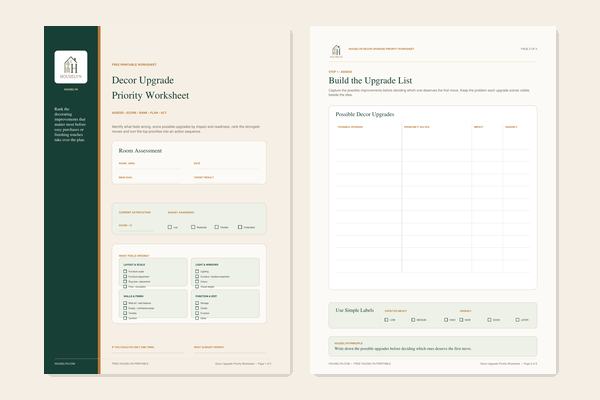
Assess the Room
Identify weaknesses across layout, scale, lighting, windows, walls, finish, function and editing.
Build the Upgrade List
Record the improvements you are considering, the problem each solves, its likely impact and urgency.
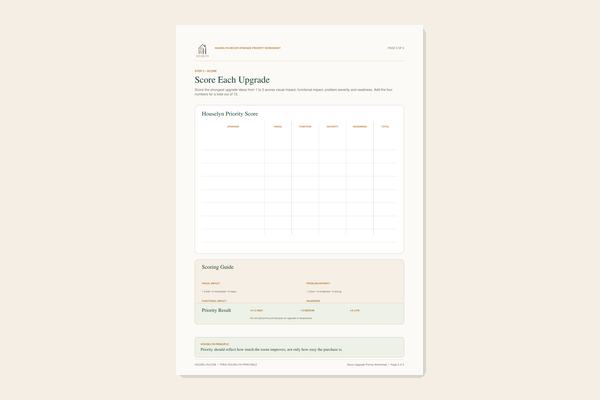
Score the Upgrades
Compare visual impact, function, problem severity and readiness using a simple score out of twelve.
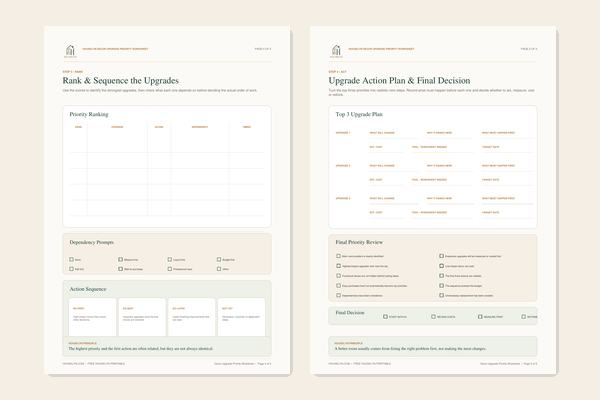
Rank & Sequence
Rank the strongest upgrades and identify dependencies that may affect the order of work.
Build the Action Plan
Turn the top three priorities into realistic next steps and decide whether to act, measure, cost or rethink.
Preview the Actual Decor Upgrade Priority Worksheet
These previews are generated directly from the corrected final A4 PDF.
Prioritise Decor Upgrades in Five Steps
Identify the room problems that are creating the strongest visual or functional weakness.
Compare possible upgrades using impact, severity and readiness rather than instinct alone.
Put the strongest upgrades into a clear priority order.
Check whether measuring, budgeting or another decision must happen first.
Turn the top three priorities into realistic next actions.
Score Impact Before You Score Convenience
Each upgrade receives a score from 1 to 3 across four factors. The combined result helps distinguish changes that could meaningfully improve the room from ideas that are simply easy to buy.
Visual Impact
How much could the upgrade improve the way the room looks?
- 1: small visual difference
- 2: noticeable improvement
- 3: major improvement
Functional Impact
How much could the upgrade improve how the room works?
- 1: little functional effect
- 2: useful improvement
- 3: significant improvement
Problem Severity
How strongly is the existing problem weakening the room?
- 1: minor issue
- 2: moderate issue
- 3: strong room problem
Readiness
How practical is the upgrade to carry out now?
- 1: difficult or dependent
- 2: manageable
- 3: ready to act on
Priority Result
10–12 = High Priority
7–9 = Medium Priority
4–6 = Low Priority
Do not give an upgrade extra points simply because it is inexpensive. Price and priority are different decisions.
Six Possible Living Room Upgrades
Imagine a living room where the rug feels undersized, storage is weak, lighting is limited, curtains are underwhelming and the finishing decor feels incomplete.
| Upgrade | Visual | Function | Severity | Readiness | Total |
|---|---|---|---|---|---|
| Larger rug | 3 | 3 | 3 | 2 | 11 |
| Better storage | 2 | 3 | 3 | 2 | 10 |
| Floor lamp | 2 | 3 | 2 | 3 | 10 |
| Curtains | 3 | 2 | 2 | 2 | 9 |
| Wall art | 2 | 1 | 1 | 3 | 7 |
| New cushions | 1 | 1 | 1 | 3 | 6 |
The cushions are inexpensive, easy to buy and ready to use, but they rank last because they do little to solve the room's actual problems.
The larger rug ranks first because it could improve scale, furniture connection and visual balance simultaneously.
Check What Must Happen Before the Upgrade
A High Score May Still Need a First Step
The highest-scoring upgrade may depend on another decision. A new rug may need room measurements. Curtains may need the pole or track position confirmed. Furniture may need a layout decision before its size is chosen.
That is why the worksheet separates priority from action sequence.
Useful Dependency Prompts
- Measure first
- Resolve the layout first
- Set or review the budget first
- Edit or remove something first
- Wait for another purchase
- Get professional input
- Confirm another room decision
What Can Distort Your Decorating Priorities?
Starting With What Is Easiest
- Buying the cheapest decor first.
- Starting with the most enjoyable purchase.
- Letting accessories outrank layout problems.
- Choosing trends before solving function.
- Replacing something before checking whether placement is the problem.
- Adding decor while clutter is still weakening the room.
Trying to Fix Everything at Once
- Treating every decorating idea as urgent.
- Ignoring dependencies between upgrades.
- Spending before ranking.
- Starting an expensive purchase before measuring.
- Continuing to upgrade after the main room problem is solved.
- Confusing an unfinished area with an area that actually needs replacement.
Use Your Priorities With Houselyn Planning Tools
Identify what the room actually needs before turning possible improvements into ranked priorities.
Estimate Next Room Refresh Cost PlannerEstimate what the selected priority upgrades may cost before deciding how much of the plan is realistic.
Allocate the Money Decorating Budget PlannerProtect and allocate the available decorating money after the highest-priority changes are understood.
Use the Right Worksheet for the Next Decision
Review the major decorating areas of the room before building your list of possible upgrades.
View Printable → Whole Project Room Makeover Planner PrintableCoordinate assessment, layout, priorities, budget and shopping across a broader room project.
View Printable → Allocate Home Decorating Budget PlannerDecide how much of the available budget should be protected for your highest-priority improvements.
View Printable → Estimate Room Refresh Cost WorksheetEstimate the actual cost of the upgrades that survive the prioritisation process.
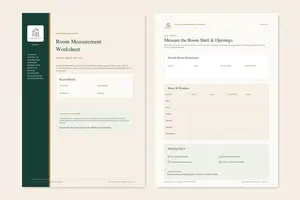
View Printable → Measure Room Measurement WorksheetRecord reliable room dimensions where the next priority depends on furniture, rug or layout scale.
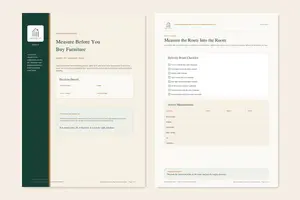
View Printable → Before Buying Measure Before You Buy Furniture ChecklistTest fit, access and room scale before a high-priority furniture change becomes an expensive mistake.
View Printable →Choose A4 or US Letter
Use the A4 edition for most UK and international printers or the US Letter edition for 8.5 × 11 inch paper.
Print at Actual Size or 100%. Both PDFs are independently laid out rather than simply scaled from one paper format to another.
Complete the Worksheet Before Shopping
The worksheet works best before you begin browsing for individual products. Start with the room problem, not with an item you have already decided you want.
Once the top priorities are clear, use measuring, cost and budget tools to test whether those upgrades are ready to move forward.
Decor Upgrade Priority Worksheet FAQ
Is the Decor Upgrade Priority Worksheet free?
Yes. Houselyn provides both A4 and US Letter versions as free printable PDFs.
How do I decide which decorating upgrade should come first?
Start by identifying the strongest room problem, then compare the possible solutions by visual impact, functional impact, problem severity and readiness. The upgrade with the highest score should normally receive serious consideration first, subject to any dependencies.
Should cost affect the priority score?
No. Cost should be reviewed after the upgrade's importance has been established. A low-cost accessory should not receive a higher priority merely because it is cheaper than a more important room improvement.
What if two upgrades receive the same score?
Compare their dependencies, functional benefit, problem severity and readiness. If one upgrade unlocks another decision or fixes a more fundamental room problem, it may deserve the earlier action.
Should functional problems rank above decorative changes?
Often, yes. Layout, circulation, storage, lighting and scale can affect both function and appearance. Finishing decor is usually more effective once those foundational issues are working well.
What does readiness mean in the scoring system?
Readiness describes how practical the upgrade is to act on now. A change may need measurements, a layout decision, budget review, another purchase or professional input before it is ready.
What if the highest-priority upgrade is too expensive right now?
Keep it high on the priority list, but review alternatives, phase the project or delay it rather than replacing it with several lower-impact purchases simply because they are cheaper.
How is this different from the Room Refresh Cost Worksheet?
The Decor Upgrade Priority Worksheet decides which improvements matter most. The Room Refresh Cost Worksheet estimates what those selected improvements are likely to cost.
Download the Decor Upgrade Priority Worksheet
Diagnose the room, compare the upgrades and create a priority order before shopping turns the plan into a collection of unrelated purchases.
Make the Next Decorating Decision With Confidence
Identify what should change before ranking individual upgrades.
Budget Planning Decorating Budget PlannerAllocate available decorating money around the priorities that matter most.
Editorial Guide Living Room Feels Off?Diagnose scale, placement, lighting, visual weight and other common reasons a room can feel unresolved.
Houselyn Editorial Team
The Houselyn Editorial Team creates practical guides for improving the way homes look, feel and function, with a focus on realistic decorating decisions, usable organization systems and attainable interior styling.
Fix the Right Problem Before Adding More
Houselyn combines practical decorating guidance, interactive tools and printable planning resources so you can diagnose the room, prioritise improvements, estimate costs and make better decisions before purchases become difficult to reverse.
Understand the scale, placement, lighting and visual-balance problems that can make a room feel wrong.
Interactive Tools Test the DecisionUse Houselyn planners and calculators for layout, budget, measurements, refresh costs and other decorating decisions.
Printable Library Plan It on PaperBrowse Houselyn worksheets, planners and checklists for decorating, measuring, budgeting, buying and room planning.
You might like these
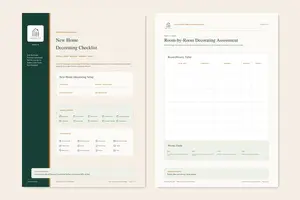
Decorating Checklist: Free Printable PDF | Houselyn
Free new home decorating checklist from Houselyn for assessing rooms, measuring before buying, prioritising furniture and decorating your new home in practical phases.
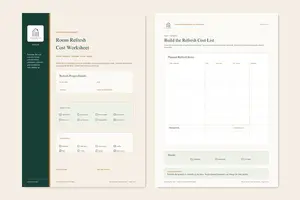
Room Refresh Cost Worksheet: Free Printable PDF | Houselyn
Free room refresh cost worksheet from Houselyn for estimating furniture, decor, delivery, labour and other refresh costs before you start spending.