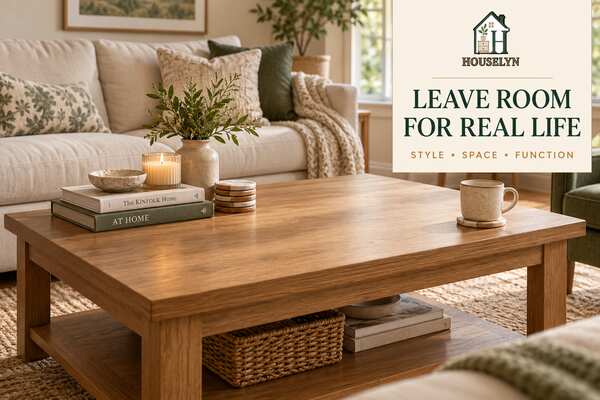
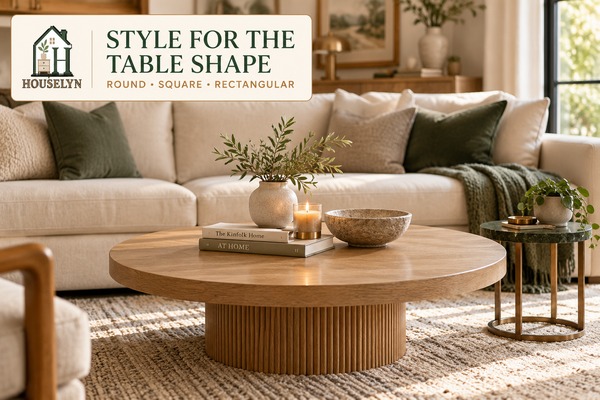
Coffee table styling works best when the table looks intentional
without losing the empty surface you need for drinks, books, remotes and everyday
living. The goal is not to fill every corner. It is to create one clear composition
that supports the living room while keeping the table genuinely useful.
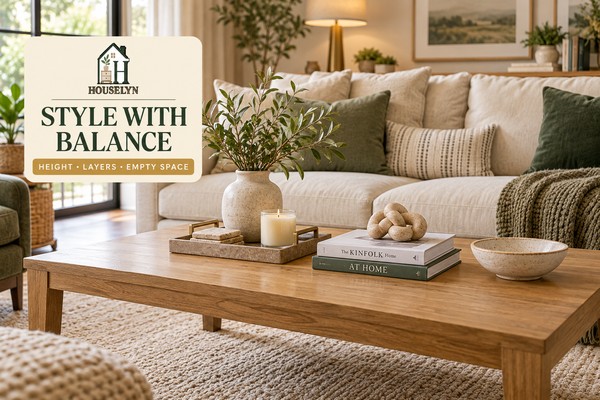
Balanced coffee table decor combines a clear focal point, varied heights and
deliberate empty space instead of covering the entire tabletop.
Good coffee table styling usually feels effortless because the
objects have a clear hierarchy. One piece leads, supporting elements add height or
texture, and enough surface remains open for the table to function normally.
This coffee table styling guide approaches the table as a small
composition rather than a collection of decorative accessories. You will learn
how to choose an anchor, build layers, vary height, group objects and edit the
arrangement before clutter begins to take over.
The strongest coffee table styling also responds to the table
itself. A long rectangular table can support a different composition from a small
round table, while an upholstered ottoman requires a more stable and practical
approach.
Why Coffee Table Styling Often Looks Harder Than It Should
Many tables become difficult to style because too many objects are treated as equally
important. A candle, bowl, vase, decorative object, stack of books and tray may all
be attractive individually, but placing every item on the same surface can create
visual competition instead of cohesion.
Effective coffee table styling solves that problem by deciding what
deserves attention first. Once the primary anchor is clear, the remaining pieces can
support it rather than compete with it.
Scale matters too. Small objects spread across a large tabletop can look lost, while
oversized books, trays or vases can consume so much space that the table becomes
difficult to use. Successful coffee table styling balances the size
of the decor with the size and shape of the surface beneath it.
Style the Surface for the Way You Actually Live
A magazine photograph can remove every remote, coaster and everyday object before
the picture is taken. A real home has to work after the photograph. That means
coffee table styling should make room for daily routines rather than
forcing you to clear the table every time you sit down.
Families may need more open space for snacks or games. A small apartment may use the
table for several purposes. Homes with children or pets may need fewer fragile or
unstable objects. In all of these situations, practical limits can improve
coffee table styling because they encourage stronger editing.
Think in Composition, Not Individual Accessories
Instead of asking whether a particular candle, bowl or ornament looks good by itself,
ask what role it plays in the complete arrangement. A low bowl can create width, a
book stack can provide structure, a vase can introduce vertical movement and a tray
can visually contain several smaller objects.
This approach makes coffee table styling easier because every item
must earn its place. If two objects serve the same visual purpose, one may be enough.
If nothing creates height, add one taller element. If the arrangement feels busy,
remove rather than automatically adding something new.
This coffee table styling guide follows seven decisions in order.
First reset the surface, then choose an anchor, build controlled layers, introduce
variation, organise objects into groups, preserve practical balance and finally
edit anything the table does not need.
ClearReset the surface
AnchorChoose the lead element
LayerBuild visual depth
VaryChange height and form
GroupCreate controlled clusters
BalanceProtect empty space
EditRemove the excess
Empty Space Is Part of the Design
One of the most important ideas in coffee table styling is that
undecorated surface is not unfinished surface. Empty space gives the objects room
to read clearly, makes the table easier to use and prevents decorative groups from
blending into one large mass.
The amount of open surface will vary by household and table size, so there is no
single percentage that works everywhere. The better test is whether the arrangement
still leaves obvious room for the things the table is expected to hold.
Before You Style, Ask These Five Questions
What shape and size is the coffee table?
What does the household actually use the table for?
Which one object or grouping should act as the visual anchor?
How much surface needs to remain clear every day?
Which objects could be removed if the finished arrangement feels crowded?
When these questions are answered first, coffee table styling
becomes a controlled design process rather than trial and error. You can make each
object contribute to height, shape, texture, function or visual balance.
The first step is therefore not buying another decorative accessory. It is clearing
the entire surface and understanding what the table needs to do before anything is
returned to it. That reset gives the next stage of coffee table styling
a clean and measurable starting point.
Affiliate disclosure: Houselyn may earn a commission from qualifying
purchases made through selected product links, at no additional cost to you. We only
include product categories that support the practical guidance in this article.
Chapter 1 — Clear
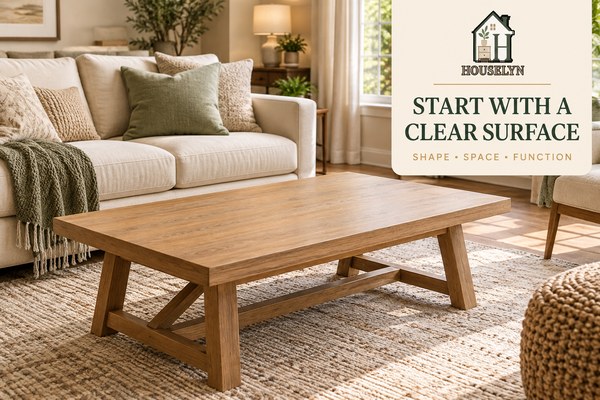
Coffee Table Styling Starts With an Empty Surface
Strong coffee table styling starts by removing everything from
the table. Clearing the surface makes it easier to see the true table shape,
available space and practical limitations before decorative decisions begin.
Many styling problems begin because existing objects are rearranged rather than
questioned. A tray stays because it has always been there, several books remain
because they look decorative, and remotes compete with candles and ornaments for
the same small area. That makes coffee table styling harder than it
needs to be.
Clearing the entire surface reveals how much room is genuinely available for
decor, drinks and everyday use.
Once the surface is empty, look at the table itself rather than the objects that
usually sit on it. Is it long and rectangular, compact and round, broad and square,
upholstered, glass-topped or built with storage underneath?
These physical characteristics influence coffee table styling
because they determine how much visual weight the table can support and how much
open space should remain around the final arrangement.
Measure the Usable Surface, Not Just the Furniture
Exact measurements are useful even on a decorative surface. Record the width and
length of a rectangular table or the diameter of a round table. If the table has a
lift-top section, inset tray, raised edge or upholstered top, note how much of the
surface is genuinely available.
Better coffee table styling comes from knowing whether a tray,
book stack or vase will occupy a small part of the tabletop or accidentally consume
most of it.
Identify What the Coffee Table Does Every Day
Before adding decor, write down the activities the table supports. Some households
mainly use it for drinks and remotes. Others use it for snacks, laptops, board
games, reading, children's activities or serving guests.
When coffee table styling ignores these routines, the arrangement
can look attractive for a few minutes but quickly becomes frustrating. The decor
is then moved constantly, which is a sign that the styling plan is working against
the furniture.
Decide What Must Stay Accessible
Everyday items do not necessarily have to disappear. Remotes can live in a compact
organiser or box. Coasters can be stacked neatly. A frequently used book can become
part of a deliberate stack rather than visual clutter.
Practical coffee table styling integrates necessary objects where
possible instead of pretending the table will remain permanently free of them.
Account for Children and Pets Before Fragile Decor
A home with young children, energetic pets or frequent family activity may need
fewer tall, heavy or breakable objects. Low bowls, soft-edged trays and stable
decorative pieces can create a finished look with less risk.
This does not make coffee table styling less sophisticated. It
simply means the arrangement is designed around the household rather than copied
from a setting with different practical requirements.
Ottomans Need a Different Reset
If an upholstered ottoman functions as the coffee table, begin by deciding how much
of the top needs to remain soft and accessible for feet, blankets or seating. A
stable tray may later become the anchor, but the tray should not automatically
occupy most of the ottoman.
Ottoman coffee table styling works best when every decorative
object can be moved easily as one contained group.
Glass Tables Need More Visual Restraint
Because the floor, rug and furniture remain visible through glass, objects can
appear visually busier than they would on an opaque surface. Fewer pieces often
create a stronger result.
On transparent surfaces, coffee table styling benefits from
generous spacing and a limited number of well-chosen forms.
Do Not Decide the Final Object Count Yet
Clearing and measuring are diagnostic steps. At this stage, there is no need to
decide whether the table should hold three objects, five objects or a tray with
several smaller pieces.
The object count in successful coffee table styling depends on
scale and grouping. Three tiny objects may look weaker than one substantial bowl,
while several small items placed inside one tray can visually read as a single
controlled composition.
Give the Table a Functional Priority
Decide what matters most before decoration begins. A formal living room may allow a
more decorative arrangement. A family living room may need quick access to clear
surface. A studio apartment may rely on the coffee table for multiple jobs.
This priority gives coffee table styling a practical boundary.
Decor can then be added up to that boundary rather than until the surface simply
looks full.
Once the table is clear, measured and understood, coffee table styling
becomes much easier to control. You know which part of the surface must remain
usable, which practical objects need a home and how much room is left for decoration.
The next step is to give the composition a visual starting point. Instead of adding
several unrelated pieces, choose one strong anchor that gives the rest of the
arrangement something to organise around.
Choose One Strong Anchor for Better Coffee Table Styling
Strong coffee table styling becomes easier when one element
establishes the visual starting point. That anchor gives the rest of the objects
a clear relationship instead of leaving every accessory to compete for attention.
The anchor does not have to be the largest object on the table. It simply needs
enough visual presence to organise the composition. In practical
coffee table styling, a tray, book stack, bowl or substantial vase
can all perform this role.
One strong anchor gives smaller objects a visual home and prevents the tabletop
from becoming a collection of unrelated pieces.
A visual anchor is the piece or grouped base that tells the eye where the
arrangement begins. It can be flat and wide, like a tray or stack of books, or more
sculptural, like a broad bowl or substantial vessel.
In successful coffee table styling, the anchor usually has enough
scale to hold attention without swallowing the table. It should establish order,
not become the only thing you can see.
Use a Tray When You Need Visual Containment
A decorative tray is useful when several small practical or decorative items need
to read as one unit. Candles, a small bowl, coasters or a compact object can feel
more intentional when contained within a defined boundary.
Tray-based coffee table styling is especially helpful on large
rectangular tables, ottomans and family tables where the entire arrangement may
need to move quickly.
Use Books When You Need Structure and Height
Coffee table books create a stable horizontal base. A short stack can elevate a
candle, bowl or small sculptural object while giving the composition a stronger
visual footprint.
Book-led coffee table styling works best when the books are
proportionate to the table and the stack remains modest. Too many books can become
a storage pile rather than part of the composition.
Use a Bowl When the Table Needs a Low, Broad Shape
A shallow decorative bowl can anchor a composition without adding much height. This
is useful when the room already contains tall lamps, plants or other vertical
features and the tabletop needs a quieter profile.
Bowl-led coffee table styling can also introduce ceramic, stone,
wood or metal without requiring several smaller accessories.
Use a Vase Carefully as the Main Anchor
A vase can work beautifully as the dominant element, especially on a large or round
table, but height matters. An arrangement that blocks sightlines between seats or
obscures the television becomes visually heavy very quickly.
Vase-based coffee table styling should therefore use restrained
greenery or flowers and keep the overall profile appropriate to seated eye level.
Do Not Automatically Centre the Anchor
Centring can work, especially on round or square tables, but it is not mandatory.
An offset tray or book stack can create a more relaxed composition on a long
rectangular surface while leaving usable space on the opposite side.
This is where coffee table styling becomes more intentional:
placement responds to the table shape and household use rather than following one
rigid centring rule.
Leave Room for the Supporting Layers
Once the anchor is in place, resist the urge to immediately fill every remaining
gap. The purpose of this stage is to establish hierarchy, not finish the entire
tabletop.
Controlled coffee table styling leaves enough room for a second
layer to add height, texture or function without forcing the arrangement outward
toward every table edge.
A Strong Anchor Should Simplify the Table
If adding the anchor makes the table feel more complicated, reconsider its scale or
position. The best anchor reduces visual decisions because it gives smaller pieces
somewhere to belong.
This is one reason the coffee table styling guide uses anchoring
before layering. Without a clear base, later objects can easily become scattered
decoration rather than one deliberate composition.
The strongest coffee table styling at this stage should feel
incomplete in a useful way: the anchor is clear, the table still has breathing room,
and there is space to add one or two supporting layers without crowding the surface.
The next stage builds those layers carefully. Instead of placing more objects beside
the anchor, we will use books, candles, bowls and small accents to create depth while
keeping the composition compact and controlled.
Chapter 3 — Layer
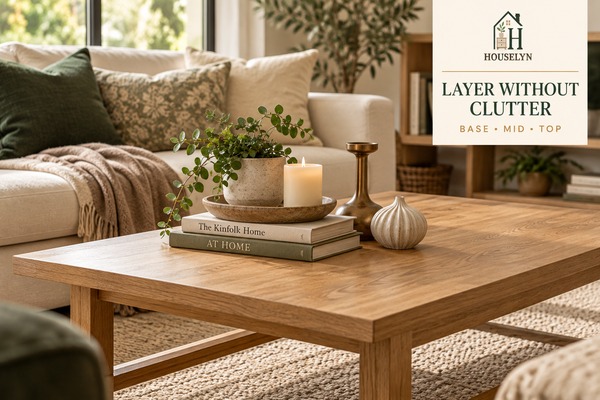
Layer Coffee Table Decor Without Making the Surface Look Crowded
Good coffee table styling gains depth by layering objects
deliberately rather than spreading everything across the surface. The strongest
layers build upward from a stable base and still leave the composition compact.
Layering is what turns a tray, book stack or bowl into a complete arrangement.
Instead of placing every item directly on the tabletop, use one element to support
another so the eye reads the objects as a connected group. This gives
coffee table styling more structure without automatically adding
more clutter.
A shallow layered arrangement creates depth while keeping the tabletop visually
controlled and practical.
A short stack of books is one of the easiest ways to create a second level. Two or
three well-proportioned books can support a candle, small bowl or compact sculptural
object while widening the visual footprint beneath it.
In refined coffee table styling, the books should act as part of
the composition rather than as a tall pile. The stack should feel stable, deliberate
and proportionate to the table.
Layer Inside a Tray Instead of Around It
If a tray is the anchor, build the next layer inside its boundary. A candle, shallow
dish and small object can sit together without requiring additional space across the
rest of the tabletop.
Tray-based coffee table styling is especially effective because
several objects can visually read as one controlled unit.
Use Height Without Building a Tower
Layering should introduce gentle changes in elevation rather than extreme vertical
stacks. A book under a candle, or a low bowl beside a slightly taller object, is
usually enough to create depth.
Successful coffee table styling keeps the composition easy to
understand from across the room and from the sofa. If several objects have to be
stacked high to remain visible, the arrangement may contain too many pieces.
Keep Each Layer Visually Different
If every layer uses the same material or shape, the arrangement can become flat
even when the heights change. A book stack paired with ceramic, glass, stone or
metal usually creates more distinction.
This is where coffee table styling becomes more than stacking.
Each level should contribute something different: height, texture, colour, shape
or function.
Avoid Layering Every Object
Not everything needs to sit on top of something else. If every candle rests on books,
every ornament sits inside a bowl and every vase stands on a tray, the composition
becomes visually dense.
Balanced coffee table styling uses layering selectively. Some
objects should remain directly on the tabletop so the arrangement has both stacked
and open elements.
Keep the Layers Shallow Enough for Daily Use
Deep stacks take up space quickly and are harder to move. For everyday living rooms,
a shallow arrangement is easier to maintain and leaves more usable surface around it.
Practical coffee table styling should never require dismantling a
tower of objects every time you want to set down a cup or open a book.
Use One Layer to Introduce Texture
A table dominated by smooth materials can benefit from one contrasting texture.
Ceramic, stone, woven fibre, glass or brushed metal can make a simple composition
feel richer without adding more objects.
This approach strengthens coffee table styling because variety
comes from material contrast rather than quantity.
At this stage, coffee table styling should begin to feel dimensional
without feeling full. The anchor still leads, supporting objects have clear roles,
and the surrounding tabletop remains visible.
The next stage focuses on variation. Once the layers are established, the composition
needs enough difference in height, shape and material to avoid becoming flat or
repetitive.
Chapter 4 — Vary
Vary Height, Shape and Material in Coffee Table Styling
Effective coffee table styling needs enough variation to keep the
arrangement visually active without making it chaotic. Height, shape and material
are the three easiest ways to create that rhythm.
When every object is the same height, the tabletop can look flat even if the pieces
themselves are attractive. When every piece has the same shape or finish, the
composition can feel repetitive. Better coffee table styling uses
contrast selectively so the eye moves naturally across the arrangement.
A low, medium and taller element create an easy visual rhythm when their shapes and
materials also differ.
One of the simplest ways to improve a tabletop is to create three different visual
levels. A low bowl or book stack can form the base, a candle or sculptural object
can occupy the middle and a restrained vase or branch can provide the tallest point.
This type of coffee table styling creates movement without requiring
many accessories. The arrangement feels dimensional because the eye has somewhere
to travel.
Keep the Tallest Element Below the Sightline
Height is useful until it begins to interfere with conversation, television viewing
or the visual connection between people sitting opposite one another.
In practical coffee table styling, the tallest object should usually
remain modest enough that the seating zone still feels open. Short stems, low branches
or compact greenery often work better than a dramatic tall floral arrangement.
Mix Curved and Angular Shapes
Shape variation can make even a limited colour palette feel richer. A rectangular
book stack paired with a round bowl and a softly curved vase creates contrast without
needing additional colours or patterns.
This makes coffee table styling particularly effective in neutral
living rooms, where form can create interest instead of relying on decorative excess.
Use Material Contrast Instead of More Objects
Wood, ceramic, glass, stone and metal reflect light differently and bring different
levels of visual weight to the table. Combining two or three materials can create
enough variation that fewer objects are needed.
Material-led coffee table styling often feels more sophisticated
because texture and finish provide the complexity rather than quantity.
Repeat a Material Once, Not Everywhere
Repetition can help a composition feel connected, but too much of the same finish
makes it flat. If a brass candle holder is used, a second subtle brass detail may
be enough. Five metallic accessories will usually overpower the table.
The strongest coffee table styling repeats materials with restraint
so the composition feels coordinated rather than matched.
Use Greenery as a Shape, Not Just a Colour
Greenery introduces irregular lines and soft movement that contrast with books,
trays and furniture. Even a small branch or simple foliage can make a structured
arrangement feel less rigid.
Greenery improves coffee table styling most when it is restrained.
A large plant can dominate the table, while a modest stem can provide enough height
and organic form.
Do Not Create Variation in Every Possible Way
A table does not need different colours, textures, heights, shapes and finishes in
every single object. Too much variation becomes another form of clutter.
Controlled coffee table styling usually chooses two or three kinds
of contrast and keeps the rest quieter. For example, vary height and material while
keeping the colour palette restrained.
Check the Composition From Across the Room
Close-up styling can hide proportion problems. Step back to the normal viewing
position and look at the whole table in relation to the sofa, rug and surrounding
furniture.
Strong coffee table styling should still read clearly from several
metres away. You should be able to identify the main anchor, the height change and
the overall grouping without seeing visual noise.
At this point, coffee table styling should have a clear anchor,
controlled layers and enough variation to avoid looking flat. The remaining challenge
is organisation: those elements now need to read as deliberate groups rather than
separate pieces spread across the surface.
The next chapter moves from individual objects to clusters. Grouping is what turns
multiple accessories into one coherent composition while preserving the empty space
that keeps the table calm.
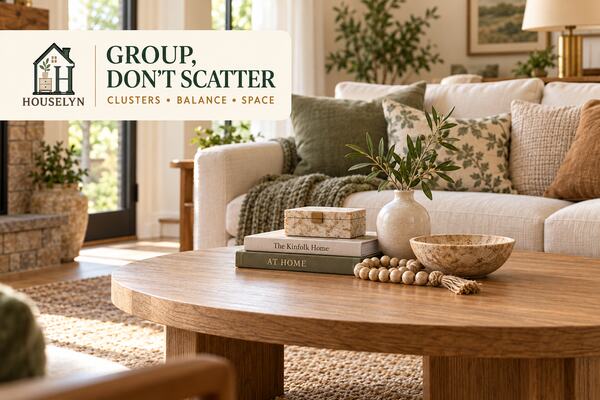
Group Coffee Table Decor Instead of Scattering Objects Everywhere
Strong coffee table styling uses controlled clusters so several
objects read as one composition. When accessories are spread evenly across the
whole surface, the table can look busy even when the total number of objects is low.
Grouping is the stage where individual pieces begin to feel intentional. A candle,
book stack and small vase placed close together can read as one visual unit, while
the same three objects spaced far apart can make coffee table styling
feel fragmented.
Grouping objects into one or two deliberate clusters creates order and leaves
valuable open space around the arrangement.
The eye naturally searches for relationships between objects. When pieces are close
enough to read as one group, the composition feels simpler even if it contains several
items.
This is why deliberate coffee table styling often looks less cluttered
than a table holding fewer but widely scattered objects.
Use Odd Numbers as a Starting Point, Not a Rule
Groups of three often work well because they create enough variation without becoming
visually complicated. A book stack, candle and small vase can form a complete cluster.
But coffee table styling does not require every group to contain
three objects. A tray with two substantial pieces may be enough, while a larger tray
may contain several small items that still read as one unit.
Keep Small Tables to One Main Cluster
Compact tables usually benefit from one clear grouping positioned centrally or slightly
off-centre. Several separate groups can consume the available surface too quickly.
Small-table coffee table styling becomes stronger when the composition
is compact enough to leave one obvious area free for drinks, remotes or everyday use.
Use Two Clusters Carefully on Large Rectangular Tables
A long rectangular coffee table may support a primary grouping on one side and a
smaller balancing element or secondary cluster on the other.
Large-table coffee table styling should still preserve a visual gap
between those zones. If the clusters merge into one continuous line of decor, the
table begins to look filled rather than styled.
Let a Tray Count as One Visual Group
A tray is useful because it can visually compress several smaller pieces into one
organised unit. Coasters, a candle and a small dish may feel like three separate
objects on the table but one composition when contained inside a tray.
This makes tray-based coffee table styling particularly useful when
practical objects need to remain accessible without appearing scattered.
Keep Space Between Separate Clusters
Two groups only work if the eye can clearly distinguish them. Leave enough bare surface
between clusters so each one has its own boundary.
Good coffee table styling uses that empty area as part of the
composition. The open section is what keeps two groups from becoming one long strip
of accessories.
Do Not Scatter Tiny Objects to Fill Gaps
Once a cluster looks complete, small empty spaces around it do not need to be filled.
Adding a tiny ornament to every gap weakens the stronger grouping you already created.
Refined coffee table styling allows the table itself to remain visible.
The surface is part of the design, especially when the table has attractive wood,
stone or glass.
Round Tables Need Tighter Grouping
Round tables naturally draw the eye toward the centre. A compact cluster usually
follows that geometry better than several objects positioned around the perimeter.
Round-table coffee table styling often works best with one central
group that varies in height while preserving a clean ring of usable surface around it.
Square Tables Can Use a Loose Quadrant Approach
On a larger square table, imagine four loose zones rather than covering all four.
One main cluster can occupy one or two zones while another low item balances the
opposite side.
This keeps square-table coffee table styling structured without
making the surface look rigid or over-planned.
At this stage, coffee table styling should feel more organised and
easier to read. The anchor leads, layered objects add depth, varied heights create
movement and the clusters keep those elements visually contained.
The next stage is balance. Even a well-grouped composition can become impractical if
it occupies too much of the tabletop, so the next chapter focuses on protecting the
empty space that lets the coffee table continue working in everyday life.
Chapter 6 — Balance
Leave Enough Empty Space for Coffee Table Styling to Work in Real Life
Successful coffee table styling is not measured by how much decor
you can fit on the surface. It is measured by how well the arrangement looks while
the table still performs its everyday job.
Empty space gives the composition breathing room, but it also gives people somewhere
to place a cup, book, snack or remote. When every available area is decorated,
coffee table styling stops supporting the room and begins competing
with the table's function.
Deliberate negative space keeps a styled table useful while helping the decorative
grouping look more intentional.
The open area around a tray, vase or book stack helps define the decorative group.
Without that space, even well-chosen objects can merge into one crowded visual mass.
This is why refined coffee table styling deliberately includes
undecorated surface rather than treating every empty area as a problem to solve.
Leave Room for Drinks and Everyday Objects
A practical table should make it obvious where a cup or glass can be placed without
moving a candle, lifting a tray or rearranging books first.
Everyday coffee table styling works best when at least one clear
zone remains accessible from the main sofa or chair.
Do Not Use a Fixed Percentage as a Universal Rule
Leaving roughly one-third to one-half of the tabletop visually open can be a useful
starting point in many living rooms, but it is not a rigid formula. A very small
table may need substantially more open space, while a large formal table may support
a fuller composition.
The better test for coffee table styling is whether the table remains
comfortably usable after the decor is in place.
Family Living Rooms Usually Need More Open Surface
If the table regularly supports snacks, homework, games, toys or several drinks,
decoration should occupy a smaller and more movable area.
Family-focused coffee table styling often works best when the main
cluster can be lifted away quickly as one unit, leaving the rest of the table free.
Small Homes Benefit From Flexible Styling
In an apartment or studio, a coffee table may double as a work surface, dining surface
or general landing zone. That makes flexibility more valuable than a highly elaborate
permanent display.
Small-space coffee table styling should therefore prioritise compact
groupings, movable objects and clear areas that can change function throughout the day.
Give Remotes a Defined Home
Remote controls become visual clutter when they are repeatedly left in different
positions. A compact organiser can make them easier to find while preventing them
from disrupting the decorative grouping.
Functional coffee table styling does not require hiding every
practical object. It requires giving everyday objects a consistent place.
Keep Practical Accessories Visually Quiet
Coasters, remote organisers and catchall dishes should support the composition rather
than create a second decorative theme. Choose pieces that relate to the existing wood,
ceramic, stone or neutral colour palette.
That restraint helps coffee table styling remain cohesive even when
functional accessories stay visible every day.
Protect the Best-Looking Part of the Table
If the coffee table has beautiful timber grain, stone veining or a refined glass
surface, covering nearly all of it wastes part of the furniture's visual value.
Balanced coffee table styling lets the tabletop material become part
of the composition instead of treating it only as a platform for accessories.
Ottoman Coffee Tables Need Even More Flexibility
An ottoman may need to support feet, blankets or extra seating as well as decor.
Keep the styling contained within a stable tray that can be moved as one piece.
Ottoman coffee table styling is most successful when the decorative
zone remains compact and the upholstered surface can still perform its other roles.
Test the Table at the End of a Normal Day
A styling arrangement can look perfect immediately after it is created but fail once
the household starts using the room. Notice what gets moved, where cups naturally
land and which objects repeatedly end up out of place.
Sustainable coffee table styling adapts to those habits. If an object
is moved every day, the arrangement may need editing rather than constant resetting.
Once coffee table styling has enough breathing room, the table should
feel both finished and easy to live with. The objects have a clear place, everyday
necessities are contained, and useful surface remains available without dismantling
the composition.
The next chapter applies the same principles to different table shapes. Rectangular,
round, square, oval, nesting and ottoman tables all change the way anchors, clusters
and negative space should be organised.
Chapter 7 — Table Shapes
Coffee Table Styling Rules Change With Table Shape
Strong coffee table styling follows the geometry of the table.
A long rectangular surface, compact round table and upholstered ottoman do not
need the same arrangement because each creates different visual boundaries.
Once the anchor, layers, height and negative space are working, table shape becomes
the final structural guide. Shape determines whether coffee table styling
should move horizontally, concentrate toward the centre or remain contained on a
stable tray.
The most natural arrangement usually follows the table geometry instead of forcing
the same decorative formula onto every shape.
Rectangular Coffee Tables Work Well With Horizontal Zones
A long rectangular table naturally encourages the eye to move from one end to the
other. Instead of filling that full length, divide it mentally into two or three
loose zones.
Rectangular coffee table styling can use one substantial cluster on
one side and a smaller balancing object on the other, while leaving an obvious area
open between them.
Do Not Create a Straight Line of Decor
Long tables can tempt you to arrange books, candles and bowls in one continuous row.
That usually emphasises the table length without creating enough depth.
Better rectangular coffee table styling uses overlapping visual
zones, varied heights and open surface rather than a decorative line running from
edge to edge.
Round Coffee Tables Prefer a Compact Central Composition
A round tabletop has no obvious beginning or end, so a central cluster often feels
more natural than objects spread around the perimeter.
Round coffee table styling can begin with a tray, bowl or book stack
near the centre and build outward just enough to create variation while preserving
a usable ring of space around the grouping.
Use Triangular Height on a Round Table
A low, medium and taller element can work especially well on a round surface because
the three points create movement without needing a rigid front and back.
This approach gives round coffee table styling structure while
keeping the composition soft enough to suit the curved edge.
Square Tables Can Use a Loose Quadrant System
Imagine a square coffee table divided into four large zones. You do not need to fill
all four. One main cluster can occupy one or two zones while a low balancing object
uses another.
Square coffee table styling works best when those imaginary zones
guide the placement without becoming a visibly symmetrical grid.
Oval Tables Benefit From Flowing Asymmetry
Oval tables combine the length of a rectangle with softened edges. A slightly
off-centre composition often follows that form more naturally than a perfectly
centred grouping.
Oval coffee table styling can use a low horizontal anchor with one
taller element positioned toward one end, allowing the eye to follow the table's curve.
Ottoman Coffee Tables Need a Stable Tray
Upholstered tops do not provide the same stable base as wood or stone. A substantial,
flat tray can create a secure decorative zone for a small vase, candle or book stack.
Ottoman coffee table styling should stay compact enough that the
complete group can be removed easily when the ottoman is needed for feet, blankets
or additional seating.
Nesting Tables Should Not All Be Fully Styled
Nesting tables are designed to move, overlap and separate. Covering each surface with
multiple decorative objects makes that flexibility difficult to use.
Nesting-table coffee table styling works better when one table carries
the main composition and the secondary table holds either one low object or remains clear.
Lift-Top Tables Need Moveable Decor
A lift-top table may become a work surface or dining surface several times a day.
Decor therefore needs to be compact and easy to relocate.
Lift-top coffee table styling benefits from one tray or grouped base
rather than several independent objects spread across the moving section.
Glass Tables Need Fewer Objects Than You Expect
A glass table visually includes the rug and floor beneath it, so even a modest number
of accessories can appear busier than on an opaque surface.
Glass-table coffee table styling usually looks stronger with fewer,
more substantial shapes and wider spacing between them.
Use These Styling Formulas as Starting Points
Table Type
Useful Starting Formula
Main Check
Small rectangular
1 tray + 1 short book stack + 1 small object
Keep one clear drink zone.
Large rectangular
1 main cluster + 1 low balancing element or second compact cluster
Maintain clear space between the zones.
Round
1 central cluster of 3 varied forms
Keep a visible ring of usable surface.
Square
1 primary cluster + 1 low secondary object
Avoid filling all four imagined quadrants.
Oval
1 low horizontal anchor + 1 taller offset element
Let the grouping follow the curve.
Ottoman
1 stable tray + 2–3 compact objects
Everything should move easily as one group.
Glass
1 restrained cluster with generous spacing
Remember the rug and floor add visual detail underneath.
These are starting formulas, not fixed rules. Table dimensions, daily use, existing
materials and the surrounding room should determine the final arrangement.
Let the Shape Solve the Layout Before You Add More Decor
When a tabletop feels difficult to style, look at its geometry again before buying
another accessory. The shape may already suggest where the anchor, height and empty
space should sit.
Shape-led coffee table styling reduces unnecessary decisions because
the furniture itself becomes part of the composition strategy.
By this stage, coffee table styling should respond to both the objects
and the furniture beneath them. The anchor, layers, variation, grouping and negative
space now have a shape-specific structure rather than a one-size-fits-all layout.
The final chapter turns the full framework into a diagnostic check. It identifies the
mistakes that make even attractive objects look cluttered, repetitive or impractical
so you can edit the surface before calling it finished.
Coffee Table Styling Mistakes That Make the Surface Look Cluttered
Most coffee table styling problems are not caused by owning the
wrong accessories. They are usually caused by too many objects, weak hierarchy,
repeated shapes or not leaving enough space for the table itself.
When a tabletop feels busy, the fastest solution is usually to edit before buying
anything new. Strong coffee table styling depends more on what you
remove, group and reposition than on how many decorative pieces you own.
Too many small objects, repeated heights and little clear surface can make even
attractive decor feel visually crowded.
The most obvious mistake is simply having more decorative pieces than the surface
can support comfortably. Even attractive objects lose impact when they compete for
attention.
Better coffee table styling starts by identifying the strongest
pieces and removing anything that does not add height, texture, shape, function or
meaning.
2. Keeping Everything at the Same Height
A row of candles, bowls or books at similar heights creates a flat horizon across
the table. The eye has no reason to move through the composition.
Successful coffee table styling introduces low, medium and taller
levels while keeping the tallest point below comfortable sightlines.
3. Centring Every Object
Perfect centring can make a rectangular or oval table feel rigid. One central object
may work, but several centred items can look more like a display grid than a relaxed
living-room arrangement.
Flexible coffee table styling allows controlled asymmetry where the
table shape and room use support it.
4. Leaving No Empty Surface
When decor reaches across most of the tabletop, the table becomes difficult to use
and every object loses visual breathing room.
Negative space is one of the most important parts of coffee table styling
because it makes both the furniture and the decorative group easier to see.
Too Many ObjectsAccessories compete rather than forming one readable composition.
Same HeightThe surface looks visually flat even when individual pieces are attractive.
Everything CentredRigid symmetry can work against long, oval or asymmetrical tables.
No Negative SpaceThe furniture disappears beneath the decoration and daily use becomes harder.
Tiny Scattered PiecesSmall objects placed far apart create visual noise rather than one cluster.
Ignoring Table ShapeThe composition fights the furniture geometry instead of following it.
5. Choosing a Tray That Is Too Large
A tray should organise part of the tabletop, not become a second tabletop sitting
on top of the first. If the tray covers most of the surface, the arrangement loses
flexibility and visual lightness.
Tray-based coffee table styling works best when clear table remains
visible around the tray.
6. Stacking Too Many Books
Books are excellent styling tools, but a tall pile can look more like storage than
decoration and can make the composition feel unnecessarily heavy.
Book-led coffee table styling usually benefits from short, stable
stacks that act as platforms rather than towers.
7. Using a Vase That Is Too Tall
A dramatic vase may look beautiful from one angle but become frustrating if it blocks
conversation or television viewing from the sofa.
Practical coffee table styling keeps tall elements restrained enough
to preserve comfortable sightlines across the seating area.
8. Scattering Tiny Decor Across the Table
Several small ornaments can create more visual clutter than one larger bowl or compact
cluster because the eye reads every piece separately.
Refined coffee table styling groups small objects together or replaces
several tiny accessories with one stronger shape.
9. Using Too Many Candles
Candles add warmth and height, but several different candles, holders and vessels can
quickly become repetitive.
A stronger coffee table styling approach is to use one candle or one
coordinated candle moment rather than repeating the same category across the table.
10. Blocking the Sightline
Styling must work from seated positions, not only from above. Tall branches, flowers
or sculptural pieces should not create a visual barrier across the conversation zone.
11. Leaving No Practical Place for a Cup
A table can look polished but still fail functionally if every accessible position
is occupied by decor.
Everyday coffee table styling should preserve at least one obvious
landing area for drinks or other frequently used items.
12. Ignoring the Table Shape
A long row of decor on a round table or several scattered clusters on a tiny square
table can feel awkward because the arrangement is fighting the surface below it.
Shape-aware coffee table styling follows the table geometry before
deciding where each accessory belongs.
13. Mixing Too Many Materials
Wood, metal, ceramic, glass, stone, woven fibre and mirrored finishes can all be
beautiful, but using all of them in one compact composition can create visual noise.
Cohesive coffee table styling generally works better when two or
three materials lead and any additional finish appears only as a subtle accent.
14. Overloading the Table With Seasonal Decor
Seasonal styling can refresh a living room, but replacing every everyday object with
themed pieces can make the table feel temporary and crowded.
Seasonal coffee table styling is usually stronger when one or two
details change while the core composition remains stable.
15. Forgetting to Edit at the End
The final styling step is not adding something. It is checking whether anything can
be removed without weakening the arrangement.
This is often the difference between acceptable coffee table styling
and a composition that feels calm, confident and finished.
Edit Before You Replace
If a finished table still feels wrong, remove one or two objects before changing the
entire arrangement. Simplifying often reveals that the anchor, tray or book stack was
already strong enough.
This makes coffee table styling easier to maintain because the final
arrangement depends on fewer, better-defined elements.
The complete coffee table styling system is now in place:
clear the surface, choose an anchor, build layers, vary the composition, group the
objects, preserve balance and edit the excess.
The next section answers the practical questions that often remain after the styling
is complete, from how many objects to use to how round, small and family coffee tables
should be handled.
This coffee table styling guide answers the most common practical
questions about arranging trays, books, candles, greenery and everyday essentials
while keeping coffee table styling balanced, useful and uncluttered.
1. How do you style a coffee table?
Start with a completely clear surface, choose one anchor such as a tray, book stack
or bowl, then add a small number of supporting objects with different heights and
shapes. Good coffee table styling should still leave obvious
usable space around the arrangement.
2. What should go on a coffee table?
A coffee table may include books, a decorative tray, shallow bowl, candle, small
vase, greenery, sculptural object, coasters or a discreet organiser. The best
selection depends on the table size and how the household actually uses it.
3. How many items should be on a coffee table?
There is no fixed number. Three well-proportioned objects may be enough on a
compact table, while a larger surface may support one or two grouped clusters.
In coffee table styling, visual groups matter more than raw object
count.
4. Should coffee table decor be centred?
Not always. A round table often suits a central grouping, while rectangular and
oval tables can look more relaxed with an offset composition. Centre the arrangement
only when it suits the table shape and everyday use.
5. How do you style a small coffee table?
Use one compact cluster and preserve a clear area for drinks or remotes. Small-table
coffee table styling usually works best with fewer, slightly more
substantial pieces rather than many tiny accessories.
6. How do you style a large coffee table?
A large table can support one substantial cluster plus a low balancing element,
or two controlled clusters separated by obvious negative space. Avoid filling the
whole surface simply because more room is available.
7. How do you style a round coffee table?
Build one compact central grouping with varied height. A tray, low bowl or short
book stack can act as the anchor, with a candle or modest vase completing the
composition. Round coffee table styling benefits from a clear ring
of surface around the group.
8. How do you style a square coffee table?
Imagine the surface divided into loose quadrants. Use one main cluster across one
or two areas and, if needed, one low balancing object elsewhere. Avoid decorating
all four zones equally.
9. How do you style a rectangular coffee table?
Use the table's length to create one main composition or two separated zones.
Rectangular coffee table styling should avoid a straight row of
accessories running from one end to the other.
10. How do you style an ottoman coffee table?
Start with a stable tray to create a hard, movable surface. Keep the arrangement
compact so the whole group can be removed when the ottoman is needed for feet,
blankets or extra seating.
11. Should you use a tray on a coffee table?
A tray is useful when it visually contains several smaller objects or practical
items. It is not essential, but tray-based coffee table styling
can make a group easier to organise and move.
12. How many coffee table books should you stack?
Two or three books are often enough to create a stable low platform. The exact
number depends on book thickness and table scale, but the stack should look
intentional rather than like book storage.
13. Can you use candles on a coffee table?
Yes. One candle or a restrained candle grouping can add warmth and medium height.
Keep open flames away from loose greenery, fabrics and unstable objects, and use
the table safely according to the candle manufacturer's instructions.
14. How tall should coffee table decor be?
There is no single ideal height, but the tallest item should generally preserve
comfortable sightlines between people sitting around the table. Good
coffee table styling uses height for rhythm without creating a
visual barrier.
15. Should you use flowers or greenery?
Yes, if they suit the room. Restrained greenery can introduce organic shape and
height without taking much surface area. Choose a modest arrangement rather than
allowing foliage to dominate the table.
16. How much empty space should you leave on a coffee table?
Roughly one-third to one-half of the table may remain visually open as a starting
point in many rooms, but this is flexible. Practical coffee table styling
should leave as much clear surface as the household needs for everyday use.
17. How do you hide remote controls on a coffee table?
Use a small organiser, decorative box or defined tray area so the remotes remain
easy to find without being scattered across the tabletop. The container should be
proportionate to the table and coordinate with the existing materials.
18. How do you style a coffee table with children or pets?
Choose stable, low-profile and less fragile objects. Avoid sharp, heavy or easily
breakable decor near accessible edges. Family-friendly
coffee table styling should prioritise safety and flexibility
over delicate displays.
19. How often should you change coffee table decor?
Change it when the room, season or household needs change rather than following a
fixed schedule. Often one small seasonal adjustment to greenery, a bowl or a book
is enough to refresh the arrangement without rebuilding it.
20. What is the most common coffee table styling mistake?
The most common mistake is adding too much and failing to edit afterward. Strong
coffee table styling usually improves when repeated objects,
unnecessary accessories and visual clutter are removed.
Houselyn Action Plan
5-Step Coffee Table Styling Plan for a Balanced, Usable Surface
Use this five-step process to turn the full framework into practical
coffee table styling. The aim is to create a finished arrangement
with clear hierarchy, varied height, controlled grouping and enough usable space
for everyday living.
Step1
Clear the Entire Surface
Remove every decorative and practical object before deciding what should stay.
Look at the table shape, size, material and everyday use with nothing competing
for your attention.
Starting from zero makes coffee table styling easier because
you can rebuild the composition deliberately instead of working around objects
that may no longer deserve a place.
Do this first: clear, clean, measure and identify the amount
of tabletop that needs to remain available for normal daily use.
Step2
Choose One Visual Anchor
Select one strong starting point such as a tray, short book stack, shallow bowl
or substantial vessel. That anchor should establish where the composition begins.
Effective coffee table styling becomes easier when smaller
objects support one clear anchor instead of competing as equal focal points.
Keep it simple: choose one anchor and initially add no more
than two to four supporting elements around it.
Step3
Add Height, Shape and Material Variation
Build a low, medium and taller level using the objects you already have. Then
check whether the shapes and materials are sufficiently different to create
rhythm without adding unnecessary pieces.
Strong coffee table styling often needs only one or two kinds
of contrast. A rectangular book stack, round bowl and modest vase can provide
enough variation in a restrained neutral palette.
Check: low + medium + taller, curved + angular, and no tall
element blocking the main seating sightline.
Step4
Group the Objects Into One Clear Composition
Bring related objects closer together so they read as a cluster rather than
as separate items scattered across the table.
Grouped coffee table styling usually feels calmer because
the eye reads several accessories as one composition instead of processing
every object independently.
Starting rule: one cluster for a small table, one main cluster
plus one balancing element for a medium table, and no more than two clear zones
for a large table.
Step5
Edit the Arrangement and Protect Usable Space
Step back from the table and remove anything repetitive, oversized or
unnecessary. Then make sure the finished arrangement leaves enough clear
surface for drinks, remotes and the way the table is actually used.
Finished coffee table styling should look complete without
making the table difficult to live with.
Final question: if one object were removed, would the table
look weaker or calmer? If it looks calmer, leave the object out.
Your Finished Surface
What a Successful Coffee Table Should Now Have
Before calling the table finished, confirm that your
coffee table styling has one clear anchor, controlled layers,
varied height and shape, intentional grouping and obvious usable space. The
arrangement should also follow the table shape and remain easy to adjust when
daily life requires more room.
Houselyn Conclusion
Coffee Table Styling Works Best When the Surface Feels Finished but Still Usable
The strongest coffee table styling does not try to prove that every
decorative idea can fit on one table. It creates one clear composition, protects
useful surface and makes the table feel complete without making it difficult to live with.
A well-styled table has hierarchy. One anchor establishes the composition, a small
number of supporting objects add depth, varied heights create movement and grouped
objects keep the arrangement visually contained.
That is why successful coffee table styling is less about buying
more decor and more about making stronger decisions with the objects already available.
Clear the table first, choose one anchor, layer supporting elements, vary height
and shape, group related objects, protect practical empty space and edit anything
that does not improve the final composition.
One of the easiest ways to judge coffee table styling is to step
back and look at the surface from the normal seating position. You should be able
to understand the composition quickly without your eye jumping between unrelated objects.
The table shape should also remain visible. A beautiful wood, stone or glass surface
should not disappear beneath trays, books and accessories. The furniture itself is
part of the design.
Practicality matters just as much as appearance. If a cup cannot be set down without
moving decor, if remotes are constantly displaced or if the entire arrangement has
to be dismantled every day, the coffee table styling needs another edit.
Small changes often solve the problem. Remove one candle. Shorten a book stack.
Move the cluster slightly to one side. Replace several small objects with one stronger
bowl. These adjustments can create more improvement than adding another accessory.
If several answers are no, return to the earliest weak stage. Weak
coffee table styling is often easier to fix when you identify
whether the problem began with the anchor, the layering, the grouping or the final edit.
If the table has no focal point, strengthen the anchor. If it feels flat, vary the
height or material. If it feels scattered, tighten the cluster. If it feels crowded,
protect more negative space.
The goal of coffee table styling is not visual perfection. It is to
create a surface that looks intentional enough to support the room and flexible
enough to keep working when people actually use it.
When that balance is right, the table becomes quieter. You notice the composition
rather than the individual accessories, and the entire seating area feels more
considered without looking overly arranged.
Continue Learning With Houselyn
Keep Refining the Living Room Around the Coffee Table
Once coffee table styling feels balanced, continue with the
Houselyn guides that help you improve furniture placement, whole-room proportion,
decor layering and the visual relationship between the coffee table, sofa and rug.
The Houselyn Editorial Team creates practical, design-conscious guidance for
decorating, organizing and improving everyday homes. Our approach focuses on
realistic proportions, functional planning, thoughtful purchasing decisions
and interiors that remain comfortable and usable after the styling is complete.
Use the Houselyn Knowledge Library to continue from the part of
coffee table styling that connects most closely with your next
living-room decision. This keeps tabletop styling focused while directing whole-room
layout, proportion and decorating questions to the specialist guides that own them.
1. Style the Living Room
Use these guides when the tabletop is working but the rest of the room still
needs decorative structure, visual direction or finishing detail.
As the Living Room cluster expands, the next specialist pages can build outward
from coffee table styling without duplicating its role. Wall art,
mirrors and shelves belong in the future Blank Wall Decor guide, while whole-room
diagnostic problems belong in Living Room Feels Off Fixes.
Keeping those topics separate protects this page's specialist purpose. Surface
hierarchy, books, trays, candles, grouping, negative space and editing belong here;
wall treatment and whole-room troubleshooting should remain in their own authority pages.
When the tabletop needs another reset, return to the complete Houselyn sequence:
Clear → Anchor → Layer → Vary → Group → Balance → Edit.
The strongest coffee table styling should make the table feel
considered without making it precious. The surface can look finished, support the
room and still remain easy to use every day.
Living Room cluster expansion:
add Blank Wall Decor and Living Room Feels Off Fixes to this Knowledge Library only
after those pages are completed and live.