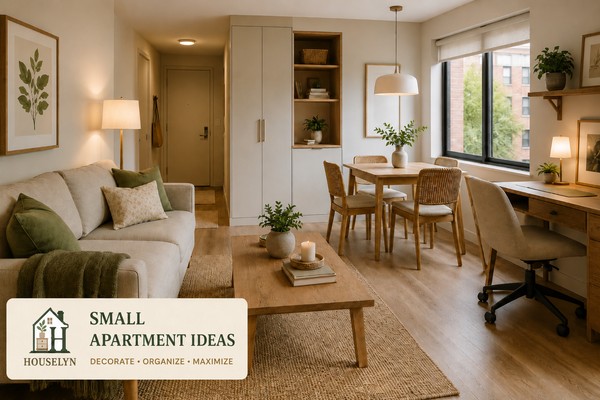
Small Apartment Ideas: How to Decorate, Organize and Maximize Every Room
A successful small apartment connects furniture, storage, lighting and
everyday routines without filling every available surface.
Affiliate and advertising disclosure: Houselyn may earn
a commission from qualifying purchases made through selected links, at no
additional cost to you. Product recommendations are chosen for their
relevance to the room-planning principles explained in this guide.
The most useful small apartment ideas begin with the
apartment you actually have: its measurements, fixed features, storage
limits, daylight, tenancy rules and daily routines. Instead of trying to
make a compact home imitate a much larger one, this guide helps every room
support more of real life with fewer conflicts.
Understand the Small Apartment
A Small Home Needs a Complete System, Not More Isolated Tricks
Small apartments are often presented as decorating puzzles that can be
solved with mirrors, pale paint or one convertible sofa. Those techniques
may help in the right room, but none of them can correct a layout that
blocks movement, storage placed far from its routine or furniture that
consumes more clearance than the home can provide.
Strong small apartment ideas connect decisions that are
frequently treated separately. The sofa affects the walking route. The
dining table may also need to support work. Storage changes how much of
the wall remains visually open. A floor lamp requires both floor space
and a practical power route. Even an attractive purchase can weaken the
apartment when those relationships are ignored.
This guide therefore treats the apartment as one connected home system.
You will measure the usable space, define activity zones, select furniture
according to real clearance, distribute storage, protect daylight, build
a consistent style and create reset routines that keep the plan working
after the initial makeover is complete.
The recommendations are designed for renters and apartment dwellers who
need practical improvements without assuming that walls can be altered,
fixtures can be replaced or permanent construction is available. Tenancy
agreements, building rules and manufacturer instructions should always
take priority over general inspiration.
Part I • Measure the Real Apartment
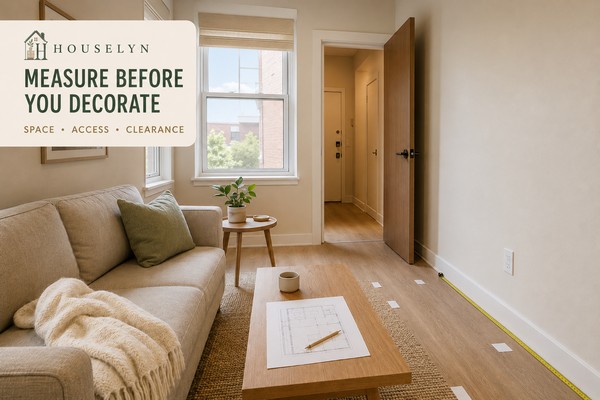
Measure Small Apartment Ideas Against the Real Space
Record walls, openings, fixed features, furniture clearance and delivery
access before deciding what the apartment should contain.
Reliable small apartment ideas begin with more than a
room’s longest wall. They account for doors that open, drawers that extend,
windows that provide light, sockets that need access and the routes people
use every day.
Measure the Space That Can Actually Be Used
A floor plan may show the total dimensions of a room without revealing
how much of that area can support furniture. A long wall may include a
radiator, socket, window, intercom, built-in cupboard or door swing. The
remaining uninterrupted section is the usable wall length.
Measure each wall in sections rather than writing down one overall
number. Record where fixed features begin and end, then note how much
open floor is needed in front of them. A cupboard cannot function when a
sofa blocks its door, and a window may become difficult to open when a
desk is placed too close to it.
Many small apartment ideas fail because the product fits
the visible gap but not the surrounding routine. The furniture may prevent
a door from opening fully, leave no comfortable route around the bed or
make a frequently used drawer inaccessible.
Trace the Apartment Through Daily Movement
Static measurements cannot show every conflict. Walk through the
apartment while imagining the routines that will happen after furniture
is installed. Carry a laundry basket from the bedroom, bring shopping
through the entrance and move between the kitchen and dining area.
Open the wardrobe, kitchen cupboards, storage benches and balcony or
patio doors. Sit where the sofa or desk may be placed. The goal is to
understand how the room changes when people and furniture are in motion.
Test Furniture as an Operating Object
Furniture dimensions usually describe the item while it is closed and
stationary. Daily use may require much more space. Dining chairs move
backwards, sofa beds extend, storage ottomans open, desks need chairs and
wardrobes require access in front of their doors.
Mark the proposed footprint with removable floor-safe materials where the
tenancy permits, or use folded paper and existing objects to represent
the edges. Then test the apartment around the marked area for at least one
normal routine.
This temporary test makes small apartment ideas more
reliable because it reveals whether a seemingly compact product will
reduce access, circulation or flexibility after it arrives.
Record Fixed Features Before Treating Them as Problems
Not every awkward feature should be hidden. A recess may provide a useful
desk or shelving position. A structural column may help define a zone.
An exposed radiator may establish the amount of clear wall that furniture
must leave available.
Photograph each fixed element and record what it affects. Consider access,
ventilation, operation, maintenance and the landlord’s requirements before
placing furniture close to it.
The aim is not to disguise the apartment’s architecture at any cost. It
is to work with the existing structure so that later choices remain
physically believable and easy to maintain.
Part II • Organize the Apartment by Activity
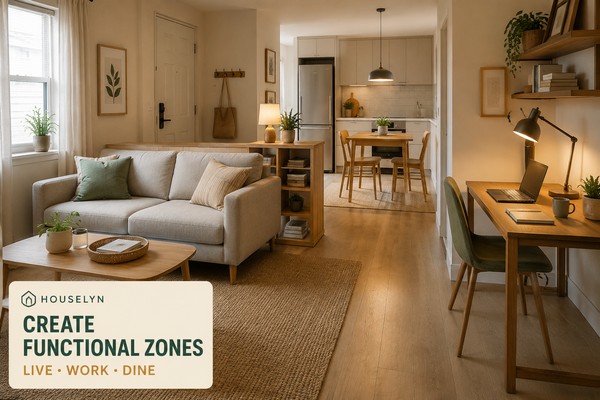
Zone Small Apartment Ideas Around Daily Life
Furniture direction, rugs, lighting and storage can define activities
without enclosing every part of an open-plan apartment.
Effective small apartment ideas give each important
routine a recognizable place. Zoning does not require permanent walls or a
collection of room dividers; it requires clear relationships between
activities, furniture and the routes connecting them.
Organize the Apartment by What Happens There
Room labels can be too broad to guide a compact home. A living room may
support relaxation, remote work, meals, exercise, hobbies and occasional
guests. When those activities compete for the same surface without an
agreed structure, the room begins to feel disorganized even when the
furniture itself is attractive.
Start by listing the routines that happen every day, every week and only
occasionally. Daily activities deserve the easiest access. Weekly
activities may share furniture or storage. Rare activities should not
control the permanent layout unless they are especially important to the
household.
Strong small apartment ideas distinguish between a zone
and a separate room. A zone is simply an area where the furniture,
lighting and nearby storage make one activity easier to begin and easier
to finish.
Use Visual Boundaries Before Physical Dividers
A solid divider can provide privacy, but it can also interrupt daylight,
movement and the visual length of a compact room. Begin with lighter
methods that indicate a change in use without closing the apartment.
Turn the sofa so its back defines the edge of the living area. Place a rug
beneath the main seating group. Use a pendant or table lamp to identify
the dining position. Arrange a narrow shelf so it stores work materials
beside the desk without becoming a full wall.
These small apartment ideas create distinction through
orientation and repetition. The zones feel intentional, but the eye can
still travel through the apartment.
Separate Work From Rest Without Duplicating Furniture
Remote work can make a compact home feel permanently unfinished when the
laptop, cables and paperwork remain visible throughout the evening.
Creating a work zone does not always require a separate office or a large
desk. It does require a defined operating surface and a reliable reset.
A dining table may support work when equipment can be stored nearby and
the table can return to meals without a lengthy transition. A slim desk
may be more appropriate when work happens daily or involves multiple
devices. The right decision depends on frequency, equipment and whether
another person needs the shared surface at the same time.
Avoid placing the work zone where it blocks the apartment’s main
relaxation view unless no practical alternative exists. When the desk is
visible from the sofa, closed storage, controlled cables and an end-of-day
routine become part of the zoning plan.
Treat the Entrance as an Operating Zone
Even a small entrance performs several responsibilities. It receives
shoes, coats, shopping, keys, post and parcels before those items reach
the rest of the home. When the entrance has no containment plan, the
nearest chair, table or kitchen counter becomes the replacement.
Build the arrival zone around the actual door clearance and walking path.
A shallow shoe cabinet, wall hooks where permitted, a small tray or one
basket may be enough. The objective is not to install every entryway
product, but to stop incoming belongings at the first practical point.
Use Flexible Zones Only Where the Transition Is Realistic
Multipurpose rooms work when the change between activities is simple. A
dining table can become a desk if equipment has nearby storage and the
table can be restored quickly. A sofa area can support occasional
exercise if the coffee table moves easily and has a proper return
position.
A zone is less successful when every transition requires carrying
furniture across the apartment, untangling cables or moving unrelated
belongings. Flexible small apartment ideas should reduce
the amount of permanent furniture without creating repeated setup work.
Part III • Scale Furniture to the Home
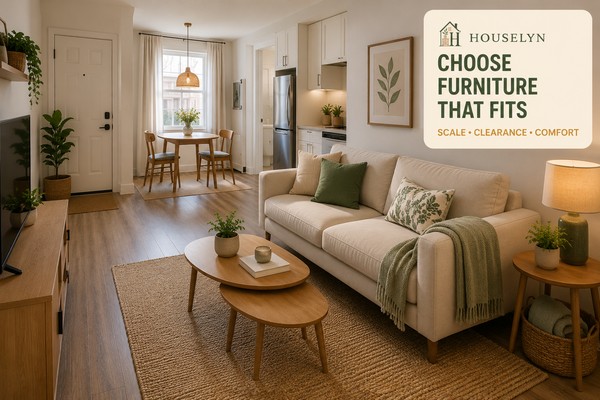
Scale Small Apartment Ideas With Furniture That Truly Fits
Appropriately scaled anchor furniture can make a compact apartment feel
calmer than a collection of undersized pieces.
Useful small apartment ideas do not require every chair,
table and cabinet to be miniature. Furniture should be large enough to
perform its job comfortably while preserving the clearance, access and
flexibility the apartment needs.
Choose Furniture by Use, Not by the Word “Compact”
Product descriptions often use terms such as compact, slim, apartment
size or space saving without explaining whether the item suits a specific
room. A narrow sofa may still have deep arms. A storage ottoman may need
substantial space for its lid to open. A folding table may require a
permanent location for the folded chairs.
Begin with the activity the furniture must support. Determine how many
people use it, how often it is used, which belongings must remain nearby
and what movement happens around it. These practical requirements produce
a more useful shortlist than the product category alone.
Many small apartment ideas appear efficient because the
furniture occupies little space in a styled photograph. The real test is
whether the item remains comfortable, accessible and easy to maintain
after the apartment’s daily routines begin.
Let Anchor Furniture Establish the Room
The largest necessary item should usually be selected before secondary
tables, stools and decorative storage. In a living area, that anchor may
be the sofa. In a bedroom, it is normally the bed. In a combined dining
and work zone, it may be the table that supports both routines.
Choosing the anchor first reveals the amount of space that remains for
circulation and supporting furniture. It also reduces the temptation to
fill the room with several small pieces whose combined footprint becomes
larger and more visually complicated than one appropriate item.
An appropriately scaled sofa may give two people comfortable seating while
leaving enough room for one small table. Several narrow chairs, stools and
side tables may provide less comfort while creating more legs, edges and
obstacles.
Protect Negative Space as Part of the Layout
Empty floor and open wall are not evidence that the apartment is
unfinished. They help doors operate, people pass, daylight travel and
visual groups remain clear. Negative space also provides flexibility for
temporary activities such as exercise, laundry, guests or assembling a
delivery.
Leave breathing room around the primary pieces before deciding what else
can be added. A clear interval between the sofa and dining table helps
both zones read properly. Open space beside the bed may be more useful
than a narrow cabinet that makes access uncomfortable.
The objective is not to maximize the number of products that technically
fit. It is to create a home in which the necessary furniture can be used
without constant adjustment.
Select Flexible Furniture Without Creating Setup Work
Folding, nesting and extending furniture can support changing routines,
but the transition should be simple. Nesting tables are useful when the
smaller surfaces can be separated for guests and returned without
dismantling the living area. An extendable dining table is useful when the
closed size serves ordinary meals and the open size still preserves
circulation.
Avoid products that depend on a storage position the apartment does not
have. Folding chairs are not space saving when they remain stacked beside
the dining table. Removable table leaves are inconvenient when they must
be stored beneath the bed behind unrelated belongings.
The best flexible product reduces permanent furniture while keeping the
transition short, safe and repeatable.
Avoid Filling the Apartment With Small Furniture
A room does not necessarily feel larger when every item is narrow. Many
small pieces create more edges, legs, gaps and surfaces to maintain. They
may also provide insufficient comfort or storage, causing the household to
add even more products later.
The most convincing small apartment ideas balance one or
two clear anchor pieces with quieter supporting furniture. This approach
reduces visual competition and makes the intended use of the room easier
to understand.
Stop adding furniture when every important routine has an appropriate
place and the room still preserves useful open space. The remaining gaps
are part of the finished plan.
Part IV • Store Belongings Where Life Uses Them
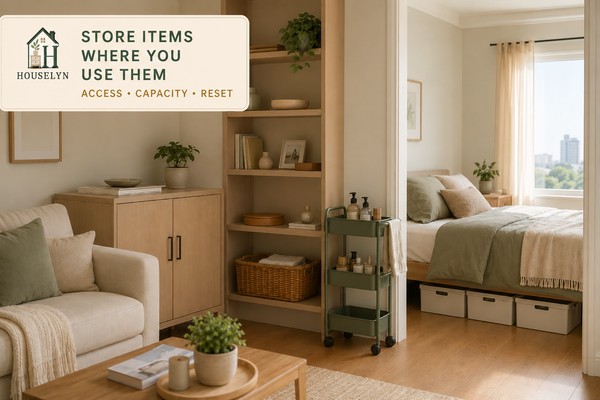
Build Small Apartment Ideas Into Every Room With Better Storage
Storage works best when daily items remain accessible, less-used
belongings move outward and every container has a practical return route.
Practical small apartment ideas do not concentrate every
belonging inside one large cabinet. They distribute storage close to the
routines it supports while preserving doors, windows, sockets, circulation
and enough spare capacity for ordinary life.
Store Belongings Near the Routine That Uses Them
Storage becomes difficult when an item’s assigned home is technically
available but inconvenient. Cleaning supplies kept behind seasonal boxes,
work equipment stored across the apartment or daily shoes buried beneath
occasional footwear all create unnecessary movement.
Begin with use frequency and location. Daily belongings should require
the fewest steps and the least rearranging. Weekly items may sit slightly
higher, lower or farther away. Seasonal possessions can occupy the least
accessible suitable spaces because they are retrieved less often.
Strong small apartment ideas treat storage as part of the
activity zone. The desk holds or closely connects to work equipment. The
entrance contains daily shoes and bags. The bedroom provides access to
current clothing, while household backstock moves to a secondary position.
Judge Storage by Access, Not Only Capacity
A cabinet can hold many items and still perform poorly. Deep shelves may
hide smaller products at the back. Stacked boxes may force the household
to remove several containers before reaching one daily object. A storage
bench may remain closed because opening it requires clearing the top.
Review the complete retrieval process. Count how many doors, lids,
containers and unrelated items must be moved before the intended object
can be reached. Then test how easily everything returns after use.
Accessible storage reduces visual clutter because belongings are more
likely to be put away. Inaccessible capacity often turns nearby chairs,
counters and floors into easier unofficial storage.
Use Vertical Space Selectively
Vertical storage can release floor space, but covering every wall with
shelves may make the apartment feel visually crowded. Reserve taller
storage for walls that do not carry the primary daylight path or the most
important sightline.
Store lighter and less frequently used objects higher, following the
furniture manufacturer’s load, installation and stability instructions.
Heavy daily-use items generally belong lower, where they can be reached
without unsafe lifting.
Freestanding tall furniture should be appropriate for the surface,
placement and household. Follow supplied anchoring guidance and tenancy
requirements rather than assuming a renter-friendly setup removes every
stability concern.
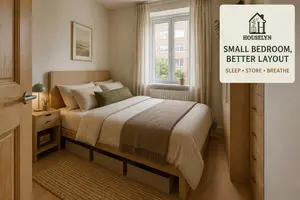
Use Under-Bed Storage Only With a Suitable Bed
The area beneath a bed can hold seasonal clothing, spare linens or
occasional belongings when the bed has a proper frame, enough clearance
and a structure designed to support the mattress independently.
Storage boxes must never act as makeshift bed supports. The containers
should slide beneath the existing frame without touching the mattress,
interfering with structural components or preventing airflow where the
manufacturer requires it.
Measure from the floor to the lowest fixed part of the frame, then allow
enough handling space for lids, handles or wheels. Check whether the
containers can be removed without moving a bedside table or blocking the
main walking route.
Balance Open and Closed Storage
Open storage keeps useful objects visible and accessible, but it also
increases the number of shapes, colours and labels visible in the room.
Closed storage creates a quieter background but can hide duplicates and
make deep contents harder to manage.
Use open shelves for a limited group of attractive or frequently used
belongings. Place visually mixed supplies, packaging, cleaning products
and household backstock behind doors or inside consistent containers.
The balance depends on the household’s routines. A person who forgets
hidden items may need more visible storage, while a visually sensitive
shared living space may benefit from a greater amount of closed capacity.
Leave Capacity for Ordinary Change
Storage filled completely on the first day has no flexibility for a
replacement product, incoming paperwork, a new season or an ordinary
grocery delivery. The overflow then appears on floors, counters and
furniture.
Leave a modest amount of capacity in the zones that regularly receive new
items. This does not mean maintaining large empty cupboards. It means
avoiding systems that depend on every object remaining perfectly packed
at all times.
Review backstock, duplicates and sentimental belongings before adding
another unit. A new cabinet increases capacity, but it also consumes floor
or wall space and may postpone decisions about items the household no
longer needs.
Part V • Protect Light and Visual Openness
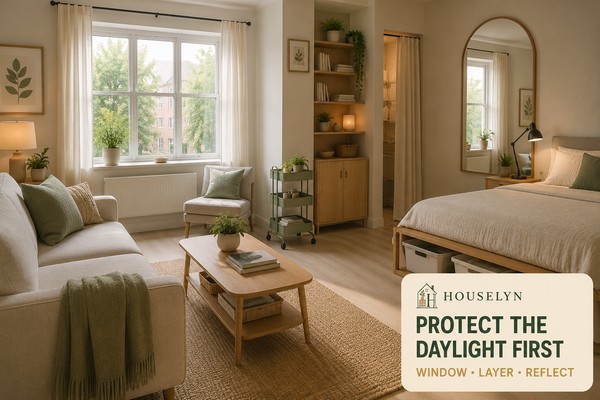
Use Small Apartment Ideas to Protect Light and Openness
Protect the available daylight first, then add task and ambient fixtures
around the activities that need support after dark.
Effective small apartment ideas begin by protecting the
light the home already receives. Artificial fixtures should support work,
meals, relaxation and movement rather than compensate for furniture or
storage that unnecessarily blocks the windows.
Observe Daylight Before Finalizing the Layout
Daylight changes according to the apartment’s orientation, surrounding
buildings, weather, season and time of day. A room that appears bright
during a midday viewing may receive limited useful light during the hours
when the household is usually at home.
Observe the windows in the morning, afternoon and early evening where
possible. Record which areas receive direct light, which remain softly
illuminated and which become shadowed by the building or nearby
furniture.
Apply small apartment ideas to those real conditions
rather than assuming that one universal furniture arrangement will work.
A desk may benefit from window-adjacent light in one apartment but suffer
glare, heat or screen reflection in another.
Keep Windows Operational and Visually Open
A window contributes more than brightness. It may provide ventilation, a
view, emergency access, cleaning access and a visual connection beyond
the apartment. Furniture should not make those functions difficult.
Avoid placing tall, deep storage directly across the most useful part of
a window. Lower furniture may work beneath a suitable sill when the
window can still open, the heating and ventilation remain effective and
the tenancy permits the arrangement.
Window treatments should answer both privacy and daylight needs. A sheer
layer may soften visibility during the day, while a separate lined or
blackout option may support sleep. Confirm that fabrics remain clear of
heating equipment and follow the product’s installation guidance.
Layer Artificial Light Around Real Activities
One ceiling fixture may provide general visibility but still leave the
desk, reading chair, kitchen counter or bedside area inadequately lit.
Adding several decorative lights without a functional plan can create the
opposite problem: many glowing objects with little useful illumination.
Begin with the activities identified in the Zone stage. Give regular
detail work a suitable local source. Add general light for safe movement
and ordinary tasks. Use one restrained ambient layer to soften the room
when concentrated task light is no longer needed.
The fixtures do not need to operate together at all times. A layered plan
is valuable because it gives the household different combinations for
working, eating, entertaining and winding down.
Plan Lighting Modes Instead of Switching on Everything
Lighting modes make a compact apartment easier to use because the same
room often supports several activities. The work mode may combine general
and task light. The evening mode may use a local lamp and one ambient
source. The cleaning mode should provide enough overall visibility to
inspect floors, corners and surfaces.
Group the fixtures according to routine rather than decorative category.
A small sculptural lamp may serve as the evening ambient source, while an
adjustable desk lamp should remain focused on the work surface.
Use Mirrors Only When the Reflected View Helps
A mirror does not improve every small room merely because it reflects
light. Its effect depends on its size, height, orientation and what
appears inside the reflection.
A mirror facing a window may increase the presence of daylight or repeat
a pleasant view. The same mirror may also reflect an overloaded shelf,
television cables, a bright bare bulb or a visually busy kitchen.
Evaluate the reflected composition from the positions where people spend
time. Confirm the tenancy and installation requirements, and use
appropriate hardware or approved placement methods for the mirror’s
weight and surface.
Plan the Power Route Before Choosing the Fixture
A lamp is not suitable for a position when its cable must cross a doorway,
run beneath a rug, sit against heating equipment or remain stretched
between furniture. The power route is part of the product footprint.
Keep plugs, switches and permitted electrical accessories accessible
enough to inspect and operate. Use approved products in good condition
and follow the manufacturer’s load, ventilation and placement
instructions.
Do not daisy-chain extension leads or power strips, and do not overload a
permitted electrical accessory. Where the tenancy, building guidance or
proposed setup is unclear, ask the landlord, managing agent or another
appropriate responsible party before installation.
Use Colour and Material to Support Available Light
Lighter nearby surfaces can reflect more of the light that reaches them,
while darker or heavily textured materials may absorb more and create
stronger contrast. This does not mean every compact apartment must be
white or pale.
Use the desired palette with awareness of placement. A deeper colour may
work well on one defined wall or within furniture and textiles when the
brightest surfaces remain available to distribute light.
Practical small apartment ideas use colour to support the
intended atmosphere without promising that one shade will make every room
objectively larger. Layout, daylight, contrast, furniture scale and
visual continuity work together.
Part VI • Connect the Apartment Visually
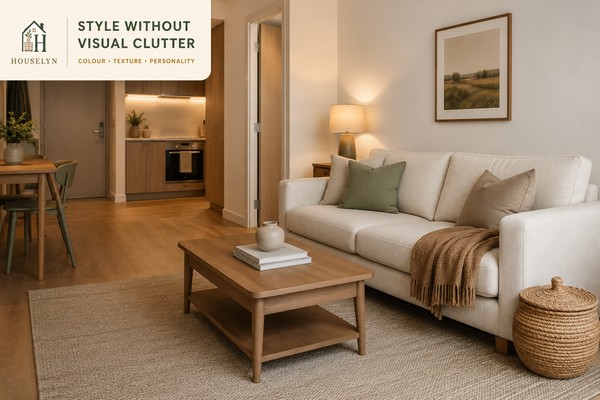
Style Small Apartment Ideas Without Creating Visual Clutter
Repeated colours and materials can connect the apartment while edited
surfaces preserve function and visual breathing room.
The best small apartment ideas create personality through
deliberate repetition rather than decorating every available surface. A
connected palette, a few recurring materials and carefully chosen personal
objects can make the home feel complete without making it feel crowded.
Build One Visual Direction Across the Apartment
Compact homes are often experienced through several rooms or zones at
once. The entrance may reveal part of the living area, dining position
and kitchen. When every visible section uses unrelated colours,
materials and accessory styles, the apartment can feel more fragmented
than its physical layout requires.
Visual continuity does not mean buying matching furniture sets or
repeating the same decoration in every room. It means establishing enough
connection that the home reads as one considered environment.
Strong small apartment ideas may repeat the same warm
wood tone, a restrained sage accent, one metal finish or a consistent
family of neutral textiles. Individual rooms can still express different
moods while remaining part of the same home.
Repeat Materials Instead of Matching Everything
Furniture collected over time may use different shapes, ages and finishes.
The apartment can still feel cohesive when selected materials repeat. A
natural-wood coffee table may connect with a wooden tray in the kitchen
and small frames in the bedroom without requiring identical timber.
Repetition should be noticeable but not mechanical. One woven basket,
textured cushion and natural-fibre shade may establish a material thread.
Covering every room with baskets can turn a useful texture into another
source of visual accumulation.
Look for relationships in tone, texture and visual weight. An older
cabinet can work beside newer furniture when the surrounding colours and
accessories help it belong.
Prefer Fewer Strong Statements to Many Small Decorations
Numerous small accessories can make a compact room visually busy because
each item creates another outline, colour and cleaning responsibility.
One appropriately scaled artwork, lamp, textile or ceramic piece may
establish more character with less surface occupation.
Group related objects rather than spreading them across every table and
shelf. A collection of three meaningful items may read as one composition
when their spacing and height are deliberate.
Keep the most functional surfaces quieter. Dining tables, desks, bedside
areas and kitchen counters should not depend on removing several
decorations before the activity can begin.
Style Walls According to Scale and Tenancy Rules
Wall decoration can add personality without consuming floor space, but
the arrangement should relate to the furniture beneath it. A collection
that is too narrow may appear disconnected from the sofa or bed, while
numerous small pieces can create visual noise.
Begin with one clear focal area. This may be a larger artwork, a balanced
group of frames or an existing architectural feature. Leave other walls
quieter so the focal point remains effective.
Review the tenancy agreement before drilling, painting, applying
removable products or changing fitted surfaces. A product described as
removable may still affect paint, wallpaper, plaster or timber. Follow
the product guidance and obtain permission where required.
Use Textiles to Add Depth Without Adding Furniture
Rugs, curtains, bedding, cushions and throws can introduce colour and
texture without requiring another cabinet, table or decorative stand.
They are especially useful when permanent changes are restricted.
Textiles should still support function. A rug must suit the furniture
group and preserve door movement. Curtains should operate easily and
remain clear of heating equipment. Cushions should not reduce the sofa’s
usable seating depth.
Coordinate textiles through shared undertones or repeated accents rather
than purchasing a complete matching set. Variation in texture can create
interest while the colour plan maintains continuity.
Let the Apartment Look Lived In Without Looking Uncontrolled
A functional home does not need to remain visually empty. Books,
photographs, useful objects and evidence of everyday life can make the
apartment feel personal and welcoming.
The difference between personality and clutter is often structure. A
group of books belongs on a defined shelf. Frequently used objects can
remain visible when they are arranged near the routine and have clear
boundaries.
Edit the apartment when the decorative layer begins to hide storage
access, reduce seating, obstruct cleaning or compete with the strongest
personal objects. Removing weaker pieces can make the remaining
collection more noticeable.
Part VII • Maintain the Complete Apartment System
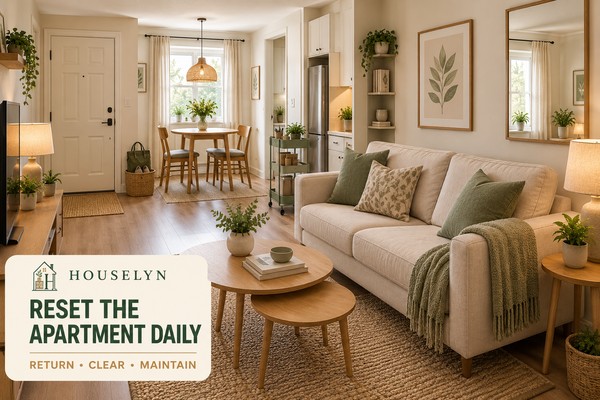
Reset Small Apartment Ideas Through Daily and Weekly Systems
A reliable reset restores the apartment’s active surfaces, walking routes
and furniture positions without requiring a complete reorganization.
The most sustainable small apartment ideas are designed to
recover after work, meals, laundry, deliveries and everyday movement. A
compact home remains functional when its busiest areas are easier to reset
than to leave unresolved.
Design the Reset Before the Apartment Becomes Untidy
Everyday disorder often reveals an unfinished system rather than a lack
of effort. Bags remain on the sofa because the arrival zone is full.
Laundry occupies a chair because the basket is too far away or cannot
contain the real weekly volume. Work equipment stays on the dining table
because its storage requires too many steps.
Observe where belongings repeatedly collect and identify the routine that
placed them there. The solution may be a better return position, reduced
category size, easier storage access or a shorter transition between two
uses of the same surface.
Strong small apartment ideas include the return journey
from the beginning. Furniture, storage and decorative choices should
support both the active routine and the reset that follows it.
Reset Active Surfaces Before Secondary Storage
The dining table, desk, kitchen counter, sofa and bed influence the
apartment more than a high shelf or seasonal cupboard. Restore these
active zones first because they support the next meal, work session,
evening routine or period of rest.
Return portable lamps, nesting tables, folding chairs and rolling carts to
their assigned positions. Clear objects from chair seats and walking
routes. Move laundry and deliveries into the system designed for them
instead of transferring the same pile to another visible surface.
A short reset should improve the apartment immediately. Detailed
organizing can wait for the weekly or monthly review when the household
has more time to make decisions.
Use the Weekly Reset to Correct Repeated Friction
The weekly review should do more than return visible objects. It should
identify where the system is beginning to weaken. A basket that repeatedly
overflows may need a more frequent emptying routine rather than a larger
replacement. A kitchen category that spreads across the counter may need
fewer duplicates or easier cabinet access.
Look for belongings that have remained in temporary positions for several
days. Decide whether the assigned storage is unsuitable, the category has
grown too large or the object no longer deserves space in the apartment.
Control Laundry Before It Occupies Furniture
Laundry affects several zones because it moves through collection,
washing, drying, folding and wardrobe return. When one stage lacks a
practical place, beds, chairs, doors and dining surfaces absorb the
overflow.
Assign each stage an operating position and a time limit. The dirty basket
should suit the household’s realistic capacity. Drying equipment should
have a safe, permitted position that does not block heating, doors or the
main route. Clean clothing should move onward before the basket is needed
again.
Practical small apartment ideas treat laundry as a moving
routine rather than one storage category. The system succeeds when every
stage can progress without taking over unrelated furniture.
Divide Shared Reset Responsibilities Clearly
In a shared apartment, general instructions such as keeping the living
room tidy may be interpreted differently. Define which zones, routines or
transition stages each person manages.
Responsibilities should reflect use and practicality. The person who
receives most deliveries may manage packaging removal. The person who
works at the dining table may be responsible for restoring it after work.
Shared storage should remain understandable to everyone who uses it.
Review the arrangement when work schedules, mobility, health, study or
household responsibilities change. A reset system should adapt to the
people living in the apartment rather than preserving an outdated
division of tasks.
Reassess the Apartment When Life Changes
A layout that worked during one season may become unsuitable after a job
change, new hobby, relationship change, mobility need or shift between
home and office work. The apartment should not be forced to preserve a
system that no longer supports the household.
Review furniture whose function has declined. A large desk may no longer
deserve permanent floor space when remote work has ended. A dining table
may need to expand its role when a new study routine begins. Storage
categories may need to move closer to their changed activity.
Remove or repurpose furniture only after confirming how the remaining
routines will operate. The purpose of the review is not constant change;
it is to keep the apartment aligned with current life.
Houselyn Apartment Planning Questions
Frequently Asked Questions About Small Apartment Ideas
These answers bring the main small apartment ideas
together in a practical order, beginning with layout and furniture before
moving through storage, decorating, shared living and long-term
maintenance.
Beginner Questions
Where to Begin
Where should I start when decorating a small apartment?
Begin with measurements and daily routines rather than accessories.
Record usable wall lengths, door and drawer movement, sockets,
windows, heating, walking routes and tenancy restrictions. Then list
the activities the apartment must support.
The most useful small apartment ideas solve a
confirmed layout, storage or routine problem before introducing
decorative purchases.
How can I make a small apartment look larger?
Protect clear walking routes, avoid blocking useful daylight, choose
furniture with appropriate visual and physical scale, and leave
selected surfaces or walls quieter. A connected colour direction can
also help the apartment feel less fragmented.
Mirrors may help when they reflect daylight or a calm view, but they
are less effective when they repeat clutter, cables or glare.
Should every piece of furniture be multifunctional?
No. Multifunctional furniture is valuable only when both functions
work well and the transition is realistic. A storage ottoman is not
useful when its lid cannot open easily, and a folding table is not
space saving when there is no sensible place for the folded chairs.
Prioritize comfort and daily reliability for the primary function,
then treat the second function as an advantage rather than a reason to
accept a poor product.
Do light colours always make a small apartment feel bigger?
Light colours can reflect available light and create a quieter
background, but they do not correct overcrowded furniture, blocked
windows or poor circulation. Deeper colours can work successfully
when they are placed deliberately and balanced with lighter or calmer
surfaces.
Layout and Furniture Questions
Making the Floor Plan Work
Should furniture always be pushed against the walls?
Not always. Moving a sofa, chair or table slightly away from the wall
may improve access, define a zone or create a more balanced
relationship between furniture. The correct position depends on the
room dimensions and walking routes.
Do not float furniture merely for appearance when the apartment lacks
enough clearance to support it.
Is large furniture unsuitable for every small apartment?
No. One appropriately scaled anchor piece may work better than several
undersized substitutes. A comfortable sofa with restrained arms may
occupy less total space and create less visual noise than multiple
small chairs and tables.
Test the full footprint, delivery route, opening clearance and
surrounding movement before deciding.
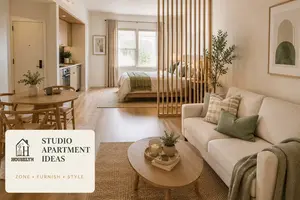
How do I divide a studio or open-plan apartment?
Start with furniture direction, one appropriately scaled rug, local
lighting and nearby storage. These elements can identify sleeping,
living, dining and work zones without interrupting the room with
unnecessary full-height dividers.
Add a physical divider only when privacy or another verified need
cannot be solved through lighter boundaries.
How can I create a home office in a small apartment?
Define the equipment, work frequency, required surface and storage
before selecting a desk. A dining table may support occasional work
when equipment can be removed quickly. Daily or equipment-heavy work
may justify a dedicated compact desk.
Include the chair, task lamp, screen position and cable route in the
measurement. A desk footprint alone does not represent the full work
zone.
How can I accommodate guests without a permanent guest room?
Decide how often guests stay and for how long before allowing
occasional hosting to control the everyday layout. A suitable sofa
bed, folding sleep surface or flexible living arrangement may work,
but it must remain comfortable in its primary daily function.
Plan where bedding, displaced furniture and personal belongings will
go during the visit.
Storage and Organization Questions
Creating Accessible Capacity
How do I add storage without making the apartment feel cluttered?
Store belongings near the routines that use them and balance closed
capacity with a limited amount of open display. Use taller storage on
selected walls rather than covering every vertical surface.
Effective small apartment ideas prioritize easy
retrieval, return and cleaning instead of maximizing the number of
containers.
Is under-bed storage a good idea?
It can be useful when the bed has a proper independent frame and
enough clearance for containers. Measure beneath the lowest fixed
component and confirm that boxes can be removed without moving
unrelated furniture.
Storage containers must never support, raise or stabilize the bed.
Preserve appropriate airflow, cleaning access and the bed
manufacturer’s structural requirements.
What should I do when my apartment has no proper closet?
Separate daily clothing from seasonal, occasional and sentimental
items. Daily clothing deserves the easiest position, while less-used
categories may use suitable high, low or secondary storage.
Before adding a large wardrobe, test its door clearance, stability,
delivery route and effect on daylight. A combination of one compact
clothes unit, drawers and carefully limited seasonal storage may work
better.
Is open shelving good for a small apartment?
Open shelving works well for frequently used or visually compatible
belongings, but too much can make the room appear busy. Use closed
storage for packaging, paperwork, mixed technology, cleaning products
and household backstock.
Leave some open shelf area rather than filling every section.
Decorating, Sharing and Advanced Questions
Personalizing and Maintaining the Home
How much wall décor should a small apartment have?
Begin with one intentional focal wall or artwork arrangement that
relates to the furniture beneath it. Leave other walls quieter to
support daylight and visual balance.
Review the tenancy agreement before drilling, painting or applying
removable products. A removable label does not guarantee that every
wall finish will remain unaffected.
How do I make a small apartment feel cosy without overcrowding it?
Use layered lighting, tactile textiles, warm materials and selected
personal objects rather than adding more furniture. One rug, a few
well-scaled cushions, a folded throw and controlled evening light can
create comfort without filling every surface.
How can two people share a small apartment comfortably?
Identify which activities must operate at the same time. Test whether
one person can work while the other uses the kitchen or living area,
and whether shared storage can be reached without interrupting another
zone.
Agree which surfaces should remain clear, when flexible zones must be
reset and who manages shared routines such as deliveries, laundry and
household stock.
How often should I reorganize a small apartment?
Avoid repeatedly reorganizing the entire home. Use short daily resets,
weekly pressure-point reviews, monthly capacity checks and seasonal
adjustments. A major change is justified when the household’s routine
or furniture needs have materially changed.
What is the Houselyn Small Apartment Blueprint?
It is a seven-stage planning method: Measure, Zone, Scale, Store,
Light, Style and Reset. The sequence keeps decoration and product
purchases connected to the apartment’s physical limitations and the
household’s real routines.
Use the blueprint to evaluate small apartment ideas
in order: understand the space, assign activities, choose appropriate
furniture, distribute storage, protect light, connect the visual style
and maintain the completed system.
The Houselyn Implementation Plan
Turn Small Apartment Ideas Into a 30-Day Action Plan
The purpose of these small apartment ideas is not to
encourage one exhausting weekend makeover. The stronger approach is to
improve the apartment in a controlled sequence, beginning with the
physical space and ending with a system the household can maintain.
The Houselyn 30-Day Apartment Improvement Plan
The schedule below separates decisions that require observation from
those that require purchasing or physical change. Adjust the pace to suit
the tenancy, household, available time and budget.
Days 1–7
Measure and Observe
Understand the apartment before changing it.
Measure usable walls, furniture footprints, door movement, drawers,
windows, sockets and the main walking routes.
Record fixed features, heating, ventilation, building equipment and
tenancy restrictions.
Observe daylight during the times when the household normally uses
each room.
Photograph repeated clutter points without immediately moving them
so the underlying routines remain visible.
Identify furniture that is uncomfortable, underused, difficult to
access or responsible for a major circulation conflict.
Days 8–14
Zone and Edit
Assign activities before introducing more products.
List the daily, weekly and occasional activities the apartment must
support.
Assign arrival, work, meals, relaxation, sleep, dressing, storage
and laundry responsibilities to practical areas.
Test furniture direction, rugs and lighting as visual boundaries
before considering a divider.
Review duplicates, expired backstock, unused furniture and objects
waiting to leave the apartment.
Protect one clear walking route and one reliable functional surface
before making decorative changes.
Days 15–21
Scale, Store and Light
Correct the highest-impact functional problems.
Test major furniture against delivery, placement, clearance, daily
use, storage impact, visual scale and future flexibility.
Move daily belongings closer to the activities that use them and
place less-frequent categories in secondary positions.
Balance closed storage with restrained open display rather than
covering every wall.
Clear useful window areas and correct furniture that blocks
daylight, ventilation or normal operation.
Add task or ambient lighting only where the fixture has a safe,
accessible and permitted operating position.
Days 22–30
Style, Reset and Review
Complete the visual direction and establish maintenance.
Choose a base colour, supporting neutral, controlled accent,
repeated material, personal story and editing rule.
Group accessories into deliberate compositions and preserve clear
space on the most functional surfaces.
Confirm that rugs, curtains, artwork and wall treatments suit the
dimensions, surface and tenancy conditions.
Complete the 15-minute daily reset for one week and note where the
system remains difficult.
Make one final adjustment to the routine or storage position behind
each repeated pile.
Conclusion
A Small Apartment Can Feel Complete Without Holding Everything
The most effective small apartment ideas do not promise
to create unlimited space. They help the available home support the
household’s real priorities with fewer conflicts between furniture,
storage, light, decoration and daily movement.
A compact apartment becomes easier to live in when its measurements guide
the layout, activities define the zones and major furniture is selected
before secondary pieces. Storage belongs near the routines it supports.
Windows remain operational. Lighting answers real tasks. Decorative
details connect the home without consuming its most useful surfaces.
The final stage is not a perfect photograph. It is the ability to prepare
a meal, complete a workday, receive a delivery, manage laundry, welcome a
guest and restore the apartment without losing access to the rest of
everyday life.
Continue measuring as needs change. Move storage when routines move.
Release furniture that no longer earns its footprint. Edit decoration
when it begins to hide the stronger personal pieces. The apartment can
evolve while the blueprint remains the same: understand the space, make
each decision serve a purpose and build a home that is realistic to
maintain.
Houselyn Knowledge Library
Continue Building a Functional, Connected Home
Use this library to continue developing the
small apartment ideas that matter most to your home.
Begin with the guide that matches your current problem rather than
opening several projects at once.
For Decorating and Visual Balance
Small Space Decorating Ideas
Develop furniture balance, vertical decoration, colour, accessories
and visual breathing room after the apartment’s functional layout
has been established.
Explore compact-room approaches to textiles, personal style, wall
decoration and renter-aware changes that can also inform highly
limited apartment rooms.
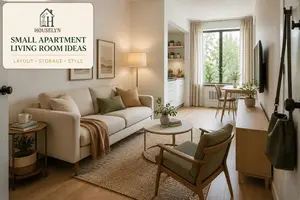
Practical small apartment living room ideas for layout, furniture, storage, lighting and decor that make compact spaces feel comfortable and functional.
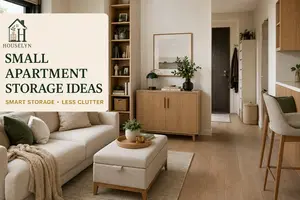
Practical small apartment storage ideas for kitchens, bedrooms, living rooms, entryways and more, with smart solutions that reduce clutter without overcrowding your home.