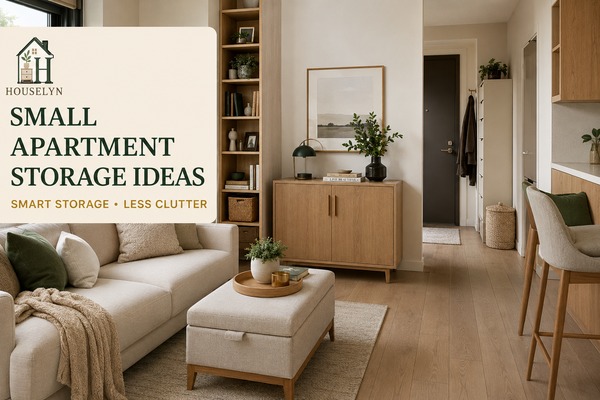
Small Apartment Storage Ideas: Smart Solutions for Every Room
Effective apartment storage combines usable capacity, sensible placement
and easy everyday access without allowing storage furniture to overwhelm
the rooms it is meant to improve.
The most useful small apartment storage ideas do more than
squeeze additional containers into unused corners. They decide what deserves
storage, where each category should live and how the storage itself can fit
without reducing circulation, daylight or everyday comfort.
A lack of built-in cupboards can certainly create pressure, but limited
square footage is not always the only problem. An apartment may have enough
total storage yet still feel cluttered because high-use items are stored too
far from where they are needed, deep cupboards hide categories behind one
another or several small storage pieces consume more floor space than one
properly planned cabinet would.
That is why successful small apartment storage ideas begin
with diagnosis. Before adding shelving, baskets or multifunctional
furniture, identify which categories are creating pressure, how frequently
they are used and whether their current storage location supports the routine
that creates them.
These dimensions also explain why visually attractive
small apartment storage ideas can fail after a few weeks.
A beautiful basket may become a dumping ground if it has no defined
category. A tall cabinet may increase capacity but make daily belongings
harder to reach. A storage bed may be useful for seasonal textiles but
frustrating for items needed several times each day.
The objective is therefore not maximum storage at any cost. It is enough
capacity, positioned correctly, with access that matches frequency and a
footprint the apartment can comfortably support.
This sequence prevents a common mistake: treating every storage problem as a
shopping problem. Some apartments need another cabinet. Others need a
category moved closer to use, a deep cupboard divided more intelligently or
belongings reduced before another piece of furniture is introduced.
By the end of this guide, you will be able to evaluate
small apartment storage ideas by more than capacity alone.
You will know how to judge location, accessibility, multifunctional
furniture, vertical storage, hidden storage, room-by-room pressure and the
everyday reset that determines whether the system continues to work.
Chapter 1: Small Apartment Storage Ideas Begin With a Real Storage Audit
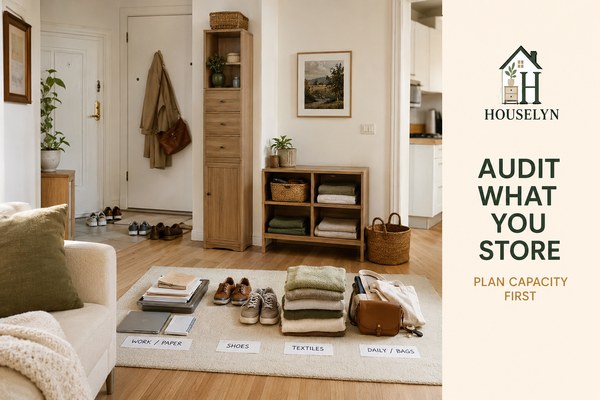
A useful storage audit identifies what the apartment is holding, how often
each category is used and whether its current location makes daily life
easier or harder.
Before buying another basket, shelving unit or cabinet, use your
small apartment storage ideas to diagnose the apartment
you already have. A storage shortage may be real, but it may also be a
location problem, an access problem, too many duplicate categories or a
collection of small storage pieces using more floor area than the belongings
themselves require.
Start with observation rather than products. Walk through the apartment and
notice where objects repeatedly collect: shoes beside the entrance, laundry
on a chair, paperwork on the dining table, toiletries around the bathroom
sink or kitchen equipment spread across worktops. Those pressure points show
where the existing system is failing.
The audit should answer two separate questions:
Do we have enough capacity? and
Is the available capacity in the right place?
Treating those questions as the same problem can lead to unnecessary
furniture. An empty bedroom cupboard does not solve entryway clutter if
nobody is realistically going to carry shoes there after every use.
Measure the Belongings Before You Measure New Furniture
It is easy to measure a wall and conclude that another cabinet will fit.
The more useful question is whether its internal proportions suit what
actually needs to be stored. A tall narrow unit can provide significant
volume yet perform poorly when the category requires wide shelves, several
drawers or frequent access.
Group belongings specifically enough to understand their true scale. Count
shoes by pairs rather than referring to them simply as entryway items.
Separate everyday blankets from seasonal bedding. Divide paperwork into
active documents and longer-term records. Sort kitchen equipment by how
frequently it enters the cooking routine.
This makes small apartment storage ideas more precise.
Once the category is understood, you can compare shelf depth, drawer
height, internal capacity and ease of access rather than choosing furniture
because its outside dimensions happen to fit an empty corner.
Separate a Capacity Problem From a Location Problem
A genuine capacity problem exists when a useful, appropriately sized
category has no safe and accessible place to live. If clothing, kitchen
equipment or household supplies reasonably belong in the apartment but the
available cupboards cannot contain them, additional capacity may be
justified.
A location problem behaves differently. The apartment may contain enough
cupboard space overall, yet the wrong categories occupy it. Cleaning
supplies may be stored behind appliances, work equipment may live in a
bedroom wardrobe even though work happens in the living area, or coats may
be stored so far from the entrance that they remain on chairs instead.
There can also be capacity that looks full but is poorly used. Deep shelves
often hide empty space behind front-row objects. Tall wardrobes may leave
unused vertical gaps. Large drawers can contain only one shallow layer when
the category could be divided more effectively.
Audit the Storage Furniture Too
Storage furniture can become part of the clutter it was supposed to solve.
Several narrow cabinets, small drawer units, side baskets and freestanding
organizers may each hold useful items while collectively consuming too much
wall and floor space.
Review every piece by function. Does the console near the entrance contain
categories used there, or has it become a convenient place for unrelated
objects? Does a large bookcase justify its footprint, or are several shelves
decorative while high-priority belongings lack closed storage elsewhere?
Consolidating storage is not automatically the solution either. One larger
cabinet may visually simplify the apartment, but combining shoes,
paperwork, cleaning supplies and seasonal textiles behind the same doors can
create another access problem. Consolidation succeeds only when internal
categories remain logical.
Look for Dead Storage Before Adding More
Dead storage is capacity that technically exists but contributes little to
daily organization. Examples include a high cupboard that is barely used,
inaccessible depth at the back of a wardrobe, an under-bed area that cannot
be reached comfortably or shelves containing categories that belong in
another part of the apartment.
Do not fill those areas merely because they are empty. Decide which
frequency level suits them. High shelves may be useful for lightweight
seasonal categories, while deep storage may need internal divisions before
it becomes practical.
Avoid placing heavy, frequently handled belongings in unnecessarily high
positions just to use every centimetre. Safe access and realistic everyday
behaviour matter more than theoretical maximum capacity.
Decide What Should Leave Before Expanding Capacity
An audit also needs an exit decision. Storage furniture is particularly
expensive in a small apartment because it costs both money and usable space.
Keeping categories that no longer serve the household can eventually require
another cabinet and permanently reduce circulation or visual breathing room.
This does not mean reducing the home to a minimalist inventory. Useful,
sentimental and genuinely seasonal belongings can deserve space. The
purpose is to avoid protecting outdated or duplicated categories simply
because they have occupied storage for a long time.
Turn the Audit Into a Priority List
Once the main categories are visible, rank the storage problems according to
how much daily friction they create. Deal first with items that obstruct
circulation, prevent furniture from operating, occupy necessary work
surfaces or require repeated tidying.
Lower-impact imperfections can wait. An untidy seasonal shelf is less urgent
than shoes narrowing the entrance route. A cupboard that is not beautifully
arranged is less important than kitchen equipment that requires several
objects to be moved every time it is used.
This keeps small apartment storage ideas focused on
measurable problems. Rather than redesigning every shelf at once, improve
the storage decisions that repeatedly make ordinary routines harder.
By the end of the audit, you should know which
small apartment storage ideas genuinely require additional
capacity and which can be solved by relocating, editing or improving the
storage already present. That distinction protects both floor space and the
household budget.
In Chapter 2, we move from diagnosis to assignment and decide where each
category should live so storage follows the routines that actually happen
throughout the apartment.
Chapter 2: Small Apartment Storage Ideas Work Better When Every Category Has a Home
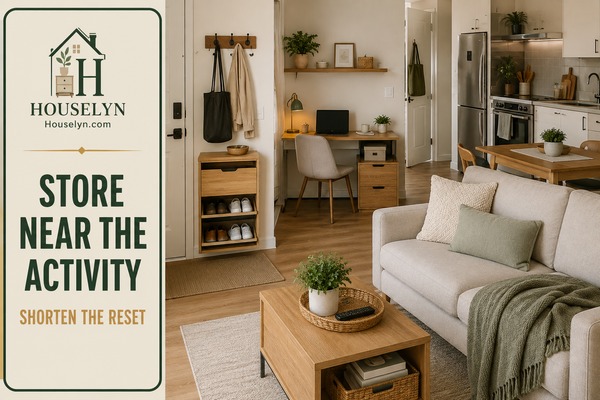
Storage becomes easier to maintain when categories are positioned close to
the routines that use and return them.
After the audit reveals what the apartment is storing, the next step is to
decide where each category belongs. The strongest
small apartment storage ideas reduce the distance between
an activity and the storage that supports it. A cupboard can be beautifully
organized and still fail if the household has to cross the apartment every
time something is used or returned.
Think less about traditional room labels and more about routines. Keys need
a home close to arrival. Television remotes need one near the seating area.
Daily cooking tools belong close to the work zones that use them. Work
supplies should not automatically live in the bedroom if the dining table is
where work actually happens.
This principle sounds simple, but it changes how storage is planned. Instead
of asking, “Where is there an empty cupboard?” ask, “Where would a person
naturally reach for this, and where would they naturally return it?”
Store by Activity Before You Store by Room Name
Apartments often combine several functions inside the same room. A living
area may also serve as a home office. A hallway may contain laundry access.
A bedroom may include exercise equipment or hobby materials. When storage is
assigned only according to room labels, categories can end up separated from
the routines that use them.
Consider a laptop setup used at the dining table five days a week. Storing
the notebook, headphones and charger in a bedroom wardrobe may technically
keep them organized, but the return journey creates friction. A compact
nearby drawer or closed box can be more effective because the storage follows
the activity.
The same reasoning improves small apartment storage ideas
across the home. Cleaning products can be assigned according to where they
are safely and appropriately used, pet supplies can sit near feeding or
walking routines, and frequently used linens can live closer to the rooms
they serve instead of competing with unrelated items elsewhere.
Give Daily Categories the Most Convenient Positions
Easy-to-reach storage should be reserved for belongings that justify the
convenience. Daily items normally deserve the best positions: reachable
drawers, lower shelves, entry cabinets or accessible containers near the
relevant activity.
Seasonal decorations, backup toiletries, spare bedding and rarely used
equipment can usually move to less convenient areas. When occasional
categories occupy prime storage, daily belongings are forced onto visible
surfaces.
This does not mean every frequently used object must remain visible. Closed
storage can still provide quick access. The goal is to reduce unnecessary
steps between taking an item out and returning it.
Stop Entryway Categories Before They Travel Through the Apartment
The entrance is one of the most important assignment points because items
arrive there before spreading elsewhere. Shoes, coats, bags, umbrellas,
post, reusable shopping bags and keys can quickly become living-room or
bedroom clutter if they lack a clear landing zone.
The answer is not necessarily a large hallway unit. A narrow shoe solution,
one hook area, a small key tray and a deliberate location for post may be
enough. The storage should correspond to the household's real arrival
pattern and preserve the route through the entrance.
In particularly tight entrances, avoid assigning more categories than the
zone can physically support. Seasonal coats, backup shoes and infrequently
used bags can move elsewhere while the entry retains only the items needed
for ordinary departures.
Separate Daily Kitchen Access From Backup Kitchen Storage
Small kitchens often feel short of storage because every cabinet is treated
as equal. In reality, the shelves nearest the main work area have much higher
value than an awkward high cupboard or a deep corner.
Place the tools used repeatedly during normal cooking where they can be
reached without clearing another category. Backup supplies, occasional
serving pieces and specialist equipment can move to less convenient
positions if doing so frees daily working storage.
Effective small apartment storage ideas therefore distinguish
between “kitchen storage” as a general category and the specific access
demands of preparing food, washing up, storing groceries and serving meals.
Assign Clothing by Routine, Not Just Available Wardrobe Space
Clothing storage also benefits from frequency. Everyday clothing should not
be buried behind occasion wear, seasonal coats or rarely used accessories.
Prime wardrobe areas are more useful when they contain the pieces most often
selected, while less frequent categories can move higher, lower or to
secondary storage.
Laundry routines matter too. If clean clothes repeatedly remain in baskets,
the problem may not be the laundry itself. The wardrobe or drawers may be
too full, the storage categories may be too complicated, or returning
clothing may require too many steps.
Give Paperwork a Defined Point of Entry and Exit
Paper becomes difficult in compact homes because a small amount creates
immediate visual clutter. Create one deliberate point for incoming post and
documents, then separate what needs action from what needs filing or
recycling.
Avoid creating multiple paper-storage points unless the household genuinely
needs them. A tray at the entrance, documents on the dining table and another
pile beside the sofa can turn one category into three separate reset jobs.
Do Not Assign a Category to Storage That Is Difficult to Use
An empty cupboard does not automatically make a good home. Daily belongings
stored above comfortable reach may remain on counters. Items in a deep shelf
may disappear behind other categories. A drawer blocked by furniture may
become unused despite offering capacity.
Storage has to work in its active position. Check whether cupboard doors can
open fully, drawers can extend without hitting another object and containers
can be removed without blocking circulation.
Safety should also override convenience. Do not store frequently handled
heavy objects in unstable high positions, block heating or ventilation, or
place cleaning products where household members who should not access them
can easily reach them.
Test the Assignment for One Week Before Buying More
A storage plan can look logical on paper and still fail in practice. Before
adding new furniture, test major category assignments using the containers
and cupboards already available where possible.
Observe what happens during a normal week. Does the household return the
shoes? Does paperwork stay in its zone? Does the work setup disappear after
the working day? Are cooking tools easier to reach? If not, diagnose the
friction before deciding that more capacity is necessary.
This testing stage makes small apartment storage ideas
more durable because the final system is based on behaviour rather than an
imagined version of how the apartment should operate.
By the end of the Assign stage, each high-priority category should have a
location that matches both use and return. Daily belongings deserve easy
access, occasional categories can tolerate greater distance, and no room
should become the accidental storage area for everything that lacks a home.
Once these assignments are working, small apartment storage ideas
can move to the next question: whether existing furniture is using the
apartment efficiently enough or whether one multifunctional piece could
replace several separate storage demands.
In Chapter 3, we move into the Compress stage and examine when storage and
furniture can share one footprint without creating awkward access, excessive
visual weight or another piece that technically does several jobs but
performs none of them particularly well.
Chapter 3: Small Apartment Storage Ideas That Combine Furniture and Storage
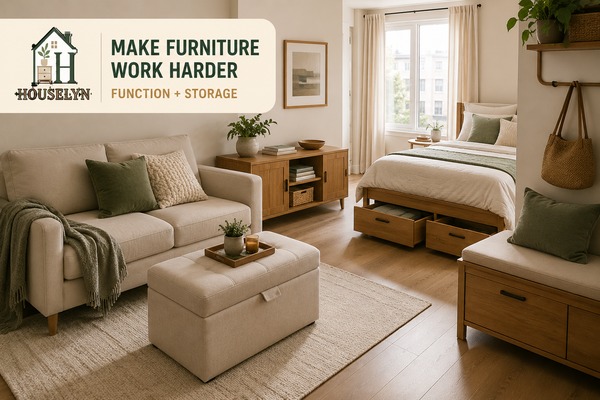
Multifunctional storage works best when the furniture remains comfortable
in its primary role and the hidden capacity is genuinely easy to use.
Once storage categories have been assigned to sensible locations, the next
question is whether too many separate pieces are occupying the apartment.
Some small apartment storage ideas work best when seating,
sleeping, surface space and storage share one carefully chosen footprint
instead of requiring separate furniture for every function.
Multifunctional furniture can be extremely useful in a compact home, but the
phrase itself is not a guarantee of efficiency. A bench with hidden storage
is only helpful if it is comfortable enough to sit on, positioned where the
household needs a seat and easy to open without moving other furniture.
The same applies to ottomans, storage beds, lift-top tables and desks with
drawers. The storage function should strengthen the main function rather than
make it awkward. If retrieving a blanket requires moving a heavy table every
night, the theoretical extra capacity may create more friction than it
removes.
Compare Capacity Gained With Floor Space Consumed
Every freestanding storage piece has a spatial cost. It occupies floor area,
interrupts a wall, changes circulation and adds visual weight. A compact
apartment therefore benefits from comparing the capacity gained with the
footprint required to obtain it.
Imagine one small basket beside the sofa, another basket under a console and
a separate footstool occupying the central floor. Replacing two of those
functions with one properly scaled storage ottoman may reduce the number of
objects while providing seating support, a footrest and closed storage.
That does not mean the largest multifunctional piece is automatically best.
A very deep storage bench may gain capacity but narrow the entrance route.
A bulky lift-top table can technically replace a desk yet dominate a small
living area when its top is raised. Good choices evaluate the furniture in
both its closed and active positions.
Choose Multifunctional Furniture for a Real Routine
Begin with the primary job. If the household needs a footrest beside the
sofa, a storage ottoman may be a natural upgrade because storage is added to
an item the room already needs. If there is no need for a bench in the
entryway, buying one simply because it contains storage can create furniture
pressure rather than solve it.
This distinction keeps small apartment storage ideas from
becoming a collection of “two-in-one” products. The best multifunctional
piece combines functions that genuinely occur in the same place and at
compatible times.
A desk with drawers makes sense when paperwork and equipment are used at the
desk. A storage bed is logical when the bedroom needs sleeping space and
lower-frequency capacity. A storage bench near the entrance can work when
the household genuinely sits to put on shoes and needs nearby concealed
storage.
Evaluate Storage Beds by Access, Not Just Volume
The space beneath a bed can provide substantial capacity, but the type of
access matters. Drawers require enough clear floor beside the bed to open
fully. Lift-up mechanisms need appropriate operation and should be used
according to the manufacturer's instructions. Simple under-bed containers
require enough clearance to slide out without striking another piece of
furniture.
The bed itself must remain properly supported by its structural frame or
legs. Storage containers should never be used to support the mattress or
bed frame. Treat the under-bed area as storage inside a functioning piece of
furniture, not as a substitute for correct furniture construction.
Under-bed capacity is often best for bedding, seasonal clothing, spare
linens or other categories that do not need constant access. Daily items can
become frustrating if the household has to lift bedding or pull large boxes
out repeatedly.
Check the Active Position of Every Storage Mechanism
Furniture measurements usually describe the closed footprint, but storage
mechanisms need additional operating space. Drawers extend outward. Lift-top
tables change height. Ottoman lids need space above them. Bench lids may
conflict with wall decor or nearby furniture.
Before buying, map the active position with simple household references such
as masking tape or measured floor markers. Test whether somebody can still
walk past when the drawer is open or whether the lift-top surface becomes too
close to the sofa to use comfortably.
Applying this test keeps small apartment storage ideas
focused on total spatial value. A multifunctional piece is successful when
it removes another footprint, provides useful capacity and remains easy to
operate—not merely because its product description lists several functions.
Avoid Multifunctional Furniture That Creates Constant Conversion Work
Some furniture technically supports several activities but requires so much
rearranging that the household stops using one of them. A dining table that
converts into a desk may work well if the work equipment has nearby storage.
If every meal requires relocating monitors, papers and cables to another
room, the combined function may not be efficient.
The same principle applies to storage seating. If everything on top has to be
removed before the compartment can open, avoid using the piece for items that
need frequent access. Store lower-frequency categories inside and keep daily
belongings in easier locations.
Leave Some Furniture Single-Purpose When It Performs Better
Compression is not an instruction to make every object perform three jobs.
Sometimes a simple chair is better than a bulky storage chair, and a small
side table is better than a complicated lifting mechanism. Single-purpose
furniture can be the more efficient choice when it is lighter, easier to
move and better suited to the room.
Choose multifunctionality where two genuine needs overlap naturally. Avoid
it where the second function increases bulk, restricts access or requires
constant conversion.
By the end of this stage, small apartment storage ideas
should have reduced unnecessary furniture pressure rather than added another
layer of clever-looking objects. The goal is not more features. It is fewer
footprints doing the right work.
In Chapter 4, we move into the Elevate stage and use the apartment's vertical
space more intelligently—without surrounding the rooms with unstable,
difficult-to-reach or visually heavy storage.
Chapter 4: Small Apartment Storage Ideas That Use Vertical Space Safely
Vertical storage can protect valuable floor space when frequently used
items remain accessible and higher positions are reserved for appropriate
lower-frequency categories.
When floor area is limited, looking upward is an obvious next step. The best
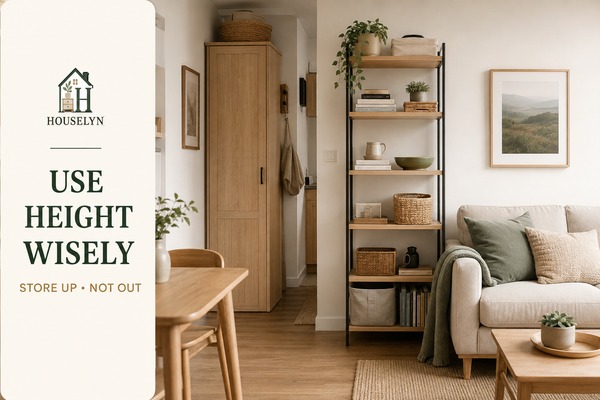
small apartment storage ideas use height deliberately,
placing the right categories at the right levels instead of treating every
empty section of wall as permission to add shelving.
Vertical storage can be efficient because a slim bookcase, tall cabinet or
upper shelf may add capacity without consuming much additional width. The
trade-off is access. The higher an item is stored, the more effort may be
required to retrieve and return it.
The objective is therefore not to fill the apartment from floor to ceiling.
It is to move lower-frequency categories upward so easier positions remain
available for things the household uses every day.
Divide Vertical Space by Frequency
Think of a tall storage area as several different zones rather than one
cabinet. The shelves between comfortable hand and eye level are the most
valuable because items can normally be retrieved without bending deeply,
climbing or moving other containers.
Higher positions can hold lightweight seasonal textiles, occasional
decorations, backup supplies or other categories that are used less often.
Lower positions may suit heavier or bulkier items when lifting them upward
would be inconvenient.
This makes small apartment storage ideas more practical
because frequency determines height. Daily storage stays easy, while less
active categories stop occupying the apartment's most convenient shelves.
Choose Tall Storage Where Width Is More Valuable Than Height
A tall cabinet can sometimes outperform a low wide unit because it preserves
more floor width. This can be particularly useful in narrow entryways,
bedrooms or living areas where maintaining the walking route matters more
than keeping every piece low.
But tall furniture has greater visual presence. Several tall units on
multiple walls can make an apartment feel enclosed even when the floor
remains technically clear. Concentrate height where the storage gain is most
useful and allow other walls to remain quieter.
A single narrow tall cabinet containing meaningful household categories can
be calmer than several smaller freestanding units, provided its depth,
stability and internal layout fit the room.
Use Open Shelves Selectively
Wall shelves can add capacity without a cabinet footprint, but everything
placed on them remains part of the visual room. A shelf holding a coherent
row of books or a few useful objects may feel light. Several shelves packed
with mixed containers can make the wall appear heavier than a closed cabinet.
Open shelving is therefore most effective when the categories remain
controlled and easy to reset. Use closed vertical storage for mixed or
visually busy belongings and open shelves where visibility actually helps.
Avoid placing heavy unsecured items above sofas, beds, desks or other places
where people spend time. Wall-mounted shelves and cabinets should be
installed according to their fixing requirements and the construction of the
wall.
Treat Over-Door Storage as Secondary Capacity
Over-door organizers can be useful in bathrooms, bedrooms, utility areas or
cupboards when they hold appropriately lightweight categories. They are
particularly helpful when permanent drilling is undesirable and the door can
still operate normally.
Check the clearance above the door, the organizer's fit and whether loaded
pockets interfere with the wall, frame or handle. A system that prevents a
door from closing properly is not useful storage.
They are usually better for contained, lighter items than for heavy bottles,
bulky equipment or categories that make the door difficult to move.
Do Not Sacrifice Daylight for Extra Shelving
Tall furniture beside windows can reduce natural light and create a boxed-in
feeling. Before placing a high cabinet or shelving unit near glazing,
consider the direction of daylight, curtain movement and access to the
window.
Strong small apartment storage ideas protect both capacity
and environmental quality. An extra shelf is not automatically worthwhile if
it darkens the main living space, blocks ventilation or makes the window
difficult to operate.
Leave Some Vertical Space Empty
Not every wall needs floor-to-ceiling storage. Empty upper wall space can
preserve daylight, reduce visual pressure and make a narrow apartment feel
less enclosed.
Concentrate tall storage where it solves the strongest capacity problem,
then allow other areas to remain lower and lighter. This creates a visual
rhythm between storage and open space rather than a continuous perimeter of
furniture.
By the end of the Elevate stage, small apartment storage ideas
should have moved suitable lower-frequency categories upward without making
everyday storage harder to reach. The apartment should gain useful capacity
while retaining safe circulation, stable furniture and visual breathing
room.
In Chapter 5, we move from height to visual control and decide which
categories should remain visible and which are better concealed behind
doors, drawers, lids or carefully chosen containers.
Chapter 5: Small Apartment Storage Ideas for Hiding Visual Clutter
Closed storage can calm a compact room when mixed practical categories are
hidden while frequently used or visually coherent items remain easy to
access.
Once the apartment has enough storage in sensible locations, visual control
becomes the next question. Effective
small apartment storage ideas recognize that storage can be
technically organized and still make a room feel busy when every category
remains visible.
Open shelves, clear containers, baskets and hooks are useful because items
are easy to see and reach. The same visibility can become a disadvantage
when dozens of small objects, mixed packaging, cables, paperwork and
household supplies are all competing for attention.
Concealment is therefore not about hiding the fact that people live in the
apartment. It is about deciding which categories contribute positively to
the room and which are better contained behind a door, drawer or lid.
Use Closed Storage for Visually Mixed Categories
Mixed categories usually benefit most from concealment. Chargers, spare
cables, game accessories, toiletries, cleaning supplies, paperwork and small
household tools may each be useful, but their shapes, colours and packaging
rarely create a calm visual composition.
A closed cabinet can make several unrelated categories read as one simple
furniture shape. Drawers can turn dozens of small objects into one quiet
horizontal surface. A lidded basket can contain soft or awkward items while
allowing the surrounding room to remain visually simpler.
This is one reason small apartment storage ideas should
consider visual capacity as well as physical capacity. A room can hold the
same number of belongings yet feel much less crowded when the most visually
fragmented categories are concealed.
Keep Open Storage for Categories That Benefit From Visibility
Closed storage is not automatically superior. Open storage is useful when
visibility improves access, when items are used frequently or when the
category itself contributes positively to the room.
A short row of books, a few frequently used kitchen jars or one shelf of
neatly contained daily items can be easier to maintain in view. Problems
begin when the open system expands faster than the household can keep it
visually controlled.
Treat the open shelf as part storage and part visual surface. If every
available centimetre is filled, the storage may technically be efficient but
the room loses the breathing space that makes the arrangement readable.
Do Not Let Baskets Become Permanent Holding Zones
Baskets are one of the easiest storage tools to add and one of the easiest to
misuse. A basket with no defined category can absorb whatever happens to be
nearby until it becomes another place that must eventually be sorted.
Assign each basket a specific purpose. One might hold current blankets,
another children's building toys, and another laundry awaiting a particular
routine. If the contents repeatedly become mixed, the basket may be too
large, too convenient or assigned to too many categories.
A lid can reduce visual noise, but it also adds an action. For categories
that are used many times every day, an open basket may be easier to maintain.
For less frequent mixed items, a lidded option can be calmer.
Use Clear Containers Inside Closed Storage
Clear containers can be extremely useful inside cupboards, wardrobes and
utility storage because visibility helps identify contents without exposing
the entire category to the room.
This combination gives two benefits: the exterior remains visually calm,
while the interior is easy to understand. It works particularly well for
backup toiletries, hobby supplies, small household parts and seasonal
accessories.
Avoid buying a full set of matching containers before confirming the actual
categories and shelf dimensions. Containers should fit both the belongings
and the cupboard rather than forcing the household to reorganize items around
a predetermined box size.
Use Labels Where They Remove Guesswork
Labels are most useful when several similar closed containers sit together or
when multiple people need to understand the system. They can reduce opening,
searching and returning errors.
Do not label every visible object simply because labels are an organization
trend. A clear drawer containing cutlery rarely needs explanation. A series
of identical boxes containing cables, documents and craft supplies may.
Conceal Cables Without Making Them Inaccessible
Cables create disproportionate visual clutter because thin dark lines cross
otherwise calm surfaces. Grouping charging leads, adapters and media cables
around defined equipment zones can reduce this effect.
Concealment should never make electrical problems harder to notice. Avoid
tightly compressing cables, blocking ventilation, placing overloaded
extension leads inside sealed boxes or routing cords where furniture can
damage them.
The goal is controlled visibility rather than complete disappearance.
Electrical equipment should remain accessible enough to inspect, disconnect
and use according to manufacturer guidance.
Do Not Hide More Than the Storage Can Manage
Closed doors can make an apartment appear tidy even when the inside of every
cabinet is overloaded. Visual calm should not become permission to ignore
capacity.
If drawers no longer close comfortably, baskets overflow as soon as they are
opened or several categories have to be moved to reach one item, return to
the Audit stage. The concealed system is signalling that it needs editing or
better internal allocation.
The strongest small apartment storage ideas make both the
exterior and interior easier to understand. The apartment should look calmer
when storage is closed and remain practical when that storage is opened.
By the end of the Conceal stage, small apartment storage ideas
should have created a deliberate visual hierarchy: frequent, coherent items
can remain visible, while mixed practical categories disappear into storage
that is still simple to open, understand and reset.
In Chapter 6, we move into the Access stage and examine whether the storage
system is genuinely easy to retrieve from, return to and use every day—because
capacity that is awkward to reach is only partially useful.
Chapter 6: Small Apartment Storage Ideas That Stay Easy to Reach
Useful capacity depends on retrieval as well as volume. Daily belongings
should be visible or easy to reach without repeatedly moving other
categories out of the way.
Storage capacity is only valuable when people can use it without turning
every retrieval into a small project. The most practical
small apartment storage ideas consider how many actions are
required to see, reach, remove and return an item—not merely whether it fits
behind a door.
Deep shelves, tall stacks and oversized containers can create impressive
theoretical capacity while making ordinary routines slower. When the item
you need sits behind three other categories, the storage system encourages
people to leave frequently used belongings somewhere easier.
This is why access should be designed around frequency. Daily categories
deserve shorter retrieval routes. Weekly categories can tolerate slightly
more effort. Seasonal belongings can occupy deeper, higher or less
convenient storage as long as they can still be handled safely.
Think in Retrieval Steps, Not Just Shelf Space
Consider the difference between a mug on a visible shelf and a pan stored
behind two appliances inside a deep cupboard. Both technically have homes,
but one requires a single action while the other creates a sequence of
movement every time it is used.
Count those actions. If the household repeatedly has to lift one box, move a
basket, open another container and then return everything in reverse order,
the system is adding friction that will eventually show up as clutter
elsewhere.
Strong small apartment storage ideas therefore reduce the
number of barriers around high-frequency belongings. The goal is not
necessarily open storage; it is simple access.
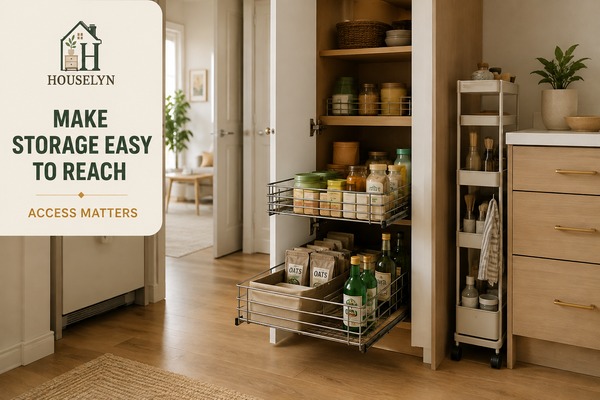
Divide Deep Shelves Into Reachable Layers
Deep cupboards often look spacious but behave poorly because the front row
hides the back. Large items can make good use of that depth, but smaller
categories may need pull-out containers, shallow bins or other divisions so
the entire shelf remains usable.
Keep high-frequency items toward the front or in a system that can move
forward as one unit. Place lower-frequency categories behind only when doing
so will not require repeated unpacking.
Avoid deep storage solutions that require people to kneel, reach blindly or
remove unstable stacks for ordinary daily use. The farther a storage area
sits from comfortable reach, the less frequently the contents should need to
be accessed.
Use Shelf Height More Efficiently Without Overstacking
Cupboards often contain unused vertical gaps because one short category sits
on a tall shelf. Shelf risers can divide some of this space so cups, plates,
pantry items or other appropriate categories remain visible instead of being
stacked into unstable towers.
The aim is to create separate levels, not to maximize every centimetre. If a
riser makes it difficult to remove the items below or pushes objects too
close to the shelf above, the extra capacity is not worth the access cost.
Use sturdy products within their stated load guidance and keep heavier items
lower where practical.
Make Children's Everyday Storage Easier to Return
For categories children are expected to put away independently, the storage
needs to be understandable and appropriately accessible. A low stable drawer,
open bin or simple contained zone may be easier to maintain than a deep box
that requires adult lifting.
Keep the number of visible categories manageable. If every toy is available
at once, the storage system may technically be accessible but still create
more floor clutter than the room can support.
Items that are unsafe or inappropriate for unsupervised access should remain
stored according to relevant product guidance and household needs rather
than being moved lower merely for organizational convenience.
Make Flexible Storage Truly Flexible
Slim rolling carts can be useful when a category moves between two nearby
activities or when a narrow gap provides the only practical footprint. They
can support craft materials, work supplies or other contained categories
that benefit from movement.
But wheels are useful only when the cart has a defined resting position.
A cart that permanently sits in a walkway or has to be shifted every time a
door opens becomes a mobile obstruction rather than flexible storage.
Check wheel stability, loaded weight, handle clearance and the route the cart
will actually travel before relying on it as an everyday solution.
Do Not Organize a Drawer So Precisely That It Becomes Hard to Use
Small compartments can improve access, but excessive subdivision can create
another type of friction. If every cable, pen or household accessory requires
an exact narrow slot, putting items away may take longer than necessary.
Match the level of precision to the category. Cutlery benefits from defined
sections because the types are predictable. A general household-tool drawer
may need broader zones rather than a compartment for every individual item.
Practical small apartment storage ideas make the correct
location obvious without demanding perfection from the person putting an
item away.
By the end of the Access stage, small apartment storage ideas
should be judged by how smoothly belongings move in and out of storage.
Daily categories should be easy to identify, retrieve and return, while
deeper or more awkward capacity is reserved for items that can tolerate the
extra effort.
In Chapter 7, we complete the framework with the Reset stage and build a
maintenance system that prevents organized storage from gradually turning
back into overflow.
Chapter 7: Small Apartment Storage Ideas That Stay Organized Over Time
A storage system stays useful when everyday categories return quickly,
seasonal items remain contained and full storage triggers review before
more furniture is added.
Even well-planned small apartment storage ideas can lose
effectiveness when belongings gradually expand beyond the boundaries
assigned to them. A basket gains several unrelated items, one seasonal
cupboard becomes permanent overflow and a useful drawer slowly turns into a
holding place for things with no clear destination.
The final stage of the Houselyn framework is therefore not another storage
purchase. It is a reset system that catches small changes before the
apartment reaches the point where every cupboard appears full and another
cabinet feels like the only option.
A reset does not require every shelf to look perfectly styled. It restores
category boundaries, keeps useful surfaces available and makes sure the
storage system still reflects what the household currently owns and uses.
Treat Overflow as Information
When items repeatedly overflow from a storage area, there are several
possible explanations. The category may have grown. The container may be too
small. The location may be inconvenient. Unrelated objects may have entered
the zone, or the category may contain belongings that no longer need to
remain.
Do not assume that a full basket automatically requires a larger basket.
First identify what changed. Increasing capacity without diagnosing the
cause can allow the same category to expand again.
The best small apartment storage ideas use recurring
overflow as a diagnostic signal. Full storage tells you to review the
category before it tells you to shop.
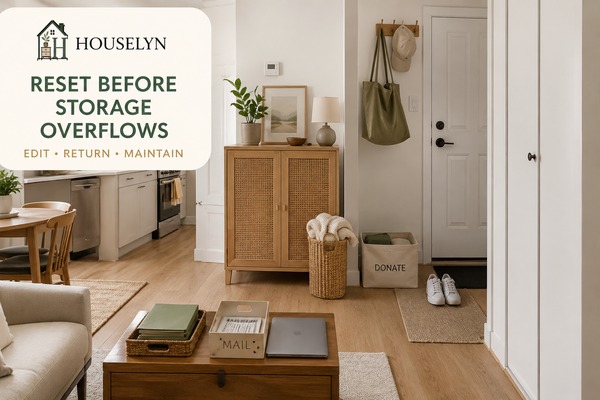
Build a Small Exit Zone
Items that are leaving the apartment need a temporary destination. Without
one, donations, returns, recycling and objects intended for another household
can remain mixed with active belongings for weeks.
Use one modest defined exit zone rather than several scattered piles. The
location might be a small bag, box or section near the entrance, provided it
does not obstruct the route.
The key is movement. An exit zone that grows indefinitely becomes another
storage category. Give it a recurring removal point so the apartment does
not permanently store things that have already been decided against.
Rotate Seasonal Storage Instead of Expanding Daily Storage
Seasonal clothing, spare bedding, holiday decor and weather-specific
equipment can consume the easiest storage positions long after their active
period ends. Rotating these categories protects premium access for the
current season.
This does not require moving the entire apartment twice a year. Review the
categories that noticeably compete with everyday belongings and relocate
only what creates useful capacity.
Strong small apartment storage ideas distinguish between
belongings that need to remain in the home and belongings that need to remain
in immediate reach. Those are not the same requirement.
Reset Entry Overflow Before It Reaches Other Rooms
Entryways often reveal storage drift first. Extra shoes appear beside the
usual pairs, post remains unopened, reusable bags multiply and coats exceed
the number the entry storage comfortably holds.
A short weekly review can move seasonal shoes, archive completed paperwork,
return bags to their assigned location and remove packaging before those
categories travel into the living room or bedroom.
The purpose is not to make the entry empty. It is to keep the arrival zone
limited to the categories that actively support leaving and returning home.
Watch Laundry as a Storage Pressure Signal
Clean laundry that repeatedly remains in baskets can indicate that clothing
storage is too full, too complicated or too inconvenient to reset. Buying
another laundry basket may hide the symptom while leaving the wardrobe
problem unchanged.
If folded clothes cannot return easily, review the drawer or wardrobe
categories. Seasonal items may need rotating, unused clothing may be
consuming easy positions or the storage may contain too many narrow
subdivisions.
This is another place where small apartment storage ideas
connect organization with maintenance: a pile outside storage can be
evidence that the storage inside is no longer functioning properly.
Use a Weekly Reset for Surfaces and Daily Storage
A weekly reset should focus on visible friction rather than reorganizing
every cupboard. Clear the main surfaces, restore high-use categories and
notice which storage areas are beginning to resist closing or returning.
If one category repeatedly requires several minutes to put away, note it for
a deeper review. The aim is to catch deterioration while it is still a
single-category problem.
Use a Monthly Review for Capacity Creep
Monthly reviews can be more selective. Look for categories that have gained
volume: toiletries, hobby materials, children's items, paperwork, pantry
backups or clothing are common examples.
Compare the category with its original boundary. If the boundary remains
appropriate, edit what has accumulated. If the household's routine has
genuinely changed, reassess the storage allocation rather than forcing the
old container to handle a new requirement.
This keeps small apartment storage ideas responsive to real
life. A storage system should be stable enough to maintain but flexible
enough to adapt when the household changes.
Revisit the Framework When the Household Changes
Moving to home working, welcoming a child or pet, starting a hobby, changing
jobs or altering cooking habits can all change storage demand. A system that
once worked well may become inconvenient without being badly designed.
When this happens, return to the relevant framework stage. Audit the changed
category, assign its new location, decide whether furniture should compress
functions, reconsider vertical capacity, adjust concealment and make sure
access still works.
The framework allows small apartment storage ideas to
evolve without restarting the entire apartment every time one routine
changes.
By the end of the Reset stage, small apartment storage ideas
should function as a living system rather than a one-time organizing
project. Categories have boundaries, overflow creates a review instead of an
automatic purchase, and items that are leaving the home do not remain stored
indefinitely.
The real test of small apartment storage ideas is not how
impressive the apartment looks immediately after organization. It is whether
the system can absorb an ordinary week, recover from normal use and reveal
clearly when a category needs attention.
When small apartment storage ideas are maintained this way,
new furniture becomes the last response rather than the first. The apartment
keeps more open space because storage capacity is reviewed, reassigned and
edited before it is expanded.
With all seven stages complete—Audit, Assign, Compress, Elevate, Conceal,
Access and Reset—the next section answers the practical storage questions
readers most often face when applying the framework to a real apartment.
Houselyn Frequently Asked Questions
Frequently Asked Questions About Small Apartment Storage
These answers address the practical decisions readers face when turning
small apartment storage ideas into a system that actually
works: capacity, furniture, closets, vertical storage, room-specific
pressure and everyday maintenance.
Beginner Questions
Start With Capacity, Categories and Priorities
1. How can I create more storage in a small apartment?
Begin by auditing what you already have before buying anything. Look for
underused cupboard height, deep shelves, furniture that could combine
storage with another function and categories stored far from where they
are used.
The strongest small apartment storage ideas often gain
capacity by reallocating existing space before introducing another
cabinet or organizer.
2. What are the best storage ideas for an apartment with very few closets?
Focus on furniture that already earns a place in the room, then add
selective vertical storage and closed freestanding capacity where a real
gap remains. Storage beds, ottomans, narrow cabinets, well-placed
shelving and entry storage can help when built-in closets are limited.
Avoid surrounding every room with storage furniture. Preserve open floor
area and decide which categories genuinely need to stay in the apartment.
3. Where should I start when organizing storage in a small apartment?
Start with the places where clutter repeatedly appears. Those areas
reveal whether the problem is capacity, location, access or unclear
category boundaries.
Audit the category, decide where it is used, assign an appropriate home
and test the location before buying a new container.
4. Should I declutter before buying storage?
Usually, yes. You do not need to remove useful or sentimental belongings
simply to create an artificially minimal home, but it is sensible to
review duplicates, unused items and categories that no longer deserve
premium space before expanding capacity.
Otherwise, new storage can simply preserve an old problem in a larger
container.
Furniture + Hidden Storage
Make Furniture Earn the Space It Occupies
5. What furniture is best for storage in a small apartment?
Furniture is most efficient when the primary function is already needed.
A storage ottoman works when the room needs a footrest or occasional
seat. A storage bench works where sitting and concealed storage naturally
overlap. A bed with usable under-bed capacity can make sense when the
bedroom already needs the bed footprint.
Good small apartment storage ideas compare the capacity
gained with the extra depth, visual weight and operating clearance of the
furniture.
6. Are storage beds worth it in a small apartment?
They can be, especially for bedding, seasonal clothing and other
lower-frequency categories. The best type depends on the room. Drawers
need side clearance, while lift-up systems require appropriate operation
space and should be used according to manufacturer instructions.
The bed must remain supported by its proper structural frame. Storage
boxes should never be used to support the bed itself.
7. Are storage ottomans useful in small apartments?
Yes, when the room already needs an ottoman, footrest or suitable extra
seat and the hidden compartment holds a defined category such as
blankets or games.
They become less useful when the lid is difficult to open, everything on
top must be moved first or the ottoman is purchased solely because it
contains storage despite the room not needing the furniture.
8. Is open shelving or closed storage better for a small apartment?
Use both selectively. Open shelving works well for visually coherent,
frequently used categories. Closed storage is usually better for cables,
paperwork, toiletries, toys, supplies and other mixed practical items.
The most balanced small apartment storage ideas use
visibility where it improves access and concealment where it reduces
visual noise.
Vertical Storage
Use Height Without Making Daily Storage Harder
9. How can I use vertical storage without making my apartment feel crowded?
Concentrate height where it solves the strongest storage problem instead
of adding tall furniture to every wall. One narrow tall cabinet can be
calmer than several small units if it consolidates meaningful
categories.
Leave some upper wall area open, protect daylight and avoid overfilling
open shelving. Vertical capacity should create more usable floor, not a
continuous wall of storage.
10. Are over-door organizers good for small apartments?
They can provide useful secondary storage for appropriately lightweight
items without using floor space. Check the door clearance, hook
thickness, loaded depth and whether the system prevents the door from
opening or closing normally.
They are less suitable for heavy items or categories that make the door
difficult to operate.
11. How high should storage shelves be?
There is no universal shelf height because wall construction, furniture,
household reach and the stored category all matter. Frequently used
belongings should normally stay within safe, comfortable reach, while
lightweight seasonal items can occupy appropriate higher positions.
Follow the shelf manufacturer's installation and load guidance, use
appropriate fixings for the wall and avoid heavy unsecured objects above
beds, sofas or other occupied areas.
Room-by-Room Storage
Solve the Storage Pressure Where It Actually Starts
12. How can I create more storage in a small apartment bedroom?
Begin with the wardrobe and under-bed areas before adding freestanding
furniture. Move lower-frequency clothing away from prime access, use
suitable internal divisions and consider under-bed capacity for bedding
or seasonal categories.
Bedroom-focused small apartment storage ideas should
preserve enough open floor for comfortable movement and should never use
storage boxes as structural support for the bed.
13. How can I increase kitchen storage in a small apartment?
Separate everyday kitchen access from backup storage. Daily tools deserve
the easiest drawers and shelves, while occasional serving pieces,
specialist appliances and backup supplies can move to less convenient
positions.
Shelf risers, internal containers and pull-out solutions can help when
existing cupboards have unused height or difficult depth, but worktop
space and ventilation should remain clear.
14. How can I add storage to a very small bathroom?
Prioritize frequently used toiletries, towels and cleaning categories,
then use suitable wall, over-door or narrow vertical storage only where
it does not interfere with doors, ventilation or normal bathroom use.
Keep backup products together rather than allowing several half-used
supplies to occupy multiple locations. Choose materials appropriate for
the environment and follow installation guidance for wall-mounted items.
15. What is the best way to organize storage in a small apartment entryway?
Keep only active arrival and departure categories near the door: everyday
shoes, current coats, keys, essential bags and a controlled point for
post. Seasonal shoes and occasional outerwear can move to secondary
storage.
Entryway small apartment storage ideas should protect
the walking route first. A larger shoe unit is not an improvement if it
makes entering the apartment awkward.
Maintenance + Reset
Stop Organized Storage From Becoming New Clutter
16. How do I stop storage baskets from becoming clutter?
Give every basket a specific category and review it when unrelated items
begin appearing inside. A larger basket often makes the problem less
visible rather than solving it.
If one basket contains several recurring categories, either divide the
storage deliberately or return those categories closer to where they are
actually used.
17. How should I organize seasonal items in a small apartment?
Keep current-season belongings in easier access zones and move suitable
lower-frequency categories to higher, deeper or under-bed storage. Use
containers that match the category and storage location rather than
choosing boxes before measuring.
Seasonal small apartment storage ideas work best when
rotation frees premium storage instead of simply creating another set of
permanent containers.
18. How do I keep a small apartment organized every day?
Keep the return journey short. Give daily belongings clear homes, reset
visible surfaces regularly and investigate categories that repeatedly
overflow instead of automatically adding storage.
Maintainable small apartment storage ideas make it easy
to identify when a category is in the wrong location, has grown beyond
its boundary or simply needs editing.
Houselyn Practical Action Plan
The 21-Day Small Apartment Storage Ideas Plan
This three-week plan turns the full Houselyn framework into manageable
decisions. Instead of emptying every cupboard at once, you will apply
small apartment storage ideas in a deliberate sequence:
Audit, Assign, Compress, Elevate, Conceal, Access and Reset.
Days 1–3
Framework Stage 1
Audit What the Apartment Is Actually Storing
Do not buy organizers during these first three days. Your goal is to
identify the categories creating the greatest pressure and determine
whether each problem comes from capacity, location, access or excess.
Day 1
Find the Visible Pressure Points
Walk through the apartment and note where shoes, laundry, paperwork,
toiletries, kitchen equipment or work supplies repeatedly collect.
Photograph or write down each location without trying to solve it
immediately.
Day 2
Review the Major Categories
List the category, approximate quantity, frequency of use, current
location, existing container and the main access problem. Separate
daily, weekly, occasional and seasonal belongings.
Day 3
Decide What Deserves Capacity
Identify duplicates, unused belongings and categories that are only
being stored because no exit decision has been made. Create a modest
donation, return or recycling zone without blocking circulation.
Days 4–6
Framework Stage 2
Assign Every Important Category a Practical Home
During the Assign stage, test whether your
small apartment storage ideas follow the real routine.
Storage should sit near where an item is used and where it can be returned
without creating unnecessary travel.
Day 4
Map Use and Return
For each high-priority category, write down where it is used and
where it naturally lands afterward. Compare that routine with the
current storage location.
Day 5
Reassign Daily Categories
Move keys, current shoes, work accessories, cooking tools and other
frequent items closer to their activities. Use existing drawers,
cupboards and containers for the trial where possible.
Day 6
Test the Reset Distance
Use the new locations for a normal day. Notice which items return
easily and which still remain on surfaces. Adjust the location before
deciding that more storage is needed.
Days 7–9
Framework Stage 3
Compress Furniture and Storage Functions
Review the number of freestanding pieces in the apartment. The objective
is not to replace everything with clever furniture, but to identify
places where one properly scaled item could remove another footprint.
Day 7
Audit Storage Furniture
List every basket, drawer tower, side cabinet, bench, ottoman and
freestanding organizer. Record which category each one holds and
whether it performs another useful function.
Day 8
Find Duplicate Footprints
Look for two or three pieces solving closely related problems. A
footstool and blanket basket, for example, may be replaceable by one
appropriately sized storage ottoman.
Day 9
Test Active Clearance
Measure lids, drawers, lift-up surfaces and pull-out containers in
their active positions. Confirm that circulation remains clear and
that the furniture's main function will still work comfortably.
Days 10–12
Framework Stage 4
Elevate Lower-Frequency Categories
Use height to protect daily convenience. At this stage,
small apartment storage ideas should move lightweight,
lower-frequency categories upward while keeping heavy and frequently
handled belongings at manageable levels.
Day 10
Map the Vertical Zones
Identify hand-reach, eye-level, upper-daily, weekly and seasonal
positions in wardrobes, cupboards and shelving. Note where daily
categories are being displaced by occasional items.
Day 11
Move Suitable Categories Higher
Relocate lightweight seasonal textiles, occasional accessories and
appropriate backup items. Keep heavy, fragile or frequently used
belongings within safer reach.
Day 12
Review Stability and Daylight
Check tall furniture, shelving, load guidance, windows, radiators and
circulation. Follow manufacturer anchoring instructions and tenancy
requirements before making permanent changes.
Days 13–15
Framework Stage 5
Conceal the Categories Creating Visual Noise
Decide what benefits from visibility and what becomes calmer behind a
door, drawer or lid. Do not buy matching containers until the categories
and internal dimensions are clear.
Day 13
Identify Visual Clutter
Look for mixed small items, cables, packaging, papers, toiletries,
toys and household supplies that make open shelves or surfaces feel
busier than their actual quantity suggests.
Day 14
Apply the Open-or-Closed Test
Keep coherent, frequent and easy-to-reset categories visible. Move
mixed, packaging-heavy or visually fragmented categories into
suitable closed storage.
Day 15
Define Every Basket and Box
Give each container one clear purpose. Remove miscellaneous holding
zones and use labels only where similar closed containers would
otherwise cause confusion.
Days 16–18
Framework Stage 6
Improve Visibility, Retrieval and Return
Work inside the storage you already have. Deep shelves, unused cupboard
height and excessive stacking often create more access trouble than the
total quantity of belongings.
Day 16
Count Retrieval Steps
Test high-use categories. Count how many lids, boxes, stacks or other
objects must move before the item can be reached and returned.
Day 17
Improve Deep and Tall Storage
Bring frequent items forward, divide suitable unused height and
reserve awkward depth for larger or lower-frequency categories.
Avoid unstable towers and excessive subdivision.
Day 18
Test One-Motion Return
Check whether daily belongings can return in one simple action.
Simplify containers or category divisions when putting something away
requires unnecessary precision.
Days 19–21
Framework Stage 7
Reset the System and Protect Its Boundaries
The final three days establish the maintenance route. Your goal is to
make overflow visible early, move exit items out and decide what should
happen when a category becomes full.
Day 19
Complete the Reset Route
Review the entry, main surfaces, daily categories, clothing,
paperwork, kitchen overflow, bathroom items, seasonal storage and
the exit zone.
Day 20
Remove What Is Already Leaving
Process donations, returns, recycling and objects intended for
another destination. Do not allow the exit zone to become permanent
storage.
Day 21
Complete the Final Storage Review
Walk through the apartment as a complete system. Confirm that
storage supports circulation, access, category boundaries and
everyday return before purchasing anything still under
consideration.
Final Houselyn Framework
Conclusion: Build Storage Around How the Apartment Actually Works
The most successful small apartment storage ideas do not
begin with buying more organizers. They begin with understanding the
belongings, routines, access needs and physical limits of the home.
A small apartment does not automatically need storage on every wall or a
container in every available gap. It needs enough capacity for the
belongings that genuinely support the household, positioned where those
categories can be used and returned without constant effort.
The difference matters. More storage can make an apartment easier to live in
when it answers a real volume problem. It can also make the home feel
smaller when unnecessary cabinets, shelving units and baskets consume
circulation without correcting the location or access problem underneath.
That is why the Houselyn approach treats storage as a complete system.
Capacity, furniture footprint, vertical space, visibility, accessibility and
maintenance must work together. Improving only one of those areas can create
a temporary result while the deeper pressure continues elsewhere.
Choose Storage Only After the Problem Is Clear
When a category repeatedly appears on a surface, begin by asking why. It may
need more capacity, but it may also live in the wrong room, sit behind too
many other items or require a return routine that is too complicated for
ordinary daily use.
Once the problem is identified, products become easier to compare. You can
judge whether a cabinet has the correct depth, whether a drawer can open
fully, whether a basket suits the category and whether a multifunctional
piece removes another footprint instead of simply adding one.
This makes small apartment storage ideas more durable.
Instead of collecting isolated organizing products, the apartment gains a
system in which each storage decision has a defined purpose.
Protect Open Space as Carefully as Storage Space
Empty floor and open wall area are not wasted capacity. They support
circulation, daylight, furniture operation and visual calm. A storage plan
should preserve enough openness for the apartment to function comfortably,
even when every possible surface could technically hold another shelf.
Concentrate storage where it solves the strongest problem, keep frequently
used categories within easy reach and allow lower-frequency belongings to
occupy less convenient positions. That hierarchy is more useful than
maximizing every centimetre equally.
Let Full Storage Trigger Review Before Expansion
A full cupboard does not always mean the household has failed or needs to
remove everything. It means the category deserves attention. The quantity
may have changed, unrelated belongings may have entered the zone or seasonal
items may be occupying valuable daily space.
Review those possibilities before adding furniture. New capacity should be
the response to a demonstrated need, not the automatic response to every
basket or drawer that becomes difficult to close.
Applied together, these small apartment storage ideas
create a home that feels more capable without becoming dominated by storage.
The goal is not to conceal every sign of daily life. It is to make belongings
easier to use, easier to return and less likely to compete with the space the
household needs for living.
A good system will continue to change. New routines, work patterns, hobbies,
seasons and household needs can alter what the apartment must hold. Return
to the framework whenever pressure reappears, adjust the relevant category
and expand capacity only where the evidence supports it.
Houselyn Knowledge Library
Continue Building a More Functional Small Apartment
Use these curated reading paths to connect your
small apartment storage ideas with whole-home planning,
organization routines, room-specific pressure points and a calmer visual
design.
Reading Path 1
Plan the Apartment Before Adding More Storage
Follow this path when layout, furniture scale and room relationships are
contributing to the storage problem.
Start Here
Small Apartment Ideas
Coordinate storage with furniture scale, circulation, functional
zones and whole-apartment priorities before introducing more
cabinets or organizers.
Follow this path when one room or routine is generating most of the
apartment-wide clutter.
Clothing + Personal Items
Bedroom Organization Ideas
Improve wardrobes, drawers, bedside categories, clothing rotation
and personal-item storage when the bedroom is carrying too much of
the apartment's overflow.
Explore wider styling principles for creating rooms that remain
comfortable, functional and visually connected after storage
problems have been addressed.
Return to this Knowledge Library whenever your
small apartment storage ideas reveal a new pressure
point. The most useful next step is the one that strengthens the system
already in place rather than starting the apartment again from the
beginning. Together, these small apartment storage ideas
support a home that remains practical, adaptable and comfortable over
time.
Practical small apartment living room ideas for layout, furniture, storage, lighting and decor that make compact spaces feel comfortable and functional.