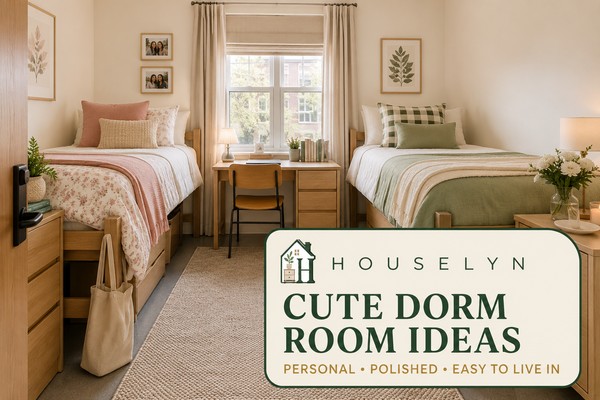
Cute Dorm Room Ideas That Feel Personal, Polished and Easy to Live In
Cute dorm room ideas work best when colour, texture and
personal details form one clear visual story while the bed, desk and
shared areas remain comfortable enough for everyday student life.
Coordinated colours and a few meaningful details allow both sides of a
shared dorm to feel personal without making the room look identical.
Why Cute Dorm Room Ideas Need More Than Attractive Accessories
The first view of a dorm room can feel surprisingly impersonal:
neutral walls, repeated furniture, limited floor area and almost no
visual connection to the student who will live there.
A Plain Room Creates Both Freedom and Pressure
An undecorated dorm offers the freedom to begin again, but it can also
create pressure to make every decision immediately. Students may feel
that bedding, photographs, lamps, cushions, rugs and decorative
accessories must all be chosen before move-in so the room looks
complete from the first day.
Effective cute dorm room ideas do not require a room
to look finished instantly. They begin with a clear understanding of
how the student wants the space to feel and which visual qualities
should connect the belongings added over time.
The Common Mistake Is Shopping Item by Item
A floral cushion may be attractive. A graphic print may feel bold. A
bright lamp, checked blanket and novelty mirror may each look appealing
in isolation. The difficulty appears when every purchase introduces a
different colour, style or visual mood.
When cute dorm room ideas are collected separately,
the room can become busy without becoming personal. The individual
products remain visible, but the student’s intended atmosphere becomes
difficult to recognise.
The Room Still Has Practical Work to Do
A dorm is a bedroom, study area, dressing space and temporary home,
often shared with another person. It may contain fixed furniture,
limited luggage capacity, restricted attachment methods and rules
governing lighting, appliances or wall treatments.
Practical cute dorm room ideas respect those
conditions. Decoration should not make the bed uncomfortable, remove
the desk’s working area, prevent a drawer from opening or place pressure
on a roommate to accept a style they did not choose.
Part I • Imagine the Room
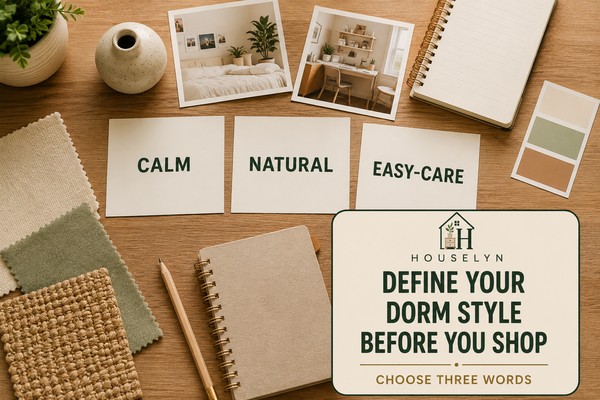
Define What Cute Dorm Room Ideas Should Feel Like Before You Shop
The first stage of successful cute dorm room ideas is
not choosing a colour or filling a basket. It is deciding which feeling
the room should communicate when the student enters, studies, rests and
spends time there.
Attractive objects do not automatically produce a coherent interior. The
student may own enough decoration to fill the available surfaces while
still being unable to explain whether the intended room is calm, playful,
romantic, natural, minimal or eclectic.
The most dependable cute dorm room ideas begin with a
short visual brief. This brief gives future decisions something more
useful to answer than, “Do I like this item?”
Choose the Experience Before Naming the Aesthetic
Style labels can be helpful, but they often contain too many different
interpretations. One person’s vintage room may feel scholarly and
collected, while another person imagines florals, lace and delicate
pastels.
Begin with the experience the student wants rather than trying to
reproduce a complete online category. Words such as calm, bright,
creative, soft, grounded or polished can guide colour, material and
scale without forcing the room to imitate one photograph.
Use One Main Style and One Supporting Influence
A room may combine influences, but they should not receive equal visual
authority. Choose one direction to control most colours, shapes and
materials. Allow a second influence to appear through a small number of
details.
A soft neutral room, for example, might include one playful graphic
lamp. A vintage-inspired scheme might use clean modern bedding so the
room does not feel theatrical. The supporting influence creates
contrast without replacing the main idea.
Give Every Future Purchase Four Questions to Answer
The room brief should reduce impulsive choices rather than create a
longer wish list. Before buying decor, test whether the item supports
the planned atmosphere and whether it earns the space required to carry
it into the dorm.
The Four-Part Shopping Filter
Does it support at least two words in the room brief?
Does it duplicate something already chosen?
Can it travel safely to move-in and future accommodation?
Will it still allow the surrounding surface to function?
Set the Budget Around Visual Priorities
A styling budget becomes easier to control when the student knows which
elements will influence the room most. Reserve more of the available
money for pieces that affect a large visual area or provide repeated
use. Smaller accessories should complete the direction rather than
consume the budget one inexpensive purchase at a time.
Consider the next room as well. Cushion covers, throws, small rugs,
photographs and portable accessories can often adapt to different
furniture. Products designed for one highly specific dorm measurement
may have less value once the academic year ends.
Three precise style words can guide colour, material and purchasing
decisions before unrelated decorative items enter the plan.
Part II • Build the Visual Foundation
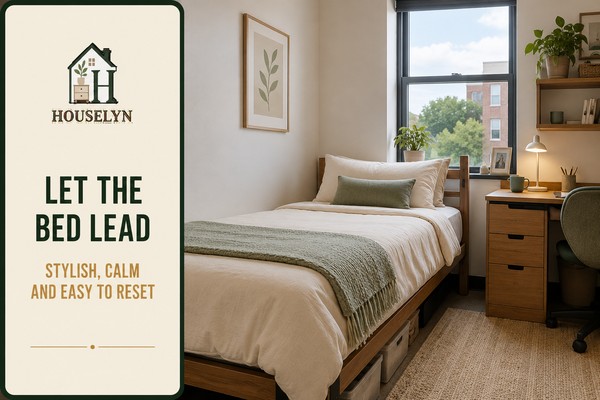
Use Cute Dorm Room Ideas to Make the Bed the Visual Anchor
Because the bed occupies one of the largest visible areas in a student
room, successful cute dorm room ideas let its colours
and patterns establish a direction that smaller accessories can support.
A bed does not need to dominate the room, but its scale means it cannot
be treated as visual background. Even simple bedding contributes a large
area of colour, texture and contrast that affects every nearby choice.
When cute dorm room ideas begin with small accessories
alone, students often keep purchasing decor in an attempt to make the
room’s style more visible. A stronger anchor allows fewer items to create
a clearer result.
Give the Bed One Dominant Textile Story
A dominant textile story might be built around a soft solid foundation,
a restrained botanical pattern, a narrow stripe or a simple geometric
design. The purpose is not to make every layer identical. It is to give
the eye one understandable starting point.
When the duvet or cover carries a noticeable pattern, nearby cushions
and throws usually need quieter surfaces. When the main bedding is
plain, one patterned layer can introduce character without creating
competition.
Let One Pattern Lead
Several strong motifs placed together can make the bed appear smaller
and busier. Select one pattern to receive attention, then use solid
colours or very subtle textures to connect the remaining layers.
Protect the Bed’s Real Job
Decorative layers should not make bedtime or morning resets
unnecessarily complicated. A student who must move a large collection
of cushions every evening may quickly transfer them to the chair,
floor or desk.
Keep only the layers that contribute genuine comfort, a useful seasonal
adjustment or a visible part of the room brief. The bed should remain
inviting when it is being used, not only when it has been arranged for
a photograph.
One leading pattern, two repeated tones and restrained supporting layers
allow the bed to guide the room without overwhelming it.
Part II • Build the Visual Foundation
Coordinate Cute Dorm Room Ideas With Colour, Pattern and Texture
Layered cute dorm room ideas feel intentional when
colour establishes hierarchy, patterns differ clearly in scale and
texture adds interest without introducing another competing theme.
Visual variety is not the problem. The difficulty appears when every
colour, pattern and texture receives equal importance. A small dorm has
fewer places for the eye to move, so unrelated decorative signals can
accumulate quickly.
Strong cute dorm room ideas create relationships rather
than exact matches. One colour may dominate, another may support it and a
third may appear sparingly. A rough woven surface can sit beside a soft
textile because their contrast is intentional.
Repeat Colour Without Making Every Item Match
Exact matching can make a room appear purchased as one fixed set.
Related shades usually feel more natural. A muted green cushion, for
example, can relate to a softer sage storage bin or a deeper green
notebook without appearing identical.
Before introducing another colour, look for one already present that
could be repeated in a new material or slightly different shade. This
strengthens the visual connection without creating unnecessary
uniformity.
Use Texture When the Colour Scheme Is Quiet
A restrained palette does not need additional bright colours to feel
interesting. Texture can create visible depth through woven fibres,
softly raised fabric, natural wood grain or a smooth ceramic surface.
Texture is most effective when the difference can be recognised
clearly. Several nearly identical soft fabrics may add physical comfort
but provide little visual contrast.
Treat Empty Space as Part of the Colour Scheme
A visible section of plain wall, an uncovered part of the desk or space
between accessories allows the chosen colours and textures to remain
distinct. Filling every gap removes the contrast that makes a layered
scheme readable.
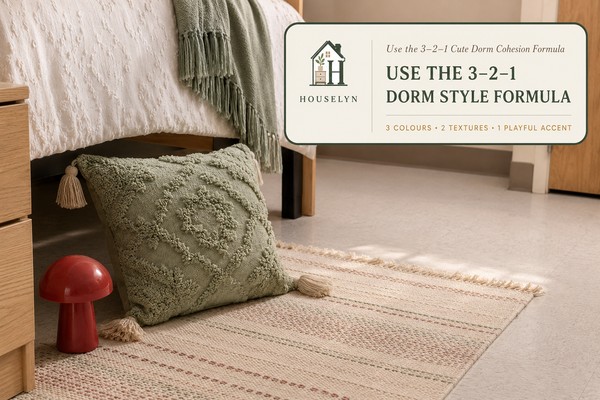
Pause after arranging the main colour, texture pair and playful accent.
Additional decoration should solve a visible weakness rather than
simply occupy remaining space.
Three related colours, two contrasting textures and one controlled
accent create interest without asking every object to compete.
Part III • Express the Room
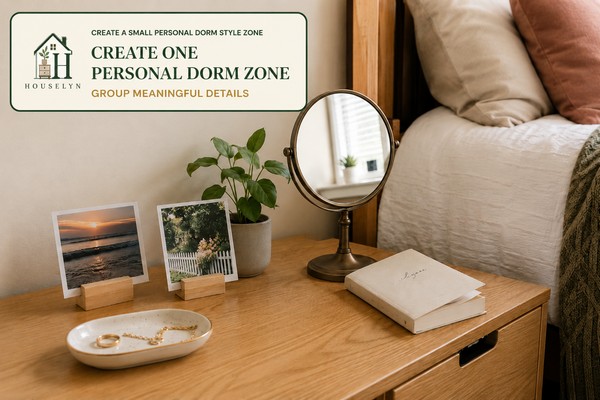
Use Cute Dorm Room Ideas to Create Personal Style Moments
Personal cute dorm room ideas become more memorable
when photographs, keepsakes and favourite objects are gathered into a
few intentional zones rather than scattered across every available
surface.
Personal objects can make temporary accommodation feel familiar, yet
spreading them evenly throughout the room often weakens their impact.
Each photograph or keepsake becomes one more small item competing with
practical belongings.
More effective cute dorm room ideas use concentration.
When related objects occupy one defined area, the student’s identity is
easier to recognise and the rest of the room can remain calmer.
Choose Objects That Carry a Story
Generic decorative filler may support colour or texture, but it does
not automatically make the room feel personal. A photograph from home,
a postcard from a meaningful place or a small object connected to a
hobby can communicate more than several trend-led accessories.
Ask what each displayed item represents. If it contributes neither a
useful function nor a recognisable connection to the student, it may
not deserve one of the limited personal display positions.
Group Photographs Instead of Scattering Them
Several isolated photographs may disappear among books, stationery and
practical supplies. A small grouped display feels more deliberate and
allows the images to support one another.
Keep the grouping modest. Select photographs that remain easy to see
from the normal viewing position, and leave enough plain space around
them to prevent the display from becoming a full wall installation.
Use a Collection Boundary
A tray, small memo holder, frame arrangement or defined shelf section
can establish where the collection begins and ends. Once that boundary
is comfortably filled, rotate an item rather than extending the display
into another area.
Keep Personal Style Beside the Desk, Not Across It
The desk can carry a small amount of personality, but its primary
responsibility remains academic work. A photograph near the rear edge
or one meaningful object beside a lamp may provide enough visual
connection without reducing the central working area.
Avoid using the desk as the default location for every decorative item
that has not found another home. Objects that must be moved before each
study session are likely to migrate to the bed, chair or floor.
Leave One Personal Zone Deliberately Quiet
Every part of the room does not need an identity display. A quieter
bedside area or minimally styled desk can give stronger personal zones
greater visibility.
This restraint also allows the room to absorb new photographs, cards
and objects acquired during the academic year without immediately
becoming crowded.
A compact personal zone gives photographs and meaningful objects a
visible relationship while leaving nearby surfaces available for daily
use.
Part III • Express the Room
Balance Cute Dorm Room Ideas With a Roommate’s Style
Shared cute dorm room ideas work best when roommates
coordinate a small number of foundations while retaining enough
independence for each side of the room to express a different
personality.
Roommates do not need the same aesthetic, matching duvet covers or
identical decorative objects. Forced similarity can remove the personal
expression that makes each side feel comfortable to its occupant.
The goal is visual cooperation. Effective cute dorm room
ideas identify which decisions affect both people and which
choices can remain completely personal without weakening the shared room.
Coordinate Foundations Rather Than Every Detail
A shared room can feel connected through one rug, a repeated neutral,
similar furniture spacing or a common practical zone. The bedding,
photographs and smaller accessories on each side may still look
noticeably different.
Begin with the parts of the room both people see and use. The centre
floor, entrance, shared appliance area and any jointly owned item
deserve agreement before either roommate develops a complete personal
scheme.
Let Different Bedding Styles Coexist
Matching bedding can create a strong visual connection, but it is not
necessary. One side might use a botanical pattern while the other uses
a graphic stripe. The schemes can still relate through colour
temperature, a shared neutral or similar visual weight.
Avoid forcing one roommate to replace existing bedding solely to create
a coordinated photograph. It is usually more affordable and personal to
identify a modest bridge between the two schemes.
Coordinate the Relationship, Not the Products
A pale neutral foundation on one side can connect with the background
colour of a brighter pattern on the other. Similar wood tones,
restrained rugs or repeated black details can also provide visual
continuity without duplicate purchases.
Make Ownership Clear From the Beginning
A jointly styled room may contain items purchased by one person, items
split equally and products borrowed from home. Record ownership for
anything valuable or genuinely shared.
Clear ownership reduces uncertainty when one roommate moves out early,
changes accommodation or wants to take an item home during a holiday.
It also prevents a low-cost decorative decision from becoming an
avoidable disagreement later.
Respect Cultural, Personal and Emotional Boundaries
Photographs, symbols, texts and decorative motifs may hold cultural,
religious or personal meaning. Roommates should not assume that every
meaningful object is available for shared styling, commentary or
relocation.
Each person should be able to define which belongings are private, which
may be displayed openly and which parts of their allocated space should
not be rearranged by the other roommate.
A neutral shared foundation and one repeated connector colour can bring
two different dorm-room styles into a comfortable visual relationship.
Part IV • Protect Comfort and Function
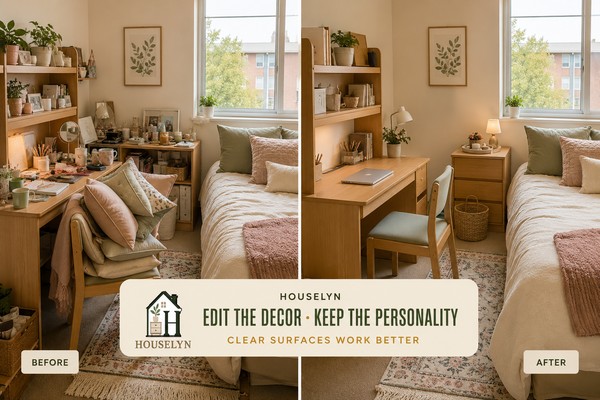
Edit Cute Dorm Room Ideas So the Room Stays Functional
Attractive cute dorm room ideas need enough restraint
for the student to open drawers, use the desk, sit comfortably, clean
the room and move through it without relocating decoration first.
A cohesive dorm can still become inconvenient when every suitable surface
receives an accessory. Visual success during move-in photographs does not
guarantee that the arrangement will support study, cleaning or an
ordinary evening routine.
Practical cute dorm room ideas preserve the strongest
details and remove the friction created by weaker ones. Editing is not an
admission that the style failed. It is the stage that allows the style to
survive real use.
Cute and Crowded Are Different Outcomes
A room may contain several related colours and meaningful objects yet
still feel crowded because too many areas demand attention. The issue
is not necessarily the number of belongings. It is how much visual and
physical responsibility they place on the available space.
Notice what must be moved before the student can begin an activity. A
cushion transferred from the chair every day, a tray shifted before
studying or a decorative box removed to open a drawer reveals that an
object has occupied a functional position.
Reduce the Number of Areas Asking for Attention
A bed, personal display and one playful object may already provide
enough visual character. Adding a strongly styled desk, crowded shelf
and additional decorative floor zone can weaken each of those earlier
decisions.
Select the two or three areas that express the room most successfully.
Allow nearby surfaces to remain supportive rather than developing each
into another complete composition.
Combine Similar Accessories Into One Stronger Group
Three small objects positioned independently can create three separate
points of visual interruption. Placing them together within one tray,
shelf section or bedside moment allows the surrounding surface to
appear calmer.
Grouping works best when the objects share colour, purpose, material or
personal meaning. Unrelated items placed together may look like
temporary clearing rather than an intentional composition.
Reduce Packaging Before Adding More Decor
Branded boxes, product wrappers, open delivery parcels and colourful
everyday packaging can introduce more visual noise than the decorative
scheme itself. Remove unnecessary packaging and contain permitted
consumables by category where practical.
Do not transfer food, cleaning products or cosmetics into unlabelled
containers when doing so could create confusion or safety concerns.
Visual calm should never remove important product information.
Keep the Styled Bed Comfortable Enough to Use
Decorative cushions and throws should not create a nightly pile on the
floor. Keep the pieces that contribute genuine comfort or a clear
visual role and remove layers that exist only because the bed looked
unfinished without them.
The bed should be easy to prepare for sleep and realistic to remake
during a busy week. A simpler arrangement maintained consistently
usually contributes more to the room than an elaborate display that
collapses after several days.
Editing repeated accessories restores the desk, chair and bedside area
while preserving the room’s strongest colours and personal details.
Part V • Let the Room Evolve
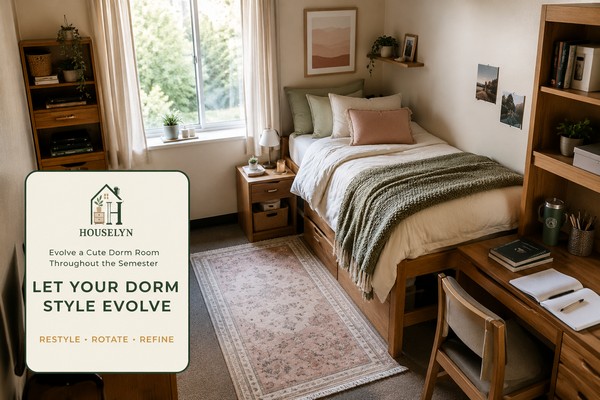
Evolve Cute Dorm Room Ideas After Move-In
The most useful cute dorm room ideas treat move-in as
the beginning of the room rather than the moment every colour, display
and decorative decision must become permanent.
A room planned before term begins is based partly on prediction. The
student does not yet know which routines will dominate, where belongings
will naturally accumulate or which decorative details will provide
lasting comfort.
The strongest cute dorm room ideas leave room for
evidence. Once the student understands how the space is actually used,
small changes can make the design more accurate, personal and comfortable
than the original move-in arrangement.
Treat the Move-In Design as the First Version
A first version gives the room direction without pretending that every
need is already known. It establishes the palette, bed anchor and
personal zones while preserving enough open capacity for the semester
to reveal what belongs.
Avoid filling every shelf or display area before the student has lived
in the room. Empty capacity allows coursework, seasonal clothing and
new personal memories to arrive without immediately overwhelming the
design.
Restyle Before Buying a Replacement
A room may feel tired because the arrangement has become familiar, not
because the objects are wrong. Moving a throw from the bed to the chair,
regrouping photographs or changing which cushion faces forward may
create enough difference.
Photograph the current arrangement before making changes. Compare the
new version after several days rather than immediately assuming that
unfamiliar placement is worse.
Refresh Through Covers and Small Accents
Cushion covers, one framed print, a small desk accessory or a rotated
photograph can change the room’s emphasis without replacing the largest
and most expensive pieces.
Keep the established colour hierarchy visible. A refresh should adjust
the room’s emphasis rather than restart the palette each time a new
trend appears.
Let Comfort Guide the Next Change
Before adding another purely decorative object, consider whether the
room needs better seating comfort, a more practical bedside arrangement
or a calmer study view.
Mature cute dorm room ideas respond to the student’s
actual experience. The room becomes more personal when its appearance
and daily comfort improve together.
Record the Successful Version Before Move-Out
Photograph the final room from several useful angles and note which
colour relationships, personal zones and practical boundaries worked
best. This record becomes a planning reference for the next
accommodation.
The purpose is not to recreate the room exactly. It is to preserve the
lessons: which objects carried the style, which surfaces needed more
freedom and which purchases continued providing value.
A mature dorm-room scheme keeps its original visual foundation while
adapting to coursework, changing seasons and personal memories gathered
during the semester.
Practical College-Room Answers
Frequently Asked Questions About Cute Dorm Room Ideas
These answers address the most common decisions surrounding
cute dorm room ideas, from choosing an aesthetic and
managing a student budget to coordinating with a roommate and preventing
the finished room from becoming crowded.
Beginner Questions
Choosing the Room’s Direction
How do I decide what aesthetic I want for my dorm room?
Begin by describing how the room should feel rather than selecting
a trend name immediately. Choose three words: one emotional word,
one visual word and one practical word. A useful example might be
calm, natural and easy-care.
Review saved photographs and identify the repeated qualities rather
than copying complete rooms. Notice whether the images share pale
colours, playful shapes, vintage details, clean lines or warm
textures. Those patterns reveal what the student genuinely likes.
The best cute dorm room ideas support a defined
feeling while remaining suitable for a temporary, compact and
practical student room.
What should I decorate first in a dorm?
Start with the largest visible elements that the student already
needs, particularly the bed and any substantial textile such as a
rug. These pieces establish colour and visual weight before smaller
accessories enter the room.
After the main foundation is clear, add one personal zone and one
practical decorative layer. Avoid beginning with numerous small
ornaments because they can introduce several unrelated styles
without giving the room a strong base.
Building cute dorm room ideas from larger surfaces
towards smaller details usually produces a more coherent and
affordable result.
How many colours should a dorm room have?
Three related colours are enough for most dorm rooms. Use one as the
foundation, a second as the recognisable supporting colour and a
third as a restrained accent.
The colours do not need equal visibility. A warm cream foundation
might occupy large areas, muted sage may repeat through several
smaller objects and a soft rose or brighter red may appear once or
twice.
Neutral furniture and ordinary belongings will introduce additional
tones naturally, so the planned palette should remain controlled
rather than attempting to account for every visible colour.
How can I make a plain dorm room look cute?
Give the room one clear visual story. Coordinate the bed, repeat one
or two colours, introduce contrasting texture and gather personal
belongings into a defined display instead of scattering them.
A plain room does not need decoration on every wall. A cohesive bed,
one small rug, a practical lamp and a contained group of photographs
can create a stronger result than many unrelated accessories.
Successful cute dorm room ideas make standard
furniture feel intentional by connecting what surrounds it, not by
attempting to hide every original feature.
Budget and Practical Questions
Shopping, Rules and Limited Space
How can I make my dorm room cute on a student budget?
Spend first on items that are necessary and visually influential.
Bedding, a useful lamp, a washable rug or practical storage may
contribute more than several inexpensive decorative purchases.
Use removable covers, personal photographs, items already owned and
small colour repetitions to develop the style. Rearranging or
grouping existing belongings can improve the room without adding
another product.
Budget-friendly cute dorm room ideas depend on
consistency rather than quantity. Three related low-cost details
will usually look more intentional than ten unrelated sale items.
What decor should I buy before seeing the dorm?
Buy only flexible items whose suitability does not depend on exact
measurements. Portable textiles, cushion covers, photographs and a
compact personal accessory are safer early choices than shelves,
large rugs or fitted organisers.
Wait for confirmed room information before purchasing anything that
depends on bed size, desk dimensions, wall permissions, door
clearance or available floor area.
Early cute dorm room ideas should establish a
palette and mood without committing the student to products that may
not fit the actual accommodation.
How can I decorate without damaging dorm walls?
Read the residence agreement before using any adhesive, hook,
removable strip or hanging system. Products described as removable
can still affect certain paints and wall finishes.
Freestanding alternatives are often safer. Use tabletop frames,
memo holders, mirrors with stands, shelf-top displays or permitted
furniture surfaces when attachment rules are unclear.
Never assume that a method allowed in a previous room will be
accepted in the current residence. Take photographs of existing
marks during move-in and keep written guidance provided by the
accommodation.
How can I make a dorm cosy when string lights are not allowed?
Use approved table or floor lamps, warm-coloured textiles, a soft
rug and layered surfaces rather than depending on decorative light
strings. Confirm the permitted bulb type, wattage and appliance
rules before bringing a lamp.
Cosiness can also come from warm neutral colours, one soft throw,
natural texture and a small personal display. The room should feel
comfortable during daylight as well as after the lights are turned
on.
Rule-aware cute dorm room ideas create atmosphere
through several restrained elements instead of relying on one
prohibited feature.
How do I personalise a dorm when I am travelling with limited luggage?
Prioritise lightweight, flat and emotionally meaningful items.
Photographs, postcards, cushion covers, a small textile and one
familiar object can provide strong personal connection without
consuming much luggage capacity.
Digital photographs can be printed after arrival, and certain
practical items can be purchased locally once dimensions are known.
Avoid packing large decorative objects that have only one possible
position.
Travel-friendly cute dorm room ideas concentrate
personality into a few portable zones rather than attempting to
transport a complete bedroom aesthetic.
Shared-Room Questions
Coordinating With a Roommate
Do roommates need matching dorm decor?
No. Two sides can look connected without using identical bedding,
cushions or artwork. Coordination requires a visual relationship,
not duplication.
Choose one connector colour, a shared neutral or a simple central
rug. Each roommate can then use a different supporting colour and
personal accessories within their own allocated area.
Roommate-friendly cute dorm room ideas should allow
both students to recognise their individual style while the shared
centre remains calm and cooperative.
How should roommates choose a shared colour scheme?
Compare the colours each roommate already plans to use and identify
one acceptable overlap. A flexible neutral, muted green, navy or
warm brown can often connect two otherwise different palettes.
Repeat the shared colour differently on each side rather than
purchasing duplicate products. One student might use it in bedding
while the other repeats it through a print, storage item or desk
detail.
Keep the remaining colours personal so the room does not become an
artificial matching set.
What should stay personal in a shared dorm?
Bedding, photographs, sentimental objects, desk accessories,
allocated storage and personal artwork should normally remain under
the control of the roommate who owns that side or furniture.
Shared decisions should focus on genuinely communal zones and
jointly owned products. Neither roommate should move, edit or use
the other person’s personal belongings without permission.
Respectful cute dorm room ideas distinguish shared
coordination from access to another person’s private space.
Advanced Styling Questions
Editing, Refinement and Long-Term Use
How do I stop cute dorm decor from looking cluttered?
Limit the number of focal areas and protect the main purpose of each
surface. The desk should remain ready for study, the chair should be
available for sitting and the bedside area should hold genuine
night-time needs.
Group related accessories, remove repeated motifs and leave visible
space around the strongest details. If an item must be moved before
an ordinary activity, reconsider its position.
Edited cute dorm room ideas retain personality by
making the most meaningful objects easier to see rather than
surrounding them with additional filler.
How can I make a dorm room look more expensive without overspending?
Prioritise consistency, fit and condition. A restrained palette,
properly sized textiles and clear surfaces often look more polished
than numerous decorative products.
Repeat a limited number of materials, keep packaging out of sight
where safe and practical, and use fewer accessories with stronger
relationships. Washable covers and neatly maintained textiles can
improve the impression without requiring luxury purchases.
Polished cute dorm room ideas come from hierarchy
and care, not from pretending that student accommodation is a
high-end hotel.
How often should I refresh my dorm decor?
Review the room after several weeks of real use, at the change of a
major season and whenever coursework or belongings begin reducing
functional space.
A refresh does not require new purchases. Restyle, rotate or
relocate existing objects before replacing anything. Change one
area at a time and observe whether the adjustment improves comfort,
function or visual balance.
Evolving cute dorm room ideas should respond to
genuine changes in student life rather than every temporary online
trend.
Complete the Houselyn Styling Journey
Build Cute Dorm Room Ideas That Still Feel Good to Live In
The strongest cute dorm room ideas do more than make a
temporary room attractive. They help the student create an environment
that feels recognisable, supports daily routines and remains flexible
enough to improve throughout the academic year.
Personality Becomes Clearer When the Room Has Direction
A dorm does not become personal because it contains the greatest number
of photographs, colours or trend-led accessories. Personality becomes
easier to recognise when meaningful objects, practical textiles and
selected visual details support the same general atmosphere.
That atmosphere does not need to belong to one prescribed aesthetic.
Soft neutral, colourful, vintage, graphic, playful and minimal rooms can
all succeed when their decisions have a clear relationship.
A Coordinated Room Should Never Feel Like a Display Window
Coordinated cute dorm room ideas still need evidence of
real student life. Books may appear on the desk, practical supplies may
occupy shelves and each roommate may express a noticeably different
personality.
The aim is not perfection. It is a room where those ordinary belongings
can exist without erasing the visual direction or preventing the main
surfaces from performing their jobs.
Use these dorm desk organization ideas to create a clear college study space with better drawer systems, vertical storage, cable control and simple resets.
Discover dorm bedding ideas that make small rooms feel like home. Learn how to create a cosy, stylish, and practical college dorm with smart bedding, storage, and decorating tips.
Learn how to decorate a stylish and comfortable living room with practical design advice, timeless styling ideas, and expert inspiration from Houselyn.
Discover practical dorm room organization ideas that help you organize clothes, desks, storage and daily routines for a calm, clutter-free college room.
Discover college dorm decor ideas for colour, bedding, walls and personal touches that turn a plain student room into warm, stylish place that feels like home