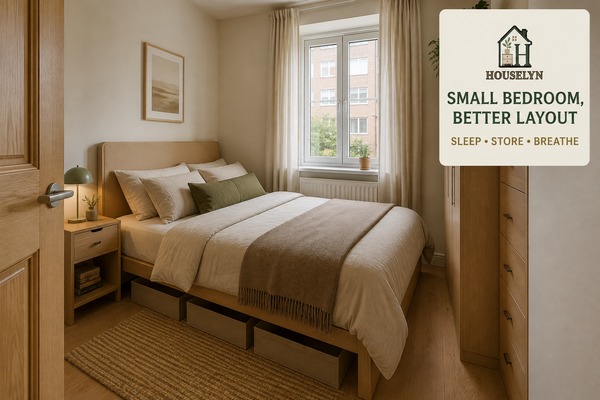
Small Apartment Bedroom Ideas: Smart Layout, Storage & Style
Houselyn Small Apartment Living Guide
Create a compact bedroom that protects sleep, provides practical storage
and still feels warm, calm and comfortable—without filling every available
wall or sacrificing the space you need to move.
Small apartment bedroom ideas work best when the room is
planned around its most important job: giving you a comfortable place to
sleep. Storage, dressing, lighting, working and decorating may all matter,
but they should be fitted around the bed and the space required to move
through the room comfortably rather than competing with them.
This matters because the bed normally occupies more floor area than any
other object in the bedroom. Once wardrobes, drawers, bedside furniture,
laundry, windows and the bedroom door are added, the usable floor can be far
smaller than the room appeared when it was empty.
Effective small apartment bedroom ideas therefore begin
with layout rather than decoration. Before choosing another cabinet,
mirror, rug or decorative accessory, you need to know where the bed can sit,
which routes must remain open and how much working clearance the remaining
furniture requires.
Plan the Bedroom as It Will Actually Be Used
A floor plan can be misleading when it shows only furniture footprints.
Bedrooms operate in three dimensions and furniture needs working space.
Wardrobe doors swing or slide. Drawers extend. Bed-storage drawers need
clearance. Someone must stand in front of a wardrobe, make the bed and walk
from the doorway without repeatedly squeezing between furniture.
That active-state thinking changes how
small apartment bedroom ideas should be judged. A narrow
chest of drawers may appear to fit a wall perfectly but still be unsuitable
if its drawers cannot open fully. An ottoman storage bed may save valuable
floor space, but only if the lifting mechanism can be operated safely and
comfortably in the available room.
The same principle applies to decoration. Heavy furniture in front of a
window can reduce useful daylight. A freestanding mirror can help distribute
light but may occupy a position needed for storage. Extra cushions can make
a bed look inviting while creating another category of items that must be
moved and stored every night.
Let Sleep Remain the Primary Function
Some apartment bedrooms also need to function as dressing rooms, home
offices, reading spaces or general storage areas. Those combinations can be
necessary, but multifunctional should not automatically mean adding as many
activities as possible to one room.
If you genuinely need a desk, it should have enough space to function and a
simple way to close down visually at the end of the working day. If clothing
storage is the bedroom's biggest secondary requirement, keeping wardrobes
easy to reach may matter more than adding another decorative chair. If one
bedside surface provides everything one sleeper needs, maintaining symmetry
with a second table may be less valuable than keeping the floor open.
The strongest small apartment bedroom ideas make these
choices deliberately. They do not fill every unused corner simply because
another storage unit or decorative object will fit there.
What This Guide Will Help You Solve
Instead of presenting dozens of disconnected
small apartment bedroom ideas, this guide will help you
determine how much furniture your room can realistically support, where the
bed should go, how to improve bedroom-specific storage, how to use lighting
effectively and how to decorate without turning useful surfaces and
walkways into display areas.
These small apartment bedroom ideas are intended for real
homes with real physical limits: doors that need to open, wardrobes that
must remain accessible, windows that provide useful daylight and furniture
that requires enough space to operate safely. The goal is not to force the
maximum amount of storage or furniture into the room. It is to create a
bedroom where sleep, movement, storage and style can coexist comfortably.
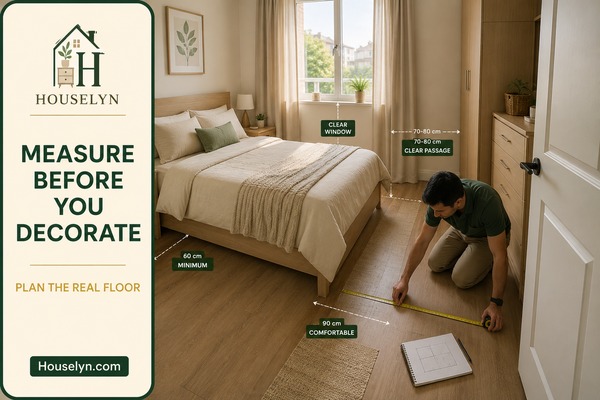
The first step is Measure, because no bedroom layout can be judged properly
until doors, windows, wardrobes, heating, sockets and the working clearance
around furniture have been mapped.
Framework Stage 1 — Measure
Chapter 1: Small Apartment Bedroom Ideas Begin With the Real Room Dimensions
Measure the bedroom as it will function every day, not simply as an empty rectangle.
The first mistake people make with small apartment bedroom ideas
is planning from the room's headline dimensions alone. A bedroom may measure
three metres by three metres, but that does not mean every part of those nine
square metres is available for furniture. Some of that floor may already be
committed to the bedroom door, a fitted wardrobe, a radiator, the space needed
to reach a window or the route you walk every morning and evening.
Begin by measuring each wall from corner to corner. Then mark everything that
interrupts those walls. Note the width and swing of the bedroom door, the
position and sill height of windows, fitted wardrobes, radiators, ventilation
grilles, sockets, switches, alcoves and architectural features that cannot
easily be moved. In a rental, also identify which permanent elements must
remain unchanged.
This immediately gives you a more useful picture of the room. It also helps
prevent expensive buying mistakes. A chest of drawers might physically fit
into a 90-centimetre section of wall, but if its drawers extend into the only
comfortable walking route beside the bed, the real furniture footprint is much
larger than its closed dimensions suggest.
Measure Furniture in Its Open Position
When evaluating small apartment bedroom ideas, measure
furniture twice: first while closed and then while it is being used. Wardrobe
doors need room to swing or slide. Drawers need space to extend. An ottoman bed
needs clearance to lift. A storage bed with side drawers needs enough open floor
beside the frame for those drawers to be pulled out properly.
You also need working space for yourself. Standing in front of a wardrobe,
opening a drawer, changing bedding or lifting a storage mechanism all require
floor area. A route that technically exists on a plan can still feel awkward if
every movement requires turning sideways or stepping over another piece of
furniture.
Measure the Bed Frame, Not Just the Mattress
Mattress dimensions do not always represent the complete size of a bed.
Upholstered frames, thick headboards, side rails and footboards can extend
beyond the mattress. In a compact room, even a few additional centimetres can
decide whether you have a comfortable passage beside the bed or a constant
squeeze between furniture.
This is one reason apparently sensible small apartment bedroom ideas
sometimes fail after the furniture arrives. The mattress may fit comfortably,
while the finished bed frame intrudes into wardrobe clearance or removes the
only practical space for a bedside table.
Storage mechanisms need the same attention. A drawer under the bed is useful
only when it can be opened. An ottoman bed can provide substantial hidden
capacity, but the frame must be structurally sound and the lifting mechanism
must have enough safe operating room. Storage containers can sit underneath a
suitable bed frame, but they should never be used as structural supports for
the bed itself.
Do Not Measure Only the Floor
Record ceiling height as well as floor dimensions. Note the usable wall height
above wardrobes, doors and windows. This information becomes valuable later
when you consider whether vertical storage can improve capacity without making
the room feel visually enclosed.
Height should be used selectively. One tall wardrobe can be an efficient use of
a limited footprint. Several full-height cabinets surrounding a small bed can
create the opposite effect, making the sleeping area feel boxed in. The goal is
not to fill every cubic centimetre but to gain enough useful storage to justify
the visual weight.
Check Whether the Furniture Can Reach the Room
Measurements should continue beyond the bedroom itself. Large bed frames,
wardrobes and dressers need to pass through the apartment entrance, hallways,
stair turns and the bedroom doorway. This is especially important in older
apartments and converted buildings where access routes may be narrow or
irregular.
Flat-pack furniture can reduce some delivery problems, but it does not remove
the need for planning. Pieces still require sufficient space for assembly, and
large assembled sections may need to be turned upright inside the room.
Leave Some Floor Space Unassigned
Measuring the room can reveal another important truth: empty floor is not wasted
floor. Space beside the bed helps with movement, dressing, cleaning and making
the bed. It also prevents the room from feeling as though every available
surface has been claimed by furniture.
The purpose of small apartment bedroom ideas is not to prove
how many pieces can physically fit inside the room. The stronger question is
whether every piece can operate properly while preserving enough open space for
the bedroom to remain comfortable.
Once the room has been measured accurately, the next decision is the most
influential one in the entire bedroom: where the bed should go. Chapter 2 moves
to Anchor and tests bed placement against circulation, wardrobe
access, windows and the everyday needs of the person—or people—using the room.
Framework Stage 2 — Anchor
Chapter 2: Small Apartment Bedroom Ideas Start With Better Bed Placement
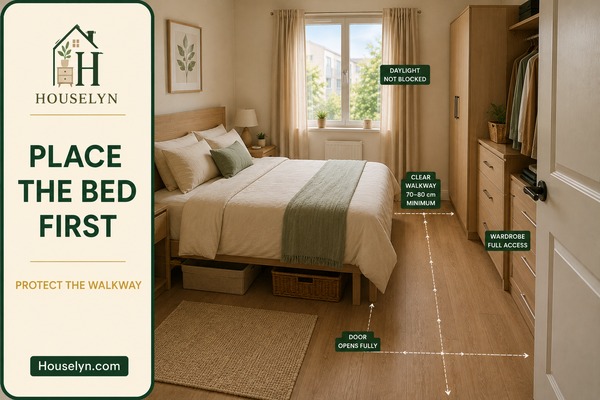
Place the bed first, then judge every other furniture decision against the space that remains.
Among all small apartment bedroom ideas, bed placement has the
greatest influence on how the room feels and functions. The bed normally claims
the largest continuous section of floor, so a poor position can restrict the
wardrobe, narrow the main walkway and leave awkward pockets of space that are
difficult to use well.
Start with the bed before deciding where the dresser, bedside table, mirror or
desk should go. Use the measurements from Chapter 1 to identify the walls that
can realistically support the entire bed frame while leaving important doors,
windows, heating and storage accessible.
Good small apartment bedroom ideas do not rely on a universal
rule such as “always place the bed on the longest wall.” In one room the longest
wall may provide the cleanest layout. In another, it may force the bed directly
into the wardrobe route or leave the bedroom door opening toward the mattress.
The correct position is the one that produces the strongest overall room,
not the one that follows a decorating formula.
Protect the Main Walking Route First
Once you identify a possible bed wall, imagine entering the bedroom and moving
through the room in sequence. Can you reach the bed without squeezing around a
sharp corner? Can you get from the bed to the wardrobe? Can you open the bedroom
door completely? Can you reach the window or curtains without climbing over
furniture?
This circulation test is especially important when comparing
small apartment bedroom ideas because a few centimetres can
decide whether a passage feels usable. A layout that looks symmetrical from the
doorway can be much less successful than an asymmetrical arrangement that gives
the room a clear route from entrance to bed and storage.
Decide Whether Both Sides of the Bed Need Access
A bed used by two people usually benefits from reasonable access on both sides,
but very compact rooms can make perfect symmetry unrealistic. The goal is not
necessarily to create identical bedside spaces. It is to make sure both sleepers
can use the bed safely and that essential items have somewhere practical to go.
For one sleeper, moving a bed closer to one wall may release enough floor for a
wardrobe, dresser or more comfortable walking route. For two sleepers, pushing
the bed tightly into a corner can make changing bedding and getting in or out
difficult. These trade-offs should be considered before copying
small apartment bedroom ideas designed for a different
household.
Do Not Sacrifice the Wardrobe for a More Photogenic Bed Position
A bed can look beautifully centered and still create a poor bedroom. If that
position prevents wardrobe doors from opening fully or leaves too little room
to stand in front of clothing storage, the room will create friction every
morning.
Practical small apartment bedroom ideas accept that the best
bed position may not always be perfectly centered. Moving the bed slightly off
centre can create a wider wardrobe zone, a useful bedside surface or a clearer
path through the room without harming the overall design.
Be Careful With Beds Under Windows
Positioning a bed beneath a window can be useful when the other walls are
occupied by doors or wardrobes, but it should be evaluated rather than treated
as automatically right or wrong. Check window opening, curtain operation,
draughts, radiator placement, headboard height and whether the window remains
safely accessible.
If the headboard covers a significant part of the glazing or makes curtains
difficult to operate, the arrangement may reduce one of the compact bedroom's
most valuable assets: natural light. Conversely, a low bed or modest headboard
can sometimes work below a window while freeing an uninterrupted wall for
storage.
Choose Bed Size by Room Function, Not Aspiration
Bed size affects more than sleep surface. A larger bed changes the width of the
walking routes, available bedside storage, wardrobe clearance and whether any
secondary furniture can remain. When comparing bed sizes, map the full frame
rather than only the mattress.
Some small apartment bedroom ideas become more successful when
the bed is slightly smaller than the largest size that can physically fit.
Giving up a modest amount of mattress width may create enough usable floor for
proper wardrobe access, a better bedside route or a dresser that can actually
open.
Use Symmetry Only When the Room Can Afford It
Symmetry can make a bedroom feel settled, but it is a design option rather than
a functional requirement. Two matching nightstands, lamps and equal walkways
can be attractive when sufficient floor exists. In a very compact bedroom,
insisting on exact symmetry may waste valuable space.
Better small apartment bedroom ideas allow the layout to become
slightly asymmetrical when that improves daily use. One bedside table can be
wider while the other is replaced with a wall-mounted or compact alternative.
One side of the bed can have a wider walkway if that side connects directly to
the wardrobe or door.
Test the Layout Before Committing
Before buying new furniture, use masking tape, cardboard or existing household
objects to mark the proposed bed footprint on the floor. Walk through the room,
open the wardrobe and bedroom door, stand where a dresser would operate and
check whether the proposed layout still feels comfortable.
This low-cost test can expose problems that are difficult to see on a screen.
It is particularly useful for small apartment bedroom ideas
because the room may have very little margin for error once the bed is in place.
Once the bed has established the bedroom's anchor point, the next question is
how much additional furniture the remaining floor can genuinely support.
Chapter 3 moves to Scale, where every nightstand, dresser,
bench and secondary piece must justify the space it consumes.
Framework Stage 3 — Scale
Chapter 3: Small Apartment Bedroom Ideas Work Better With Properly Scaled Furniture
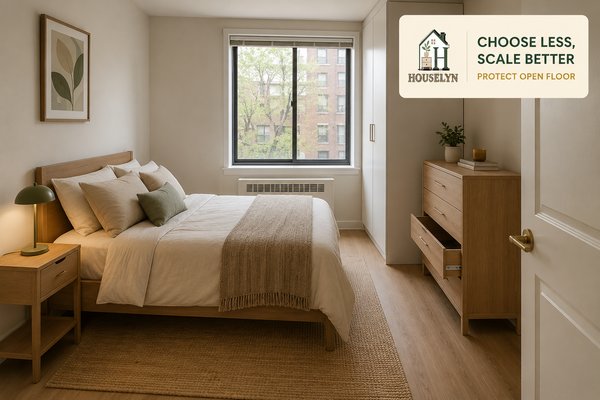
Choose fewer pieces that fit the room properly rather than filling every available furniture zone.
After the bed is anchored, the next challenge with
small apartment bedroom ideas is deciding what else genuinely
deserves a place in the room. A compact bedroom does not automatically need two
nightstands, a dresser, bench, chair, desk and freestanding wardrobe simply
because those pieces are common in larger bedrooms.
Scale is not about choosing miniature versions of everything. It is about
matching the number, depth, height and visual weight of furniture to the
available floor. One properly sized dresser can be more useful than two narrow
cabinets that interrupt circulation and divide storage into awkward sections.
The strongest small apartment bedroom ideas treat every piece
as a trade-off. A bedside table provides useful surface and storage, but it also
consumes part of the walkway. A bench can help with dressing, yet the floor at
the foot of the bed may be more valuable as open circulation. A desk can support
essential work, but only if the bedroom truly needs to function as a workspace.
Choose Function Before Furniture Type
Instead of beginning with a list of expected furniture, begin with the functions
you need. Ask whether you need bedside lighting, folded-clothing storage,
somewhere to sit while dressing, a work surface or a place for laundry. Then
select the smallest number of pieces that can perform those functions well.
This changes how small apartment bedroom ideas are evaluated.
If a wardrobe already contains drawers, a separate chest may be unnecessary. If
the bed frame includes useful storage, a large blanket chest at the foot of the
bed may duplicate capacity. If a wall-mounted light replaces a large lamp, the
bedside surface can become narrower.
Pay Attention to Furniture Depth
Width often receives the most attention, but depth can have an even greater
impact on circulation. A dresser that extends far into the room may reduce the
passage between the bed and wall even if it fits neatly along the available
horizontal space.
When comparing small apartment bedroom ideas, look at the
furniture from above as well as from the front. A tall, relatively shallow
dresser may protect more floor than a low, deep unit. A slim bedside table can
provide enough surface for a lamp and phone without creating a bottleneck beside
the bed.
Do Not Confuse Small Furniture With Good Furniture
A room filled with many tiny pieces can feel busier than a room containing a few
larger but correctly proportioned items. Several narrow cabinets create more
edges, handles, gaps and visual interruptions. One well-scaled storage piece can
make the same room feel calmer while providing easier access.
Better small apartment bedroom ideas therefore focus on
proportion rather than simply reducing dimensions. The bed can remain generous
enough for comfortable sleep while secondary furniture becomes shallower,
narrower or fewer in number.
Let Some Furniture Show More Floor
Furniture with visible legs can make a compact bedroom feel lighter because more
flooring remains visible beneath the piece. This does not mean every cabinet
must be raised, but slim legs or visually lighter bases can reduce the sense of
a solid block surrounding the bed.
The same reasoning applies to colour and material. A large dark wardrobe may be
completely practical, yet pairing it with several equally heavy pieces can make
the room feel enclosed. Natural wood, warm cream, muted finishes and restrained
contrast can help substantial storage blend more comfortably into the room.
Be Honest About Bedroom Chairs and Benches
Seating can be useful, particularly for dressing, but it should be judged by
actual behaviour. If a chair is routinely covered with clothes, it is functioning
as uncontrolled storage rather than seating. In that case, the room may benefit
more from improving clothing storage and removing the chair.
The same rule applies to a bench at the foot of the bed. Among
small apartment bedroom ideas, benches are often presented as
automatic multifunctional solutions, but they only help when enough clearance
remains for walking and when the seating or storage function is genuinely used.
Keep the Room Flexible Where Possible
A compact apartment bedroom may need to change over time. Work-from-home needs,
storage demands or household routines can shift. Furniture that is easy to
reposition and does not consume unnecessary floor gives the room more ability
to adapt.
This flexibility is another reason to keep
small apartment bedroom ideas focused on fewer, more useful
pieces. When every wall and corner is permanently occupied, even a small change
in routine can require a complete redesign.
Test the Room With the Furniture Footprints Marked
Before ordering a dresser, bench or desk, mark its dimensions on the floor with
low-tack tape or cardboard. Then move through the bedroom normally. Open the
wardrobe, walk around the bed and test whether drawers or doors could operate
without conflict.
This simple exercise makes small apartment bedroom ideas much
easier to judge because you can experience the lost floor area before committing
to the furniture.
With the furniture footprint under control, the next stage is
Store. Chapter 4 focuses specifically on clothing, bedding,
shoes, personal items and other bedroom categories that need capacity without
surrounding the bed with storage furniture.
Framework Stage 4 — Store
Chapter 4: Small Apartment Bedroom Ideas Need Storage That Protects the Floor
Use the bedroom's existing footprint more intelligently before adding another freestanding storage unit.
Storage is one of the biggest reasons people search for
small apartment bedroom ideas, but adding more storage furniture
is not always the answer. A second dresser, extra shelving unit or freestanding
cabinet may increase capacity while simultaneously reducing the open floor that
makes the bedroom comfortable to use.
Start with the storage already built into the room. Review the wardrobe, drawers,
under-bed zone and any high shelves before buying another piece. The objective is
to make existing capacity work harder and reserve new furniture for categories
that genuinely have nowhere suitable to go.
Strong small apartment bedroom ideas organize bedroom storage
around frequency. Clothing worn several times a week should be easier to reach
than seasonal bedding. Everyday underwear should not sit behind boxes of
occasional accessories. Items used rarely can move higher, deeper or beneath the
bed, leaving the easiest positions for daily routines.
Audit What the Bedroom Actually Needs to Store
Bedrooms often accumulate categories that do not truly belong there. Paperwork,
spare household supplies, luggage, hobby equipment and general overflow can
slowly occupy wardrobes that were intended for clothes and bedding. Before
reorganizing, separate genuine bedroom categories from items that should be
reassigned elsewhere in the apartment.
This is an important distinction when applying
small apartment bedroom ideas. A wardrobe may appear too small
when the real problem is that it is storing several unrelated household
categories. Removing those items can create more useful capacity without
purchasing anything.
Organize the Wardrobe by Frequency, Not Appearance
Put frequently worn clothing in the easiest positions: comfortable hanging
height, accessible drawers and shelves that do not require moving another
container first. Use upper shelves and deeper areas for seasonal clothing,
occasion wear and less frequently needed textiles.
The wardrobe should also be easy to reset. If returning a jumper requires
lifting several boxes, moving handbags and opening an overfilled container, the
system creates too much friction. Storage that looks perfectly ordered after a
one-day makeover can quickly fail if daily return steps are complicated.
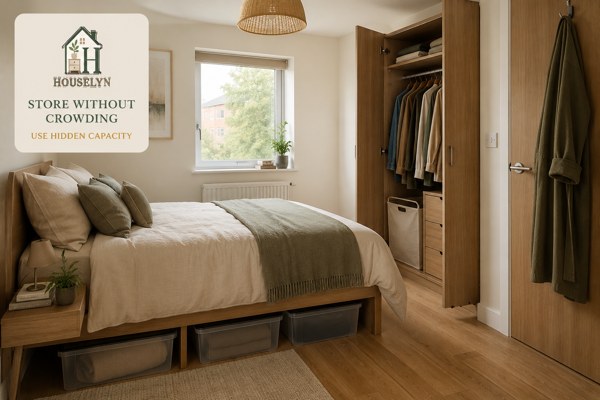
Use the Space Under the Bed Intentionally
Under-bed storage can be extremely useful because it adds capacity without
claiming another section of floor. It works best for contained categories such
as spare bedding, seasonal clothing or less frequently worn shoes rather than as
an unsorted holding area.
When using under-bed storage as part of
small apartment bedroom ideas, check the actual clearance under
the frame and choose containers that slide in and out without catching. Keep
enough space to clean beneath the bed and avoid filling the area so tightly that
accessing one box requires removing everything else.
The bed must remain structurally supported by its intended frame, legs or base.
Storage containers should sit beneath the bed only where the manufacturer and
frame design allow; they should never be used to support the bed itself.
Use Height Without Surrounding the Bed With Storage
Tall wardrobes and upper shelves can increase capacity efficiently, but more
vertical storage is not automatically better. A compact room lined with tall
cabinets can feel enclosed even when the floor remains technically clear.
Better small apartment bedroom ideas concentrate tall storage
where it provides the greatest return. One efficient wardrobe taken closer to
the ceiling may be calmer than several separate cabinets of different heights.
Keep heavy or frequently used items within safe reach and follow appropriate
stability and anchoring guidance for tall furniture.
Separate Clean Clothing From Laundry
Laundry can become one of the fastest sources of bedroom clutter. If there is no
defined place for worn clothing, chairs, floors and bedside surfaces often
become temporary holding zones. A realistic laundry system prevents those
surfaces from becoming permanent storage.
Choose a basket or hamper that fits the household's actual laundry volume and
has a clear home. If the basket overflows repeatedly, the problem may be the
laundry routine rather than the container size. Increasing container capacity
endlessly can simply hide a maintenance problem.
Closed Storage Usually Works Harder in a Bedroom
Open shelves can be useful for a few attractive or frequently reached items, but
bedrooms contain many visually busy categories: folded clothes, toiletries,
accessories, cables, shoes and laundry. When too much of that inventory remains
visible, the room can feel more active than restful.
For that reason, many small apartment bedroom ideas work better
when the majority of storage is closed and only a small amount is displayed.
Drawers, wardrobes, lidded containers and contained under-bed storage reduce
visual noise without requiring the room to become plain.
Give Every Everyday Category a Clear Home
The final test is whether you can name where each daily category belongs:
sleepwear, worn-once clothing, clean folded clothes, shoes, laundry, chargers
and bedside essentials. Ambiguous categories are the ones most likely to remain
on the bed, floor or chair.
The best small apartment bedroom ideas make those destinations
obvious enough that returning an item becomes almost automatic. A smaller
storage system with clear category boundaries will usually outperform a larger
system where everything can be placed anywhere.
Once clothing and bedroom belongings have clear homes, the next stage is
Light. Chapter 5 looks at daylight, bedside lighting and softer
evening illumination so the bedroom remains practical during the day and calmer
when it is time to rest.
Framework Stage 5 — Light
Chapter 5: Small Apartment Bedroom Ideas Use Light to Add Depth and Comfort
Protect daylight during the day and layer softer, more useful light for the evening.
Lighting can change how spacious and restful a bedroom feels, which is why it
deserves more attention than simply choosing a decorative lamp. Effective
small apartment bedroom ideas use daylight, practical task
lighting and softer evening light together so the room can support different
activities without becoming visually flat or overly bright.
Start with the natural light the bedroom already receives. A compact room
benefits from keeping windows as open and usable as possible because daylight
helps reveal depth, texture and the space between furniture. Tall cabinets,
oversized headboards or heavy window treatments should not reduce that advantage
unless there is a clear functional reason.
This does not mean every successful small apartment bedroom ideas
scheme needs sheer curtains or white walls. The goal is to understand how light
enters the room, which surfaces reflect it and where furniture creates shadows.
Once that pattern is clear, artificial lighting can support the room instead of
trying to compensate for avoidable daylight loss.
Protect the Window as a Functional Zone
The area around a bedroom window is not wasted space, but it does need careful
planning. Curtains or blinds must be able to operate. The window may need to open
for ventilation. A radiator below it may require clearance. Furniture positioned
nearby should not make those ordinary actions difficult.
When evaluating small apartment bedroom ideas, check whether
moving a tall dresser or wardrobe away from the window improves both light and
circulation. Sometimes the most useful change is not adding another light at all;
it is removing an unnecessary obstacle from the natural light path.
Do Not Make One Ceiling Light Do Every Job
A single bright ceiling fitting can illuminate the room, but it rarely performs
every bedroom task equally well. It may be useful for cleaning or getting
dressed while feeling unnecessarily harsh when you are preparing to sleep.
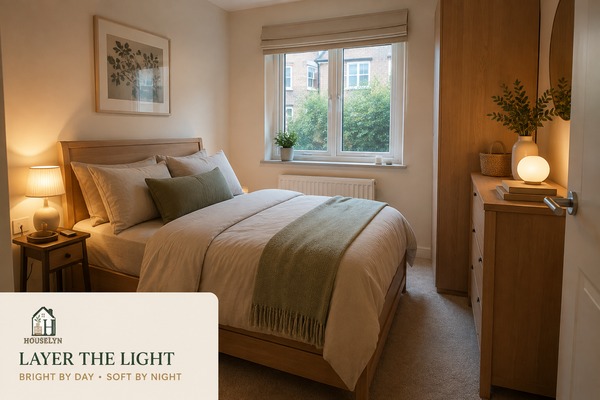
Strong small apartment bedroom ideas usually distribute light
across different levels. General illumination provides safe movement. Bedside
or dressing light supports specific activities. Softer evening light reduces the
need to keep the brightest fitting switched on until bedtime.
Keep Bedside Lighting Compact
Bedside lighting is useful, but the lamp should not consume most of a narrow
nightstand. Compact lamps with stable bases can preserve more surface for a
phone, water or book. Where suitable, plug-in wall lights can free the bedside
surface almost completely.
For renters considering wall-mounted solutions, plug-in fittings can be more
practical than permanent electrical work, provided the product is installed
according to its instructions and any wall fixing is appropriate for the
tenancy. Keep cables controlled and away from the primary walking route.
These details matter because small apartment bedroom ideas
should reduce friction rather than simply look good in photographs. A beautiful
lamp with an oversized base can make a tiny bedside table less useful; a slightly
simpler light may improve the whole zone.
Use Mirrors to Support Light, Not Just to “Make the Room Bigger”
Mirrors are often recommended for compact rooms because they can reflect light
and extend sightlines. Their value depends on placement. A mirror that reflects
a bright window or an attractive open section of the room can add depth. One
positioned opposite visual clutter may simply duplicate that clutter.
Better small apartment bedroom ideas treat a mirror as a working
part of the room. It should serve dressing, distribute useful light or improve
visual depth without taking a furniture position that the bedroom needs more.
Large leaning mirrors should also be positioned securely according to the
manufacturer's guidance.
Choose Warmth According to the Job the Light Is Doing
Bedrooms generally benefit from lighting that can feel comfortable in the
evening rather than clinical. Warm-toned bulbs can contribute to that atmosphere,
while dressing or makeup zones may need enough clarity to show colour and detail
accurately.
If you use dimmable lamps or bulbs as part of
small apartment bedroom ideas, confirm that the lamp, bulb and
dimming system are compatible. Do not assume every LED bulb is suitable for
every dimmer or fitting.
Keep Decorative Lighting Secondary to Useful Lighting
String lights, decorative lamps and accent lighting can add warmth, but they
should supplement rather than replace the illumination needed for safe movement
and ordinary bedroom tasks. A compact bedroom rarely benefits from filling
several surfaces with decorative lamps.
The best small apartment bedroom ideas use fewer light sources
more deliberately. Each source should have a clear role, whether that is general
visibility, reading, dressing or creating a softer evening atmosphere.
Check the Bedroom at Different Times of Day
Before making final lighting decisions, look at the room in the morning,
afternoon and evening. The same bedroom can behave very differently as daylight
changes. A corner that appears dark in the morning may receive excellent
afternoon light, while a bedside area that seems bright during the day may need
focused illumination after sunset.
Testing at different times makes small apartment bedroom ideas
more accurate because lighting decisions are based on the room's real daily
pattern rather than a single photograph or moment.
With the room measured, anchored, scaled, stored and properly lit, the next stage
is Soften. Chapter 6 uses bedding, colour, texture, mirrors and
restrained decor to make the compact bedroom feel warmer without bringing visual
clutter back into the space.
Framework Stage 6 — Soften
Chapter 6: Small Apartment Bedroom Ideas Can Feel Calm Without Looking Plain
Use colour, texture and a few intentional details to add warmth without filling the bedroom with decorative clutter.
Once the practical decisions are settled, small apartment bedroom ideas
can become softer and more personal. The aim is not to remove colour or character.
It is to control how many visual elements compete for attention in a room where
the bed already occupies a large share of the view.
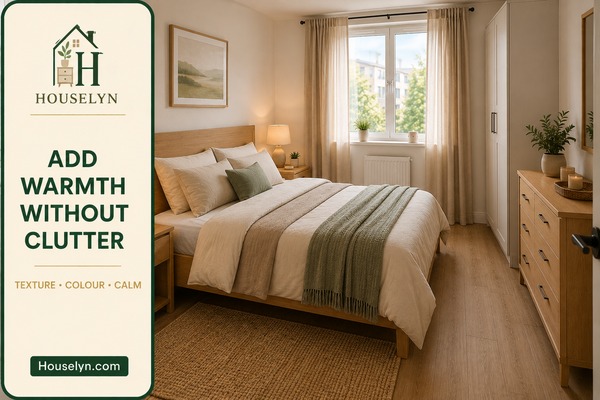
A compact bedroom can feel warm with very few decorative objects when the larger
surfaces are doing more of the work. Bedding, curtains, a rug, wall colour and
natural wood can provide texture and personality without requiring every shelf,
table and wall to carry another accessory.
This is where thoughtful small apartment bedroom ideas differ
from simply making a room minimalist. Visual calm does not require an all-white
bedroom or empty surfaces. It requires enough repetition and restraint that the
eye can understand the room without processing dozens of unrelated colours,
patterns and objects.
Let the Bed Carry More of the Decorative Weight
Because the bed is normally the largest visible surface, bedding has more impact
than many smaller accessories combined. A considered duvet cover, throw or
textured blanket can establish the room's palette without requiring decorative
objects on every available surface.
For many small apartment bedroom ideas, the easiest approach is
to choose one dominant bedding colour family, add texture through materials and
then repeat one or two restrained accent colours elsewhere in the room.
Avoid building a bed that becomes difficult to use. Large collections of
decorative cushions may look inviting during the day, but they also create items
that must be removed every night and stored somewhere. A few useful layers are
usually easier to maintain than a heavily styled arrangement.
Light Colours Can Help, but They Are Not the Only Option
Pale walls and bedding can reflect available light and reduce visual weight, but
a compact bedroom does not need to be completely white. Warm cream, muted beige,
soft taupe, restrained sage and gentle earthy colours can create a calm backdrop
while still giving the room depth.
Darker colours can also work when used deliberately. A deeper headboard, small
painted section or darker textile can anchor the bed without overwhelming the
entire room. The stronger small apartment bedroom ideas consider
contrast as a proportion problem rather than treating any particular colour as
automatically suitable or unsuitable.
Use Texture Before Adding More Objects
Texture is one of the easiest ways to make a simple bedroom feel finished.
Linen-look bedding, woven fabrics, a subtle rug, natural wood and softly textured
curtains can add depth even when the colour palette remains controlled.
This matters in small apartment bedroom ideas because texture
occupies visual space without necessarily consuming physical space. A woven
throw can add interest to the bed without introducing another shelf. A textured
curtain can soften the window without requiring decorative objects on the sill.
Choose Artwork With the Wall, Not Just the Picture, in Mind
One appropriately scaled artwork can create a stronger focal point than a group
of small unrelated pieces. Above the bed, any wall decor should be lightweight,
securely installed and appropriate for the wall construction and sleeping area.
When renting, removable hooks or other temporary hanging methods may be useful
where the product, wall surface and tenancy conditions allow. Always check the
manufacturer's load guidance; a removable fixing is not suitable for every
object or wall type.
Use Mirrors Where They Solve More Than One Problem
A bedroom mirror can support dressing, reflect useful daylight and add visual
depth. That makes it particularly valuable when it serves several purposes from
one position. The ideal placement should also avoid blocking drawers, doors or
the main walking route.
Better small apartment bedroom ideas do not add a large mirror
only because mirrors are commonly recommended for small rooms. If the room
already has a mirrored wardrobe or an effective dressing mirror, another large
reflective surface may offer little additional value.
Make Renter-Friendly Decorating Truly Reversible
Removable wallpaper, temporary hooks and freestanding decorative solutions can
be useful for renters, but “renter-friendly” should not be treated as a guarantee
that every product will leave every surface unchanged.
Test removable products in an inconspicuous area, follow installation and removal
instructions and consider the paint, wall finish and tenancy agreement before
using them. The best small apartment bedroom ideas improve the
room without creating avoidable repair work when it is time to move.
Keep Personal Character, but Group It Deliberately
Personal photographs, books and meaningful objects can make the bedroom feel
like home. Instead of spreading them across every available surface, give them
one or two intentional locations. A small bedside arrangement or contained
dresser display is easier for the eye to read and easier to maintain.
This approach helps small apartment bedroom ideas feel lived-in
without becoming visually restless. The room should reflect the person using it,
but the decor should still leave enough quiet space for sleep and everyday
routines.
Stop Decorating Before the Room Feels Finished
One of the easiest ways to overcrowd a small bedroom is to keep adding items
because a wall, shelf or corner still appears available. Leave the room for a
few days before filling the final spaces. What initially looks unfinished may
begin to feel balanced once you experience the bedroom through normal routines.
The most durable small apartment bedroom ideas leave room for
ordinary life. A bedside table needs space for tonight's book. A dresser needs
room for an item being put away. The floor needs enough openness for cleaning,
dressing and movement. Decoration should support those realities rather than
compete with them.
A bedroom can be beautifully measured, furnished, stored, lit and decorated and
still become cluttered again if there is no maintenance rhythm. Chapter 7 moves
to Reset, where the room is given a practical routine for
clothing, laundry, bedside items, work equipment and the transition back to rest.
Framework Stage 7 — Reset
Chapter 7: Small Apartment Bedroom Ideas Should Support a Better Daily Reset
A short daily reset helps the bedroom return to a calmer sleeping environment before clutter begins to accumulate.
Even the best small apartment bedroom ideas can stop working
when everyday belongings are allowed to remain wherever they were last used.
Clothes settle on a chair, laundry collects beside the wardrobe, charging
cables spread across the bedside table and the carefully protected floor begins
to disappear again.
The final stage of the Houselyn framework is therefore not another decorating
decision. It is a maintenance system. Reset means returning the bedroom to a
usable baseline before small temporary piles become accepted parts of the room.
Sustainable small apartment bedroom ideas need this maintenance
stage because compact rooms have very little spare capacity. In a large bedroom,
several misplaced items may barely affect movement. In a small room, the same
belongings can immediately occupy the only clear chair, bedside surface or
walking route.
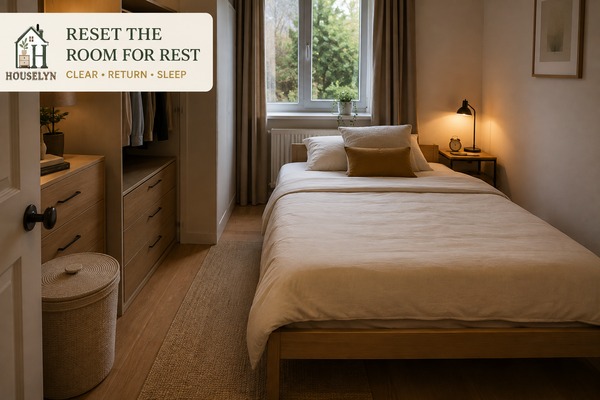
Start With the Bed, but Keep the Routine Realistic
Straightening the bed can quickly make a compact bedroom feel more ordered
because the bed is usually the largest visible surface. The routine does not
need to reproduce a hotel-style arrangement every morning. Pulling the bedding
into place, arranging the sleeping pillows and returning any extra blanket may
be enough.
This is an important principle for small apartment bedroom ideas:
the maintenance routine should be simple enough to repeat. A highly styled bed
with numerous cushions and throws may require more resetting than the household
realistically wants to do every day.
Stop the Bedroom Chair From Becoming a Wardrobe
Clothing that is neither freshly clean nor ready for laundry creates one of the
most common bedroom storage problems. Items worn briefly may end up on a chair,
bench, door or floor because they do not have an agreed destination.
Give this category a deliberate home. Depending on the household, that may be a
small wardrobe section, a designated hook, one contained basket or another
clearly defined location. The important point is that the category has a limit
and does not spread across several surfaces.
The strongest small apartment bedroom ideas anticipate these
imperfect daily categories rather than designing only for freshly laundered
clothes folded neatly in drawers.
Use Laundry as an Early Warning Signal
An overflowing laundry basket often indicates more than a container problem.
The collection schedule may be too infrequent, clothing may be entering the
basket faster than it leaves, or clean laundry may be waiting too long to return
to wardrobes and drawers.
When applying small apartment bedroom ideas, treat recurring
overflow as information. Buying a larger hamper may help a household with
genuinely higher laundry volume, but it will not solve a routine that repeatedly
leaves clean and dirty clothing circulating around the bedroom.
Close the Workday if the Bedroom Also Contains a Desk
Some small apartments make a bedroom workspace unavoidable. If that is your
situation, create a visible end to the working day. Close the laptop, put papers
away, return headphones and chargers, clear the chair and switch from task
lighting to the bedroom's softer evening light.
This transition matters because small apartment bedroom ideas
should help one room support more than one function without forcing those
functions to remain visually active all the time. Work equipment does not need
to disappear completely, but it should stop dominating the sleeping environment
once work has finished.
Control the Bedside Table Before It Becomes General Storage
Bedside surfaces are particularly vulnerable to clutter because they are easy to
reach. A phone, book and glass of water can quickly be joined by receipts,
packaging, cosmetics, medication, chargers and items brought into the room
temporarily.
Keep the bedside category narrow. Decide what genuinely needs to remain within
reach while sleeping and return everything else during the reset. If the table
repeatedly becomes overloaded, review whether it needs a small drawer or whether
unrelated categories are simply being left there.
Do Not Let the Reset Become a Second Cleaning Routine
The reset should be short and focused on returning categories, not deep-cleaning
the room every night. If it routinely takes a long time, the storage locations
may be too difficult to reach or too many belongings may be competing for the
available capacity.
Effective small apartment bedroom ideas reduce that friction.
Everyday clothing should not require a step stool. Laundry should not need to be
carried around furniture. Bedside items should have enough room to be returned
without rearranging an entire drawer.
Use Overflow to Decide What Needs to Change
Repeated clutter in the same location is useful evidence. Shoes beside the
wardrobe may indicate that shoe storage is too difficult to access. Clothing on
the chair may reveal that the worn-once category has no home. A constantly full
bedside table may mean personal items need a nearby drawer.
This diagnostic approach makes small apartment bedroom ideas
more durable because the room is adjusted according to real behaviour rather
than constantly forcing the household back into a system that does not fit.
Protect the Bedroom's Transition Into Rest
The final reset should make the bedroom feel different from its most active
daytime state. That may mean closing the wardrobe, clearing the desk, reducing
lighting, moving laundry out of sight and restoring a clear route to the bed.
The most successful small apartment bedroom ideas support this
transition without demanding perfection. A bedroom can remain personal and
lived-in while still having enough order that the visual focus returns to rest
rather than unfinished tasks.
The seven-stage bedroom framework is now complete:
Measure → Anchor → Scale → Store → Light → Soften → Reset.
Next, the FAQ answers the practical questions readers are most likely to have
about bed size, furniture arrangement, storage, lighting, decorating and daily
organization in a compact apartment bedroom.
Houselyn Bedroom FAQ
Small Apartment Bedroom Ideas: Frequently Asked Questions
These answers cover the practical decisions that most often affect a compact
bedroom: bed placement, furniture size, storage, lighting, decorating,
renter-friendly changes and everyday organization.
Beginner Questions About Small Apartment Bedrooms
1. How do I make a small apartment bedroom look bigger?
Start by protecting the floor and the longest sightlines. Keep the main route
from the bedroom door to the bed and wardrobe clear, avoid placing bulky
furniture directly in front of windows and reduce the number of unnecessary
freestanding pieces.
Some of the most effective small apartment bedroom ideas
make the room feel larger by improving function rather than using visual
tricks alone. Correctly scaled furniture, visible floor, controlled storage
and good daylight often have more impact than adding several mirrors or
painting everything white.
2. Where should I put the bed in a small apartment bedroom?
Place the bed where it creates the best overall relationship between the
bedroom door, wardrobe, window and main walking route. The longest wall is
not automatically the best wall.
Test each potential position with the Houselyn Bed Placement Test: make sure
the door can open, the wardrobe can operate, the bed is easy to reach,
windows remain usable and heating or ventilation is not obstructed.
3. What bed size is best for a small bedroom?
The best size is the largest bed that still allows the bedroom to function
properly. Measure the complete bed frame rather than the mattress alone, then
check the remaining walkway, wardrobe clearance and bedside access.
When comparing small apartment bedroom ideas, a slightly
smaller bed can sometimes improve the room more than any storage product
because it releases usable space every day.
4. Should a small bedroom have one nightstand or two?
Not necessarily. Two matching nightstands can create symmetry, but symmetry
is less important than keeping the room usable. One slim bedside table may
be enough for a single sleeper or for a layout where a second table would
narrow the wardrobe route.
For two sleepers, the second side can sometimes use a narrower table,
compact wall-mounted surface or bedside organizer rather than duplicating a
large piece.
Layout and Furniture Questions
5. How do I arrange furniture in a very small bedroom?
Arrange the room in order of importance. Position the bed first, protect the
main walking route and wardrobe operation, then add secondary furniture only
when it solves a genuine need.
Good small apartment bedroom ideas often use fewer pieces
rather than many miniature ones. A single narrow dresser may be more useful
than several small storage units that break up the floor and create visual
clutter.
6. Is it better to use tall furniture in a small bedroom?
Tall furniture can increase capacity without increasing the floor footprint,
but it should be used selectively. One efficient tall wardrobe may work very
well, while several full-height units around the bed can make the room feel
enclosed.
Follow manufacturer stability guidance and appropriate anchoring
instructions for tall furniture. Renters should also check their tenancy
conditions before fixing furniture to walls.
7. Should I put a bench at the foot of the bed?
Only if enough circulation remains after the bench is added and the bench
provides a function you genuinely use. It can offer seating or contained
storage, but in a very compact room the open floor at the end of the bed may
be more valuable.
8. How can I fit a desk into a small apartment bedroom?
Add a desk only when the bedroom genuinely needs to support work or study.
Look for a position that does not compromise the bed, wardrobe or main
walking route, and measure the chair in both its tucked-in and occupied
positions.
If a workspace is unavoidable, small apartment bedroom ideas
should also include an end-of-work routine so papers, cables and equipment
stop dominating the room when it returns to sleep mode.
Bedroom Storage Questions
9. How can I add storage when my apartment bedroom has a tiny closet?
Begin by making the existing wardrobe or closet more efficient. Put daily
clothes at easy reach, move seasonal items higher or beneath the bed and use
organizers only where they create clear category boundaries.
Before buying another cabinet, remove household categories that do not need
to live in the bedroom. Sometimes the wardrobe appears too small because it
is storing paperwork, luggage or general overflow as well as clothing.
10. Is a storage bed worth it in a small bedroom?
It can be, particularly when the space beneath the bed can replace another
freestanding storage piece. Compare the complete bed-frame dimensions and
make sure drawers or lifting mechanisms have enough room to operate safely.
Among small apartment bedroom ideas, storage beds work best
when the hidden capacity is used for defined categories such as bedding,
seasonal clothing or occasional items rather than becoming an unsorted
storage cavity.
11. What should I store under the bed?
Good under-bed categories include spare bedding, seasonal clothing,
less-frequently worn shoes and other items that do not need daily access.
Use properly sized containers that can be removed without moving other
furniture.
The bed must remain supported by its intended frame, legs or base. Storage
containers should never act as structural supports for the bed.
12. Should I use open or closed storage in a small bedroom?
Closed storage is usually more useful for visually busy categories such as
clothing, shoes, accessories, toiletries and cables. Open storage works best
when it holds a small number of attractive or frequently used items.
Many small apartment bedroom ideas become calmer when most
inventory is contained behind drawers, wardrobe doors or lidded storage,
leaving only selected objects visible.
Lighting and Decorating Questions
13. What colours make a small bedroom feel larger?
Light and mid-tone colours can help reflect available daylight and reduce
visual weight, but the room does not need to be all white. Warm cream,
beige, soft taupe, muted sage and other restrained colours can work well.
Darker colours can also be used in smaller amounts for contrast or to anchor
the bed. The important factor is the overall balance of colour, daylight,
furniture and visual clutter.
14. Are mirrors good for small bedrooms?
Yes, when they serve a useful purpose. A mirror can support dressing,
reflect daylight and add visual depth. Place it where it reflects something
useful or attractive rather than duplicating clutter.
In small apartment bedroom ideas, one well-positioned mirror
is usually more useful than several reflective surfaces added simply to make
the room appear larger.
15. What lighting works best in a small apartment bedroom?
Use three layers where practical: ambient light for general visibility,
task light for reading or dressing, and softer evening light for the
transition toward rest.
Keep bedside fixtures proportionate to the available surface and prevent
cables from crossing walking routes. If you use dimmable bulbs, make sure
the bulb, fitting and dimming system are compatible.
16. How do I decorate a small bedroom without cluttering it?
Let larger surfaces do more decorative work. Bedding, curtains, a rug and
one meaningful artwork can provide colour and texture without requiring
numerous accessories.
Strong small apartment bedroom ideas leave some surfaces
deliberately quiet so there is room for everyday life rather than treating
every empty wall, corner or tabletop as something that must be filled.
Renter-Friendly and Everyday Organization Questions
17. How can renters decorate a bedroom without damaging the walls?
Use reversible solutions carefully: freestanding decor, removable hooks,
temporary wall treatments and plug-in lighting can reduce the need for
permanent alterations.
Always follow the product instructions and test removable adhesives on an
inconspicuous area where appropriate. “Removable” does not guarantee that
every product is suitable for every paint or wall finish, so check tenancy
conditions before making changes.
18. How do I keep a small bedroom organized every day?
Use a short reset rather than waiting for a major clean-up. Straighten the
bed, clear the main walking route, return clean clothes, contain laundry,
simplify the bedside surface and remove anything that belongs elsewhere.
The most sustainable small apartment bedroom ideas make
these return steps easy. If the same clutter repeatedly appears in the same
place, treat that pattern as evidence that the storage destination or routine
needs to change.
Houselyn 14-Day Action Plan
The 14-Day Small Apartment Bedroom Ideas Reset Plan
Use two focused weeks to improve the bedroom in the same order as the
Houselyn framework: Measure, Anchor, Scale, Store, Light, Soften and Reset.
Each day has one main decision so the room can improve without turning the
project into an exhausting whole-bedroom makeover.
Week 1
Fix the Bedroom's Layout and Storage Foundation
Day 1
Measure the Room Properly
Framework Stage: Measure
Record the room length, width, ceiling height, bedroom door swing,
window dimensions, wardrobe position, radiators, ventilation and sockets.
Do not judge small apartment bedroom ideas from the
empty floor alone. Mark which parts of the room are already committed
to fixed features and access.
Day 2
Map the Working Clearances
Framework Stage: Measure
Measure the full operating space needed for wardrobe doors, drawers,
the bedroom door and any storage mechanisms.
Mark the main route between the entrance, bed, wardrobe and window.
Treat that route as functional space rather than empty floor waiting
for furniture.
Day 3
Test the Best Bed Position
Framework Stage: Anchor
Try the realistic bed positions available in the room and test each one
against the door, wardrobe, window, radiator and main walking route.
The best small apartment bedroom ideas begin with the
position that helps the whole room operate—not automatically the wall
that creates perfect symmetry.
Day 4
Confirm Bed Size and Bedside Access
Framework Stage: Anchor
Measure the complete bed frame, including headboard, side rails and
footboard. Decide whether both sides need full access and how much
bedside surface is genuinely required.
If a slightly smaller bed or slimmer bedside solution creates a much
stronger circulation route, compare that gain with the sleeping space
being surrendered.
Day 5
Audit Every Secondary Furniture Piece
Framework Stage: Scale
List the dresser, nightstands, desk, chair, bench, mirror and any other
freestanding furniture currently in the bedroom.
For each piece, write down the function it provides. If a piece has no
clear function—or duplicates one already handled elsewhere—consider
whether the bedroom works better without it.
Day 6
Compare Footprint With Function
Framework Stage: Scale
Measure furniture depth as well as width. Open drawers and doors and
check how much floor remains while the furniture is operating.
This makes small apartment bedroom ideas more realistic
because the decision is based on usable room rather than product
photographs or closed dimensions.
Day 7
Audit Bedroom Storage Categories
Framework Stage: Store
Separate clothing, bedding, shoes, laundry, bedside essentials and
personal items from belongings that do not truly need to live in the
bedroom.
Remove unrelated household overflow before assuming the room needs
another storage cabinet.
Week 2
Improve Storage, Light, Style and Daily Maintenance
Day 8
Rebuild Storage by Frequency
Framework Stage: Store
Put daily clothing and essentials in the easiest positions. Move weekly,
seasonal and occasional categories progressively higher, deeper or
beneath the bed.
Effective small apartment bedroom ideas make frequent
items easy to return rather than simply increasing total capacity.
Day 9
Fix Laundry and Worn-Once Clothing
Framework Stage: Store
Give dirty laundry a contained home and decide where clothes that are
likely to be worn again belong.
If a chair is acting as a permanent clothing pile, either create a better
clothing destination or reconsider whether the chair deserves the floor.
Day 10
Protect Natural Daylight
Framework Stage: Light
Look at the room during daylight and identify furniture or window
treatments that unnecessarily reduce useful light.
Test whether repositioning a tall piece, simplifying the window treatment
or changing a mirror position improves depth without adding another
fixture.
Day 11
Build Three Useful Light Layers
Framework Stage: Light
Check whether the bedroom has general illumination, focused light for
activities such as reading or dressing, and a softer option for the
evening.
Good small apartment bedroom ideas give each light source
a purpose instead of filling multiple surfaces with decorative lamps.
Day 12
Edit Bedding, Colour and Texture
Framework Stage: Soften
Let the bed carry more of the decorative work. Simplify unnecessary
cushions and introduce warmth through bedding, curtains, natural wood,
texture and restrained colour.
Remove decorative items that consume useful surfaces or interrupt
circulation without adding enough function or meaning.
Day 13
Run the Visual Calm Test
Framework Stage: Soften
Check the bed, dresser, bedside surface, walls and floor for competing
patterns, unnecessary displays and decorative storage.
The strongest small apartment bedroom ideas leave some
surfaces deliberately quiet so ordinary life has somewhere to happen.
Day 14
Build the Bedroom Reset Route
Framework Stage: Reset
Establish the final daily route: bed, floor, clothing, laundry, bedside,
work items, dressing surface, lighting and anything that belongs outside
the bedroom.
Test the routine at the end of a normal day. If returning items requires
too many steps, adjust the storage destination rather than relying on
motivation alone.
Conclusion: Build a Small Apartment Bedroom Around Rest, Movement and Daily Use
The strongest small apartment bedroom ideas do not begin with
decor, storage products or a list of furniture to buy. They begin by deciding
how the bedroom must work: where the bed belongs, which routes need to stay open,
what genuinely needs to be stored and how the room should feel when the day is
finished.
That is why the Houselyn approach works in sequence. Good
small apartment bedroom ideas start with accurate measurements,
anchor the bed, scale the remaining furniture, organize bedroom-specific
storage, protect useful light, soften the room deliberately and finish with a
repeatable reset.
None of those stages is intended to maximize the number of objects that can fit
inside the bedroom. The goal is to create enough function without sacrificing
circulation, daylight or the sense of calm that makes the room comfortable for
sleep.
When small apartment bedroom ideas are applied in this order,
later decisions become easier. Accurate measurements prevent furniture mistakes.
Better bed placement protects circulation. Proper scale reduces unnecessary
furniture. Storage becomes more focused because the categories have already
been identified.
Lighting and decorating also become more effective because they are being added
to a room that already functions. Instead of using mirrors, pale colours or
decorative tricks to disguise an overcrowded layout, the room gains style after
the physical problems have been solved.
This principle is particularly important when evaluating
small apartment bedroom ideas from photographs or social media.
A room can look attractive while hiding blocked drawers, poor wardrobe access or
furniture positioned too tightly to use comfortably. Always judge the active
room rather than the styled image.
The same applies to storage. More capacity is not automatically better if it
surrounds the bed with cabinets or makes daily categories harder to reach.
Lighting is not improved simply by adding more lamps. Decoration is not improved
by filling every blank wall. Each decision needs to solve more than it costs.
If a bedroom still feels crowded after following these
small apartment bedroom ideas, resist the urge to immediately
buy another organizer. Return to the framework and identify which stage is
failing. The bed may be too large for the chosen position, a dresser may be too
deep, storage categories may have spread beyond their limits or the room may
simply contain more furniture than its circulation can support.
The most durable small apartment bedroom ideas are therefore
adaptable rather than perfect. The room should be able to absorb ordinary life,
minor changes in routine and the belongings you actually use without requiring
a complete redesign every few months.
A successful compact bedroom is not one where every centimetre has been filled.
It is one where the bed feels comfortable, storage makes sense, movement is easy
and the room can return to a calmer state at the end of the day. That is the
standard these small apartment bedroom ideas are designed to
achieve.
Houselyn Knowledge Library
Continue Building a More Functional Small Apartment
Use these curated Houselyn guides to continue from the bedroom into the
wider apartment. Choose the reading path that matches the problem you want
to solve next rather than trying to apply every small-space strategy at once.
The best small apartment bedroom ideas work more effectively
when the rest of the home follows the same logic. A bedroom cannot remain calm
if it continually absorbs belongings that have no home elsewhere, and a good
bedroom layout is easier to maintain when the surrounding apartment also has
clear zones, realistic storage and appropriately scaled furniture.
Reading Path 1
Plan the Apartment Before Adding More Furniture
Choose this path if the bedroom problem is connected to the layout, scale or
overall function of the apartment rather than the bedroom alone.
Small Apartment Ideas
Step back from the bedroom and plan the apartment as a whole, including
furniture scale, circulation, storage and multifunctional living.
This is particularly useful when small apartment bedroom ideas
are being asked to solve problems created elsewhere. If general household
storage, work equipment or overflow repeatedly moves into the bedroom, the
wider apartment may need better allocation before the bedroom itself can stay
organized.
Reading Path 2
Strengthen Bedroom Storage and Everyday Organization
Choose this path when clothing, bedding, laundry or recurring clutter is the
main pressure point.
Small Apartment Storage Ideas
Apply a whole-apartment storage framework to capacity, vertical space,
hidden storage, access and routine maintenance.
If your small apartment bedroom ideas still depend on piles,
overflow baskets or furniture that is permanently covered with clothes, this
organization path should come before buying more bedroom furniture.
Reading Path 3
Make the Bedroom and Apartment Feel More Cohesive
Choose this path once the room functions well and your next priority is colour,
visual balance, texture and small-space decorating.
Small Space Decorating Ideas
Use furniture, colour, light and visual balance to decorate compact rooms
without sacrificing circulation or useful surfaces.
Decorative small apartment bedroom ideas are most successful
after layout and storage are already working. This prevents styling choices from
becoming substitutes for unresolved circulation, furniture or clutter problems.
Reading Path 4
Continue Through the Small Apartment Room by Room
Choose this path if the bedroom is working and you are ready to apply the same
space-conscious planning to the rest of the apartment.
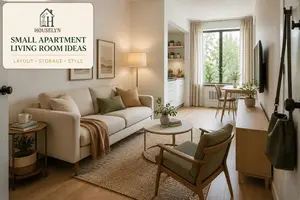
Small Apartment Living Room Ideas
Plan seating, circulation, media, storage and multifunctional living in a
compact apartment living room.
The principle behind these small apartment bedroom ideas also
applies elsewhere: protect the room's primary function first, then make
furniture, storage and decor justify the space they consume.
Practical small apartment storage ideas for kitchens, bedrooms, living rooms, entryways and more, with smart solutions that reduce clutter without overcrowding your home.
Practical small apartment living room ideas for layout, furniture, storage, lighting and decor that make compact spaces feel comfortable and functional.