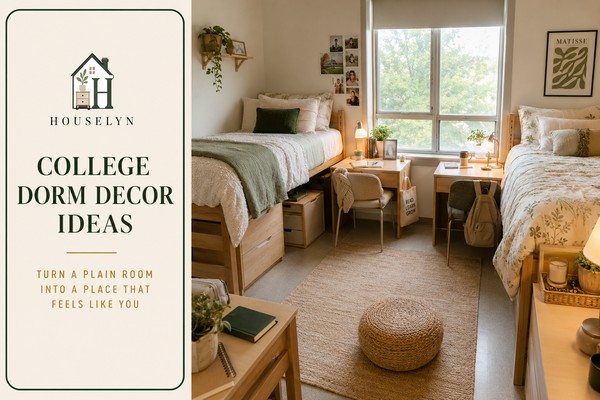
College Dorm Decor Ideas
Turn a Plain Room Into a Place That Feels Like You
College dorm decor ideas should do more than make an
empty student room look attractive. They should help a temporary
space feel warmer, more personal and comfortable enough for ordinary
college life.
Before
Plain furniture, disconnected purchases and decorative pieces
competing for attention.
→
After
A warm, collected and personal room that remains practical to
live in every day.
The Houselyn transformation:
coordinated without looking overmatched, personal without becoming
crowded, and beautiful enough to inspire while remaining practical.
A Dorm Can Be Temporary and Still Deserve to Feel Like Home
The room may begin with plain walls, standard furniture and very
little evidence of the person who will live there. Yet within a few
weeks, that same room will hold late-night conversations, difficult
study sessions, quiet phone calls home and the ordinary routines that
shape college life.
That is why thoughtful college dorm decor ideas
matter. Decoration is not only about making a room photograph well.
It can create familiarity, emotional comfort and a stronger sense of
belonging during a period of significant change.
1
Begin With the Real Student Room
Most dorm rooms do not begin as blank design studios. They contain
fixed furniture, visible flooring, limited wall space, practical
restrictions and sometimes a roommate with a completely different
style.
Houselyn begins with those realities rather than hiding them behind
an unrealistic makeover.
2
Understand Why Decor Matters
Colour, texture, photographs and meaningful objects can soften an
institutional room and help the student recognise it as a personal
place.
The goal is not visual perfection. The goal is a room that supports
rest, study, connection and the feeling of being at home.
3
Decorate Through Connection, Not Quantity
A room rarely feels cohesive because every wall and surface has
been filled. It feels cohesive because a limited number of colours,
materials and meaningful objects are repeated with intention.
This guide will help you decide what belongs before teaching you
where to place it.
4
Build the Room in Deliberate Layers
You will move through the room in a practical sequence rather than
buying unrelated products.
Define the feeling and visual direction.
Build a flexible colour story.
Coordinate two roommate styles.
Use the bed as a visual anchor.
Soften floors, walls and hard surfaces.
Add personality through meaningful objects.
Edit the room after real student life begins.
5
Let Accommodation Rules Shape the Plan
Before using adhesives, hooks, removable wall coverings, curtains,
additional lighting or furniture attachments, read the rules for
your specific residence. A product described as removable or
damage-free is not automatically permitted, and different wall
finishes can respond differently to the same product.
Never cover smoke detectors, vents, signs, sprinklers, outlets or
other safety equipment. The most beautiful decorating choice is not
successful when it creates damage, instability or a safety problem.
6
Expect the Room to Evolve
The first move-in arrangement does not need to become the final
version. Some college dorm decor ideas will look
different once books, laundry, study materials and everyday
routines enter the space.
Houselyn treats editing as part of decorating. Removing an object,
opening a surface or changing the focal point can improve the room
as meaningfully as purchasing something new.
Part I • Imagine the Room
College Dorm Decor Ideas Begin With a Feeling, Not a Shopping List
Before choosing a rug, poster, cushion or lamp, decide what you want
the room to communicate and how you want it to support you. The most
successful college dorm decor ideas begin with an
emotional direction that helps every later choice belong.
This is where many decorating plans become difficult. The reader has
collected products before creating a story for the room. Each item may
be attractive on its own, yet the group can feel disconnected once it
is placed beside institutional furniture, existing flooring and the
belongings of a roommate.
Houselyn begins somewhere quieter. Before asking what you should buy,
ask what you want the room to feel like when you return from class,
sit down to study or wake up on an ordinary morning. That feeling
becomes the foundation for every later decorative decision.
A Mood Board Should Reduce Decisions
Saving inspiration can be helpful, but a large collection of images
is not automatically a decorating plan. One image may feature soft
neutrals, another may use bold colour, and a third may depend on a
large room, permanent wall treatment or furniture that your
accommodation does not provide.
The most useful college dorm decor ideas are not
necessarily the images you like most at first glance. They are the
ideas that can be translated into your room, budget, daily routine
and residence restrictions.
Look across your saved images and ask what emotional quality appears
repeatedly. Perhaps you are drawn to soft lighting, natural textures,
clean surfaces, creative colour or rooms that feel deeply cosy. That
repeated quality is more important than copying any individual room.
Houselyn Signature Exercise
Create Your Three-Word Dorm Story
Choose one word from each category. Together, the three words should
describe how the room should feel, how it should look and how it
should work.
1
Emotional Word
Choose the feeling you want the room to provide: comforting,
restful, energising, welcoming, peaceful or uplifting.
2
Visual Word
Describe the visual direction: natural, colourful, minimal,
vintage, modern, playful, collected or softly layered.
3
Practical Word
Name the quality that supports daily life: flexible, easy-care,
affordable, organised, durable or roommate-friendly.
Example Dorm Story
Comforting + Natural + Easy-Care
This story might lead to warm neutral bedding, restrained sage
accents, woven textures and decorative pieces that are simple to
move, clean and maintain.
Turn the Three Words Into a Decorating Filter
Your three words are not merely a description. They are a filter for
deciding what belongs. Before saving another product or adding it to
the room, ask whether it supports at least two of the three words.
A bright novelty accessory may be appealing, but it may not support a
room intended to feel restful, natural and easy to maintain. A woven
basket may fit the visual direction but still fail if it has no
practical purpose or reliable place to remain.
Ask These Questions Before Buying
Does this item support at least two words in my dorm story?
Does it connect with something I already own?
Is there a measured and permitted place for it?
Will it remain useful after the first move-in photograph?
Does it strengthen the room, or simply add another competing
detail?
Let the Real Dorm Shape the Final Plan
A beautiful plan can still fail when it ignores the actual room.
Before finalising your college dorm decor ideas,
confirm the wall colour, flooring, furniture finish, natural-light
direction, usable wall areas and the decorative rules of your
residence.
These fixed features do not have to become obstacles. They can become
part of the decorative foundation. Dark university furniture may
encourage a warmer palette. A cool grey floor may need soft textiles.
Plain cream walls may provide the quiet background that allows
photographs, artwork and bedding to feel more intentional.
Record What Cannot Change
Note the wall colour, supplied furniture, flooring, window
position and fixed room features before building the final colour
or styling plan.
Check What Is Permitted
Read the rules for adhesives, wall displays, additional lighting,
curtains, furniture additions and any product attached to a
supplied surface.
Identify What You Already Own
Bedding, photographs, books, baskets and meaningful objects may
already provide the first colours and textures in the room.
Delay What You Cannot Confirm
Wait until move-in when a decorative purchase depends on an
uncertain measurement, wall finish, roommate decision or
residence rule.
Choose One Visual Anchor Before Decorating the Whole Room
A visual anchor is the first major element that establishes the
decorative direction. In a dorm, this is often the bed because it
occupies a large part of the room. It could also be a correctly scaled
rug, a meaningful artwork arrangement or one colour repeated across
several areas.
Choose one anchor before layering smaller objects. When several
elements compete to lead the design, the room can feel busy even when
it contains relatively few belongings.
The Anchor Is a Starting Point, Not a Complete Theme
A sage duvet does not require every accessory to become sage. Instead,
it may introduce a colour that reappears in a small artwork, desk cup
or shared rug. The repetition creates connection while varied
materials and neutral spaces keep the room from looking overmatched.
A useful dorm mood board connects the real room, existing belongings
and a clear emotional direction before new décor is purchased.
Part II • Build the Decorative Foundation
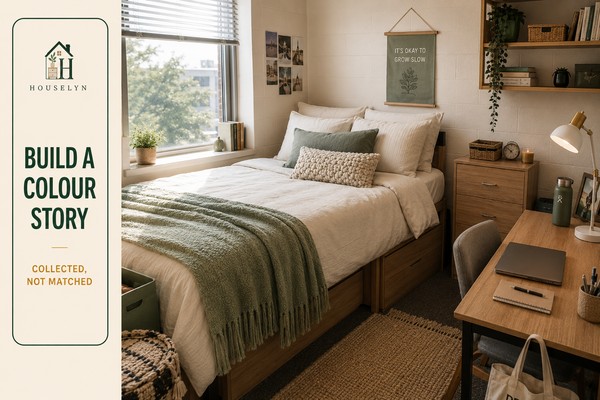
Build a College Dorm Colour Story That Feels Collected
Strong college dorm decor ideas do not depend on
buying every item in one exact shade. A collected room gives each
colour a clear role, repeats it with restraint and leaves enough
visual quiet for personal belongings to join the story later.
The room is not suffering from a lack of colour. It is suffering from a
lack of hierarchy. When every object tries to become the accent, the eye
has nowhere to settle and the student may assume that everything needs
to be replaced.
Houselyn takes a more forgiving approach. Instead of starting again,
identify which existing colours can become the foundation, which one
carries the room’s personality and which smaller detail should provide
contrast. Once those roles are clear, many unrelated pieces can be
edited, relocated or connected rather than discarded.
Begin With the Colours the Dorm Already Gives You
Before finalising your college dorm decor ideas,
record the colours that are fixed or difficult to change. These may
include the walls, flooring, wardrobe, desk, bed frame, window
covering and larger belongings already owned by the student or
roommate.
These features are not interruptions to the decorating plan. They are
the first layer of it. Dark university furniture can ground a lighter
scheme. Cream walls can become a quiet background. Grey flooring can
be softened by warm textiles rather than hidden beneath several
competing colours.
Walls and Flooring
Notice whether the fixed surfaces feel warm, cool, bright, muted
or visually heavy before selecting the main textile colours.
Supplied Furniture
Record the finish of the desk, wardrobe, drawers and bed frame so
later materials feel connected rather than accidental.
Existing Belongings
Include bedding, photographs, books, storage pieces and meaningful
objects the student already intends to use.
Roommate Colours
A shared neutral or repeated material can connect two individual
colour directions without forcing identical styling.
Houselyn Signature Formula
Foundation + Character + Spark
Use this three-part formula to turn scattered
college dorm decor ideas into one flexible colour
story. The aim is not mathematical perfection. It is to give every
visible colour a clear job.
1
Foundation
The quiet colour supporting the largest areas of the room. It
gives the eye a place to rest and helps different pieces feel
connected.
Cream, oatmeal, soft grey, beige or light taupe
2
Character
The colour that expresses the room’s personality and connects
back to the Three-Word Dorm Story created in Chapter 1.
Sage, muted blue, terracotta, navy or dusty rose
3
Spark
The smaller colour or finish that introduces contrast and energy
without competing with the main colour story.
Caramel gold, black, mustard, berry or warm metal
Houselyn Colour Story Example
Warm Cream + Muted Sage + Caramel Gold
Repeat Colour Without Matching Every Product
Repetition creates connection. Exact matching can make the room feel
flat or overly manufactured. A sage duvet does not require an
identical sage lamp, rug, frame, basket and desk organiser.
Instead, repeat the colour family through varied strengths and
materials. A muted green bedding layer might connect with a darker
botanical print, a softer olive desk cup and a small green detail in
the rug. The relationship remains visible without looking like a
complete retail collection.
Neutral gaps are equally important. Cream bedding, a visible wooden
desk or an open section of wall allows the repeated colour to feel
deliberate rather than constant.
Collected rooms repeat a story.
Matched rooms repeat a product.
Control Pattern Before It Controls the Room
Pattern adds personality, but a compact dorm can become visually busy
quickly when the bedding, rug, cushions and artwork all use large-scale
prints. Choose one pattern to lead and allow the others to become
quieter supporting layers.
Lead Pattern
The strongest print, usually appearing on the bedding, rug or one
important piece of artwork.
Supporting Pattern
A quieter stripe, small geometric design or subtle woven detail
that does not compete for attention.
Resting Areas
Solid colours, visible surfaces and open wall areas that allow
the eye to pause between decorative details.
Test Undertones Before You Commit
Two products can both be described as beige while one appears yellow
and the other appears grey. A muted green may look soft in a product
photograph but become much brighter beside the room’s actual
furniture.
Compare proposed colours in natural daylight and again under the
room’s evening lighting. Keep receipts until the major layers have
been seen together, and delay purchases that depend on a wall colour,
flooring tone or roommate decision you have not yet confirmed.
A flexible dorm colour story repeats a limited number of colours
through different textures, strengths and useful objects rather than
matching every product exactly.
Part II • Build the Decorative Foundation
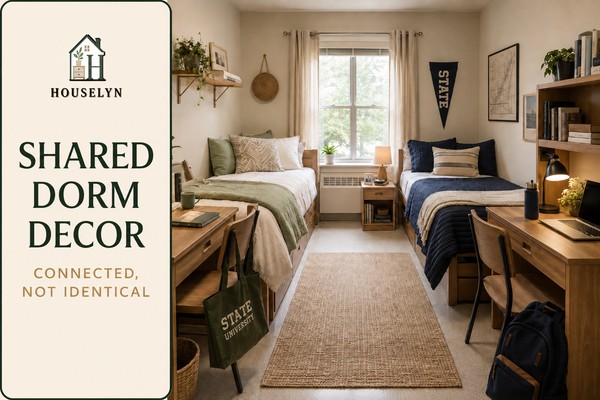
Coordinate Shared College Dorm Decor Ideas Without Losing Your Identity
Shared college dorm decor ideas work best when two
students feel represented within one visual environment. The goal is
not to make both sides identical. It is to create enough connection
that the room feels intentional rather than divided.
A shared dorm is not a matching exercise. It is a small visual
negotiation between two people who may have different tastes, budgets,
routines and expectations. Requiring identical bedding or decorations
can make one student feel as though they are living inside the other
person’s style.
Houselyn begins by protecting individual identity. Each student should
have areas where personal colour, photographs, interests and decorative
choices can be expressed. The shared task is to create a gentle bridge
between those areas so the room still feels connected when viewed as a
whole.
Decide What Is Personal, Shared and Visually Connected
Before comparing bedding or choosing a rug, divide the room into
three types of decorative space. This prevents one roommate from
assuming that every visible surface is available for a shared design
decision.
1
Personal Zones
The bed, bedside area, individual desk and agreed wall section
where each student controls the personal decorative direction.
2
Shared Zones
The central floor, entrance, window area or shared surface where
both students should approve the function, cost and appearance.
3
Bridge Zones
The visual spaces between both sides where repeated colour,
material, scale or lighting can help the room feel connected.
Houselyn Signature Framework
Build the Shared Room Bridge
Use one or two connecting elements to bring different
college dorm decor ideas into the same room. The
bridge should create harmony without erasing the personality of
either student.
Connecting Neutral
Repeat cream, oatmeal, grey, taupe or another quiet neutral across
both sides while allowing each student to keep a separate accent
colour.
Repeated Material
Use natural wood, woven texture, matte black, clear acrylic or a
shared metal finish to create connection without matching every
colour.
Balanced Visual Weight
Keep large patterns, wall displays and darker colours reasonably
balanced so one side does not visually overpower the other.
Compatible Light Warmth
Lamps do not need to be identical, but compatible light warmth
prevents the shared room from feeling like two unrelated spaces
after dark.
Shared Room Example
One student uses sage and natural textures. The other uses navy and
graphic details. Warm cream bedding layers, similar wood finishes
and one shared neutral rug connect both sides.
Coordinate Visual Weight Instead of Matching Every Detail
Two sides can use different colours and still feel balanced. Problems
often begin when one side has several dark patterns, a large wall
display and many visible accessories while the other remains light
and visually quiet.
Look at the room from the doorway and compare the visual weight of
both sides. The answer is not always to add more to the quieter side.
It may be better to reduce one large display, simplify a pattern or
repeat a neutral across the busier side.
Compare Scale
One large print may carry more visual weight than several small
photographs, even when both students display the same number of
items.
Compare Darkness
Deep colours and strong contrast naturally attract attention and
may need quieter surroundings rather than an identical match.
Compare Pattern
Keep the strongest patterns separated by neutral bedding, visible
wall space or another resting area.
Compare Clutter
Decorative volume can make one side appear heavier even when the
major furniture arrangement is symmetrical.
Keep Shared Purchases Small, Clear and Easy to Divide
Shared purchases should solve a real shared need. A rug, small mirror
or practical window-area accessory may benefit both students, but a
large decorative purchase can become difficult when tastes change or
the year ends.
Agree on the price before purchasing and record who owns the item.
When both students contribute, decide in advance who keeps it or how
the cost will be handled at move-out. This may feel formal for a small
decorative object, but clarity protects the relationship.
Avoid buying several shared pieces before seeing the room. The
accommodation may already provide more furniture than expected, and
a central decorative object can easily become another obstruction in
a compact layout.
A successful shared dorm allows two individual styles to coexist while
a repeated neutral, material or shared feature connects the room.
Part II • Build the Decorative Foundation
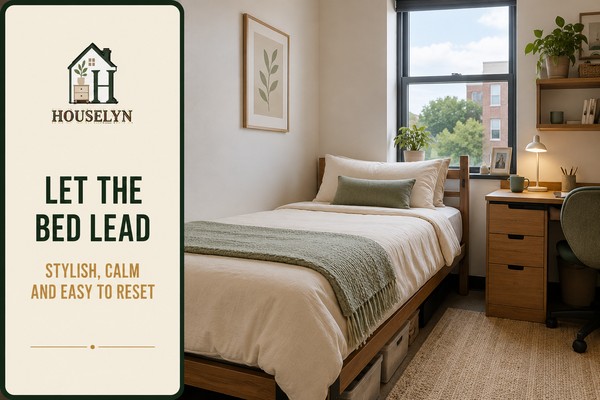
Let the Bed Become the Visual Anchor
In many student rooms, the bed is the largest soft surface and the
first decorative element visible from the doorway. The strongest
college dorm decor ideas use that visual weight to
establish the room’s colour and atmosphere without loading the bed
with more styling than everyday life can support.
The problem is not that the bed has been decorated. The problem is that
decoration has been separated from use. A dorm bed must support sleep,
reading, rest and sometimes daytime seating within a room that may not
have another comfortable surface.
Houselyn treats the bed as a visual anchor rather than a display shelf.
It should introduce the colour story, provide one or two meaningful
textures and help the rest of the room feel connected. It should not
require a lengthy removal and rebuilding routine every day.
Why the Bed Often Leads the Decorative Story
In a compact dorm, bedding often covers more visible area than the
rug, artwork or desk accessories. This makes its colour and pattern
especially influential. A busy bed can make a quiet room feel full,
while a calm bed can help several smaller decorative details feel
more intentional.
Begin with the largest visible bedding layer. This may be a duvet
cover, quilt, bedspread or blanket. Let that piece connect with the
Foundation + Character + Spark colour story from Chapter 2.
The bed does not need to contain every colour in the room. It only
needs to establish enough of the visual language that later details
can echo it.
Houselyn Bed-Anchor Method
Anchor + Echo + Quiet
Use this three-part method to connect the bed to the wider room
without turning every decorative object into an exact match.
1
Anchor
Choose the largest bedding layer that establishes the main colour,
pattern or atmosphere of the room.
2
Echo
Repeat one bedding colour or material in two or three smaller
locations, such as artwork, a desk accessory or the rug.
3
Quiet
Leave solid colours, visible surfaces and open wall areas around
the bed so the visual anchor has space to work.
Example
A muted sage quilt anchors the room, a small green detail in the
artwork echoes it, and cream sheets plus open wall space keep the
composition quiet.
Choose the Largest Bedding Layer First
When several bedding pieces are selected independently, the bed can
become the busiest area in the room. Start with the largest visible
layer, then let the smaller pieces support it.
A solid or lightly patterned foundation is often easier to adapt than
a highly specific design. Reversible pieces can also help the room
evolve because the visual direction can change without replacing the
complete bedding layer.
If the duvet or bedspread uses a strong print, keep the throw and
cushions quieter. If the main layer is solid, one smaller patterned
piece can introduce movement without overwhelming the bed.
Repeat One Bed Colour Elsewhere in the Room
The bed becomes part of the whole room when one of its colours appears
somewhere beyond the mattress. The repetition does not need to be
exact or obvious. A darker version of the same colour family can feel
more natural than an identical match.
Bedding to Artwork
Repeat one bedding colour in a small part of the wall display
rather than choosing artwork that copies the complete palette.
Bedding to Rug
Let the rug contain a related neutral or accent instead of buying
a rug that matches the duvet exactly.
Bedding to Desk
One practical desk object can echo the bed colour while the rest
of the study surface remains visually quiet.
Bedding to Roommate Side
In a shared dorm, one connecting neutral can appear on both beds
while each student keeps a separate character colour.
Add Texture With Restraint
Texture helps institutional furniture feel softer and more welcoming.
A quilted surface, woven throw or lightly textured cushion can add
depth even when the colour palette remains simple.
However, several competing textures can make a small bed feel visually
heavy. Choose one main textural contrast and one quieter supporting
layer. A quilted bedspread may need only a smooth throw, while simple
bedding may benefit from a more tactile blanket.
These college dorm decor ideas work best when texture
can be felt and used—not only viewed. Avoid delicate decorative
materials that make the student afraid to sit, eat, read or relax on
the bed.
A calm dorm bed anchors the colour story through one main layer, one
controlled texture and a small colour echo elsewhere in the room.
Part II • Build the Decorative Foundation
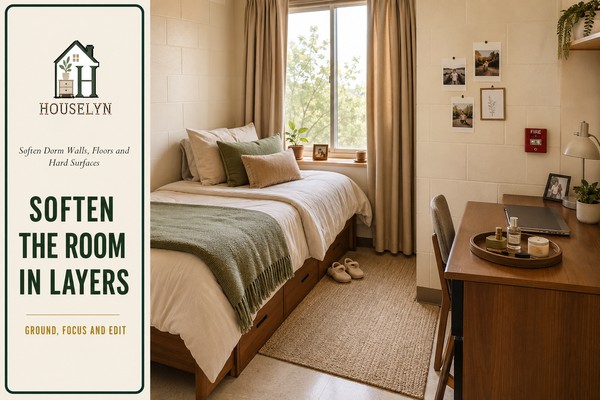
Soften the Walls, Floor and Hard Surfaces Without Overdecorating
The most effective college dorm decor ideas soften
the room in layers. A correctly scaled rug, one intentional wall
display and a few controlled surface groupings can make institutional
furniture feel warmer without covering every visible area.
Institutional rooms often feel hard because the floor, furniture and
walls were chosen for durability rather than emotional warmth. It is
understandable to want to soften every surface immediately. The
difficulty begins when each layer is treated as a separate decorating
project.
Houselyn uses a more deliberate sequence. Begin at the floor, move to
the walls and finish with the horizontal surfaces used every day. Each
level should contribute something different: the floor creates
connection, the walls create focus and the surfaces reveal personality
without surrendering their function.
Houselyn Layering Method
Ground + Focus + Edit
Use this order to turn scattered
college dorm decor ideas into one controlled
decorative composition.
1
Ground
Use the floor layer to connect the bed, desk and central walkway.
The rug should support the room rather than appear as a small
decorative island.
2
Focus
Choose one main wall area for the strongest visual display so
photographs, art and personal details do not compete across every
surface.
3
Edit
Keep daily surfaces partly visible and group smaller objects into
a limited number of arrangements that can be moved or reset
easily.
Ground the Room With a Correctly Scaled Rug
A rug can soften a cold floor, reduce the institutional feeling of the
room and visually connect furniture that otherwise appears unrelated.
Its success depends more on placement and proportion than on pattern.
Measure the open floor area after the beds and desks are in position.
Check that doors, drawers and desk chairs can still move freely. A rug
should not create a raised corner in the central walkway or extend
into an area where it will constantly shift.
Connect, Do Not Float
Position the rug so it relates clearly to a bed, desk or shared
central zone rather than sitting without a visual connection.
Protect Movement
Keep the main walkway clear and confirm that doors, storage
drawers and chair legs do not catch on the rug edge.
Choose Easy Care
Select a practical low-pile or washable option that can tolerate
shoes, food crumbs and the realities of shared student life.
Support the Colour Story
Let the rug repeat a neutral or accent already present rather than
introducing another unrelated palette.
Choose One Primary Wall Story
A dorm wall can hold photographs, art, reminders of home and evidence
of the student’s interests. It becomes overwhelming when every open
section receives an unrelated display.
Select one primary wall area, often above the bed or beside the desk,
and let that area carry the strongest visual story. Smaller wall
details can support it, but they should not create several competing
focal points.
Leave some wall space open. Empty space is not unfinished space. It
separates the display from the room’s fixed features and allows the
chosen photographs or artwork to feel more meaningful.
Keep this chapter at the design-principle level. Detailed gallery-wall
arrangements, hanging-product comparisons and removable-wall
treatments belong to the dedicated Dorm Room Wall Decor Ideas guide
later in the cluster.
Style Surfaces Without Taking Away Their Purpose
A desk must still support studying. A dresser must still receive keys,
toiletries or clothing. When decoration occupies the full surface,
ordinary belongings spill into other parts of the room and quickly
create visual pressure.
Keep a clear working zone on every functional surface. Use one tray or
shallow container to turn several small items into a single visual
group. Combine decorative and useful objects whenever possible so each
item earns its place.
Create One Group
Gather a framed photograph, small object and practical accessory
into one contained arrangement instead of spreading them across
the surface.
Vary Height Carefully
A lamp, medium object and lower tray can create depth, but nothing
should block study light, mirrors, drawers or daily reach.
Keep a Clear Zone
Reserve enough open space for a laptop, notebook, skincare routine
or the ordinary activity the surface must support.
Remove the Weakest Detail
When the arrangement feels crowded, remove the least meaningful
object before buying a larger organiser or another surface.
A layered dorm uses the floor to connect, the wall to focus and the
surfaces to express personality without sacrificing function.
Part III • Express the Student
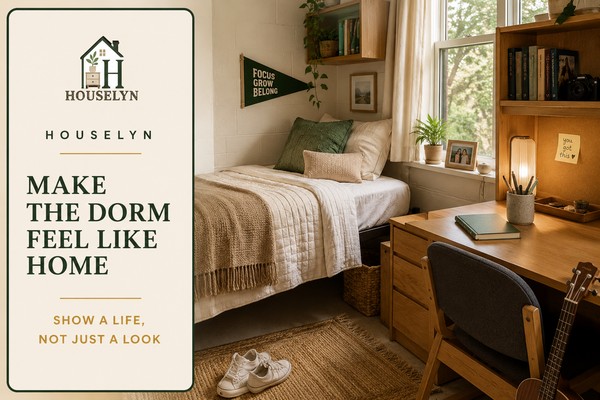
Add Meaningful College Dorm Decor Ideas That Make the Room Feel Like Home
Meaningful college dorm decor ideas do not create a
personality from a matching retail collection. They reveal the person
who already lives there through carefully chosen photographs, books,
interests, memories and practical objects that carry a real story.
This is the difference between styling a dorm and belonging in it. A
room can follow every decorative rule and still feel emotionally
distant when the objects have been chosen only because they fit an
aesthetic.
Houselyn does not ask the student to fill the room with every
sentimental belonging. It asks them to select a small number of objects
that reveal where they come from, who matters to them, what they enjoy
and how their life is changing. Those details give a temporary room
emotional depth.
Houselyn Signature Method
Create Evidence of Life
Choose one or two details from each relevant category. The purpose is
not to represent every part of the student’s identity, but to make the
room recognisably theirs.
1
Origin
A photograph, small textile, postcard or object connected to home,
family history or a familiar place.
2
People
A limited group of photographs or messages that represent the
relationships the student wants to keep emotionally close.
3
Interests
Books, music, sport, art or a hobby-related object that reflects
how the student genuinely chooses to spend time.
4
Growth
A current project, campus memory, course-related object or new
achievement that records the student’s developing life.
5
Rituals
A useful object connected to a comforting routine, such as
reading, journalling, tea, skincare or evening study.
A personal room does not display everything about the student. It
shows enough evidence that the space could not belong to anyone else.
Choose Meaning Before Quantity
A large wall of photographs can become visually anonymous when every
image is given equal importance. A smaller display often feels more
personal because each photograph can be seen, remembered and
connected to a real relationship.
The same principle applies to souvenirs, books and collections.
Select the objects that communicate the strongest story. Store or
rotate the rest rather than displaying every meaningful item at once.
Photographs
Choose a limited group that represents different relationships or
moments instead of repeating many similar images.
Books
Display books the student is reading, values or regularly uses
rather than filling a surface with decorative titles alone.
Souvenirs
Select one or two objects with a clear story and give them enough
space to be noticed without becoming a scattered collection.
Hobbies
Let one practical or recognisable hobby-related item contribute
to the room instead of purchasing generic décor that imitates an
interest.
Let Useful Objects Carry Part of the Story
Personalisation does not need to come only from objects labelled as
décor. A favourite mug used as a desk cup, an attractive notebook, a
sculptural mirror or a woven laundry basket can contribute colour,
texture and personality while performing a necessary function.
This is especially valuable in a small student room. When a useful
item also supports the colour story and Three-Word Dorm Story, the
room gains character without gaining another object that needs a
separate home.
Decorative and Useful
Trays, desk cups, mirrors, bookends, covered boxes and baskets can
provide visual interest while supporting daily routines.
Decorative Only
Keep purely decorative pieces limited and select them for
emotional meaning rather than simply filling an available gap.
Create One Intentional Collection
A collection can give the room identity when its boundaries are
clear. The student might display a small group of postcards, three
favourite books, a limited set of photographs or several objects
connected to one hobby.
Avoid creating several unrelated collections across the same compact
room. When photographs, figurines, postcards, plants, memorabilia and
decorative objects all compete, the most meaningful items lose their
voice.
Strong college dorm decor ideas often become more
personal after something is removed. Editing creates enough visual
quiet for the remaining objects to communicate their stories.
Allow the Room to Collect New Memories
A dorm does not need to arrive fully personalised on move-in day.
Leave space for a new photograph, campus event ticket, project,
postcard or object that represents the student’s developing college
life.
This makes the room feel collected rather than staged. It also
prevents the first decorating plan from becoming so complete that
there is no room for the student to change.
Meaningful dorm décor shows evidence of the student’s relationships,
interests and routines while leaving enough space for the room to keep
evolving.
Part IV • Evolve the Room
Master College Dorm Decor Ideas With the Houselyn Decorating Framework
The final stage of college dorm decor ideas is not
adding the last decorative object. It is observing how the room works
after move-in, editing what creates pressure and allowing the space to
become more personal as the student’s life changes.
A dorm room cannot be fully understood before it is lived in. Some
decorative decisions will prove useful, while others will interfere
with studying, sleeping, dressing or maintaining the room. This is why
Houselyn treats editing as part of decorating rather than evidence that
the plan went wrong.
The Evolve stage gives the student permission to remove, move, rotate
and simplify. A room becomes stronger when it responds to real habits
instead of protecting a move-in-day photograph.
Houselyn Decorating Framework
Imagine, Build, Express, Comfort and Evolve
Use the five stages together whenever the room feels disconnected,
crowded or less personal than intended.
1
Imagine
Define how the room should feel before deciding what it should
contain.
2
Build
Establish colour, scale, visual anchors and the shared foundation.
3
Express
Add selected photographs, interests and meaningful evidence of
life.
4
Comfort
Soften the room through useful textiles, warmth and visual calm.
5
Evolve
Edit the room as routines, relationships and personal preferences
change.
A Finished Dorm Is Not a Full Dorm
A room can feel complete while still containing open wall space,
partly clear surfaces and areas that have not been assigned a
decorative object. Completion comes from connection, not from using
every available inch.
Review the room from the doorway. The bed, rug, wall display and desk
should contribute to one visual story without demanding equal
attention. If the eye moves restlessly between several strong areas,
remove or quiet the weakest one.
This principle protects the page from turning
college dorm decor ideas into an endless product list.
The aim is not to reach a maximum number of decorative layers. It is
to reach the point where the room feels recognisable, comfortable and
easy to maintain.
Complete the Houselyn Doorway Audit
Stand at the entrance when the room is in its ordinary weekday state,
not immediately after a careful reset. This viewpoint reveals whether
the decorative plan survives real life.
Find the Visual Anchor
Can you identify one main area that leads the room, or do the bed,
walls and surfaces all compete equally?
Check Colour Repetition
Do the foundation, character and spark colours appear with enough
repetition to feel connected but not overmatched?
Protect Daily Functions
Can the student study, sleep, dress and move through the room
without relocating decorative objects first?
Look for Visual Pressure
Are any walls, corners or surfaces carrying more objects, pattern
or darkness than the rest of the room can support?
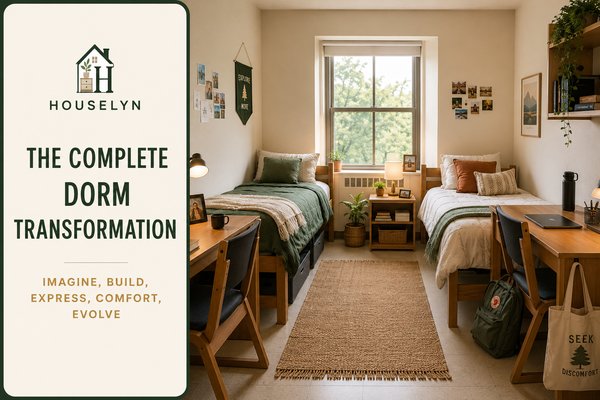
Complete Houselyn Dorm Transformation
From Decorated but Disconnected to Personal and Practical
This example brings every chapter together and shows how the room can
change without replacing everything.
Before
The shared room has mismatched bedding colours, several unrelated
wall displays, too many cushions, a small floating rug, crowded
desks and two roommate sides competing for attention.
→
After
Two individual styles remain, but a calm foundation, shared
material bridge, stronger visual anchors, meaningful details and
clear working surfaces make the room feel connected.
Imagine
One student chooses Warm + Creative + Restful. The roommate chooses
Simple + Natural + Practical. Their shared bridge becomes warm
neutrals and natural textures.
Build
Cream becomes the foundation. Sage and muted caramel provide
separate accents. One correctly scaled rug connects the central
zone, and both beds are simplified.
Express
Each student creates one personal photograph display and keeps a
limited number of meaningful books, hobbies and campus memories.
Comfort
One soft throw per bed, compatible lamp warmth and visible desk
space make the room easier to rest and study in every day.
Evolve
After several weeks, unused cushions are removed, photographs are
rotated, the rug is adjusted and one new campus memory is added
without disturbing the room’s visual calm.
The room did not become more personal because more objects were added.
It became more personal because every remaining object had a reason to
be there.
The completed Houselyn transformation feels personal and visually
connected while leaving enough space for studying, sleeping and the
room to keep evolving.
Houselyn Dorm Decorating Questions
Frequently Asked Questions About College Dorm Decor Ideas
These practical answers bring the complete Houselyn Decorating
Framework together, from choosing the first room feeling to editing
the finished dorm after everyday student life begins.
Begin With Intention
Decorate Practically
Personalise Carefully
Edit and Evolve
How should I begin decorating a college dorm room?
Begin with how you want the room to feel rather than a shopping
list. Choose one emotional word, one visual word and one practical
word. A dorm story such as
Comforting + Natural + Easy-Care
gives later decisions a clear direction.
Next, record the fixed colours, furniture, dimensions and
residence rules. Choose one visual anchor—usually the bedding—and
delay purchases that depend on measurements or surfaces you have
not yet seen.
What colour scheme works best for college dorm decor ideas?
There is no single colour scheme that suits every dorm. Use the
Houselyn
Foundation + Character + Spark
formula. Select a quiet foundation that works with the room’s
fixed surfaces, one character colour that expresses your style
and one smaller accent that adds contrast.
For example, warm cream can become the foundation, muted sage the
character colour and caramel gold the spark. Repeat those colours
in different materials and strengths instead of matching every
product exactly.
How can I make a dorm room feel like home without buying lots of decor?
Use meaningful objects before generic accessories. A small group
of photographs, favourite books, one hobby-related item and a
practical object connected to a comforting routine can make the
room recognisably yours.
Focus on Evidence of Life: origin, relationships,
interests, growth and rituals. Fewer objects with genuine stories
often create more emotional warmth than a large matching
collection.
How do roommates coordinate college dorm decor ideas without matching?
Protect each student’s personal zone first. Then create one
Shared Room Bridge using a connecting neutral, repeated material,
compatible light warmth or balanced visual weight.
The beds and wall displays can remain different. A shared cream
foundation, similar wood finish or one central rug may provide
enough connection. Agree on ownership, budget and what happens to
shared purchases at move-out before buying them.
How much dorm decor should I buy before move-in?
Buy only the pieces that do not depend on uncertain dimensions,
supplied furniture or residence rules. Bedding and a small number
of meaningful personal objects can usually establish the initial
direction, but rugs, wall treatments, curtains and larger
accessories are often safer to select after seeing the room.
Create a buy-later list for anything that needs a
measurement, roommate decision or confirmed location. Waiting can
prevent duplicate purchases, poor scale and objects without a
reliable home.
Can I hang dorm wall decor without damaging the walls?
Start with the rules issued by your own accommodation provider.
Permitted products, attachment methods and wall-coverage limits
vary, so a method allowed in one residence may be prohibited in
another.
Never assume that a product described as removable or damage-free
is automatically approved. Keep decorations away from smoke
detectors, sprinklers, vents, electrical equipment and safety
notices, and test only where the residence permits it.
How can I make a college dorm cosy without making it cluttered?
Add comfort through a few high-impact layers: calm bedding, one
useful throw, appropriate lamp light, a correctly scaled rug and
selected meaningful objects. Avoid using several small
accessories to compensate for one missing foundation.
Use the Houselyn methods together:
Anchor + Echo + Quiet for the bed.
Ground + Focus + Edit for the floor, walls and surfaces.
Evidence of Life for personal details.
Keep, Move, Rotate or Release when the room feels full.
How can I use college dorm decor ideas on a student budget?
Begin with what you already own and choose purchases that perform
more than one role. A washable throw can add colour and warmth, a
tray can organise and decorate, and personal photographs can
create a wall story without an expensive art collection.
Spend first on the larger layer that establishes the room, then
stop and review. Avoid buying complete matching collections,
duplicate roommate items or finishing accessories before the
function and scale of the room are clear.
What should I do when my dorm decor looks mismatched after move-in?
Do not replace everything immediately. Stand at the doorway and
identify the fixed colours, strongest visual anchor and area
creating the most pressure. Then choose one foundation colour or
repeated material that can connect the existing pieces.
Remove the weakest competing pattern, relocate an unrelated
accessory and leave more neutral space around the main focal
point. The room may need editing rather than more shopping.
How should college dorm decor ideas evolve during the academic year?
Review the room after the first few weeks, when real study,
laundry, sleep and social routines are visible. Use the Houselyn
Evolve Edit to decide what should be kept, moved, rotated or
released.
Leave space for new photographs, campus memories and changing
interests. A successful dorm is not frozen at move-in. It remains
visually connected while adapting to the student’s developing
life.
Final Houselyn Reflection
Your Dorm Should Feel Like You—Not Like a Shopping List
The purpose of college dorm decor ideas is not to
disguise every institutional surface or fill every empty space. It is
to create enough warmth, identity and visual connection that a
temporary student room begins to feel supportive, familiar and
genuinely personal.
A Plain Room Can Become a Meaningful Place
The transformation does not begin with the duvet cover, rug or wall
display. It begins when the student decides how the room should feel
and which parts of their life deserve to become visible within it.
Every later decorative decision becomes easier when it supports that
original intention.
The colour story creates connection. The bed establishes a visual
anchor. The floor, walls and hard surfaces receive controlled layers
of softness. Meaningful photographs, books and interests reveal the
person living there. Shared-room bridges allow two identities to
coexist without demanding that either student disappear.
Most importantly, the room remains editable. The strongest
college dorm decor ideas can survive an ordinary week
of studying, laundry, early classes and changing routines. They do not
depend on constant restyling or a surface remaining untouched.
The Complete Houselyn Decorating Framework
Imagine, Build, Express, Comfort and Evolve
Return to these five stages whenever your
college dorm decor ideas begin to feel disconnected,
crowded or difficult to maintain.
1
Imagine
Define the feeling, visual direction and practical character of
the room.
2
Build
Establish the colour story, visual anchors and shared-room
foundation.
3
Express
Add selected evidence of relationships, interests, origin and
growth.
4
Comfort
Introduce softness, warmth and calm without sacrificing daily
function.
5
Evolve
Keep, move, rotate or release items as the student and room
change.
How to Know When the Dorm Is Decorated Enough
A dorm is ready when the decorative story is clear and the student can
still live comfortably inside it. Look for these signs instead of
searching for another product to fill the remaining spaces.
The Feeling Is Recognisable
The room reflects the Three-Word Dorm Story through colour,
texture, lighting and visual calm.
Personal Identity Is Visible
Photographs, interests and meaningful belongings make the room
recognisable without covering every surface.
Daily Functions Remain Easy
Studying, sleeping, dressing and moving through the room do not
require decorative objects to be relocated first.
The Room Can Still Change
Open space remains for new memories, changing interests and the
practical needs that appear during the academic year.
Learn how to decorate a stylish and comfortable living room with practical design advice, timeless styling ideas, and expert inspiration from Houselyn.
Use these dorm desk organization ideas to create a clear college study space with better drawer systems, vertical storage, cable control and simple resets.
Discover dorm bedding ideas that make small rooms feel like home. Learn how to create a cosy, stylish, and practical college dorm with smart bedding, storage, and decorating tips.
Discover practical dorm room organization ideas that help you organize clothes, desks, storage and daily routines for a calm, clutter-free college room.