- Home
- Dorm Room Ideas
- Dorm Room Organization Ideas
Dorm Room Organization Ideas: A Practical System for a Calm, Functional College Space
Dorm room organization ideas work best when they create simple systems you can actually maintain during busy lectures, assignment deadlines and everyday college life. A well-organized dorm isn't about buying dozens of storage containers or copying a perfectly styled room from Pinterest. It's about giving every item a logical home, creating routines that fit your schedule and designing a space that supports studying, relaxing and living comfortably in a small room.
 Beautifully organized college dorm room featuring practical storage, a tidy study area, organized closet and calm neutral styling.
Affiliate Disclosure: This article contains affiliate links. Houselyn may earn a commission if you purchase through these links, at no additional cost to you. As an Amazon Associate I earn from qualifying purchases.
Moving into a college dorm is exciting, but it also brings a unique challenge. Your bedroom suddenly becomes your study, wardrobe, dining area, storage room and personal retreat—all within a surprisingly limited amount of space. Without a practical organization system, everyday items quickly begin competing for the same surfaces. Clothes migrate onto chairs, chargers disappear beneath textbooks, toiletries end up on desks and laundry quietly takes over valuable floor space.
At Houselyn, we've found that successful dorm organization isn't determined by how many organizers you buy—it's determined by how well your organization system matches the way you actually live. The students who keep their rooms tidy throughout the semester aren't necessarily spending more money. Instead, they've created simple habits, logical zones and realistic routines that make staying organized almost effortless.
In this guide, you'll learn how to organize every part of your dorm room using a complete Houselyn system. We'll show you how to plan before buying storage, divide your room into practical zones, organize clothing and study areas, manage toiletries and laundry, maintain order during busy college weeks and build habits that continue working long after move-in day. Whether you're preparing for your first semester or improving a room that's already become cluttered, these dorm room organization ideas will help you create a calm, functional space that truly works for student life.
Reader Promise
By the end of this guide, you'll know how to:
- Build an organization system instead of simply buying storage products.
- Create functional zones for studying, sleeping, dressing and daily living.
- Organize clothes, shoes and limited closet space efficiently.
- Keep your study desk clear and ready for productive work.
- Manage toiletries, laundry, snacks and everyday essentials.
- Maintain your room with quick daily and weekly reset routines.
- Adapt your organization system as college life changes throughout the semester.
THE HOUSELYN APPROACH
Dorm Room Organization Ideas Should Make College Life Easier
Dorm room organization ideas should do more than make a college room look tidy for move-in photographs. A successful system should still work when lectures become demanding, laundry begins to build up, assignments cover the desk and you have only a few minutes to reset the room before leaving for class.
That is where many dorm organization plans begin to fail. They are designed around matching containers, perfect labels and an ideal daily routine rather than the way a student actually lives. A system may look beautiful when everything is freshly arranged, but it quickly becomes frustrating when frequently used belongings are hidden behind lids, daily essentials are stored too far from where they are needed or returning an item requires several unnecessary steps.
At Houselyn, we approach dorm organization differently. We begin with behaviour. Where do your clothes naturally land at the end of the day? Which items do you reach for before class? What usually collects on your desk? Which belongings need to move between your room, bathroom, laundry area and lectures? Once those patterns are understood, it becomes much easier to create practical homes for everything you use.
A REALISTIC DORM TRANSFORMATION
From Constant Clutter to a Room That Resets Easily
Before: Clothes are spread across the chair, chargers disappear beneath textbooks, toiletries migrate onto the study desk and the laundry hamper overflows into the walkway. The room is not necessarily full of too many belongings; it simply has no clear system for where those belongings should go.
After: Clothing has one defined area, the desk remains reserved for studying, daily essentials sit in an accessible landing zone and laundry is contained before it reaches the floor. A five-minute reset is enough to return the room to order.
Why it works: The improved room is organized around activities and frequency of use. Every item is stored close to where it is normally needed, reducing the effort required to put it away.
Houselyn insight: An organization system succeeds when returning an item is easier than leaving it somewhere random.
Organization Is Different from Storage
Storage answers the question, “Where can this item fit?” Organization answers a more useful question: “Where should this item live so I can find it, use it and return it easily?” That distinction matters in a dorm because limited space makes every poorly placed item more noticeable.
Buying more bins cannot solve a system that does not match your routine. In fact, adding containers too early can make the room harder to use. Deep baskets may hide everyday items, complicated categories may become impossible to maintain and oversized organizers can consume more space than they save.
The strongest dorm room organization ideas use fewer, clearer systems. Clothing stays near the wardrobe. Study materials remain close to the desk. Toiletries travel together. Laundry has one obvious boundary. Keys, student identification and headphones return to the same departure station every day. These decisions reduce visual clutter, but they also reduce the number of small choices you need to make during an already busy week.
What This Guide Will Help You Build
This guide will take you through the complete Houselyn organization journey. You will begin by understanding your real habits, then create functional zones for sleeping, studying, clothing, personal care, food and laundry. From there, you will build practical systems, support them with carefully selected tools and learn how to maintain the room during deadlines, exam weeks and changing routines.
You will also learn what not to organize, when reducing belongings is more effective than adding storage and how to recover when the room becomes messy. A good system should not demand perfection. It should make ordinary student life feel calmer, quicker and easier to manage.
The Houselyn Organization Promise
We will not ask you to create a picture-perfect room that requires constant attention. Instead, we will help you build simple systems that can survive rushed mornings, busy weeks and real college life while still making your dorm feel calm, functional and welcoming.
The first step is not buying organizers. It is understanding your routine, your room and the places where clutter naturally begins. That is where Chapter 1 starts.
Chapter 1
Dorm Room Organization Ideas Begin with Understanding Your Real Routine
The best dorm room organization ideas do not begin with matching storage bins or expensive organizers. They begin with understanding how you actually live. Before deciding where anything should be stored, take a step back and observe your everyday routines. The way you move through your room each morning, where you naturally place your backpack after class and which belongings you reach for most often will tell you far more about the right organization system than any perfectly styled photograph online.
Moving into a dorm means fitting an entire lifestyle into one compact room. That single space quickly becomes your bedroom, study area, wardrobe, dining corner, storage room and place to relax after a demanding day. When every activity competes for the same surfaces, clutter does not usually appear because you are untidy. It appears because your room has not yet been organized around the way you use it.
At Houselyn, we have found that students often blame themselves when a room becomes messy. In reality, the problem is usually the system rather than the person. If putting something away takes too many steps, most people will naturally leave it on the nearest chair, desk or bedside table. A successful organization system reduces effort instead of demanding more discipline.
That is why the first step is not shopping for organizers. It is understanding your own habits. Once you know where clutter naturally appears and why it collects there, creating a system that lasts becomes much simpler.

Your Habits Reveal the Best Organization System
Imagine arriving back at your dorm after a full day of lectures. Without thinking, you place your backpack beside the desk, your hoodie lands on the chair, your keys go onto the bedside table and your water bottle stays beside the bed. None of these actions are planned. They are simply habits. Repeat them every day, and those same locations gradually become clutter hotspots.
Now imagine a different version of that room. A hook waits beside the door for your backpack, a dedicated basket sits nearby for everyday accessories, your hoodie has a clearly defined home inside the wardrobe and your water bottle belongs on a small bedside shelf. Nothing about your behaviour has changed. The only difference is that your room has been designed to support it.
This simple shift explains why some organization systems survive the entire semester while others fall apart within a few weeks. They are not built around an ideal version of the student. They are built around the student's real routine.
One principle we always return to at Houselyn is this: the easiest place to put something away is usually the best place to store it. When your room follows that principle, staying organized becomes part of your everyday routine instead of another task on your to-do list.
Organize for Your Real Life, Not Your Ideal Life
One of the biggest mistakes students make is creating an organization system for the person they hope to become instead of the person they already are. It's easy to imagine yourself folding every item of clothing immediately after laundry, filing every piece of paper neatly away or putting every charger back into the same drawer every evening. Those intentions are good—but real college life rarely follows a perfect schedule.
Assignments take longer than expected. Friends knock on your door unexpectedly. Laundry waits until the weekend. Some evenings you'll return from lectures feeling motivated, while other days you'll simply want to rest. A successful organization system accepts those realities instead of fighting them.
BEFORE & AFTER
Build a System You Can Maintain
Before: A student buys matching storage boxes, labels every container and creates complicated categories for stationery, electronics and personal items. During the first busy week of classes, belongings are dropped onto the nearest surface because putting them away takes too much time.
After: The same student simplifies the system by keeping daily essentials within easy reach, reducing unnecessary categories and giving frequently used belongings obvious homes. Tidying up now takes only a few minutes because every item has a logical place that's easy to access.
Why it works: People naturally choose the option that requires the least effort. When returning an item is quick and convenient, the habit becomes easier to repeat consistently.
Houselyn Insight: We've learned that simple systems are usually the ones that last. If putting something away feels inconvenient, your room is quietly telling you the system needs improving—not that you've failed.
Observe Before You Organize
Before buying organizers or rearranging furniture, spend a day or two simply paying attention to your habits. Notice where your backpack lands after class, where you place your headphones, how you manage your laptop charger and which surfaces attract clutter first. These patterns reveal the locations where your room needs better systems—not necessarily more storage.
At Houselyn, we always recommend observing before organizing. Think of yourself as a designer studying how the room is used rather than judging how tidy it looks. Once you understand your daily routine, creating practical zones becomes far easier because every decision is based on real behaviour instead of guesswork.
This approach also helps reduce decision fatigue. When frequently used belongings always return to the same location, your brain no longer has to decide where to put them each time. Those tiny decisions may seem insignificant, but they quickly add up during a busy semester. Removing them frees your attention for studying, relaxing and enjoying college life.
💚 Houselyn Tip
Before buying your first organizer, write down the ten items you use every single day. These belongings deserve the easiest-to-reach locations in your room because they're part of your daily routine. Organize around frequency of use before thinking about appearance.
Key Takeaway
The strongest dorm room organization ideas are built around your everyday habits, not around perfect routines. When your room reflects how you naturally live, staying organized becomes easier, faster and far more sustainable throughout the college year.
Now that you understand how your routines shape your organization system, the next step is to turn those habits into practical zones that give every activity—and every belonging—a clear place within your dorm room.
Chapter 2
Create Clear Zones for Every Part of Dorm Life
Once you understand your daily habits, the next step is turning them into practical spaces within your room. The most effective dorm room organization ideas do not rely on storing more things. They rely on giving every activity a clear place to happen. Even in the smallest dorm, creating simple zones helps reduce clutter because your room begins guiding your behaviour instead of competing with it.
A college dorm may be compact, but it still supports many different parts of your day. You sleep, study, get dressed, prepare for class, relax, organize personal items and sometimes enjoy a quick meal in the same space. When those activities overlap, belongings naturally begin spreading across every available surface. The result is a room that feels busier than it actually is.
At Houselyn, we think of every room as a collection of purposeful zones rather than one large space. Each zone has a simple job to do, and every item within that zone should support that activity. When your study materials stay close to your desk, clothing remains near your wardrobe and everyday essentials have an obvious landing place, tidying becomes faster because there are fewer decisions to make.
The goal is not to create rigid rules. It is to make your room intuitive. When every activity has its own area, your room quietly encourages helpful habits without demanding constant effort.

Every Activity Deserves Its Own Space
Imagine waking up on a weekday morning. Your laptop charger is mixed with yesterday's snacks, clean clothes are resting on your study chair and your lecture notes have been pushed aside to make room for toiletries. Nothing is terribly untidy on its own, yet every task takes a little longer because the room no longer supports what you are trying to do.
Now picture the same room after creating simple activity zones. The desk is reserved for studying, clothing stays within the wardrobe area, toiletries remain together in one portable location and your everyday essentials return to the same landing place whenever you come back from class. You spend less time searching, less time moving items between surfaces and more time focusing on your day.
This transformation does not require a larger room or expensive furniture. It comes from giving each activity a defined home. That is one reason zoning remains one of the most effective organization principles used by professional organizers and interior designers.
Think in Activities, Not in Furniture
Many students organise their dorm room around the furniture they see instead of the activities they perform every day. They think about the bed, the desk and the wardrobe as separate pieces of furniture rather than asking what each area needs to help them accomplish. This small change in perspective can completely transform how a room functions.
Instead of asking, "Where should I put this storage basket?", ask, "Where will I naturally use these items?" Study materials belong where you study. Clothing belongs where you dress. Everyday essentials belong close to the door if you reach for them before leaving. When activities determine where things live, putting them away becomes almost automatic.
BEFORE & AFTER
A Room That Works With You
Before: A student keeps chargers beside the bed, notebooks in the wardrobe, snacks on the study desk and toiletries scattered across several shelves. Every task begins with searching for something.
After: Study items remain together near the desk, clothing stays within the dressing area, toiletries travel in one portable kit and everyday essentials have a dedicated departure station beside the door. The room immediately feels calmer because every activity has a clear place to happen.
Why it works: Grouping belongings by activity reduces visual clutter and eliminates unnecessary movement around the room. Your environment begins supporting your routine instead of interrupting it.
Houselyn Insight: We've found that students rarely struggle because they own too much. More often, they struggle because similar items are spread across multiple locations. Keeping related belongings together creates a system your brain quickly learns and remembers.
Keep High-Frequency Items Within Easy Reach
Not every belonging deserves the same location. The items you use several times a day should always be the easiest to reach, while occasional or seasonal items can live farther away without causing frustration. This principle is one of the simplest ways to make your organization system feel effortless.
Think about your daily routine. Your student ID, headphones, laptop charger, notebook and water bottle are probably used almost every day. Compare those with winter clothing, spare bedding or sentimental keepsakes that may only be needed occasionally. Treating these categories differently makes your room feel far more efficient because the things you reach for most often are always close at hand.
At Houselyn, we always recommend organising by frequency before organising by appearance. A beautifully styled room quickly becomes frustrating if you have to move several containers just to find something you use every morning. Convenience should always come before perfection.
✓ Pro Organizer Tip
Before changing your room layout, stand in the centre of your dorm and mentally walk through a normal weekday—from waking up to going to bed. If you find yourself crossing the room repeatedly for items you use together, your activity zones probably need adjusting.
Key Takeaway
The most effective dorm room organization ideas don't simply arrange belongings—they organise your daily life. When every activity has a dedicated zone, staying organised becomes a natural part of your routine instead of a constant chore.
With your room now divided into practical activity zones, the next step is learning how to organise the category that challenges most students first: clothing, shoes and limited closet space.
Chapter 3
Dorm Room Organization Ideas for Clothes, Shoes and Limited Closet Space
One of the biggest challenges in any college dorm is not finding somewhere to sleep. It is finding a practical way to manage your clothing every day. The best dorm room organization ideas do not try to squeeze an entire wardrobe into a tiny closet. Instead, they create a simple clothing system that keeps everyday items accessible while preventing clean clothes, worn clothes and laundry from competing for the same space.
Most students arrive with far more clothing than their dorm can comfortably support. That is not necessarily a sign of poor planning. It is a natural response to preparing for changing weather, social events, sports, formal occasions and everyday classes. The challenge is not simply fitting everything into the wardrobe. It is creating a system that remains easy to use after the excitement of move-in week has passed.
At Houselyn, we have learned that clothing organization is not about maximizing every centimetre of wardrobe space. It is about reducing daily decisions. When you immediately know where clean clothes belong, where yesterday's hoodie should go and where laundry waits until wash day, getting dressed becomes quicker and your room stays noticeably calmer.
Rather than trying to create a perfectly arranged wardrobe, focus on building a system that matches the rhythm of college life. The easier it is to return clothing to its proper place, the more likely you are to keep doing it, even during the busiest weeks of the semester.

Your Wardrobe Should Reflect Your Weekly Routine
Think about a typical college week. Some clothes are worn almost every day, while others may only come out for interviews, presentations, sports or special occasions. Treating every item as equally important often leads to overcrowded wardrobes and frustration when you are rushing to get ready for class.
Instead, organize your clothing according to how often you actually wear it. Everyday essentials deserve the easiest-to-reach locations because they support your daily routine. Less frequently used items can comfortably live farther back in the wardrobe or in longer-term storage without slowing down your morning.
This simple shift does not require more storage. It requires better prioritization. Your wardrobe becomes a practical tool that supports your lifestyle instead of a crowded space that makes everyday decisions more difficult.
Separate Clean, Worn and Dirty Clothing
One of the most common reasons clothing spreads across a dorm room is that students are trying to manage three different categories with only two obvious choices. Clean clothes return to the wardrobe, and dirty clothes go into the laundry hamper—but what happens to the jumper, jeans or hoodie that has been worn once and is still clean enough to use again?
Without a clear answer, those items usually land on the chair, the end of the bed or the floor. Over several days, the pile grows until clean, worn and dirty clothing become difficult to distinguish. The room begins to look disorganised even when the student is genuinely trying to keep things tidy.
At Houselyn, we recommend giving each clothing state a simple, visible home. Clean clothing belongs in the wardrobe or drawers. Dirty clothing goes directly into the hamper. Clothes that can be worn again need one small, controlled location, such as a designated hook, narrow basket or single shelf. The system only works when that temporary area has a clear limit.
BEFORE & AFTER
Stop the Chair from Becoming a Second Wardrobe
Before: Clean clothes are mixed with worn clothes on the chair, shoes collect beneath the desk and the laundry hamper is so full that clothing begins spilling onto the floor. Getting dressed becomes slower because nothing has a clear status.
After: Clean clothing returns to the wardrobe, dirty clothing goes directly into a divided hamper and one small hook holds the few items that can be worn again. Shoes stay together in one low, contained area.
Why it works: The system reflects the real journey clothing takes between being clean and ready for laundry. Removing uncertainty makes it easier to act immediately instead of postponing the decision.
Houselyn Insight: A clothing system becomes easier to maintain when every item has a status and every status has one clear destination.
Edit Before You Expand the Closet
When a dorm wardrobe feels too small, the first instinct is often to add more shelves, hanging organisers or storage containers. Sometimes those tools are helpful, but they cannot solve a wardrobe that contains more clothing than the room can reasonably support.
Before adding another organiser, look honestly at what you have brought. Are there duplicate sweatshirts, rarely worn shoes or special-occasion outfits taking up prime space? Could off-season clothing stay at home until the weather changes? Reducing volume often creates more usable space than adding another layer of storage.
A little breathing room inside the wardrobe also makes the system easier to use. When hangers can move freely, shelves are not overfilled and shoes are visible, getting dressed requires less searching and the room is easier to reset after laundry day.
⚠ Common Mistake
Trying to use every centimetre of closet space can make the wardrobe harder to maintain. Overfilled shelves, tightly packed hangers and stacked shoes may look efficient on move-in day, but they make everyday access difficult. Leave enough breathing room for the system to work during real college life.
Key Takeaway
The best clothing system does not fit the greatest number of items into the smallest wardrobe. It makes clean, worn and dirty clothing easy to manage during ordinary, busy student life.
With clothing and shoes under control, the next step is protecting the space that supports your academic routine. In Chapter 4, we will create a dorm desk that stays clear, focused and ready for studying.
Chapter 4
Keep Your Dorm Desk Organized Without Losing Focus
Your desk is more than another piece of furniture. It is where assignments are completed, lectures are reviewed, exams are prepared for and important decisions about your education are made. Among all the dorm room organization ideas in this guide, creating a study-ready workspace can have one of the greatest effects on your daily productivity because it directly influences how easily you can begin focused work.
Unfortunately, the dorm desk often becomes the easiest place to leave everything. Lecture notes mix with snack wrappers, charging cables weave around notebooks, toiletries are placed beside textbooks and yesterday's coffee mug quietly occupies valuable workspace. None of these items seems significant on its own, yet together they create visual clutter that makes studying feel more difficult before you have even opened your laptop.
At Houselyn, we believe a desk should always communicate one clear message: This is where focused work happens. The moment your desk begins supporting too many unrelated activities, it stops supporting your academic routine. A study area does not need to be perfectly styled or completely empty, but it should make beginning your next study session feel simple rather than overwhelming.
The goal is not perfection. The goal is removing unnecessary friction. When your laptop, notebook and everyday study materials are ready to use, you spend less time preparing to study and more time actually learning.

A Clear Desk Helps Your Mind Focus
Imagine sitting down to revise for tomorrow's exam. Before opening your notebook, you first move yesterday's takeaway container, gather scattered pens, untangle charging cables, relocate toiletries and search for your lecture notes beneath unrelated paperwork. By the time your workspace is usable, you have already spent valuable energy on tasks that have nothing to do with studying.
Now imagine returning to a desk that already supports your next study session. Your notebook is waiting where you left it, your laptop charger is easy to reach, the surface is mostly clear and only the materials for your current subject remain visible. You can begin working within moments because the room has already removed the barriers that often delay productive study.
This is why professional organizers often focus on reducing visual noise rather than simply adding more storage. A calm workspace encourages a calmer state of mind, making it easier to concentrate on the task in front of you rather than everything competing for your attention.
Make Starting Easier Than Procrastinating
A well-organized desk does more than look tidy. It lowers the effort required to begin. When the surface is already clear, the right notebook is nearby and your laptop charger has one dependable home, the distance between deciding to study and actually starting becomes much smaller.
This matters most during busy weeks. After a long day of lectures, the smallest obstacle can become an excuse to delay work. A desk covered with unrelated items asks you to make several decisions before you can focus. A study-ready desk removes those decisions and makes the next action obvious.
BEFORE & AFTER
From Dumping Ground to Study-Ready Workspace
Before: The desk holds cosmetics, unopened post, cables, snacks and several weeks of loose notes. Studying usually happens in bed because clearing the surface feels like another task.
After: The desktop contains only current study materials, one small organizer, a lamp and a charging point. Loose papers move into a single inbox, while unrelated items return to their own zones.
Why it works: A clear work surface reduces the activation energy required to begin. Instead of preparing the space first, the student can move directly into the task.
Houselyn Insight: At Houselyn, we have found that the best study system is not the one with the most organizers. It is the one that leaves the desk ready for the next session.
Give Loose Papers and Technology One Clear Path
Loose papers often create more visual disorder than their size suggests. Lecture handouts, receipts, forms and revision notes can spread quickly because they do not have an obvious next step. Instead of creating several complicated categories, begin with one simple paper inbox. Anything that needs attention enters there, then gets reviewed during a weekly reset.
Technology benefits from the same simplicity. Your laptop, phone, headphones and charger should return to one dependable location. This does not require a complicated cable-management system. It simply means deciding where charging happens and keeping that area consistent.
One thing we always recommend at Houselyn is ending every study session with a short closing routine. Put away the notebook you used, return pens to their holder, connect devices to the charging station and clear any cups or wrappers. That final two-minute reset protects tomorrow's focus.
⚡ Quick Win
At the end of your next study session, return just five items to their proper homes before leaving the desk. This tiny reset is often enough to keep the workspace ready for tomorrow.
Key Takeaway
The best dorm desk is not the most decorated or heavily organized. It is the one that remains clear enough to support focused work without requiring a long preparation routine.
Once your study zone is protected, the next challenge is managing the smaller categories that move through your room every day. In Chapter 5, we will organize toiletries, laundry, snacks and the essentials that are easiest to misplace.
Chapter 5
Organize Toiletries, Laundry, Snacks and Everyday Essentials
Not everything in a dorm room stays in one place. Some of the most frequently used belongings move constantly between your room, shared bathrooms, laundry facilities, classrooms and other parts of campus. That is why the most effective dorm room organization ideas do not only organize stationary items. They also create simple systems for the belongings that travel with you every day.
These smaller categories may not occupy much space individually, but together they create a surprising amount of visual clutter. Toiletries spread across the desk after a rushed morning. Laundry waits in several different piles. Snacks slowly migrate onto study surfaces. Keys disappear just when you are ready to leave for class. These problems are not always caused by owning too much. They are usually caused by everyday essentials having no consistent place to return to.
At Houselyn, we often say that the smallest categories deserve the clearest systems. Large furniture rarely creates daily frustration because it stays where it belongs. Small items move constantly, making them much easier to misplace. Giving these belongings simple, repeatable routines can dramatically reduce stress during busy college weeks.
Instead of treating toiletries, laundry and everyday essentials as separate problems, think of them as part of one continuous daily routine. The easier they are to collect, carry, use and return, the easier your entire room becomes to maintain.
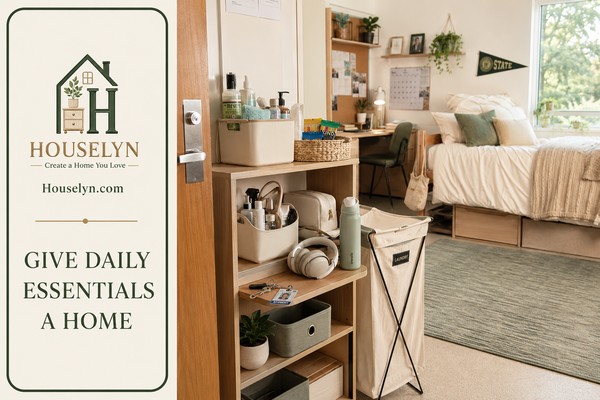
Build One Daily Departure Station
Think about your typical morning. Before leaving your dorm, you probably reach for your student ID, room key, wallet, headphones, phone charger, water bottle and perhaps a notebook or laptop. When each item is stored in a different place, leaving for class quickly becomes a frustrating search.
Now imagine returning from your last lecture of the day. Instead of dropping everything onto the nearest surface, you naturally place your keys, student card and headphones into one dedicated departure station near the door. Tomorrow morning begins with everything exactly where you expect it to be. The room feels calmer because your routine has become predictable.
This small habit illustrates one of the most powerful principles in home organization: when frequently used belongings always return to the same place, your brain stops wasting energy searching for them. That is exactly the kind of quiet efficiency we want every dorm room to support.
Create Simple Routines for the Items That Move Most
Unlike furniture, everyday essentials are constantly in motion. Your shower caddy travels to the communal bathroom, your laundry hamper moves to the laundry room, your reusable water bottle goes to lectures and your headphones seem to follow you everywhere. Because these items rarely stay in one place, they need systems that make leaving and returning just as simple as using them.
Rather than creating complicated storage for these categories, focus on building predictable routines. When you return from the shower, the caddy goes back to one shelf. After laundry, clean clothes are put away before the hamper returns to its corner. Snacks stay together in one contained area instead of spreading across your study desk. These small routines take only moments, yet they prevent clutter from quietly building throughout the week.
BEFORE & AFTER
Small Habits Create a Big Difference
Before: Toiletries are left on the desk after a rushed morning, snacks collect beside textbooks, headphones disappear into bedding and the laundry hamper sits wherever there is space. Every day begins with searching for something.
After: Toiletries return to one shelf after every shower, snacks stay in a dedicated basket, headphones always return to the departure station and the laundry hamper lives in one consistent location. The room feels calmer because every frequently used item follows the same routine.
Why it works: Everyday essentials no longer rely on memory. Consistent routines remove unnecessary decisions and reduce the chance of small items creating visual clutter.
Houselyn Insight: At Houselyn, we believe the easiest routines are the ones you repeat without thinking. When returning an item becomes part of the activity itself, organization stops feeling like a separate chore.
Group Daily Essentials by the Way You Use Them
Many people organise everyday items by category alone, but there is another approach that often works even better in small spaces: organise them by routine. Instead of thinking about toiletries, technology or snacks separately, think about the moments when you actually use them. Your morning routine, study routine, evening routine and departure routine each need only a few carefully chosen essentials close at hand.
For example, your departure station might include your student ID, room key, headphones, wallet and reusable water bottle because those items leave the room together. Likewise, your evening routine might naturally bring together your shower caddy, fresh towel and sleepwear. Organising around routines keeps related items together and reduces unnecessary trips around the room.
At Houselyn, we recommend asking one simple question whenever a small item feels out of place: "When do I normally use this?" The answer usually reveals exactly where it should live.
💚 Houselyn Tip
Before going to bed each evening, spend two minutes returning your toiletries, headphones, student ID and water bottle to their proper places. Tomorrow morning will begin with less stress because today's routine prepared the room in advance.
Key Takeaway
The smallest items often create the biggest frustrations. When toiletries, laundry, snacks and everyday essentials each follow a simple routine, your dorm becomes noticeably easier to maintain throughout the semester.
With your everyday essentials now organized into practical routines, the next chapter will show you how to maintain those systems through busy weeks, deadlines and exam season without letting clutter take over again.
Chapter 6
Maintain Dorm Room Organization During Busy College Weeks
Creating an organized dorm room is a great achievement, but maintaining it throughout an entire semester is the real challenge. The best dorm room organization ideas are not judged only by how your room looks on move-in day. They are judged by how well the system survives assignment deadlines, exam periods, social events and the unpredictable pace of college life.
Every student experiences weeks when routines begin to slip. Laundry waits a little longer than planned. Lecture notes accumulate on the desk. Clothes stay on the chair after a late-night study session. None of this means your organization system has failed. It simply means your room is responding to a busier season of life.
At Houselyn, we never expect organization systems to remain perfect. Instead, we design them to recover quickly. A room that becomes slightly untidy for a few days is completely normal. What matters is having simple routines that help you regain control before small amounts of clutter become overwhelming.
Think of organization as something you maintain rather than something you finish. Just as brushing your teeth or making your bed becomes part of everyday life, caring for your dorm works best when it relies on small, repeatable habits instead of occasional marathon cleaning sessions.
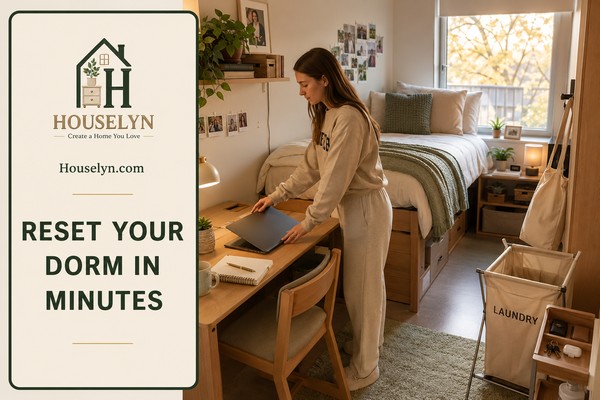
Small Daily Resets Prevent Big Weekend Cleanups
Many students believe organization requires setting aside an entire afternoon to clean their room. In reality, the opposite is usually true. Rooms that stay consistently organized are rarely maintained through long cleaning sessions. They stay manageable because small resets happen before clutter has time to build.
Imagine finishing an evening study session. Instead of leaving everything exactly where it is, you spend five minutes returning books to their shelf, placing your laptop charger back in its usual spot, putting clothing where it belongs and preparing tomorrow's essentials. Those few minutes may seem insignificant, but repeated over an entire semester they prevent dozens of larger cleanup sessions.
This is a practical example of habit psychology at work. Small actions repeated consistently require far less motivation than occasional bursts of effort. The room stays within easy reach of organized because it never drifts too far away from that state.
Recover Quickly Instead of Trying to Stay Perfect
Every organized dorm room eventually becomes untidy. Exams arrive, assignment deadlines pile up, social events fill the evenings and laundry gets postponed for another day. This isn't a sign that your organization system has failed—it's simply a reflection of real student life. The difference between a room that stays manageable and one that becomes overwhelming is not perfection. It's the ability to recover quickly.
Many students make the mistake of waiting until the room feels completely out of control before doing anything about it. By that point, the task feels so large that procrastination becomes even more likely. A much better approach is to notice small signs of clutter early and reset them before they spread into every corner of the room.
At Houselyn, we don't measure organization by whether a room is always tidy. We measure it by how quickly the room can return to order after everyday life interrupts your routine. The easier recovery becomes, the longer your organization system will survive throughout the semester.
BEFORE & AFTER
Recovery Is More Important Than Perfection
Before: After a demanding week, clean clothes remain inside the laundry basket, notebooks cover the desk, yesterday's coffee mug is still beside the laptop and everyday essentials are scattered across several surfaces. Looking around the room feels exhausting because every area appears to need attention at once.
After: Instead of attempting a complete room makeover, the student follows one simple reset sequence. Laundry returns to the wardrobe, the desk is cleared for tomorrow's classes, rubbish leaves the room, the bed is straightened and everyday essentials return to the departure station. In less than fifteen minutes, the room feels calm again.
Why it works: The reset focuses on restoring function rather than achieving perfection. By tackling the highest-impact areas first, the room immediately feels easier to use, even if every detail hasn't been completed yet.
Houselyn Insight: A successful organization system isn't the one that never becomes messy. It's the one that's easy to recover because every item already has a logical home waiting for it.
Follow the Houselyn Five-Minute Recovery Method
One of the principles we use throughout Houselyn is that small, repeatable systems always outperform occasional bursts of motivation. That's why we recommend using a simple recovery routine whenever your room begins feeling overwhelming. Rather than trying to organize everything, focus only on the tasks that restore the room's functionality.
Our Houselyn Five-Minute Recovery Method is designed specifically for busy students. The goal isn't creating a perfect room—it is rebuilding momentum.
The Houselyn Five-Minute Recovery Method
- Clear the study desk. Remove everything that isn't needed for your next study session.
- Reset the bed. Straighten the bedding to instantly reduce visual clutter.
- Collect all rubbish. Empty packaging, bottles and food wrappers leave the room immediately.
- Return everyday essentials. Put keys, headphones, chargers, toiletries and your student ID back into their regular homes.
- Contain the laundry. Dirty clothes go into the hamper, while clean clothing returns to the wardrobe instead of remaining in baskets.
Even if you stop after these five steps, your room will already feel dramatically calmer because you've restored the areas that support your daily routine.
💚 Houselyn Tip
If your room feels overwhelming, don't start with the hardest job. Start with the task that takes less than two minutes. Small wins create momentum, and momentum makes the rest of the reset feel much easier.
Key Takeaway
The strongest dorm room organization ideas are not built around perfection. They're built around recovery. When your systems are simple enough to reset in just a few minutes, your dorm stays functional, welcoming and ready for whatever college life brings next.
With a reliable maintenance routine in place, the final chapter brings everything together into one complete Houselyn framework, helping you create an organization system that can adapt as your college life changes from move-in day through graduation.
Chapter 7 • Master
The Houselyn Dorm Organization Blueprint™
Every chapter in this guide has focused on one important part of creating an organized college dorm. You have learned how to understand your habits, divide your room into functional zones, manage clothing, protect your study space, organize everyday essentials and maintain everything through busy college weeks. Individually, each idea is valuable. Together, they become something much more powerful: a complete organization system designed for real student life.
The most effective dorm room organization ideas are never isolated tricks or one-time projects. They work because every part of the room supports the next. Your clothing system makes mornings easier. Your study area helps you stay productive. Your departure station reduces stressful mornings. Your daily reset keeps clutter from spreading. Instead of solving individual problems, your room begins working as one connected system.
At Houselyn, we have discovered that lasting organization is not created by buying more storage or following strict rules. It comes from building simple systems that support the way people actually live. That is why we have brought everything together into one practical framework that you can use not only in your dorm room, but in every home you live in afterwards.
We call it the Houselyn Dorm Organization Blueprint™. It is not another checklist to memorize. It is a simple way of thinking that helps every organization decision become easier, whether you are moving into your first college dorm, upgrading to an apartment or creating a home of your own after graduation.
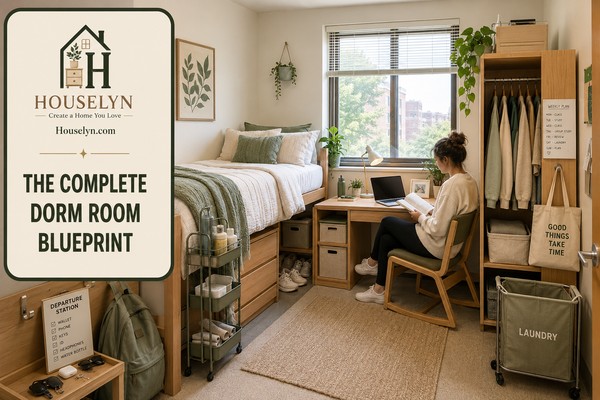
One System Instead of Hundreds of Small Decisions
Think about how many small decisions you make every day. Where should your backpack go after class? Where do you leave your headphones? Should today's hoodie go back into the wardrobe or onto the chair? Where do tomorrow's notes belong? None of these choices seems important on its own, yet together they quietly shape how your room feels to live in.
Without a clear system, every one of those moments requires another decision. Over time, those small choices become exhausting, especially during demanding weeks at college. That is why well-organized rooms often feel calmer than cluttered ones. It is not simply because there are fewer belongings. It is because there are fewer decisions to make.
The Houselyn Dorm Organization Blueprint removes much of that uncertainty. Instead of wondering where something belongs, the system has already answered the question. Every belonging has a purpose, every activity has a place and every routine supports the next. Your room begins guiding your habits instead of relying on constant motivation.
That is the real goal of organization. It is not creating a room that looks perfect for a photograph. It is creating one that quietly makes everyday life simpler, calmer and easier to enjoy.
The Five Stages of the Houselyn Dorm Organization Blueprint™
The Houselyn Dorm Organization Blueprint™ is built around five simple stages. They are not individual projects to complete once—they are habits that work together throughout your college journey. Every organized dorm room naturally moves through these stages again and again as your classes, routines and responsibilities change.
1. Reduce
Every successful organization system begins by reducing unnecessary volume. Dorm rooms are designed for student living, not unlimited storage. Keeping only what genuinely supports your college life creates space that no organizer can manufacture.
Houselyn Insight: Organization becomes dramatically easier when you stop asking, "Where can I fit this?" and start asking, "Do I really need this here?"
2. Zone
Once you've reduced what you own, divide the room according to activities rather than furniture. Sleeping, studying, dressing and everyday routines each deserve their own purpose. When every activity has a home, clutter has fewer opportunities to spread.
Houselyn Insight: Great organization isn't about filling every corner. It's about helping every part of the room perform one clear job exceptionally well.
3. Return
Every belonging should have a permanent home waiting for it. The real power of organization appears after an item has been used. Returning it immediately prevents small amounts of clutter from multiplying throughout the day.
Houselyn Insight: Every time something returns home, your future self saves time searching for it.
4. Reset
Life becomes busy, and every dorm room will drift away from perfect organization. Instead of waiting for complete chaos, use quick daily resets and short weekly recovery sessions to restore the room before clutter becomes overwhelming.
Houselyn Insight: Small resets protect great systems. Recovery—not perfection—is what keeps a room organized for months.
5. Refine
Your dorm room should evolve as your college life changes. New classes, different schedules, seasonal clothing and changing priorities all require small adjustments. The best systems are flexible enough to grow with you rather than locking you into one way of living.
Houselyn Insight: Organization is never finished. The best systems improve a little every semester.
THE COMPLETE TRANSFORMATION
From Surviving Your Dorm to Enjoying It
Before: Every semester begins with good intentions but gradually becomes harder to manage. Clothes collect on chairs, the desk disappears beneath paperwork, mornings become rushed and weekends are spent catching up on cleaning instead of enjoying college life.
After: The Houselyn Dorm Organization Blueprint™ quietly guides every decision. You own only what you need, every activity has a defined zone, belongings naturally return home, quick resets prevent overwhelm and the system evolves as your routine changes. Instead of constantly managing clutter, you spend more time studying, relaxing and enjoying your space.
Why it works: The framework supports real behaviour instead of demanding perfection. It reduces decisions, builds repeatable habits and creates an environment that works with you every day.
The Houselyn Promise
At Houselyn, we don't believe beautiful, organized homes belong only to people with large houses, unlimited budgets or perfectly predictable lives.
We believe thoughtful systems can transform any space—even a single college dorm room—into a calmer, more functional place to study, rest, grow and feel at home.
Our goal has never been to help you build a perfect room. Our goal is to help you build a room that quietly supports your life every single day.
Your Next Step
Don't try to organize your entire dorm today. Choose one area—your desk, wardrobe, departure station or bed—and apply the Houselyn Dorm Organization Blueprint™. Small improvements create momentum, and momentum creates lasting change. One system, repeated consistently, will always outperform one perfect weekend of organizing.
CONTINUE LEARNING WITH HOUSELYN
Explore More Guides to Support Your Organized College Space
These related Houselyn guides build naturally on the dorm room organization ideas in this article. Each guide focuses on a different part of creating a college room that feels comfortable, functional and easier to maintain throughout the academic year.
Use these resources to deepen the dorm room organization ideas that matter most to your daily routine, whether you are improving your bedding, planning the entire room or strengthening your wider home-organization habits.
PARENT PILLAR GUIDE
Dorm Room Ideas
Plan a complete college room with practical guidance for bedding, layouts, decorating, studying, storage and everyday comfort.
COMFORT & SLEEP
Dorm Bedding Ideas
Create a comfortable Twin XL bed with layered bedding, supportive sleep upgrades and practical styling for student life.
WHOLE-HOME SYSTEMS
Home Organization Ideas
Learn the wider organization principles that help every room stay calmer, more functional and easier to reset.
SMALL-SPACE LIVING
Small Space Decorating Ideas
Discover how thoughtful layouts, visual balance and multifunctional choices help compact rooms feel larger and more inviting.
BEDROOM ROUTINES
Bedroom Organization Ideas
Build practical systems for clothing, bedside essentials, surfaces and routines that keep a bedroom easier to maintain.
Build Your Organization Knowledge One System at a Time
The strongest dorm room organization ideas become easier to maintain when they connect with wider principles for small-space living, bedroom routines and whole-home organization.
You do not need to apply every guide at once. Choose the resource that supports your most pressing challenge and use its lessons to strengthen the dorm room organization ideas you have already begun building.
Over time, these connected dorm room organization ideas will help you develop practical habits that continue serving you in future bedrooms, apartments and homes.
HOUSELYN KNOWLEDGE LIBRARY
Continue Building Your Home Organization Knowledge
Learning great dorm room organization ideas is only the beginning of creating a home that feels calm, practical and enjoyable to live in. At Houselyn, every guide is designed to build upon the last, helping you develop long-term organization skills that extend far beyond your college years.
Whether you're improving your dorm room today or preparing to organize your first apartment after graduation, these carefully selected resources will strengthen the dorm room organization ideas you've learned throughout this guide and help you create systems that continue working wherever life takes you.
🏡 Build Strong Organization Foundations
- Dorm Room Ideas — Build the complete foundation for planning, decorating and organizing your entire college room.
- Dorm Bedding Ideas — Create a comfortable, supportive and stylish sleep space for college life.
- College Dorm Decor Ideas — Learn how to decorate a dorm that feels personal without sacrificing function.
📚 Expand Your Organization Skills
- Home Organization Ideas — Discover practical organization systems that work throughout the home.
- Bedroom Organization Ideas — Apply the same organization principles to larger bedrooms and guest rooms.
- Small Space Decorating Ideas — Make compact living spaces feel bigger, brighter and easier to enjoy.
🎓 Continue Your College Living Journey
As Houselyn continues expanding our college living collection, you'll discover more advanced dorm room organization ideas covering closet systems, desk organization, storage planning, lighting, wall décor and every other part of creating a comfortable student home.
Every new guide follows the same practical philosophy you've learned throughout this article: understand your habits, build simple systems, maintain them with realistic routines and continuously refine them as your lifestyle evolves. These connected dorm room organization ideas work together to create one complete organization framework rather than isolated tips.
Our Editorial Commitment
Every Houselyn article is written to help you build practical systems that improve everyday life—not simply create beautiful photographs. We believe the best homes support the people living in them, and every guide we publish reflects that philosophy.
As you continue exploring Houselyn, you'll notice that our dorm room organization ideas, decorating advice and home organization frameworks all connect together into one consistent approach that grows with you from your first dorm room to your future home.
FREQUENTLY ASKED QUESTIONS
Frequently Asked Questions About Dorm Room Organization Ideas
These answers address some of the most common questions students ask when searching for dorm room organization ideas. They combine practical experience with the Houselyn organization philosophy to help you create systems that are realistic, easy to maintain and adaptable throughout college.
1. Where should I start when organizing my dorm room?
Start by observing how you naturally use your room before buying any organizers. The best dorm room organization ideas begin with understanding your daily routine, identifying clutter hotspots and reducing unnecessary belongings. Once you know how you move through the room, it becomes much easier to create practical systems that last.
2. How do I keep my dorm room organized all semester?
Consistency matters more than perfection. Spend a few minutes each evening returning everyday items to their proper homes and complete a short weekly reset before clutter builds. Small habits are far easier to maintain than occasional deep-cleaning sessions.
3. What are the biggest dorm organization mistakes students make?
Many students buy storage products before creating a system, bring more belongings than they actually need or organize for an ideal routine instead of their real lifestyle. Successful dorm room organization ideas always begin with behaviour first and storage second.
4. How can I organize a very small dorm room?
Focus on creating clear activity zones rather than trying to fill every empty space with storage. Keep only frequently used items within easy reach, reduce duplicate belongings and maintain clear pathways throughout the room to make the space feel larger and more functional.
5. How often should I reorganize my dorm room?
You should make small adjustments whenever your schedule changes significantly, such as after exams, at the start of a new semester or when the weather changes. The best organization systems evolve with your routine rather than remaining fixed.
6. Are expensive organizers necessary for a tidy dorm room?
No. Well-planned dorm room organization ideas rely much more on simple routines than expensive products. A few carefully chosen organizers can support your system, but they cannot replace clear habits and logical organization.
7. How do I organize a shared dorm room with a roommate?
Agree on shared expectations early. Decide which areas are communal, which belongings remain personal and how both people will manage cleaning, rubbish and shared supplies. Clear communication usually prevents more clutter than additional storage products.
8. What should I do if my dorm room becomes messy during exams?
Avoid attempting a complete reorganization. Instead, follow a short recovery routine by clearing your desk, containing laundry, removing rubbish and returning everyday essentials to their proper places. Functional spaces are more important than perfect spaces during busy periods.
9. Why do some organization systems stop working after a few weeks?
Most systems fail because they require too much effort to maintain. If putting something away is inconvenient, the habit usually disappears. Great dorm room organization ideas reduce effort by placing frequently used items exactly where they are naturally needed.
10. What is the Houselyn Dorm Organization Blueprint™?
The Houselyn Dorm Organization Blueprint™ is our five-stage framework for creating sustainable dorm room organization ideas. It follows five simple principles: Reduce, Zone, Return, Reset and Refine. Together, these stages help you build an organization system that grows with your college life instead of relying on constant motivation or perfection.
Have A Great Story About This Topic?
Do you have a great story about this? Share it!
You might like these
Living Room Decor Ideas: How to Create a Stylish & Comfortable Space
Learn how to decorate a stylish and comfortable living room with practical design advice, timeless styling ideas, and expert inspiration from Houselyn.
Dorm Room Lighting Ideas for a Cozy College Space | Houselyn
Discover dorm room lighting ideas for studying, relaxing and sleeping, with layered lamps, cozy LEDs, safer cord planning and small-space tips.