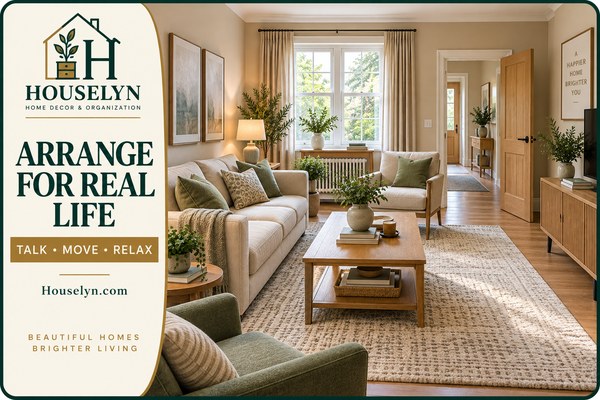
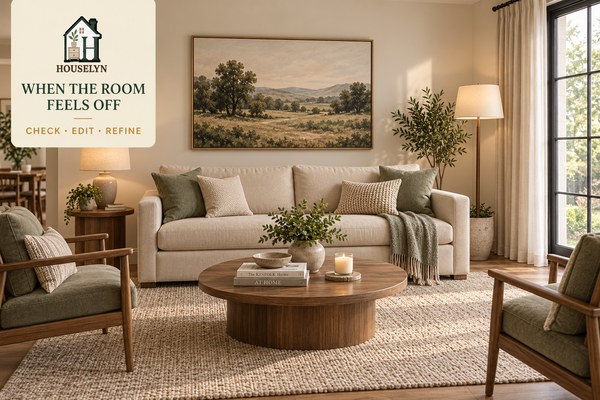
Living Room Decor: A Complete Guide to Layout, Colour, Furniture & Style
A successful living room starts with layout, scale and furniture relationships before decorative layers are added.
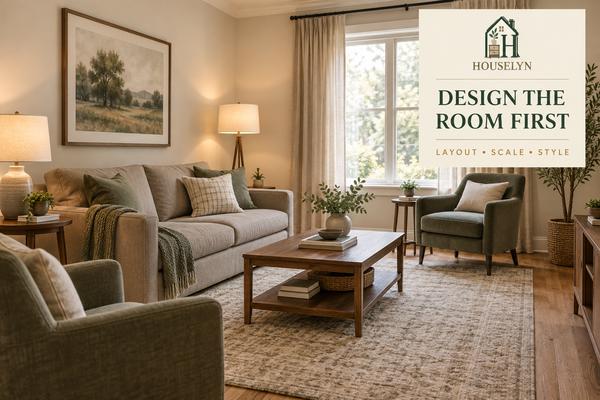
Living room decor works best when the room is planned before it is styled.
Start with function, furniture scale, circulation and visual hierarchy, then build the rug,
curtains, lighting, textiles, wall art and accessories around those decisions.
Living room decor is often approached as a shopping exercise: choose a sofa,
add a rug, buy cushions, hang artwork and fill the coffee table. But a room can contain
attractive individual pieces and still feel awkward, undersized, overcrowded or visually
unfinished when those pieces do not relate properly to one another.
The more reliable way to plan living room decor is to treat the room as a
connected system. The sofa affects the rug. The rug affects the apparent seating zone.
The coffee table must relate to the sofa. Curtains change how tall and wide the windows
appear. Lighting influences depth, mood and how colours are perceived. Wall art must relate
to the furniture beneath it rather than simply filling an empty wall.
This is why good living room decor begins before accessories are selected.
The first questions are practical: What does the room need to do? Where do people enter?
Which walls are usable? Where are the windows, radiators and focal points? How large should
the main furniture be? Which areas must remain open so the room is comfortable to move through?
Once those questions are answered, decorating becomes much easier. Instead of buying isolated
pieces and hoping they work together, you can make each new decision support the room that is
already taking shape.
Why Living Room Decor Often Feels Wrong Even When the Furniture Is Attractive
Many living room decor problems are not caused by poor taste. They are caused
by relationships. A sofa may be perfectly attractive but too large for the wall. A beautiful
rug may be too small to connect the seating group. Curtains may be well made but mounted too
low, visually shortening the room. A coffee table may be stylish but too small to relate to
the sofa around it.
The same principle applies to colour and accessories. A room may contain several appealing
colours but still feel disconnected when none of them repeats enough to create visual rhythm.
It may contain expensive accessories yet feel cluttered because every surface has been styled
and nowhere has been left quiet.
That distinction is central to this guide. Rather than presenting
living room decor as an endless list of trends, the Houselyn approach
focuses on the decisions that remain useful even when styles change: proportion, hierarchy,
circulation, layering and editing.
You can apply those principles to modern, traditional, minimalist, cosy, neutral, colourful
or eclectic interiors. The decorative language may change, but the underlying room still
needs furniture that fits, pathways that remain open, lighting that works and objects that
have enough visual space around them.
Throughout the guide, this framework turns living room decor into a sequence
of decisions rather than a collection of purchases. Each chapter solves one layer of the room,
beginning with the floor plan and finishing with the details that make the space feel intentional.
The goal is not a perfectly staged room. Successful living room decor should
still support sitting, talking, watching television, reading, entertaining, family life and the
ordinary objects that come with daily use. A beautiful room that is difficult to walk through,
sit comfortably in or reset after use is not fully resolved.
Framework Stage 1 — Plan
Chapter 1: Living Room Decor Starts With How the Room Needs to Work
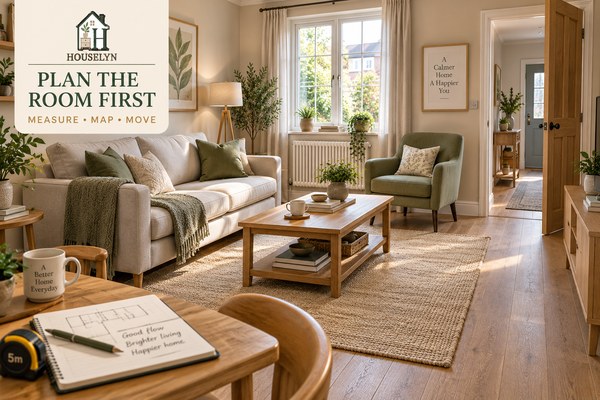
Measure the fixed room first. Doors, windows, radiators, focal points and walking routes determine which decorating choices are genuinely available.
The most reliable living room decor decisions begin with the
room you actually have, not the room shown in an inspiration photograph. Before
choosing a sofa, rug, curtains or wall treatment, record the dimensions and fixed
features that will determine what can fit comfortably.
This first stage is intentionally broader than a complete furniture-layout guide.
The goal is to establish the boundaries of the room: where people enter, which
walls are usable, where natural light comes from and which architectural features
cannot simply be moved because a particular arrangement looks attractive online.
Define What the Living Room Has to Do
Start by identifying the room's primary jobs. Some living rooms are built mainly
around conversation. Others need to support television, reading, children's play,
entertaining or occasional work. In smaller homes, several of those functions may
need to coexist.
Good living room decor becomes easier when those functions are
ranked rather than treated as equally important. If television viewing is a major
daily activity, seating orientation matters. If conversation is more important,
the room needs seating that relates to people rather than only to a screen.
The pillar should establish this principle without prescribing every sofa-and-chair
arrangement. Detailed furniture configurations belong in the dedicated
Living Room Layout Basics guide, where layout becomes the primary search
intent rather than one part of a broader decorating system.
Measure the Room Before Measuring the Furniture
Record the overall length and width first, then measure usable wall sections between
doors, windows, radiators and architectural interruptions. A wall may look long in
a photograph but offer far less practical furniture space once the door swing and
heating position are accounted for.
Ceiling height matters too. It influences the apparent scale of furniture, curtains,
lighting and wall art. At this stage, however, the purpose is simply to understand
the vertical proportions of the room. Exact curtain-placement rules are reserved
for the later Curtain Height and Width Rules guide.
Map Doors, Windows and Fixed Architecture
Doors need operating space. Windows need access and daylight. Radiators and other
heat sources require appropriate clearance. Fireplaces can create a natural focal
point, while television connections and sockets may influence where equipment can
realistically sit.
These features should be treated as part of the living room decor
plan rather than obstacles to hide. A room often feels more settled when the design
acknowledges its architecture instead of forcing furniture into positions that
compete with it.
Identify the Main Circulation Route
Watch how people naturally cross the room. The most important route may run from
the hallway to the kitchen, from the entrance to a patio door or between seating
and another part of an open-plan space.
That route should remain understandable after the furniture arrives. Strong
living room decor does not force people to weave through narrow
gaps simply because every visible patch of floor has been treated as an opportunity
for another table, chair or basket.
Notice the Natural Focal Points Without Choosing One Too Early
Look for features that naturally attract attention: a fireplace, a large window,
a view, built-in shelving or the wall where a television already sits. At this
stage, simply record them.
The next chapter will decide which feature should become the room's functional
and visual anchor. Keeping that decision separate prevents the planning stage
from drifting into the specialist topic of focal-point arrangement too early.
Account for the Room in Use, Not Only When It Is Staged
A photographed room is usually shown at rest. Real rooms operate differently.
People pull chairs slightly forward, open drawers, place drinks on tables, move
through doorways and use lamps, blinds or curtains throughout the day.
When assessing living room decor, imagine those actions before
deciding that an empty corner needs filling. A side table may physically fit but
make chair access awkward. A console may fit against a wall but narrow the main
path once people begin moving through the room.
Consider Storage Pressure Without Turning the Living Room Into a Storage Project
Books, media, toys, blankets, games and everyday electronics may genuinely need
homes in the living room. Record those categories during planning so they are not
forgotten until the styling stage.
However, this pillar should not become a full storage guide. The question here is
simply whether storage needs affect the furniture plan. Detailed apartment-wide
storage systems belong in the dedicated Houselyn storage content.
Protect Natural Light Before Adding Tall Furniture
Tall cabinets, shelving and plants can change how daylight travels through the room.
Before placing them near windows, consider whether they block useful light, make the
window harder to operate or visually crowd one side of the room.
Effective living room decor treats daylight as part of the room's
design infrastructure. Decorative layers should work with it rather than forcing
the lighting plan to compensate for avoidable obstruction.
With the room mapped, the next step is Anchor: deciding which
seating element and visual feature should give the room its centre of gravity
before scale and arrangement are refined.
Framework Stage 2 — Anchor
Chapter 2: Living Room Decor Needs a Clear Visual and Functional Anchor
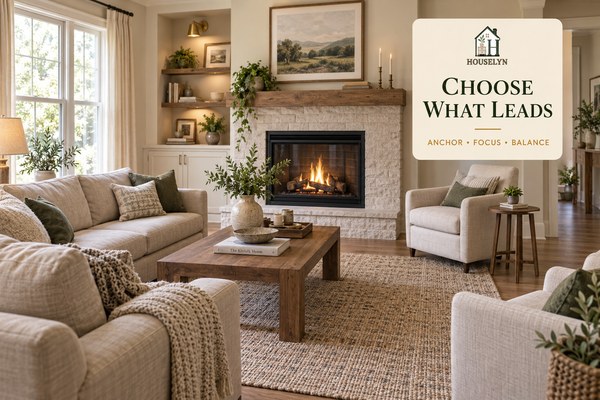
A clear anchor gives the eye somewhere to settle and gives supporting furniture a reason for being where it is.
Once the room has been mapped, the next living room decor
decision is to establish what should visually and functionally anchor the space.
Without a clear anchor, attractive furniture can still feel scattered because
the eye has no obvious centre and the supporting pieces have no shared relationship.
An anchor does not have to be the most expensive object in the room. It is the
feature that gives the rest of the composition direction. In one room that may
be a sofa facing a fireplace. In another, it may be a seating group oriented
toward a large window or a television wall that genuinely reflects how the room
is used.
Separate the Functional Anchor From the Visual Focal Point
These two ideas often overlap, but they are not always identical. The sofa may
be the functional anchor because most activity happens around it, while a
fireplace, artwork or view becomes the strongest visual focal point.
Strong living room decor allows those elements to cooperate.
Problems begin when every feature competes for equal attention: a large
television on one wall, dramatic artwork on another, a fireplace elsewhere
and furniture positioned as though none of them matters more than the others.
Choose the Main Seating Anchor Before the Supporting Pieces
The main sofa or sectional usually carries the greatest visual weight among the
movable furniture. Decide its broad role before adding chairs, tables, stools
and storage pieces around it.
This chapter intentionally stops at anchor selection. Exact sofa positioning,
chair angles and circulation distances belong in the dedicated
Living Room Layout Basics guide. The pillar establishes hierarchy;
the specialist layout page will solve configurations in detail.
Do Not Let the Television Automatically Control the Entire Room
If television is a major daily activity, it deserves to be considered honestly.
But that does not automatically mean every chair and decorative object should
point toward the screen.
Better living room decor asks whether the television is the
room's true primary function or simply one part of it. In a family room, TV
viewing may dominate. In a conversation-led sitting room, the screen may be
intentionally quieter within the composition.
Use Architecture When the Room Already Gives You an Anchor
A fireplace, built-in shelving, bay window, large picture window or architectural
opening may already provide visual importance. Rather than creating a second
competing centre, consider whether the furniture can acknowledge that existing
feature.
This does not mean every sofa must face a fireplace directly or every room must
be symmetrical. It means the architecture should be recognised instead of
visually contradicted without a clear reason.
Ask What the Eye Notices First
Stand at the room's normal entrance and look without analysing individual
accessories. What attracts attention first? Is that where you want attention
to go?
Successful living room decor usually gives the eye a clear
first read and then allows supporting details to be discovered gradually. If
several equally bold objects demand attention at once, the room can feel busy
even when it contains relatively little furniture.
Use the Anchor to Reduce Random Buying
An anchor gives later purchases a reference point. Instead of asking whether a
chair is attractive in isolation, ask whether its visual weight supports the
sofa and the room's focal point. Instead of choosing artwork solely because
you like it, ask whether it strengthens or competes with the existing hierarchy.
This makes living room decor more selective. Fewer pieces need
to work harder, and the room is less likely to become a collection of individually
appealing objects that never quite feel connected.
Once the room has a clear anchor, the next decision is Scale:
making sure the sofa, rug, coffee table, chairs, lamps and other pieces feel
proportionate to both the room and one another.
Framework Stage 3 — Scale
Chapter 3: Living Room Decor Depends on Getting Furniture Scale Right
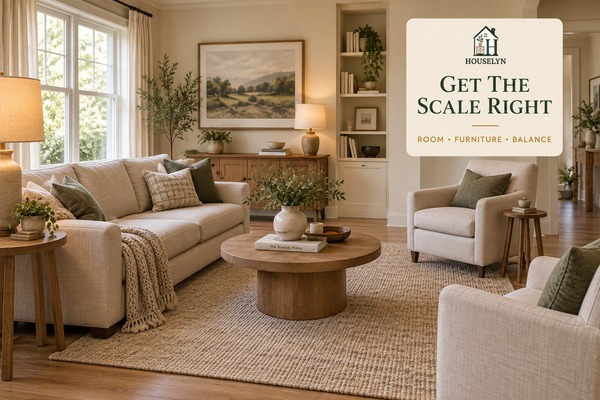
Furniture feels intentional when the largest pieces, supporting furniture and decorative elements share a believable visual scale.
Scale is one of the easiest living room decor problems to
underestimate because individual pieces can look perfectly attractive on their
own. The problem becomes visible only when the sofa, rug, tables, chairs, lamps
and wall elements are seen together.
A large sofa beside a tiny side table can feel top-heavy. A generous seating
group placed around a very small rug can appear disconnected. Oversized furniture
can make circulation feel compressed, while a collection of undersized pieces can
make a normal room feel temporary or unfinished.
Judge Scale as a Relationship, Not a Standalone Measurement
Good living room decor does not begin with a rule that every
sofa, rug or coffee table must have one universally correct dimension. Scale
depends on the room, the main furniture and the relationships between the pieces.
This is why a coffee table that works beside a compact two-seat sofa may look
visually weak beside a long sectional. Likewise, a floor lamp that feels
substantial in a small room may disappear visually beside tall ceilings and
heavier furniture.
Let the Main Furniture Establish the First Scale Reference
Once the anchor has been chosen, use it as a reference for the supporting
furniture. The sofa or principal seating element usually carries enough visual
weight to influence the scale of the rug, coffee table, side tables, lamps and
nearby artwork.
This does not mean everything should be large because the sofa is large. It means
the supporting pieces should look intentional beside it. A lighter accent chair
can balance a substantial sofa because visual weight also depends on form, colour,
height and openness.
Watch for the Undersized-Piece Effect
A common living room decor mistake is using several small
elements in an attempt to make the room feel larger. A small rug, tiny coffee
table, narrow artwork and miniature accessories may preserve floor area, but
collectively they can make the furniture look isolated.
A better approach is often to use fewer pieces at a scale that visually belongs
with the room. This can make the space feel calmer because the eye reads stronger
shapes instead of many disconnected objects.
Do Not Oversize Furniture Simply to Make the Room Feel Luxurious
The opposite problem is equally important. Deep sofas, oversized armchairs,
substantial coffee tables and large storage furniture can look luxurious in
spacious interiors but overwhelm a room that does not have enough operating
clearance around them.
Strong living room decor protects function while considering
visual weight. If a piece makes the doorway feel narrow, leaves chairs difficult
to enter or forces awkward movement around the room, its physical scale is
working against the design.
Use Rug Scale to Connect the Seating Zone
The rug is visually important because it helps the eye understand which furniture
belongs together. When it is too small relative to the seating group, the sofa and
chairs can appear to float around it rather than forming one composition.
At pillar level, the key living room decor principle is simple:
choose a rug that visually relates to the seating arrangement rather than treating
it as a small decorative island beneath the coffee table.
Exact rug dimensions, sofa-to-rug combinations, front-leg placement and room-size
scenarios are deliberately reserved for the dedicated
Sofa and Rug Size Match guide so this pillar does not compete with that
specialist search intent.
Match the Coffee Table to the Visual Weight of the Seating
A coffee table should feel large enough to relate to the main seating without
becoming a barrier. Shape, visual weight and leg design also matter: an open-frame
table can feel lighter than a solid storage table with similar outer dimensions.
This chapter addresses scale only. Detailed spacing and placement belong to the
future Living Room Layout Basics page, while decorative arrangements on
the tabletop belong to the dedicated Coffee Table Styling Guide.
Consider Side-Table and Lamp Scale Together
Side tables and lamps are often purchased separately, yet visually they operate
as a pair. A very small table beneath a substantial lamp can feel unstable, while
a tiny lamp may disappear beside a deep sofa or tall chair.
Good living room decor looks for a believable relationship in
height, mass and usefulness. A side table should support the person seated beside
it, and the lamp should provide useful light without visually overpowering the
furniture around it.
Scale Wall Decor to the Furniture Relationship
Artwork can feel wrong even when the artwork itself is attractive. A very small
piece floating above a broad sofa may lack enough visual weight to connect with
the furniture below.
Here, the pillar introduces the principle only: wall decor should relate to the
furniture and wall it occupies. Detailed blank-wall planning, gallery arrangements
and artwork decisions remain reserved for the future Blank Wall Decor
specialist guide.
Once the major pieces have the right visual weight, the next framework stage is
Arrange: positioning those pieces so conversation, movement,
access and everyday use work together.
Framework Stage 4 — Arrange
Chapter 4: Living Room Decor Works Better When Furniture Supports Conversation and Movement
A successful arrangement should look balanced when still and remain comfortable when people actually walk, sit and use the room.
Once the furniture has an appropriate scale, living room decor
depends on arranging those pieces so the room works in motion. A sofa can fit
the wall, a rug can suit the seating group and a coffee table can look
proportionate, yet the room may still feel awkward if people cannot move,
converse or reach useful surfaces naturally.
Arrangement is where the earlier decisions about planning, anchoring and scale
begin to operate together. Instead of asking only where a piece will physically
fit, ask what happens around it once the room is being used.
Start With the Main Seating Relationship
The sofa or primary seating anchor should establish the broad seating zone.
Supporting chairs can then reinforce that zone rather than occupying unrelated
corners simply because floor space is available.
Strong living room decor makes it visually clear which seats
belong together. This does not require rigid symmetry or a formal conversation
circle, but the furniture should feel connected enough that people can interact
without the room reading as several separate waiting areas.
Do Not Push Every Piece Against a Wall Automatically
Wall placement can be practical in some rooms, especially where space is tight.
But treating every wall as a furniture parking position may stretch the seating
arrangement apart and leave a large, inactive void in the middle.
A modest shift forward can sometimes create a stronger relationship between
sofa, chairs and coffee table while still preserving circulation behind or around
the seating group. Whether that works depends on the room itself, which is why
detailed configurations are reserved for the specialist layout guide.
Protect the Route Into and Through the Room
The main path identified in Chapter 1 should remain easy to read. People should
not have to sidestep a coffee table, squeeze behind a chair or walk directly
through the centre of a conversation group every time they cross the room.
Better living room decor treats circulation as part of the
arrangement rather than leftover floor space. The route does not need to look
like an empty corridor, but movement should feel natural and predictable.
Keep Useful Surfaces Connected to Seating
Side tables and coffee tables work best when they support the seating rather
than merely filling gaps. A table may be attractive but still be ineffective if
it sits too far away to place a drink, book or remote comfortably.
The pillar should not prescribe exact distances here. Detailed sofa-to-table
clearances, chair relationships and room-specific arrangements belong in
Living Room Layout Basics. The broader principle is that usable surfaces
should relate to the people expected to use them.
Keep Conversation and Television in Proportion
Many rooms need to support both conversation and television. The two functions
do not have to compete if the seating arrangement acknowledges both honestly.
Good living room decor avoids making every seat behave as though
television is the only activity unless that accurately reflects the household.
Equally, a room used for television every evening should not ignore comfortable
viewing simply to imitate a formal design photograph.
Use Open-Plan Furniture to Define Rather Than Block
In an open-plan home, the back of a sofa or the edge of a rug may help define the
living zone without adding a wall. That can create useful visual boundaries
between living, dining and kitchen functions.
The boundary should not become a barrier. Avoid placing furniture so tightly
across an open-plan room that movement between zones becomes awkward or the
living area feels fenced off.
Allow Furniture to Have Breathing Room
Not every gap needs to be filled. A little open floor around a chair, table or
sofa can make the piece easier to use and easier to read visually.
This is particularly important in living room decor when the
room already contains visually heavy furniture. Adding small filler pieces to
every remaining gap can make the composition feel busier without improving
function.
Test the Arrangement Before Styling Around It
Live with the broad furniture arrangement before adding floor baskets, extra
stools, decorative ladders, plants or additional side tables. Those smaller
elements can alter circulation more than they appear to in an empty corner.
A short trial period also reveals where people naturally place drinks, where
reading light is needed and whether one chair is rarely used because it is
difficult to access.
Once the furniture arrangement works, the next framework stage is
Layer: using rugs, curtains, lighting, textiles and colour to
connect the room visually without undoing the function established so far.
Framework Stage 5 — Layer
Chapter 5: Living Room Decor Comes Together Through Rugs, Curtains, Lighting and Texture
Layer from the largest visual surfaces inward so the rug, windows, lighting, textiles and accents feel connected rather than collected at random.
Once the main furniture is planned, scaled and arranged, living room decor
can move into the layers that make the room feel warmer and more complete.
Rugs, curtains, lighting, cushions, throws and colour all influence how the
furniture is visually connected.
The important distinction is that layering is not the same as adding more.
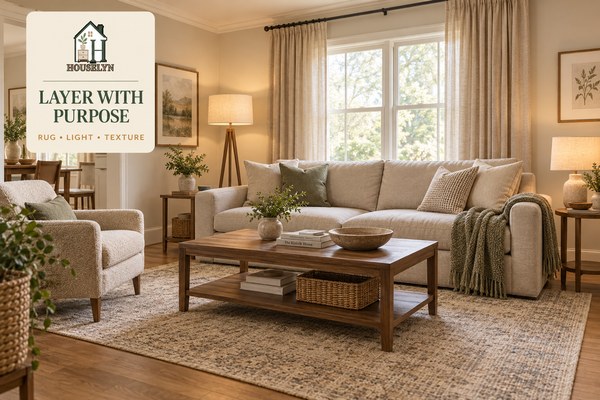
Each layer should solve a specific visual or functional need. A rug can connect
the seating group, curtains can frame the window, lighting can build depth and
textiles can soften harder furniture surfaces.
Start With the Floor Because It Connects the Furniture
The rug usually covers one of the largest decorative surfaces in the seating
area, so its relationship with the furniture strongly affects how the room reads.
A rug that visually connects the seating can help separate the living zone from
surrounding floor without adding another physical divider.
At pillar level, the living room decor principle is to treat
the rug as part of the furniture composition rather than as an isolated decorative
object under the coffee table.
This page intentionally does not provide detailed rug-size charts, sofa-to-rug
formulas or room-specific dimensions. Those belong in the dedicated
Sofa and Rug Size Match guide, where sizing becomes the primary search intent.
Use Curtains to Support the Window, Not Shrink It
Curtains influence the apparent height and width of the window wall. When the
treatment feels visually cramped around the frame, even generous windows can
appear smaller and heavier.
Better living room decor treats curtains as an architectural
layer as well as a textile one. They should relate to the wall, ceiling, window
and furniture around them while still functioning properly for privacy and light control.
Exact rod position, curtain fullness, finished width and length rules are
deliberately reserved for the future Curtain Height and Width Rules
guide. Here, the key decision is simply to avoid choosing curtains independently
from the proportions of the window wall.
Build Lighting in More Than One Layer
A single ceiling light can make a room technically bright without creating much
depth. Living rooms usually benefit from different sources serving different
needs: general illumination, reading or task light, and softer light that contributes
atmosphere in the evening.
Strong living room decor uses lighting to support the arrangement.
A floor lamp beside a reading chair, a table lamp near the sofa or a subtle accent
light can make parts of the room useful after dark instead of relying on one
intense central fitting.
Introduce Texture Before Adding More Objects
A room can feel visually flat even when its colour palette is attractive.
Texture creates contrast through material rather than through additional clutter.
Wool, linen, boucle, timber, woven fibres, soft upholstery and subtle metal finishes
can make a restrained palette feel more layered.
This is often more effective than filling every table and shelf with decorative
objects. A textured throw across a simple sofa may contribute more warmth than
several unrelated accessories.
Use Colour as a Repeating Thread
Colour does not need to appear in equal amounts across the room. A stronger
approach is to establish a dominant background, a supporting family of tones
and a smaller accent that repeats deliberately.
Successful living room decor often feels cohesive because the
same colour family appears in more than one location: perhaps a muted green in
a cushion, artwork and plant; or a warm caramel tone repeated through timber,
textiles and small decorative details.
The purpose is rhythm rather than perfect matching. If every textile and object
uses exactly the same tone, the room can feel overly coordinated. If no colour
repeats at all, it may feel disconnected.
Choose Cushions and Throws After the Sofa and Rug
Soft furnishings are easier to select once the largest colour and material
decisions are visible. Instead of building the entire room around a set of
cushions, use them to bridge tones already present in the sofa, rug, curtains
or artwork.
Good living room decor also leaves enough seating space for
people to sit comfortably. A sofa covered end to end with decorative cushions
may photograph well but creates another task every time the furniture is used.
Keep the Palette Connected to the Room's Fixed Finishes
Floors, fireplaces, built-ins and large architectural finishes already contribute
colour and texture. Treat them as part of the palette instead of designing as
though the room begins with the sofa.
Warm timber flooring, for example, may naturally support cream, taupe, muted
greens and warmer metals. A cooler stone fireplace may suggest a different
balance. The objective is not to follow a rigid colour formula but to avoid
introducing finishes that appear unrelated to the room around them.
Allow Some Surfaces to Stay Quiet
Layering needs contrast between visually active and visually quiet areas.
If the rug is patterned, curtains are bold, cushions use multiple prints and
every wall carries artwork, the room may lose hierarchy.
A restrained wall, plain curtain or simple upholstery can give stronger
decorative elements room to register. Negative visual space is part of
living room decor, just as open floor was part of the layout.
Once the main decorative layers are established, the next framework stage is
Style: arranging coffee tables, consoles, shelves, plants and
accessories so the room gains personality without losing useful surface space.
Framework Stage 6 — Style
Chapter 6: Living Room Decor Should Add Personality Without Creating Clutter
Styling works best when accessories add character while enough empty surface remains for the room to function comfortably.
Styling is the stage where living room decor becomes more
personal. Books, objects, plants, trays, ceramics, photographs and collected
pieces can make a room feel lived-in and distinctive, but they work best after
the larger decisions about layout, scale, rugs, curtains and lighting are settled.
The goal is not to decorate every available surface. A coffee table still needs
space for a drink. A console should remain easy to clean. Shelves need enough
breathing room for individual objects to be noticed, and seating should not
disappear beneath decorative cushions.
Style the Room You Actually Use
Strong living room decor reflects everyday behaviour. If the
coffee table regularly holds remote controls, reading glasses or drinks, styling
should leave space for those items rather than creating a display that must be
dismantled every evening.
The same principle applies to family rooms. Toys, books, blankets and chargers
may need to coexist with decorative objects. The solution is not to pretend those
categories do not exist, but to give them discreet, practical homes while keeping
visible styling controlled.
Give Each Surface a Clear Job
A coffee table, console, side table and bookcase do not need identical styling.
Each surface supports a different function. The coffee table is usually highly
active, while a console may tolerate a slightly more decorative arrangement.
Better living room decor respects that difference. High-use
surfaces need more negative space. Lower-use display areas can hold more visual
interest as long as they do not become crowded or difficult to maintain.
Start With One Strong Object Instead of Many Small Ones
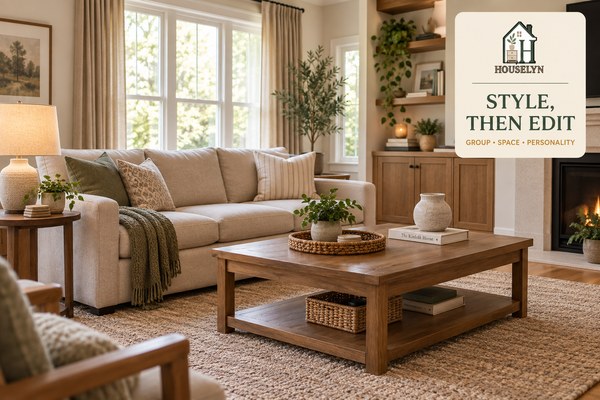
A single tray, substantial vase, stack of books or sculptural object can create a
stronger visual anchor than several unrelated small decorations. Larger forms are
often easier for the eye to understand and can make a surface feel calmer.
That does not mean every accessory should be large. It means the arrangement
benefits from hierarchy. One object can lead while smaller supporting pieces add
contrast without competing equally for attention.
Vary Height Without Building a Display Tower
Objects at different heights can create rhythm across a table or shelf. A low
stack of books beside a taller vase or plant may feel more dynamic than several
objects lined up at the same level.
Successful living room decor uses height variation selectively.
Tall objects should not block conversation, television views, artwork or access
to windows and switches.
Group Related Objects Instead of Scattering Them
A few objects placed together often read as one intentional composition, while
the same number spread across an entire table can make the surface feel busier.
Grouping can also make cleaning and resetting easier.
A tray can help visually contain smaller items, but it should not become an excuse
to add more. If the tray itself is full and the surrounding table is also styled,
the surface may still feel overloaded.
Use Books and Personal Objects to Add Meaning
Styling becomes more convincing when at least some objects have a reason to be
there. Books you enjoy, a meaningful ceramic piece, a framed photograph or an
object collected while travelling can make the room feel personal without
requiring a large number of accessories.
Good living room decor does not need to look anonymous or
showroom-perfect. Personal pieces can coexist with a polished room when their
quantity, scale and placement are edited thoughtfully.
Use Plants Where the Conditions Actually Support Them
Plants can introduce shape, texture and natural colour, but their location should
suit the available light, temperature and household. Do not place a plant where
it blocks a walkway simply because an empty corner appears visually convenient.
Where live plants are impractical, the room can gain natural character through
timber, woven fibres, artwork or other materials instead. Greenery is one option,
not a requirement for a finished room.
Keep Decorative Storage Visually Quiet
Baskets and lidded boxes can be useful when they contain genuine recurring
categories such as throws, children's items or small electronics. They become less
useful when every empty shelf or floor corner receives a basket without a defined job.
Practical living room decor uses storage as part of the reset
system rather than as decoration by itself. If a basket has no clear category,
it can quickly become another place for miscellaneous clutter.
Do Not Style Every Shelf the Same Way
Repeating an identical formula across every shelf can make a room feel staged.
Allow some shelves to carry books, some to display a single object and some to
remain more open.
Variation creates a more natural rhythm, especially when the bookcase already has
strong architectural presence. The goal is to support the whole room rather than
make every shelf demand attention.
Once the surfaces are styled with restraint, the next framework stage focuses
on Walls: deciding which blank areas genuinely need artwork,
mirrors, shelving or another treatment and which are stronger when left quiet.
Framework Stage 7 — Walls
Chapter 7: Living Room Decor Needs Wall Art That Matches the Furniture Below It
Wall decor feels more intentional when it belongs to the furniture and architecture around it rather than simply occupying an empty patch of wall.
Walls are one of the final large surfaces addressed in living room decor,
and that timing matters. Artwork, mirrors, shelves and picture ledges are easier
to judge once the sofa, rug, furniture arrangement, curtains and lighting have
already established the room's scale and visual hierarchy.
Starting with the wall too early can create a backwards design process. A gallery
arrangement may dictate furniture placement, a shelf may interfere with a later
lamp position or a group of small pictures may prove too weak once a substantial
sofa arrives beneath them.
Ask Whether the Wall Actually Needs Decorating
Not every blank wall is unfinished. Some areas provide useful visual rest between
stronger elements, particularly when the room already contains patterned textiles,
substantial furniture, a fireplace, built-ins or a prominent view.
Good living room decor distinguishes between a wall that lacks
connection and a wall that is simply quiet. Filling every surface can flatten the
hierarchy because the eye no longer has anywhere to rest.
Start With the Furniture Beneath the Wall
A wall above a sofa, console or fireplace is not an isolated rectangle. The
furniture below establishes visual width, height and weight that the wall treatment
needs to acknowledge.
Strong living room decor therefore judges artwork relative to
its surroundings. A very small picture may look attractive close up but appear
disconnected when floating above a broad sofa.
At pillar level, the principle is to make the wall treatment feel visually connected
to its anchor furniture. Exact artwork-width formulas and detailed hanging dimensions
are intentionally reserved for the dedicated Blank Wall Decor guide.
Choose One Dominant Wall Treatment Before Combining Several
A large artwork, gallery arrangement, mirror, picture ledge or shelving system can
all work, but using several equally strong treatments on the same wall can create
unnecessary competition.
Better living room decor establishes a dominant idea first.
Secondary details can then support it rather than forcing the wall to carry
artwork, shelves, plants, decorative objects and mirrors simultaneously.
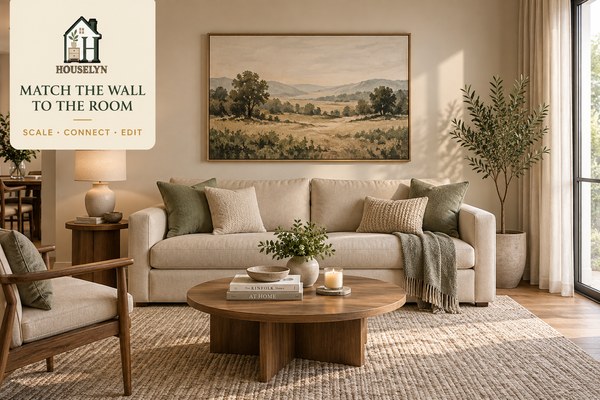
Use Large Artwork When the Wall Needs a Clear Visual Statement
One appropriately scaled artwork can create clarity because the eye reads it as
a single shape. This can be especially effective above a sofa or console where
multiple small items would otherwise compete with a large piece of furniture.
Large does not mean oversized. The artwork still needs enough surrounding wall
space to breathe and should not appear squeezed between furniture, curtains,
ceiling features or architectural edges.
Use Gallery Walls When the Collection Has a Reason to Be Together
Gallery arrangements work best when the pieces share some form of relationship:
subject, colour, frame family, personal meaning or visual rhythm. A gallery wall
should feel like one composition rather than a storage solution for unrelated frames.
This pillar deliberately stops before detailed gallery-wall templates, spacing
plans and frame configurations. Those belong in the specialist wall guide so
that living room decor remains the broader authority topic.
Use Mirrors for a Purpose Beyond Filling Space
Mirrors can reflect light, reinforce symmetry or provide a useful decorative
focal point. Their value depends heavily on what they reflect.
Before positioning one, check the view from the main seating and entrance.
Reflecting a window, artwork or attractive room feature can strengthen the
composition. Reflecting clutter or a visually awkward utility area may do the opposite.
Keep Shelving Visually and Structurally Appropriate
Wall shelves can add storage and display space, but they should solve a real
need rather than automatically occupy an empty wall. Their depth, mounting,
weight capacity and position all matter.
Practical living room decor also considers what sits below.
Shelves should not create an awkward overhead relationship with seating or be
positioned where objects could be easily knocked or become unsafe.
For renters, do not assume a wall-mounted solution is acceptable simply because
the product is described as easy to install. Check the tenancy agreement, wall
construction, fixing requirements and permission where needed.
Consider the Wall From the Main Entrance
Wall treatments are rarely viewed only from directly in front. Step into the room
from the main entrance and look at how the artwork or mirror participates in the
wider composition.
Successful living room decor lets the wall support the room's
existing hierarchy. If it immediately steals attention from the intended focal
point, it may be too visually dominant even if it looks attractive by itself.
Repeat Colour Without Matching Everything
Artwork can help repeat an accent colour already present in the rug, textiles or
furniture, creating another visual connection across the room.
That does not require choosing artwork simply because it matches the cushions.
Subject, meaning and personal preference still matter. Colour repetition should
support the artwork choice rather than reduce it to a decorating accessory.
Avoid Small Objects Spread Across a Large Wall
Several widely separated small frames can make a large wall feel even larger
because the eye reads the empty gaps between them rather than one intentional composition.
In living room decor, grouping related items more deliberately
or choosing fewer pieces with greater visual presence can often create a calmer
result.
With the major wall decisions in place, the final framework stage is
Refine: diagnosing why a room can still feel slightly wrong
even when the furniture and decorative pieces are individually attractive.
Framework Stage 7 — Refine
Chapter 8: Living Room Decor Feels Finished When the Proportions Work Together
A room often feels finished not because more has been added, but because the existing pieces finally relate to one another.
The final stage of the Houselyn framework is to step back from individual
purchases and judge the living room decor as one composition.
A room can contain a good sofa, attractive rug, beautiful curtains and carefully
chosen artwork yet still feel slightly wrong when the relationships between
those pieces have not been resolved.
Refinement is therefore less about adding and more about diagnosing. Instead of
asking, “What else does this room need?” begin with, “Which existing relationship
is making the room feel unsettled?”
Start With the Largest Relationships First
Before changing cushions, ornaments or small accessories, look at the sofa,
rug, chairs, coffee table, curtains and principal wall treatment. Those elements
carry much more visual weight than the decorative details layered over them.
Strong living room decor can often be improved dramatically by
correcting one large relationship rather than making several small purchases.
If the rug is visually disconnected from the seating, for example, new cushions
will not resolve that structural problem.
Check Whether the Rug Is Visually Connecting the Seating
A rug that appears stranded beneath the coffee table can make the surrounding
seating feel fragmented. At the opposite extreme, a rug that overwhelms the
available room may weaken the sense of floor around the furniture.
The broad living room decor diagnostic is whether the rug helps
the eye understand the seating as one group. Exact size combinations and
sofa-to-rug placement belong in the dedicated Sofa and Rug Size Match
page rather than this pillar.
Look at the Curtains as Part of the Wall
Curtains can affect the apparent proportions of an entire wall. Treatments that
feel compressed around the window may make the room look visually shorter or
narrower, while overly bulky fabric can dominate a modest space.
At this stage, ask whether the curtain treatment supports the architecture and
furniture around it. Exact height, width and fullness rules remain protected for
the specialist Curtain Height and Width Rules guide.
Check Whether the Coffee Table Belongs to the Seating Group
A coffee table can feel wrong because of scale, shape, visual weight, location
or simply because it has become overloaded with styling. The question is not
whether it looks attractive by itself but whether it participates naturally in
the seating arrangement.
Successful living room decor keeps the coffee table visually
connected and practically useful. Detailed clearance rules remain part of
Living Room Layout Basics, while object arrangements and styling formulas
belong in the Coffee Table Styling Guide.
Check Whether the Wall Art Is Large Enough to Belong
Wall decor often looks unfinished when several small pieces float independently
above substantial furniture. The problem may not be empty wall space; it may be
insufficient visual connection between the artwork and the anchor beneath it.
Likewise, a very dominant wall treatment can overpower a sofa, fireplace or
architectural feature that should carry greater visual importance.
Check Whether the Lighting Has Enough Depth
A room lit only from the ceiling can look flat after dark because every surface
receives similar illumination from one direction. Adding useful lighting at
different heights can help create depth while supporting reading, conversation
and quieter evening use.
Better living room decor uses lighting as part of the composition
rather than treating lamps as isolated accessories. If one corner feels visually
weak, the solution may be useful illumination rather than another decorative object.
Check Whether Everything Has the Same Visual Weight
Rooms can feel monotonous when every object is similar in height, colour intensity,
shape or material. They can also feel chaotic when every object is competing to
become the strongest feature.
Refinement looks for hierarchy: one dominant anchor, several supporting elements
and quieter areas that allow those features to register.
Check Colour Repetition Before Introducing Another Accent
A room can feel disconnected when every accent colour appears only once. Before
introducing a new shade, look for opportunities to repeat an existing tone subtly
through textiles, artwork, natural materials or small details.
Cohesive living room decor does not require identical colours
across every object. Repetition works best as a visual thread rather than a
matching set.
Check Whether the Room Needs Texture Instead of More Colour
When a neutral room feels flat, the immediate reaction is often to add a stronger
colour. Sometimes the missing ingredient is material contrast rather than hue.
Timber grain, woven fibres, linen, wool, soft upholstery, stone, ceramics and
subtle metals can create depth while preserving a restrained palette.
Remove One Layer Before Adding Another
When the room feels busy, remove a group of accessories temporarily and look
again. Clear one section of the coffee table. Take one decorative cushion away.
Simplify one shelf or wall.
Practical living room decor often improves through subtraction
because stronger pieces gain more visual breathing room. Editing also reveals
whether clutter was hiding a deeper scale or layout problem.
Look at the Room From More Than One Viewpoint
Stand at the doorway, sit on the sofa and look from adjoining rooms where the
living area is visible. Different viewpoints reveal imbalances that may not be
obvious when you stand directly in the centre.
This is particularly useful in open-plan homes, where the living room needs to
relate not only to itself but also to the dining or kitchen areas around it.
Test the Room at Night
A living room can feel beautifully resolved in daylight and completely different
after sunset. Artificial lighting changes colour perception, creates new shadows
and determines which corners remain visually active.
Final living room decor decisions should therefore be judged
across the household's real schedule rather than at one particularly flattering
time of day.
The full Houselyn framework is now complete:
Plan → Anchor → Scale → Arrange → Layer → Style → Refine.
The next section answers the practical questions readers are most likely to have
about furniture, rugs, curtains, colour, styling and rooms that still feel unfinished.
Living Room Questions Answered
Living Room Decor FAQ: Planning, Furniture, Rugs, Curtains & Styling
These answers cover the most common living room decor
questions at pillar level. Where a topic needs detailed measurements,
layouts or specialist troubleshooting, Houselyn addresses it separately
in the supporting Living Room guides.
1. Where should I start when decorating a living room?
Start with the room itself. Measure the usable floor area and walls, note
doors, windows, radiators, fireplaces and sockets, then decide how the room
needs to function. Only after that should you choose or reposition the main
furniture. This prevents decorative purchases from controlling decisions
that should have been based on space and everyday use.
2. How do I make my living room look put together?
Create relationships between the largest elements. The sofa, rug, coffee
table, curtains, lighting and wall treatment should feel as though they
belong to the same room. Cohesive living room decor usually
comes from repetition, proportion and editing rather than buying a matching
furniture set.
3. How do I choose a living room style?
Begin with the architecture, fixed finishes and furniture you intend to
keep. Then identify a small group of materials, colours and shapes that you
consistently prefer. A style should help you make decisions; it does not
need to force the room into a strict label such as modern, traditional or
minimalist.
4. What should I buy first for a living room?
If you are furnishing from scratch, the main seating is usually the most
influential purchase because it affects the available space, rug scale,
supporting tables and overall visual weight. Measure before buying and avoid
purchasing small accessories until the important furniture relationships
are established.
5. Should I choose the sofa or rug first?
In most rooms, choose or confirm the sofa first because it is a major
functional and visual anchor. The rug can then be selected to support the
seating group. If you already own a valuable or important rug, however, it
may become one of the fixed design constraints when selecting the furniture.
6. How big should a sofa be for a living room?
The sofa should leave enough space for circulation, supporting furniture,
doors and the other activities the room needs to accommodate. Good
living room decor considers not only whether the sofa fits
physically, but whether its depth, height and visual weight suit the room.
Detailed room-by-room sizing belongs in Houselyn's specialist planning guides.
7. How should living room furniture be arranged?
Arrange the main seating around the room's primary function and focal point,
then make sure people can approach the seats, reach useful surfaces and move
through the space naturally. Avoid placing every piece against a wall simply
by default. Detailed configurations will be covered in the dedicated
Living Room Layout Basics guide.
8. Should living room furniture touch the walls?
Not necessarily. In a compact room, wall placement may preserve useful floor
space, while in a larger room pulling seating forward can create a stronger
conversation zone. The right decision depends on circulation, room width,
focal points and how the furniture relates to the other pieces.
9. How much space should be between the sofa and coffee table?
There should be enough room to sit, stand and move comfortably while keeping
the table useful from the sofa. Rather than forcing one measurement into
every room, account for seat depth, table shape, household mobility and the
main walking routes. Exact clearance guidance belongs in the specialist
Living Room Layout Basics page.
10. How big should a living room rug be?
A rug should be large enough to relate visually to the main seating group
rather than appearing as a small decorative island beneath the coffee table.
Better living room decor uses the rug to help connect the
furniture. Exact rug dimensions and sofa-to-rug combinations are reserved
for the Sofa and Rug Size Match guide.
11. Should a rug go under the sofa?
The rug should visually connect with the sofa and surrounding seating, but
the exact relationship depends on the rug, sofa, room and overall layout.
Several arrangements can work successfully. Houselyn's dedicated sofa-and-rug
guide will compare the main placement options in detail rather than imposing
one universal rule here.
12. How high should living room curtains be hung?
Curtains should normally be planned in relation to the entire window wall,
not only the edge of the window frame. The aim is to support the room's
vertical proportions while keeping the treatment practical. Exact rod
positions and installation scenarios are reserved for the Curtain Height
and Width Rules guide.
13. How wide should living room curtains be?
The finished treatment needs enough fabric to frame and close across the
window without looking visually thin. Window width, curtain type and desired
fullness all matter. Because width calculations are a specialist search
intent, detailed formulas will sit in the dedicated curtain guide rather
than this pillar.
14. What colours work well in a living room?
Use the room's fixed finishes as the starting point, then build a dominant
background, supporting tones and a smaller accent family. Successful
living room decor usually repeats important colours in more
than one place without making every object match exactly.
15. How many colours should a living room have?
There is no required number. A restrained palette may use several variations
of similar neutrals, while a more colourful room can contain many hues if
their relationships are controlled. What matters is hierarchy: some colours
should dominate, others should support and the strongest accents should be
used more selectively.
16. How do I make a living room feel cosy?
Combine comfortable seating with layered lighting, tactile materials,
curtains, a rug that connects the seating and a controlled mix of cushions
and throws. Cosiness is not the same as filling the room. Effective
living room decor can feel warm while retaining clear
circulation and useful negative space.
17. How do I decorate a coffee table?
Begin with one visual anchor, vary height modestly, group smaller pieces and
leave enough empty area for normal use. Do not assume the entire tabletop
needs decorating. Detailed arrangements for different table shapes and
surfaces will be covered in the dedicated Coffee Table Styling Guide.
18. What should I put on a blank living room wall?
First decide whether the wall needs anything. If it does, choose a treatment
that relates to the furniture or architecture around it, such as artwork,
a mirror or purposeful shelving. Better living room decor
does not fill walls simply because they are empty. Detailed wall plans are
reserved for the Blank Wall Decor guide.
19. Why does my living room still feel unfinished?
Check the largest relationships before adding accessories. The rug may be
too visually disconnected, curtains may weaken the window, artwork may feel
underscaled, lighting may be flat or too many small objects may be creating
visual noise. The future Living Room Feels Off Fixes guide will diagnose
these problems in greater depth.
20. How do I make a living room look expensive without overspending?
Prioritise proportion, restraint and consistency before decorative quantity.
Well-scaled furniture, a coherent palette, fuller-looking window treatments,
layered lighting and fewer stronger accessories can make
living room decor feel considered without requiring luxury
furniture. Correcting what looks visually wrong often has greater impact than
buying more.
Houselyn Action Plan
14-Day Living Room Decor Reset: From Room Plan to Finished Space
Use this two-week reset to improve living room decor in the
same order as the Houselyn framework:
Plan → Anchor → Scale → Arrange → Layer → Style → Refine.
The aim is not to redecorate everything in fourteen days. It is to correct
the biggest decisions first, then edit the room with greater confidence.
Day 1 — Plan
Measure the Room
Record the room length, width, ceiling height and usable wall sections.
Measure around doors, windows, radiators and other fixed features rather
than relying on the apparent size of an empty wall.
Action: Create a simple written or sketched room map before moving furniture.
Day 2 — Plan
Map Doors, Windows and Walking Routes
Mark the paths people use most often. Include door swings, routes to adjoining
rooms and access to windows, curtains or patio doors.
Action: Identify one main route that should remain visibly clear.
Day 3 — Plan
Define the Room's Main Job
Decide whether the room primarily supports conversation, television, family
time, reading, entertaining or several functions. Rank those needs instead
of treating every possible use as equally important.
Action: Write down the top two functions the room must perform well.
Day 4 — Anchor
Choose the Main Visual and Functional Anchor
Identify the sofa or primary seating element and decide which architectural
or functional feature should lead visually. This may be a fireplace, view,
artwork or television relationship.
Action: Decide what the eye should notice first when entering the room.
Day 5 — Arrange
Test the Main Furniture Arrangement
Reposition the largest movable pieces if needed. Judge the room from the
entrance, from the sofa and while walking through it. Good
living room decor should support movement as well as appearance.
Action: Remove or move any piece that interrupts the main circulation route.
Day 6 — Scale
Check the Major Proportion Problems
Compare the sofa, chairs, coffee table, side furniture and room itself.
Look for pieces that feel obviously too heavy, too small or visually
disconnected from the main seating.
Action: Identify the single biggest scale problem before considering new purchases.
Day 7 — Scale & Layer
Review the Rug
Check whether the rug visually connects the seating group or behaves like
a small decorative island. Do not rush into exact sizing rules here; first
decide whether the broad relationship looks connected.
Action: Decide whether the rug is helping the seating read as one zone.
Day 8 — Layer
Review the Curtains and Window Wall
Step back and judge whether the curtains support the proportions of the wall
and window. Check whether they make the window feel visually cramped, overly
heavy or disconnected from the rest of the room.
Action: Identify whether the window treatment feels proportionate before changing hardware or fabric.
Day 9 — Layer
Build a Better Lighting Mix
Look at how the room works after daylight fades. If one central ceiling light
does all the work, consider where a useful floor or table lamp would improve
reading, conversation or evening atmosphere.
Action: Add or reposition one practical secondary light source if the room needs it.
Day 10 — Layer
Refine the Colour Palette
Identify the dominant background, supporting tones and strongest accents.
Better living room decor often comes from repeating existing
colours more deliberately rather than introducing another new shade.
Action: Choose one accent colour that should repeat quietly in two or three areas.
Day 11 — Layer
Add Texture Before More Accessories
If the room feels flat, look for material contrast through textiles, timber,
woven fibres or upholstery before buying extra decorative objects.
Action: Add or reposition one useful textural layer, then reassess the room.
Day 12 — Style
Edit the Coffee Table and Visible Surfaces
Remove everything from one high-use surface and return only what adds function,
meaning or visual balance. Leave enough open space for the table to remain usable.
Action: Remove at least one object that does not improve the surface.
Day 13 — Walls
Review the Wall Decor
Look at each major wall in relation to the furniture beneath it. Decide whether
the wall needs a stronger treatment, a simpler treatment or no additional
decoration at all.
Action: Choose one wall to simplify before adding anything new.
Day 14 — Refine
Run the Houselyn “Why Does This Room Feel Off?” Test
Review scale, spacing, focal point, rug, curtains, lighting, wall art, colour,
texture and clutter. Judge the room from several viewpoints and again after dark.
Action: Make one final correction based on the largest remaining relationship problem.
Houselyn Conclusion
Living Room Decor Works Best When the Room Is Designed Before It Is Decorated
The strongest living room decor rarely comes from adding
the greatest number of objects. It comes from making the biggest decisions
in the right order: understand the room, choose what leads, get the scale
right, arrange furniture around real life, layer the large visual surfaces,
style with restraint and then refine the relationships that still feel wrong.
That sequence matters because every stage affects the next. A sofa that is too
large changes the circulation. A rug that is too small weakens the seating zone.
Curtains that feel cramped around the window can make the wall look smaller.
Poor lighting can flatten an otherwise attractive room. Too many accessories
can hide the fact that the larger composition was never fully resolved.
Better living room decor therefore begins with function before
accessories. The room should support the way people actually sit, talk, watch
television, read, entertain and move through the space before the final styling
layer is added.
Proportion should come before decoration too. A well-scaled sofa, rug, coffee
table and wall treatment can make a room feel more complete with fewer objects,
while attractive but poorly related pieces can leave the same room feeling
unsettled.
Circulation is equally important. Empty floor is not a failure to decorate.
Open space may be protecting a doorway, creating access to a chair, allowing
people to cross the room comfortably or giving larger furniture enough visual
breathing room.
Use this sequence whenever the room begins to feel confusing. Instead of
solving every problem at once, return to the earliest stage that is not working.
If the furniture does not fit, styling is too early. If the arrangement works
but the room feels flat, look at layering. If everything is attractive but the
room still feels wrong, refine the relationships before purchasing anything else.
Good living room decor also leaves room for personality. A
family photograph, favourite books, a collected object or a distinctive piece
of artwork can make a room feel more meaningful than a perfectly coordinated
set of generic accessories. The goal is not to remove character; it is to give
meaningful pieces enough space to be noticed.
The same principle applies to colour and texture. Rooms do not need to match
perfectly. They need enough repetition to feel connected and enough variation
to remain interesting. Natural wood, textiles, ceramics, metal, woven fibres,
upholstery and a controlled palette can create depth without forcing every
surface to become decorative.
Most importantly, successful living room decor should improve
daily life as well as appearance. The room should be easier to enter, easier to
sit in, easier to light, easier to use and easier to reset after ordinary
household activity.
If several answers are no, resist the urge to solve them all through shopping.
Return to the earliest problem in the framework. Correcting one structural
relationship can improve several later layers of living room decor
at the same time.
Continue Learning With Houselyn
Build on Your Living Room Plan
Once the main room is working, these established Houselyn guides can help you
apply the same principles to compact homes, decorating decisions and the wider
space around the living area.
The Houselyn Editorial Team creates practical, design-conscious guidance
for decorating, organizing and improving everyday homes. Our approach
focuses on realistic proportions, usable spaces, thoughtful purchasing
decisions and rooms that continue to work after the photographs are taken.
Use the Houselyn Knowledge Library to continue from the part of
living room decor that matters most in your home. The
resources below are grouped by reader intent so you can move from the
pillar into more focused guidance without repeating the entire process.
1. Plan a Compact Living Room
If limited floor area is affecting your living room decor,
begin with the relationship between furniture, circulation and the wider
apartment before adding more decorative pieces.
Storage should support living room decor rather than
introduce furniture or containers without a clear job. These guides help
solve storage pressure across smaller homes.
If the layout works but your living room decor still
lacks warmth or cohesion, focus on colour, texture, visual repetition and
the relationship between decoration and the room's existing architecture.
Practical living room decor should remain manageable
after normal use. Organization systems can help recurring categories
return to a defined home instead of remaining on tables, seating or floors.
As the dedicated Living Room cluster expands, this library will connect
living room decor directly to specialist guides for layout,
sofa-and-rug proportion, curtain sizing, coffee-table styling, blank walls
and room diagnostics.
That structure keeps living room decor as the complete
starting point while allowing each specialist topic to answer a narrower
question in substantially greater depth.
If you are unsure where to continue, return to the earliest part of
living room decor that still feels unresolved:
planning, anchoring, scale, arrangement, layering, styling or refinement.
The goal of the Houselyn living room decor system is not
to create more decorating work. It is to help you identify the decision
that matters next and avoid spending time or money solving the wrong problem.
Living Room cluster expansion:
as each specialist article is published, its live link should replace or
supplement the broader temporary links above. Do not publish links to
unfinished pages.