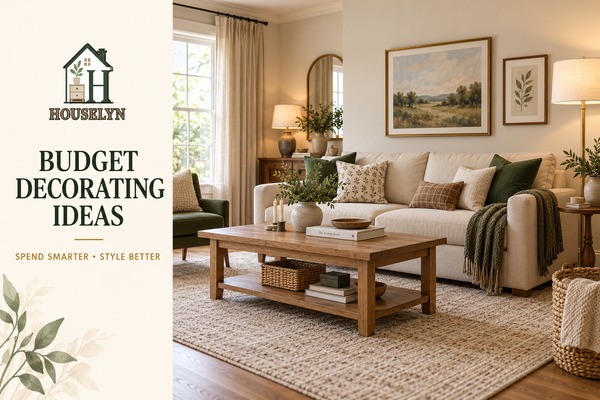
Budget Decorating Ideas: How to Make Your Home Look Better Without Overspending
Houselyn Budget Decorating Guide
Budget decorating ideas work best when you focus your money on the changes that create
the greatest visual and practical difference instead of simply buying the cheapest decor
you can find. A beautiful home does not require replacing everything at once. By
assessing what you already own, prioritizing the weakest parts of the room and spending
selectively, you can create a more polished and cohesive space without letting decorating
costs get out of control.
Decorating on a budget is less about finding the lowest possible price and more about
making better decisions. A larger rug, improved lighting, better curtain placement or
one stronger piece of wall art can sometimes transform a room more effectively than a
collection of inexpensive accessories.
Disclosure: Houselyn may earn a commission from qualifying purchases
made through selected affiliate links in this article, at no additional cost to you.
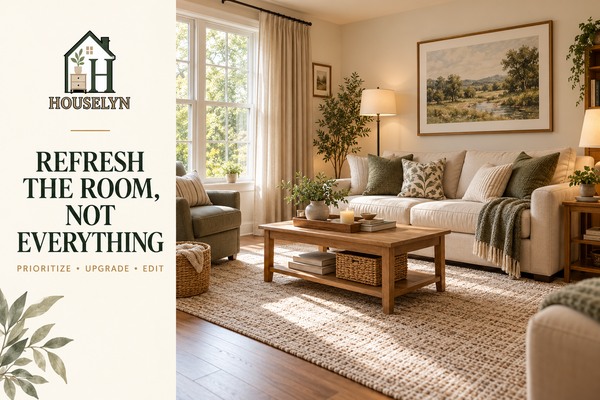
A well-planned room can look polished without relying on expensive furniture or
constant new purchases.
Spend Less by Making Better Decorating Decisions
Budget Decorating Ideas Should Improve the Room, Not Just Fill It
The strongest budget decorating ideas begin with the room you already have. Before
buying new cushions, frames, baskets or decorative objects, look at the furniture
arrangement, the scale of the rug, the lighting, the wall space and the items already
available elsewhere in your home.
Decorating on a budget becomes much easier when every purchase has a clear purpose.
One item might solve a scale problem, another might improve function, and another
might connect colours that already exist in the room. Purchases that do none of those
things are often the ones that quietly consume the budget.
Assess First
Identify what is already working before assuming the room needs new furniture or
decor.
Prioritize Impact
Spend first on the change that will affect the largest visible or functional part
of the room.
Reuse What Works
Move, restyle, repurpose or regroup existing pieces before replacing them.
Upgrade Selectively
Improve the weakest details rather than replacing everything at the same time.
Style With Intention
Use colour, texture, lighting and proportion to help affordable items look more
considered.
Edit at the End
Remove unnecessary objects so the strongest improvements have enough space to
stand out.
Budget decorating ideas are most effective when they solve visible problems in the
right order. A room with weak lighting may not need more accessories. A wall that
looks unfinished may need one correctly scaled piece rather than several small frames.
A sofa that feels disconnected may need a better rug relationship rather than new
cushions.
This approach also helps prevent false economy. A cheap item that is the wrong size,
wrong colour or wrong function can cost more in the long term if it needs to be
replaced. Good-value decorating means considering cost alongside usefulness, visual
impact and how long the item is likely to work in the room.
Another advantage of decorating on a budget is that it encourages more deliberate
styling. When every purchase has to earn its place, it becomes easier to notice which
furniture is already good, which objects can move to another room and which small
changes will genuinely improve the space.
Budget decorating ideas can also work especially well in small homes because a few
well-chosen changes often have a strong visual effect. Better furniture placement,
more useful lighting, fewer undersized accessories and improved storage can make the
room feel calmer without requiring a complete makeover.
The aim of this guide is therefore not to make every room look expensive. It is to
help you make a home look more intentional, comfortable and cohesive while spending
only where the improvement is worthwhile.
Chapter 1 — Assess
Start Budget Decorating Ideas With What You Already Own
Budget decorating ideas become much more effective when you begin by assessing what
is already in the room instead of assuming that the solution is another purchase.
Existing furniture, lighting, frames, baskets, textiles and decorative objects may
have more potential than they appear to have in their current positions.
Decorating on a budget works best when you separate a genuine problem from a styling
problem. A chair may look wrong because it is in the wrong corner. A lamp may feel
outdated because the shade is weak. A group of frames may seem too small because they
are scattered instead of arranged as one stronger composition.
Before spending, identify which parts of the room already work and which pieces could
improve simply by being moved, edited or restyled.
A photograph makes it easier to see the room as one composition. Furniture you have
stopped noticing may suddenly appear too crowded, too small or badly positioned when
viewed in a single frame.
Budget decorating ideas should start with this kind of distance because it helps you
identify the visual problem before spending money on a proposed solution.
Clear Temporary Clutter Before Judging the Decor
Paperwork, charging cables, toys, bags, laundry and other temporary items can make a
perfectly workable room appear visually worse than it really is.
If decorating on a budget is the goal, clear temporary clutter first so you do not buy
furniture or storage simply to solve a short-term mess.
Identify What Is Already Working
It is easy to create a mental list of everything you dislike while ignoring the parts
that already support the room. Start by identifying the strongest furniture, colours,
finishes and practical features.
Budget decorating ideas become easier to manage when good pieces are treated as anchors
rather than candidates for unnecessary replacement.
Separate Worn Out From Poorly Styled
Some items genuinely need replacement because they are damaged, unstable or no longer
functional. Others simply need a different position, surrounding colour or styling
treatment.
A wooden side table that feels dull may work well in another room. A plain sofa may
become more convincing once the rug and lighting are improved. A mirror may look better
above a console than in an isolated corner.
Move Furniture Before You Buy Furniture
Rearranging the sofa, chairs or side tables can change the room more than another
decorative purchase. A better layout may reveal that you need fewer items rather than
more.
Budget decorating ideas should therefore test placement before replacement. Moving one
chair into the main conversation zone may remove the need to buy an additional seat.
Shop the Other Rooms in Your Home
A lamp that feels wrong in the bedroom may work perfectly beside the living-room sofa.
A basket hidden in a spare room may solve visible clutter. An unused mirror may add
enough scale to a wall that previously seemed empty.
Decorating on a budget becomes more flexible when objects are treated as household
resources rather than permanent fixtures assigned to one room forever.
Check Storage Before Shopping for Decor
Frames, vases, trays, textiles and seasonal items often sit forgotten in cupboards,
lofts or storage boxes. Review those items before purchasing something similar.
Budget decorating ideas lose much of their value if the same category of item is bought
repeatedly while usable alternatives are already stored elsewhere in the home.
Regroup Small Decor Into Stronger Compositions
Several small objects spread across different surfaces can look weak and cluttered.
Grouping selected pieces together can create more visual impact without adding anything.
A few books, a bowl and one sculptural object may work better as one controlled group
than as separate items scattered across shelves, side tables and a coffee table.
Use Empty Space as a Budget Tool
Not every blank wall, shelf or corner needs something new. Leaving useful negative space
can make the objects you already own look more intentional and reduce the pressure to
keep shopping.
Decorating on a budget becomes easier when empty space is understood as part of the
composition rather than as evidence that the room is unfinished.
Make a Replacement List Only After the Assessment
Once you have moved, regrouped and edited existing pieces, the real gaps become much
clearer. At that point, any replacement list should be shorter and more specific.
Budget decorating ideas work best when the shopping list is created after this process,
not before it.
After this assessment, you should know which items are worth keeping, which can move,
which deserve a small improvement and which genuinely need replacement.
The next step is deciding where limited money will create the greatest return. The next
chapter ranks decorating changes by visual impact, function and value instead of
spreading the budget evenly across the room.
Spend Your Decorating Budget Where It Creates the Most Visual Impact
Budget decorating ideas become more effective when the money goes first to the change
that affects the largest visible or functional part of the room. Spreading a limited
budget evenly across many small purchases often creates less improvement than solving
one obvious weakness properly.
Decorating on a budget requires priorities. A badly scaled rug can influence the entire
seating area, while another vase may change almost nothing. Weak lighting can flatten
the whole room, while another cushion may only improve one small corner of the sofa.
Prioritize changes that influence the largest area of the room before spending on
smaller decorative details.
Stand at the room entrance and identify the feature that most weakens the space. It may
be a tiny rug, poorly placed curtains, an empty wall, an awkward furniture arrangement
or flat lighting.
Budget decorating ideas should address that larger problem before money is divided
among small accessories that cannot correct it.
Think in Terms of Area Affected
Some changes influence only one surface. Others alter how a large part of the room is
perceived. Curtains affect the window and wall height. A rug affects the whole seating
zone. Lighting changes colour, depth and atmosphere across the room.
Decorating on a budget becomes more efficient when you ask how much of the room each
proposed purchase can improve.
Prioritize Function When It Also Improves the Look
The best-value changes often solve two problems at once. A floor lamp can improve both
reading light and vertical balance. A larger basket can contain clutter while adding
texture. Better curtains can improve privacy while strengthening window proportion.
Budget decorating ideas gain more value when an item contributes to both appearance and
everyday use.
Do Not Spend the Same Amount on Every Part of the Room
Equal spending rarely produces equal improvement. One room may need most of the budget
directed toward lighting, while another may need a larger rug or better window
treatment.
A useful decorating budget should follow the room's weaknesses instead of assigning an
identical amount to walls, textiles, furniture and accessories.
Lighting Often Has More Impact Than Another Accessory
A room with poor lighting can make good furniture and colour choices look flat. Adding
useful light at sofa, reading or side-table level can change the atmosphere more than
several decorative purchases.
Budget decorating ideas should therefore treat lighting as part of the design structure,
not merely as a finishing detail.
Rug Scale Can Affect an Entire Furniture Group
An undersized rug may make the sofa, chairs and coffee table appear disconnected.
Correcting the floor anchor can improve several existing pieces without replacing any
of them.
When decorating on a budget, a stronger rug relationship can sometimes deliver more
visible change than purchasing new small furniture.
Use Paint Strategically Rather Than Automatically
Paint can create broad visual change for relatively modest material cost, but repainting
every room is not automatically the best use of money. Sometimes the existing wall
colour is perfectly workable and the problem lies elsewhere.
Budget decorating ideas should use paint when colour is genuinely weakening the room,
not simply because repainting is commonly described as an inexpensive makeover.
Correct Curtain Placement Before Replacing the Curtains
Curtains can look inexpensive because of their position rather than their fabric. A rod
mounted too low or too narrowly can make otherwise acceptable panels look less polished.
Decorating on a budget means testing whether better placement solves the problem before
purchasing an entirely new window treatment.
Choose One Stronger Wall Treatment Over Many Weak Ones
Several small decorative objects can consume a surprising amount of money while still
failing to give a wall enough visual presence.
Budget decorating ideas often work better when that money is redirected toward one
larger artwork, mirror or coordinated grouping with enough scale for the furniture below.
Consider Longevity Before Following a Trend
A low-cost trend can become expensive when several items need replacing once the look
changes. This does not mean avoiding trends completely, but they are usually safer in
smaller, easily changed details.
Decorating on a budget benefits from a stable foundation with more temporary style
expressed through lower-cost accents.
Compare Total Cost, Not Just the Shelf Price
Delivery, required fixings, assembly, replacement bulbs, frames or other extras can
increase the real cost of a seemingly inexpensive purchase.
Budget decorating ideas should evaluate what it will cost to make the item usable in
the room, not only the number printed on the product page.
Once priorities are clear, the next opportunity is to reduce the amount you need to
buy at all. Existing furniture and decor can often be moved, regrouped or repurposed
into a stronger arrangement.
The next chapter focuses on reuse and explains how budget decorating ideas can begin
with a room swap, a furniture move and a deliberate restyle before another new item
enters the home.
Chapter 3 — Reuse
Reuse, Rearrange and Restyle Before You Buy New Decor
Budget decorating ideas become more powerful when existing furniture and decor are
treated as flexible resources rather than fixed objects. Moving, swapping, regrouping
or repurposing what you already own can create a noticeable change before any new
purchase enters the room.
Decorating on a budget is often less about finding more and more about seeing existing
pieces differently. A lamp may work better in another room, a mirror may solve an empty
wall, and several small accessories may look stronger when grouped together instead of
spread across different surfaces.
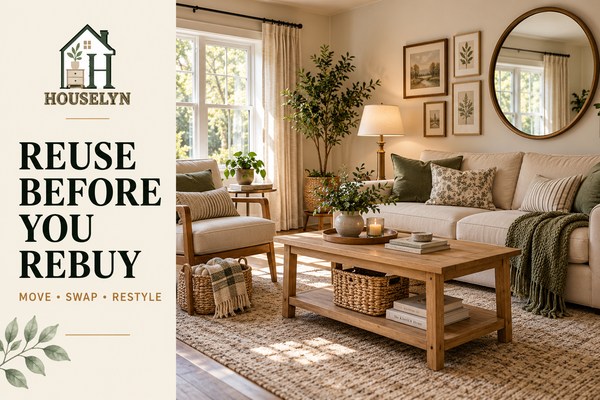
Repositioning and regrouping existing pieces can create a stronger room without adding
another layer of spending.
Furniture can feel wrong because of position rather than design. A chair isolated in a
corner may become useful once it joins the conversation zone. A console may work better
on a different wall where its width relates more naturally to the surrounding space.
Budget decorating ideas should test a better arrangement before assuming a major item
needs to be replaced.
Swap Lamps Between Rooms
Lamps are especially useful for room swaps because their scale, shade shape and finish
can feel very different beside new furniture. A lamp that looks underwhelming on a
bedroom bedside table may have enough presence for a living-room console.
Decorating on a budget becomes easier when lighting is moved to where it creates the
strongest functional and visual effect.
Move Mirrors Where They Can Do More Work
A mirror can add scale, reflect useful daylight and provide a stronger focal point than
several smaller decorative objects. Before buying another wall piece, check whether an
existing mirror could work elsewhere.
Budget decorating ideas often improve when one substantial existing object replaces
several weaker new purchases.
Regroup Frames Instead of Buying More Art
Small frames distributed across different walls can lack impact. Bringing selected
frames together may create a more substantial composition without requiring new artwork.
Existing photographs, prints or inexpensive inserts can also be changed while the
frames themselves remain in use.
Reuse Baskets Where Clutter Is Most Visible
A basket that currently stores rarely used items may be more valuable in a living room
where throws, magazines or toys create everyday visual clutter.
Budget decorating ideas can improve both appearance and function simply by moving
useful storage to the room that needs it most.
Rotate Cushions and Throws Instead of Buying a New Set
Textiles can feel new when they appear against a different sofa, chair or bedding
colour. Moving them between rooms also helps reveal which combinations actually support
the wider palette.
Decorating on a budget does not require every room to keep the same accessories
permanently.
Repurpose Trays to Create Order
A tray that once held candles or toiletries may become useful on a coffee table,
console or sideboard. Grouping several small objects within one boundary can make them
appear more deliberate.
Budget decorating ideas often depend on better presentation rather than a greater
quantity of decor.
Move Plants to Improve Balance
A plant can soften a hard corner, add height beside low furniture or bring colour to an
area that feels visually empty. Moving an existing plant may solve the problem without
buying another decorative object.
The plant still needs suitable light and growing conditions, so styling should never
make the location impractical for the plant itself.
Use Books as Styling Material You Already Own
Books can add height, colour and structure to shelves, consoles and coffee tables.
Instead of buying decorative objects purely to create layers, use a restrained selection
of books already in the home.
Decorating on a budget becomes more personal when useful possessions are incorporated
into the room instead of replaced by generic styling objects.
Change What Is Inside the Frame
Existing frames can be refreshed with personal photography, printable art, children's
artwork, postcards or other suitable paper pieces. The frame may have years of useful
life even when the existing image no longer suits the room.
Budget decorating ideas should preserve the part that still works and change only the
element that no longer does.
Give Small Furniture a New Job
A stool may become a plant stand or occasional side table. A small bench may move to an
entryway. A narrow console may work as a compact desk or display surface in another room.
Reuse is most successful when the new role remains practical, stable and appropriate
for the item's construction.
Do Not Keep an Item Only Because Reusing It Is Free
Reuse should improve the room, not force unsuitable pieces into it. A free item that is
badly scaled, damaged or visually disruptive can make the room harder to decorate.
Budget decorating ideas still require editing. The goal is to make useful pieces work
harder, not to keep every object simply because it is already owned.
After rearranging and reusing what you already own, the remaining gaps become clearer.
Those gaps are the best candidates for selective, low-cost improvements rather than
general shopping.
The next chapter focuses on small upgrades with disproportionate visual impact, including
textiles, lampshades, hardware, lighting details and other changes that can improve the
room without replacing its major furniture.
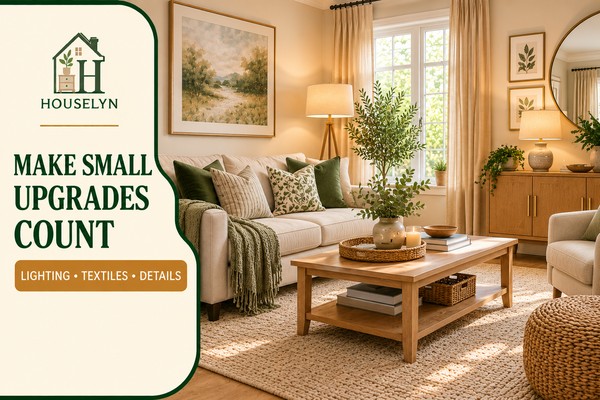
Choose High-Impact Low-Cost Upgrades Before Buying More Accessories
Budget decorating ideas work best when small upgrades improve something that is
already visible across the room. A better lampshade, fresh cushion covers, corrected
hardware or stronger lighting can make existing furniture feel more finished without
replacing the furniture itself.
Decorating on a budget becomes more effective when upgrades are selective. The aim is
not to update every small detail at once. It is to identify the weakest visible element
and improve that first.
Small upgrades create more value when they improve visible details that were weakening
otherwise useful furniture and decor.
Replace the Weakest Visible Detail, Not the Whole Item
A useful piece of furniture can look tired because one detail is letting it down. A
lamp may only need a more suitable shade. A sofa may benefit from better cushion covers.
A cabinet may look dated because of its handles rather than its basic shape.
Budget decorating ideas should identify that weakest detail before a larger replacement
is considered.
Use Cushion Covers to Refresh Colour and Texture
Replacing entire cushions can be unnecessary when the inserts are still comfortable
and in good condition. New covers can change colour, texture and pattern while preserving
the usable inner cushion.
Decorating on a budget works especially well when covers help connect existing colours
rather than introducing another unrelated palette.
Update a Lampshade Before Replacing the Lamp
A lamp base may still be well proportioned and functional even when the shade looks
dated, damaged or too small. Changing the shade can alter both the silhouette and the
quality of light.
Budget decorating ideas can therefore treat the lamp as two separate decisions: whether
the base still works and whether the shade still supports it.
Change Hardware Where It Is Visually Prominent
Handles and knobs can influence how a cabinet, sideboard or chest reads from across the
room. Updating them can be worthwhile when the furniture itself remains structurally
sound.
Measure existing fixing centres and check suitability before buying replacement hardware.
A cheap handle becomes poor value if it requires unnecessary drilling or does not fit
the door or drawer safely.
Improve Light Quality Before Adding More Decor
The appearance of paint, wood, textiles and artwork changes under different lighting.
A room that seems flat or cold may need better light distribution or more suitable bulbs
rather than more objects.
Budget decorating ideas should consider lighting before trying to solve atmosphere with
additional accessories.
Refresh Worn Textiles Selectively
Curtains, throws and cushions occupy enough visual area to influence the room strongly.
Replacing one visibly tired textile can make more difference than several small tabletop
purchases.
Decorating on a budget does not require all fabrics to be new or perfectly matching.
The priority is removing the textile that visibly weakens the wider composition.
Use Paint for Focused Corrections
Paint does not always need to mean repainting the entire room. A suitable small project
may involve refreshing a worn furniture piece, improving a selected wall or correcting
an area where the finish is genuinely weakening the room.
Budget decorating ideas are stronger when paint is used to solve a defined problem
rather than because every low-cost makeover is expected to include it.
Improve Frames Instead of Replacing the Artwork
Existing art or photography may look less convincing because the frame is undersized,
mismatched or poorly suited to the surrounding furniture.
A better frame, mount or grouping can give existing images more presence without the
cost of replacing the artwork itself.
Correct Curtain Placement Before Buying Better Fabric
Affordable curtains can look more polished when the rod position, length and fullness
are right. Expensive fabric cannot fully compensate for a treatment that is hung too
low or too narrowly.
Decorating on a budget should therefore correct placement before upgrading material.
Do Not Upgrade Details That Nobody Notices
Some changes are inexpensive but still poor value because they affect an area that has
little influence on the room. A minor hardware change on hidden furniture may matter
less than improving the lamp beside the main sofa.
Budget decorating ideas should always return to impact: how visible is the problem,
how much of the room does it affect, and will the upgrade genuinely improve it?
Once the strongest low-cost upgrades are complete, wall decor becomes another area
where scale and presentation can create substantial impact without a large spend.
The next chapter focuses on affordable wall treatments and explains how budget
decorating ideas can create stronger visual scale with frames, artwork, mirrors and
grouped displays without filling every blank area.
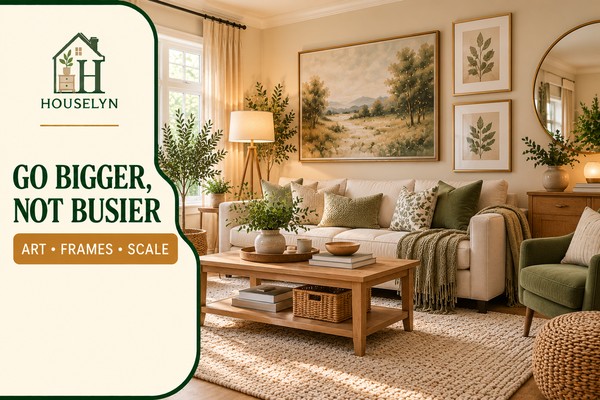
Chapter 5 — Walls
Use Budget Wall Decor Ideas to Create Scale Without Overspending
Budget decorating ideas can create strong wall impact without filling every blank area
or buying a large collection of small pieces. The goal is to create enough scale for
the furniture below while keeping the composition simple, intentional and affordable.
Decorating on a budget often becomes more expensive when walls are filled one small item
at a time. Several inexpensive frames, objects and prints can eventually cost more than
one larger treatment while still looking visually weaker.
Affordable wall decor looks stronger when the total composition has enough scale for
the furniture beneath it.
A £10 print is not necessarily good value if it is so small that the wall still feels
unfinished and another five purchases are needed around it.
Budget decorating ideas should compare the total cost of the finished wall rather than
judging each individual piece only by its low price.
Use One Larger Piece When It Solves the Wall More Simply
One larger artwork or mirror can create a clear focal point and reduce the need for many
smaller objects. This is especially useful above a sofa, console or sideboard where the
furniture already creates a strong horizontal reference.
Decorating on a budget often becomes easier when one substantial piece does the work
of several smaller purchases.
Group Smaller Frames Into One Visual Unit
Small frames can work well when they are arranged closely enough to read as one
composition. The combined width and height matter more than the size of an individual
frame.
Budget decorating ideas can therefore reuse several existing frames more effectively
by creating one coordinated grouping instead of scattering them around the room.
Reuse Frames Before Buying New Ones
Existing frames can be repainted where appropriate, regrouped or filled with different
artwork. A frame that feels wrong in one composition may work perfectly when moved or
combined with others.
Personal photographs, printable artwork, postcards or other suitable paper pieces can
refresh the contents without replacing the entire frame.
Use Printable Art Selectively
Printable artwork can be inexpensive and flexible, particularly when you already have
suitable frames. The key is to choose imagery that works with the room and print it at
a size that creates enough visual presence.
Budget decorating ideas lose impact when printable art is chosen only because it is
inexpensive while scale and composition are ignored.
Turn Personal Photography Into Meaningful Wall Decor
Personal photographs can give a room character that generic decorative prints cannot.
Use a restrained selection, consistent framing or a deliberate grouping so the result
feels designed rather than accidental.
Decorating on a budget can become more distinctive when the wall includes meaningful
material you already own.
Use Mirrors Where Reflection Adds Real Value
A mirror can create wall scale while reflecting useful light or an attractive part of
the room. It is most effective when the reflection and placement are considered rather
than when it is added only to occupy blank wall space.
Budget decorating ideas should make the mirror work as part of the room, not simply as
another inexpensive wall object.
Consider Textiles for Large Wall Areas
Suitable textiles can create a broad area of colour and texture without requiring a
collection of smaller frames. The treatment should be securely and appropriately
installed for the material and wall.
Decorating on a budget benefits from materials that create substantial visual area
without requiring many separate purchases.
Use Picture Ledges to Make Existing Art More Flexible
A picture ledge can allow several lightweight framed pieces to overlap and change over
time. That flexibility can be useful when you already own artwork but do not want to
create a permanent gallery arrangement.
Keep the display edited so the ledge remains one clear composition rather than becoming
storage for every small object.
Do Not Fill a Wall Just Because It Is Empty
Blank space can make neighbouring furniture, windows and artwork easier to appreciate.
Not every open section of wall represents an unfinished decorating task.
Budget decorating ideas become less expensive and often more polished when negative
space is treated as intentional.
Measure Before Building a Gallery Wall
A gallery wall can consume more frames, prints and fixings than expected. Plan the total
footprint first and make sure the grouping has enough scale for the wall and surrounding
furniture.
Decorating on a budget means knowing the cost of the complete grouping before buying
one frame at a time.
Once wall scale is working, the next way to stretch a decorating budget is sourcing
selected pieces secondhand. Thrifted decor can offer excellent value when material,
condition and final cost are evaluated carefully.
The next chapter explains how budget decorating ideas can use thrifted and secondhand
pieces without confusing a low purchase price with genuine long-term value.
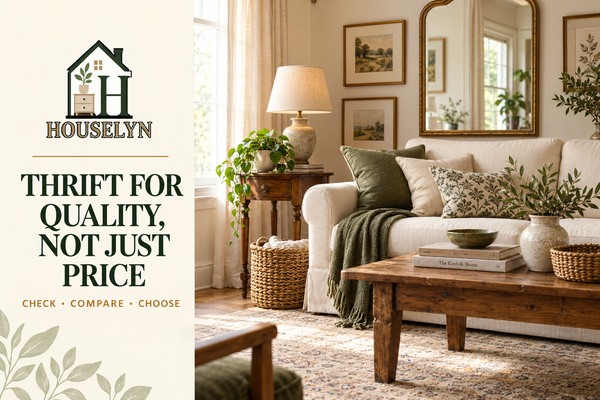
Budget decorating ideas can stretch much further when secondhand pieces are chosen for
quality, usefulness and fit rather than low price alone. A thrifted mirror, frame or
solid wood table can offer excellent value, but a bargain stops being a bargain when
repairs, cleaning, transport or poor condition make it expensive to use.
Decorating on a budget works best when secondhand shopping is treated as a sourcing
strategy rather than a treasure hunt without limits. The item still needs to solve a
real problem, fit the room and remain practical once it comes home.
The best secondhand finds earn their place through material, condition, scale and
usefulness—not simply because the purchase price was low.
Buy Secondhand for Material and Character, Not Just Price
Older pieces can sometimes offer better materials or more character than similarly
priced new decor. Solid wood, sturdy frames, substantial mirrors and well-made baskets
may remain useful for years when their condition is sound.
Budget decorating ideas become more effective when secondhand buying focuses on what
would be costly to reproduce new rather than on collecting inexpensive objects simply
because they are available.
Measure Before You Visit the Shop
Thrift stores and secondhand marketplaces can encourage quick decisions because stock
may be unique. That makes measurements even more important.
Decorating on a budget still requires knowing the maximum width, height and depth that
the room can accept. A beautiful table that blocks circulation is not good value.
Inspect the Structure Before the Finish
Scratched paint or a dated finish may be relatively easy to improve. Loose joints,
serious warping, broken supports or unstable construction can be much harder to justify.
Budget decorating ideas should distinguish cosmetic problems from structural ones before
money changes hands.
Often Worth Considering Secondhand
Mirrors in good condition
Picture frames
Solid wood occasional tables
Sturdy baskets
Ceramic vases and decorative bowls
Decorative trays
Suitable lamps that can be safely checked before use
Small furniture with sound construction
Items That Need More Caution
Heavily worn upholstered furniture
Mattresses and other bedding with hygiene concerns
Damaged electrical items
Furniture with unstable or broken structure
Pieces with serious moisture damage or warping
Items requiring specialist restoration beyond the budget
Anything that cannot be cleaned or used safely
Objects purchased without a clear place or purpose
Mirrors Can Be Excellent Secondhand Buys
Mirrors can be expensive when bought new, especially at larger sizes. A secondhand
mirror with a sound frame and undamaged reflective surface can provide substantial wall
impact for less.
Budget decorating ideas should still account for safe transport, weight and secure
installation before deciding that the saving is worthwhile.
Frames Offer Flexible Low-Cost Potential
Frames can be useful even when the existing image is not. The insert can be replaced,
while a suitable frame may be cleaned, regrouped or refinished where appropriate.
Decorating on a budget becomes more flexible when secondhand purchases are judged by
the part you intend to keep rather than by the current presentation.
Solid Wood Can Be Worth the Extra Inspection
Small solid wood tables, stools, benches and cabinets may offer good value when joints
are sound and dimensions suit the room.
A worn finish can sometimes be improved, but budget decorating ideas should avoid
assuming every damaged piece is an easy DIY project. Repairs, tools and finishing
materials can quickly change the total cost.
Use Ceramic Decor Selectively
Vases, bowls and other ceramic objects are common secondhand finds and can add texture
or shape without high cost. Check carefully for cracks, unstable repairs and damage.
One or two strong pieces are often more useful than a large group purchased simply
because each item is inexpensive.
Be More Careful With Upholstery
Upholstered furniture can carry more cleaning, condition and hygiene considerations
than hard-surface pieces. Inspect fabric, seams, structure, odour and overall condition
carefully before considering it.
Decorating on a budget should never require bringing home an item you cannot clean,
maintain or use confidently.
Do Not Gamble on Damaged Electrical Items
A lamp may look attractive, but damaged wiring, fittings or plugs should not be treated
as a simple decorative flaw. Electrical safety matters more than the saving.
Budget decorating ideas should favour items that can be assessed and used safely, and
electrical work should be handled appropriately where inspection or repair is needed.
Calculate the Cost of Restoration Before You Buy
Sandpaper, paint, hardware, replacement parts, tools, transport and time can turn a cheap
purchase into a surprisingly expensive project.
Decorating on a budget means comparing the restored cost with the price of a suitable
alternative, not comparing only the thrift-store ticket with the cost of a new item.
Avoid Buying for an Imaginary Future Room
A unique find can feel difficult to leave behind, but buying without a clear location
creates clutter and ties up money that could solve an actual decorating problem.
Budget decorating ideas should keep secondhand shopping tied to the current room plan.
Clean and Assess the Item Again at Home
Once the piece is cleaned and placed in better light, reassess whether it still fits the
room. A low purchase price does not require you to keep using an item that weakens the
final composition.
Secondhand shopping can reduce decorating costs significantly, but only when low prices
do not encourage unnecessary purchases. The same principle applies to new decor:
inexpensive mistakes still consume the budget.
The next chapter focuses on the decorating decisions that quietly waste money, including
impulse buying, undersized accessories, false bargains and purchases made before the
room has been properly measured or edited.
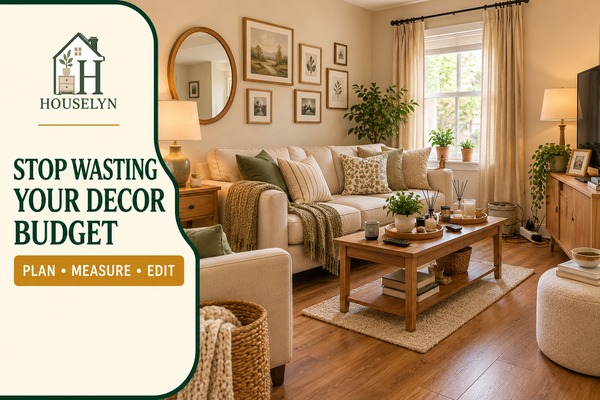
Chapter 7 — Avoid Wasted Money
Avoid Decorating Mistakes That Make a Small Budget Disappear
Budget decorating ideas can only stretch so far if money keeps disappearing into
purchases that do not solve a real room problem. The biggest budget leaks are often
not expensive statement pieces but repeated small mistakes: buying before measuring,
choosing decor because it is discounted, and adding accessories to a room that still
has unresolved scale or layout problems.
Decorating on a budget requires just as much attention to what you do not buy as to what
you bring home. A £15 purchase made five times without a plan can consume more money
than one carefully chosen £60 improvement that actually changes the room.
A limited budget goes further when purchases solve visible problems instead of creating
another layer of small, disconnected decor.
One of the fastest ways to waste a decorating budget is buying by eye and discovering
later that the rug is too small, the table is too wide or the wall art lacks enough
presence.
Budget decorating ideas should begin with dimensions because returning, replacing or
living with the wrong scale can cost more than measuring properly at the start.
Buying Because the Item Is on Sale
A discount changes the price, not whether the item belongs in the room. Sale purchases
often feel harmless because the saving is obvious while the unnecessary spending is
easier to ignore.
Decorating on a budget works better when the question is “Would I still want this at
its normal price?” rather than “How much am I saving?”
Buying Too Many Small Accessories
Candles, trays, miniature vases, ornaments and small frames can seem inexpensive
individually. Together, they can consume a significant part of the budget while leaving
the room visually under-scaled.
Budget decorating ideas usually become stronger when several weak purchases are replaced
by one more substantial improvement.
Choosing an Undersized Rug to Save Money
Buying the smallest rug available may reduce the initial cost, but it can leave the main
furniture group looking disconnected. That often leads to more purchases intended to
compensate for a problem created by scale.
A better approach is to test the required size first, then decide whether to wait, shop
secondhand, choose a simpler material or allocate more of the budget to the rug.
Trend Chasing
Replacing multiple items every time a trend changes turns low-cost decor into a
repeating expense.
Matching Sets
Buying an entire set for convenience can create unnecessary cost when only one or
two pieces are actually needed.
Low Curtains
Replacing acceptable curtain panels without first correcting rod position can spend
money without fixing the visual problem.
Storage Before Decluttering
Buying boxes and organisers before editing possessions can simply create better
containers for things you no longer need.
Replacing Instead of Restyling
Furniture and decor that only need better placement, framing or styling may be
replaced unnecessarily.
Ignoring Hidden Costs
Delivery, assembly, fixings, bulbs, frames and restoration can change the real cost
of an apparently cheap purchase.
Avoid Repeatedly Buying the Cheapest Version
The cheapest option can be good value when it performs well, but repeatedly replacing
a poor-quality basic can cost more than buying a more durable version once.
Budget decorating ideas should consider expected use. Frequently handled items, heavily
used storage and practical furniture may justify spending more than purely decorative
objects.
Do Not Buy Storage Before You Know What You Are Keeping
Storage products can feel productive, but purchasing them before decluttering can make
the room more crowded. The first step should be deciding what genuinely needs a home.
Decorating on a budget becomes more efficient when containers are purchased for known
quantities and specific locations.
Do Not Buy Decor Without Knowing Where It Will Live
A decorative object without a planned location often becomes clutter. The problem is
especially common with small items because they seem easy to fit somewhere later.
Budget decorating ideas should require every non-essential object to have a clear role
in the composition before it enters the home.
Avoid Matching Everything
Buying coordinated sets can seem like a shortcut to cohesion, but a room rarely needs
every lamp, side table, cushion or frame to match. Repeating only selected materials,
colours or shapes can create connection for less.
Decorating on a budget benefits from consistency without unnecessary duplication.
Do Not Replace Something Only Because It Is Not New
Age is not automatically a decorating problem. A well-made table, neutral sofa, wooden
frame or useful cabinet may only need to be restyled around newer elements.
Budget decorating ideas should reserve replacement for items that are damaged, badly
scaled, impractical or genuinely incompatible with the room.
Watch for False Economy
False economy occurs when saving on the initial price leads to greater spending later.
Examples include buying an undersized rug that is soon replaced, purchasing flimsy
storage repeatedly or selecting hardware that does not fit existing furniture.
Low price and good value are not the same thing.
Do Not Keep Shopping After the Problem Is Solved
One of the easiest ways to overspend is continuing to decorate after the room has reached
a comfortable level of completion. Once the layout, scale, lighting and visual balance
are working, additional purchases may provide very little return.
Decorating on a budget requires knowing when to stop.
By this point, the decorating budget should be more controlled: existing pieces have
been assessed, the highest-impact problems prioritized, useful items reused, targeted
upgrades made and unnecessary purchases filtered out.
The final chapter brings those decisions together into a complete room-refresh plan so
budget decorating ideas can be turned into a realistic sequence instead of a collection
of unrelated purchases.
Build a Complete Budget Room Refresh Without Changing Everything
Budget decorating ideas work best when individual decisions are combined into one
controlled room-refresh plan. Instead of replacing furniture, adding accessories and
changing colours at random, use the budget in a sequence that protects what already
works and concentrates money on the areas that will create the greatest improvement.
Decorating on a budget becomes easier when the project has a defined finish line.
Without one, a low-cost refresh can turn into months of small purchases that eventually
exceed the amount you would have willingly allocated at the beginning.
A successful budget refresh improves the weakest parts of the room while allowing
furniture and decor that already work to remain in place.
Decide what you are comfortable spending on the entire room rather than approving each
purchase separately. This gives every later decision a context.
Budget decorating ideas are easier to control when a £40 lamp, £60 rug or £25 set of
cushion covers is considered as part of the same total rather than as an isolated
affordable purchase.
Define What the Refresh Needs to Achieve
A room-refresh plan should have a small number of clear objectives. Perhaps the seating
area needs to feel more connected, the room needs better evening light, visible clutter
needs to be reduced or the walls need stronger scale.
Decorating on a budget becomes more focused when each proposed purchase can be linked
to one of those objectives.
Protect the Parts of the Room That Already Work
If the sofa is comfortable and correctly scaled, leave it alone. If the main furniture
arrangement functions well, do not move everything simply to make the refresh feel
larger.
Budget decorating ideas become expensive when good elements are replaced simply because
the room is undergoing an update.
Put the Largest Share of Money Into the Strongest Problem
The most important weakness should receive the largest share of the budget. That may be
a rug, lighting, curtains, wall treatment, storage or another feature with broad visual
influence.
Equal spending is not the goal. Improvement is.
The formula is intentionally adjustable. A room with a good rug may need almost nothing
allocated to the floor, while a dark room may deserve more of the budget for lighting.
A rented home may need more reversible solutions. A room with strong walls may need no
new artwork at all.
Example: A Room Refresh With a £200 Ceiling
A £200 ceiling does not guarantee the same result in every home, and prices vary by
product, retailer and what you already own. The useful part is the allocation method.
For example, a room might direct around £80 toward its strongest problem, roughly £40
toward lighting or textiles, about £30 toward wall improvement, around £30 toward a
functional need and keep approximately £20 available for finishing or unexpected costs.
Budget decorating ideas should use figures like these as decision boundaries, not as a
shopping list that must be spent completely.
You Do Not Have to Spend the Whole Budget
A spending ceiling is a maximum, not a target. If moving furniture, reusing frames and
improving a lampshade solve the room for less, the remaining money should stay unspent.
Decorating on a budget succeeds when the room improves, not when every available pound
has been assigned to a product.
A Practical Order for the Refresh
Clear and assess: remove temporary clutter and identify what stays.
Measure: confirm furniture, rug, wall and window dimensions where relevant.
Rearrange: test the layout before making purchases.
Solve the main problem: direct the largest share of the budget here.
Improve function: address lighting, storage or circulation where needed.
Add wall or textile support: connect colour, scale and visual balance.
Edit: remove anything that now feels unnecessary.
Stop: reassess before buying another finishing detail.
Refresh Lighting Before Assuming the Room Needs More Decor
A floor lamp, table lamp or improved bulb choice can change how the entire room is
perceived in the evening. Better lighting may reveal that the existing colours and
furniture are stronger than they appeared.
Budget decorating ideas should always allow the lighting correction to settle before
more decorative objects are added.
Use Textiles to Connect What You Already Own
Cushion covers, a throw or curtains can repeat colours already present in art, rugs,
timber or upholstery. This can make mismatched pieces feel more related without
requiring a coordinated furniture set.
Decorating on a budget is often about creating visual connections between existing
items rather than replacing each item until everything matches.
Use Wall Decor to Finish the Composition, Not Start It
Wall art is easier to choose once furniture placement, colour and lighting are stable.
At that point, you can see the actual amount of visual weight the wall needs.
Budget decorating ideas are less likely to waste money when wall purchases happen after
the furniture relationships are established.
Keep Functional Storage Visually Quiet
If the refresh requires new storage, choose it to solve a defined category of clutter.
Storage should make the room calmer rather than creating another visible collection of
boxes and containers.
The strongest solution may be one basket, a better-used drawer or a concealed cable
system rather than another storage unit.
Build in a Small Contingency
Small projects often reveal unexpected costs: a different fixing, replacement bulb,
delivery fee or additional frame mount. Keeping a small amount uncommitted prevents
these costs from forcing the project beyond its ceiling.
Decorating on a budget becomes more realistic when the plan accepts that not every cost
can be predicted perfectly.
Pause After Every Major Improvement
Once the main rug, lighting or wall problem has been corrected, stop and look at the
whole room again. The improvement may have solved several smaller problems automatically.
Budget decorating ideas should be reassessed as the room changes. A shopping list made
before the first improvement should not be treated as a contract.
Know When the Refresh Is Finished
A room is not unfinished simply because there is still money left or one empty wall
remains. If circulation works, lighting is comfortable, the main furniture feels
connected and the room has enough visual balance, continued shopping may weaken the
result.
That completes the room-by-room strategy behind this guide. The process began with
assessment, moved through priorities, reuse, upgrades and smarter sourcing, and ended
with a controlled refresh rather than an open-ended shopping cycle.
The next section answers the practical questions that commonly come up when applying
budget decorating ideas in real homes, including what to spend on first, how to make
inexpensive decor look better and whether a room can realistically be refreshed for
under £200.
Frequently Asked Questions
Budget Decorating Ideas: Common Questions Answered
Budget decorating ideas become easier to apply when you know what to prioritize,
what to reuse, where to save and when spending slightly more may produce better
long-term value. These answers bring the main principles together for practical
everyday decorating decisions.
1
What are the best budget decorating ideas?
The best budget decorating ideas usually begin with what you already own. Rearrange
furniture, improve lighting, correct scale problems, reuse frames, move mirrors,
refresh selected textiles and edit clutter before buying more decor. The strongest
savings come from making fewer, more deliberate purchases rather than collecting
many inexpensive accessories.
2
How can I decorate my home cheaply?
Start by setting a spending ceiling, identifying the room's biggest visual problem
and shopping your home before shopping elsewhere. Reuse furniture, move accessories
between rooms, consider suitable secondhand pieces and choose low-cost upgrades that
affect a larger part of the room. Cheap decorating works best when each purchase has
a specific purpose.
3
What should I spend money on first when decorating?
Spend first on the problem with the greatest visual or functional impact. That might
be a poorly scaled rug, weak lighting, curtains that are badly positioned, inadequate
storage or a blank wall that lacks enough scale. Do not divide the budget equally
across every category simply for the sake of balance.
4
How can I make cheap decor look expensive?
Focus on proportion, spacing, repetition and restraint. Affordable decor tends to
look stronger when there are fewer pieces, the scale suits the furniture, colours
connect with the wider room and objects have enough empty space around them. Good
placement often matters more than the original price.
5
How do I decorate without buying everything new?
Use the Houselyn Keep, Move, Improve or Replace approach. Keep what already works,
move useful pieces to better locations, improve items with small upgrades and replace
only what is damaged, impractical or badly scaled. This prevents a room refresh from
turning into an unnecessary full replacement.
6
What home decor is worth spending more on?
Spend more where durability, scale or daily use matters. Frequently used storage,
major lighting, a correctly sized rug or a practical piece of furniture may justify
more investment than decorative objects that are easy to change. The right answer
depends on how strongly the item affects the room and how often it is used.
7
What decor items can I buy cheaply?
Cushion covers, simple frames, selected baskets, small trays, printable artwork and
suitable secondhand decorative pieces can often be affordable. Lower price is most
useful when the item already fits the room's scale, colour palette and function.
8
Is thrift-store decor worth buying?
It can be excellent value when material, condition and dimensions are right. Mirrors,
picture frames, baskets, ceramic decor and small solid-wood furniture can be strong
secondhand candidates. Always consider cleaning, transport, repair and final cost
before deciding that the purchase is genuinely inexpensive.
9
What should I avoid buying secondhand?
Be cautious with heavily worn upholstery, mattresses, damaged electrical items,
unstable furniture, pieces with serious moisture damage and anything that cannot be
cleaned or used safely. A low purchase price does not compensate for poor hygiene,
structural problems or safety concerns.
10
How do I refresh a living room on a budget?
Begin with layout and clutter, then assess the rug, lighting, curtains, walls and
textiles. Keep major furniture that still works and direct most of the budget toward
the biggest weakness. Small, connected improvements usually create a more convincing
result than replacing the whole room.
11
How can I decorate a blank wall cheaply?
Reuse existing frames, group smaller pieces into one stronger composition, use
personal photography, consider printable art or move an existing mirror. The main
goal is enough visual scale. One substantial wall treatment can cost less than many
small purchases made over time.
12
What small home upgrades make the biggest difference?
Better lampshades, improved lighting, fresh cushion covers, correctly placed
curtains, updated compatible hardware and stronger wall framing can all create
visible change without replacing major furniture. Choose the upgrade that corrects
the most obvious weakness first.
13
Should I buy lots of small decor or one larger piece?
In many cases, one larger piece creates stronger visual impact and reduces clutter.
Several small objects can cost more collectively while still failing to fill the
visual space properly. Compare the total cost and final scale before buying either
option.
14
How can I make old furniture look better?
First check whether the furniture is structurally sound and correctly scaled. Then
consider better placement, updated compatible hardware, a refreshed finish where
appropriate or improved styling around it. Sometimes the furniture is not the
problem; the rug, lighting or surrounding decor may be making it look dated.
15
How do I avoid wasting money on home decor?
Measure first, wait before non-essential purchases, decide exactly where each item
will go and ask what problem it solves. Avoid buying purely because something is on
sale. A good purchase should improve function, scale, cohesion or visual impact.
16
How do I decorate with a very small budget?
Focus first on zero-cost changes: rearrange furniture, remove clutter, swap decor
between rooms, regroup frames and use empty space more deliberately. Then spend the
limited budget on one high-impact weakness rather than dividing it across several
minor purchases.
17
Can I update a room for under £200?
Sometimes, depending on what the room already has and the changes required. Treat
£200 as a spending ceiling rather than a guaranteed makeover formula. A room that
mainly needs lighting, textiles, wall styling or small functional improvements may
be much easier to refresh within that amount than a room needing major furniture.
18
How do I make mismatched decor feel cohesive?
Repeat selected colours, materials or shapes across the room instead of trying to
make everything match exactly. A few repeated tones in textiles, wood finishes,
frames or lighting can create connection between otherwise different pieces.
19
What makes cheap decor look cheap?
Poor scale, excessive quantity, obvious repetition, weak materials, bad placement
and disconnected colours can make inexpensive decor look less considered. The fix
is often editing, regrouping or improving proportion rather than replacing every
item with something more expensive.
20
What should I change first in a room that looks dated?
Identify the feature with the greatest visual influence. It may be lighting, window
treatment, a dominant textile, wall colour, furniture arrangement or one dated
finish. Start there, then reassess the room before changing anything else.
Houselyn Action Plan
The 6-Step Budget Decorating Action Plan
Budget decorating ideas are easier to put into practice when the process is reduced
to a clear sequence. Use these six steps to move from assessment to improvement
without allowing the project to turn into open-ended shopping.
1
Photograph and Assess the Room
Take a clear photograph from the main entrance or viewing point, remove temporary
clutter and identify what already works. Separate genuine problems from items that
simply need better placement or styling.
2
Choose the Highest-Impact Problem
Decide which issue weakens the room most. It may be the rug, lighting, curtains,
wall scale, storage, furniture position or another element that influences a large
part of the space.
3
Reuse and Reposition What You Already Own
Move furniture, swap lamps, regroup frames, relocate mirrors and test existing
baskets, textiles or accessories before buying replacements. Keep only the changes
that genuinely improve the room.
4
Set a Realistic Spending Ceiling
Decide the maximum amount you are comfortable spending on the refresh as a whole.
Treat that figure as a ceiling, not a target that must be completely used.
5
Upgrade Selectively
Spend on the smallest number of changes that create the greatest return. Improve
lighting, textiles, wall scale, hardware or storage only where those upgrades solve
a clearly identified problem.
6
Edit Before You Buy Anything Else
Step back, photograph the room again and remove anything that now feels unnecessary.
If the room already feels more balanced, useful and cohesive, stop the project there.
Conclusion
The Best Budget Decorating Ideas Start With Better Priorities, Not More Purchases
Budget decorating ideas are most effective when every decision begins with the room
you already have. A limited budget does not have to mean a collection of cheap,
temporary fixes. It can lead to a more thoughtful home when you assess first, spend
selectively and allow useful furniture and decor to keep working.
The central lesson is simple: price alone does not determine value. An inexpensive item
that is the wrong size, wrong colour or wrong function may cost more in the long term
than a slightly higher-priced piece that solves the room properly.
Decorating on a budget therefore depends on judgment more than volume. You do not need
to replace everything, fill every wall or follow every trend. You need to identify the
parts of the room that are weakening the whole composition and correct those first.
The Houselyn Budget Decorating Framework
Return to the Same Six Decisions
The entire guide can be reduced to one sequence. Use it whenever you refresh a room,
consider a new purchase or feel unsure about what to change next.
Assess before assuming that something needs replacing. Prioritize the change with the
greatest visual or functional impact. Reuse what can still serve the room. Upgrade only
where a targeted change will make a meaningful difference. Style the room so colours,
scale and materials connect. Then edit anything that no longer contributes.
Budget decorating ideas become especially effective when the process includes pauses.
After changing the rug, moving the furniture or improving the lighting, reassess the
whole room before continuing. One correction may solve several problems at once.
The same discipline applies to bargains and secondhand finds. A low price should never
be the main reason an object enters your home. Measure it against the space, the existing
palette, the practical need and the total cost of making it usable.
Decorating on a budget also means knowing when a room is finished. A room does not need
another object simply because there is space for one. Negative space, clear surfaces
and visual breathing room can make inexpensive pieces look stronger and help the home
feel calmer.
If several of those answers are unclear, wait. A pause costs nothing and often prevents
a purchase that would have added very little to the final room.
The most successful budget decorating ideas do not make a home look as though every
item was bought at once. They make the home feel considered. Existing pieces have a
purpose, new purchases solve real problems and the finished room feels comfortable,
useful and visually connected.
Continue Learning
Keep Improving Your Home With Smarter Decorating Decisions
If you want to keep building on these budget decorating ideas, these Houselyn guides
can help with overall home styling, small-space decisions and living-room improvements.
Build a more polished living room with better scale, styling and visual connection.
About the Author
Houselyn Editorial Team
Home Styling, Interiors & Practical Organization
The Houselyn Editorial Team creates practical home styling, decorating and
organization guides designed to help readers make thoughtful decisions about
everyday living spaces.
Explore More Home Decor, Small-Space and Living-Room Guides
Continue through the Houselyn Knowledge Library for related guidance on decorating,
room layout, wall styling, organization and making better use of the home you already
have.