Diagnose
Name the actual room problem.
Spend Smarter Avoid Costly Missteps Fix the Right Problem First

Decorating mistakes that waste money often happen because a purchase is made before the room problem is properly understood. New accessories, furniture or storage may feel productive, but spending rarely fixes poor scale, weak lighting, clutter or an unresolved layout unless the purchase addresses the real cause.
Many decorating mistakes that waste money also come from doing the right things in the wrong order—replacing before testing, buying before measuring, choosing finishing pieces before higher-impact needs, or considering the product price without the complete project cost.
This guide will help you recognise the decorating mistakes that waste money before they become purchases, so you can protect your budget for changes that genuinely improve how the room looks, feels and functions.
Name the actual room problem.
Decide whether it deserves money now.
Check scale, placement and fit.
Consider the complete expense.
THE HOUSELYN DECISION CHECK
Use these five checks before committing money to the next decorating decision.
CHAPTER 1
One of the most common decorating mistakes that waste money is deciding what to buy before deciding what is actually wrong. A room may feel unfinished, dark, cluttered or disconnected, but those descriptions are symptoms rather than shopping instructions.

Many decorating mistakes that waste money begin when an empty wall becomes “I need artwork,” a crowded corner becomes “I need storage,” or an uninspiring sofa becomes “I need new cushions.” The proposed purchase may be attractive, but it is only useful when it responds to the cause of the problem.
Poor lighting can flatten colours and make existing furniture look less appealing. An undersized rug can leave otherwise suitable seating feeling disconnected. Too many objects can make a room feel unfinished because there is no clear visual hierarchy. In each case, decorating mistakes that waste money happen when accessories are used to treat a larger relationship.
Before shopping, look at the room from the doorway and from the positions where you normally sit or move through it. Ask whether the weakness comes from scale, light, layout, storage, colour connection or function. This diagnostic pause prevents decorating mistakes that waste money from turning a vague feeling into several unnecessary purchases.
It also helps separate a genuine need from simple familiarity. Furniture can feel old without being unsuitable. Artwork can feel weak because it is positioned badly rather than because it needs replacing. Storage can feel insufficient because the room is holding too much. Avoiding decorating mistakes that waste money often begins by testing what can change before deciding what must be bought.
BEFORE YOU SHOP
If the sentence contains the name of a product, step back and describe the room condition instead. That small distinction helps prevent decorating mistakes that waste money from starting with the solution rather than the need.
CHAPTER 2
Some decorating mistakes that waste money begin with the assumption that anything tired, awkward or dated needs replacing. Before making that decision, test whether placement, styling, grouping or the surrounding room relationships are causing the problem instead.

Replacing a sofa because the room feels disconnected, buying new artwork because a wall feels weak or changing a table because the arrangement feels crowded can all become decorating mistakes that waste money when the object itself is not the real problem. Sometimes the relationship around the piece needs attention first.
Try moving furniture into a stronger relationship before judging it. Regroup artwork before replacing every frame. Restyle a shelf with fewer objects. Move a lamp to the area that actually needs another light level. These small tests help reveal whether decorating mistakes that waste money are being driven by the item or by how the room is using it.
Condition still matters. Furniture that is damaged beyond practical repair, genuinely unsuitable for the room or unable to meet everyday needs may deserve replacement. But decorating mistakes that waste money happen when style fatigue alone becomes enough reason to discard something that could still work successfully.
TEST BEFORE YOU REPLACE
Move it, remove competing pieces, restyle it or test a different position. If the problem remains after those changes, replacement becomes easier to justify. This simple sequence reduces decorating mistakes that waste money without forcing you to keep something that genuinely no longer works.
CHAPTER 3
Some decorating mistakes that waste money feel harmless because each purchase is small. Cushions, candles, baskets, ornaments and decorative accessories are easy to buy, but convenience should not allow finishing pieces to outrank the changes that would make the room work and feel better.

Decorating mistakes that waste money often develop one inexpensive item at a time. A room with poor lighting, weak furniture connection or an undersized rug may accumulate several decorative additions while the main weakness remains untouched. Each purchase can seem reasonable on its own, yet together they divert attention and budget from the stronger first move.
Lighting can affect atmosphere, colour perception and practical use at the same time. A correctly scaled rug can improve furniture connection and visual balance. Better curtains can change wall proportion and softness. When those relationships are weak, decorating mistakes that waste money occur when minor accessories are asked to create an improvement they are too small to deliver.
This does not mean every larger change should be expensive or immediate. Repositioning a lamp, editing a display or regrouping existing artwork may have more impact than buying several new objects. The goal is to identify the strongest problem first, then decide whether it requires spending at all.
PRIORITY CHECK
Before buying a finishing piece, compare it with the room's larger unresolved needs. If another change would improve scale, lighting, function or furniture connection more strongly, hold the accessory until that priority is settled.
CHAPTER 4
Some decorating mistakes that waste money are completely preventable because they begin with dimensions that were never checked. A piece can be attractive, affordable and well made, yet still be the wrong purchase if it does not fit the room, the furniture or the way people move through the space.
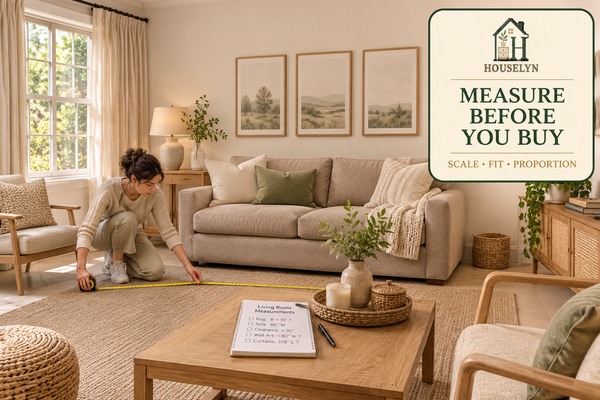
Decorating mistakes that waste money often appear when a product is chosen from memory, a photograph or a rough guess. A rug that looks generous online can feel undersized beneath the actual seating group. Artwork can arrive too small for the furniture below it. Curtains can technically cover a window while still lacking the width or drop needed to look properly considered.
Furniture needs enough room to function as well as enough room to enter the space. Coffee tables need practical clearance from seating. Rugs need to relate to the furniture arrangement rather than float independently beneath a small central area. These decorating mistakes that waste money usually happen when the product dimension is considered without the surrounding room dimension.
The same principle applies vertically. Wall art needs a usable wall width and a clear relationship to the sofa, bed or console below it. Curtains need the actual window frame, surrounding wall, floor distance and nearby obstructions to be considered. Measuring the relevant zone is more useful than relying on a standard product size.
MEASURE BEFORE YOU ORDER
Before buying, write down the room dimensions that affect the decision: furniture width, usable wall area, circulation, window clearance or floor coverage. This extra step reduces decorating mistakes that waste money caused by products that fit on paper but fail in the actual room.
CHAPTER 5
Some decorating mistakes that waste money happen because the price on the product page is treated as the whole cost. A purchase can look affordable until delivery, installation, preparation, hardware or supporting items are added to the same decision.

Decorating mistakes that waste money can begin with a product that appears to fit the budget but creates several additional costs. Curtains may need poles, rings or fitting. Wall treatments can require preparation materials. Furniture may involve delivery or assembly. Even a simple refresh can expand when the supporting expenses were never considered at the start.
This is especially important when comparing two options. One may cost more upfront but need little else, while another may appear cheaper until extra hardware, labour or replacement accessories are added. Decorating mistakes that waste money occur when the lowest visible price is mistaken for the lowest complete cost.
Costing the decision also makes it easier to protect the wider decorating budget. If one change consumes more than expected, lower-priority purchases can be delayed before the money is committed rather than after the room is already halfway through a refresh.
FULL-COST CHECK
Add delivery, installation, fitting, preparation, hardware, tools and any supporting pieces that are genuinely necessary. This makes decorating mistakes that waste money easier to spot before a purchase quietly grows beyond its original budget.
CHAPTER 6
Some decorating mistakes that waste money begin when a crowded room is treated as a storage or styling problem before anything has been edited. Adding baskets, organisers or more decorative pieces can make the room busier while leaving the real source of the visual weight untouched.
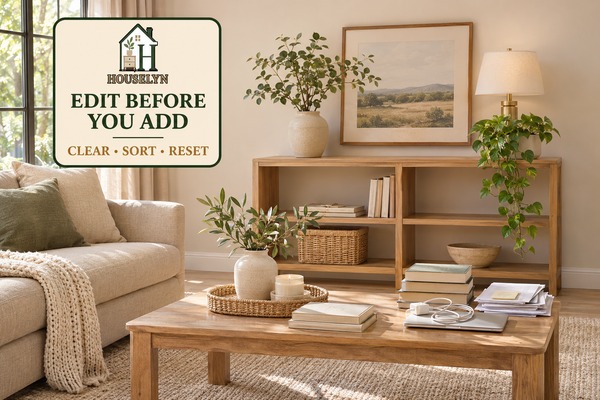
Decorating mistakes that waste money often happen when storage is purchased for belongings that should first be reviewed. A new basket can hide a pile, but it does not answer whether the contents belong in the room. A larger cabinet can create more capacity without improving the way the space feels or functions.
Start with visible surfaces. Remove objects that belong elsewhere, obvious duplicates and temporary items such as paperwork, packaging or things waiting to be moved. Then look again. Decorating mistakes that waste money become easier to avoid when the room is no longer being judged through layers of unnecessary objects.
Empty space is useful too. A clear section of a console, shelf or coffee table gives the objects that remain room to register. Filling every newly cleared surface can simply replace old clutter with new decor, which defeats the purpose of editing first.
EDIT BEFORE YOU ADD
Sort what is useful, what belongs elsewhere, what needs containing and what should leave. That sequence reduces decorating mistakes that waste money by making storage a response to a real need rather than a way to disguise excess.
CHAPTER 7
Some decorating mistakes that waste money happen after the room has already improved. A successful change can create momentum, but momentum is not the same as need. Once the original problem has been corrected, every remaining item on the shopping list deserves to be questioned again.

Decorating mistakes that waste money can develop when one improvement automatically triggers several others. A new rug may make existing cushions seem less exciting. Better lighting may suddenly draw attention to a side table. Fresh curtains may create the urge to change nearby artwork. None of those follow-up purchases are automatically necessary.
Give the room time to settle. Look at it in daylight and evening light. Use the space normally for several days. A stronger layout, better rug scale or improved lighting can make smaller concerns disappear because the room now has clearer visual structure.
Decorating mistakes that waste money also happen when empty space is mistaken for unfinished space. A clear wall, open shelf or uncluttered surface may be providing exactly the breathing room that the composition needs. More objects do not automatically make the room more complete.
STOP CHECK
Cross out anything that no longer solves a visible or functional problem. This simple review helps prevent decorating mistakes that waste money by allowing earlier improvements to remove later purchases from the plan.
THE HOUSELYN DECISION CHECK
The easiest way to reduce decorating mistakes that waste money is to slow the decision down before it becomes a purchase. Use the same five checks whenever something new enters the plan.
What exactly feels wrong or fails to function?
Does this matter more than the room's other weaknesses?
Will the solution work physically and visually?
What is the complete cost of making it work?
Should another change happen before this purchase?
WORKED EXAMPLE
The first shopping list includes cushions, artwork, storage baskets and a new side table. Before buying, the room is reassessed. Weak evening lighting, an undersized rug relationship and visible clutter are creating most of the discomfort. This prevents decorating mistakes that waste money by separating the real problems from the easiest purchases.
The clutter is edited first. Lighting is improved using what is already available, and the rug zone is measured before any replacement is considered. Several original purchases immediately become less important. That is why decorating mistakes that waste money often disappear when the order of decisions changes.
After the stronger issues are addressed, the room is reviewed again. If cushions or artwork still improve the composition, they can be considered with clearer purpose. If not, they leave the list. This final review prevents decorating mistakes that waste money from continuing simply because an earlier shopping plan existed.
FREQUENTLY ASKED QUESTIONS
These answers cover the decisions that most often turn a simple room refresh into unnecessary spending.
One of the most common decorating mistakes that waste money is buying before identifying the real room problem. A new accessory may feel useful, but it will not correct poor scale, weak lighting, clutter or an unresolved layout unless it directly addresses that issue.
Not automatically. Test position, styling and the furniture around it first. Decorating mistakes that waste money often happen when an item is replaced because it feels tired even though a different layout, rug, lighting treatment or editing would make it work again.
It can be. Several low-cost purchases can consume money without creating much improvement. Prioritise the changes that influence scale, function, lighting and furniture connection before adding finishing pieces.
Measuring helps prevent decorating mistakes that waste money caused by the wrong scale or fit. Check the relevant furniture, wall, floor, window and clearance dimensions instead of relying on memory or a product photograph.
Consider the product plus any required delivery, fitting, preparation, hardware, tools, assembly or supporting pieces. Decorating mistakes that waste money are easier to avoid when the complete project cost is visible before you commit.
Usually, edit first. Remove what belongs elsewhere, duplicates and anything no longer needed. Then decide what genuinely requires storage. This prevents the room from gaining more containers while keeping the same underlying clutter.
Look for balance rather than fullness. If the room functions well, the major visual relationships feel connected and remaining empty space feels calm, continuing to add objects can become another form of decorating mistakes that waste money.
Use the Houselyn decision check: Problem → Priority → Fit → Cost → Timing. If the purchase cannot clearly pass those five questions, delay it. That simple pause can prevent decorating mistakes that waste money before they enter the room.
FINAL TAKEAWAY
Avoiding decorating mistakes that waste money does not mean refusing to buy anything new. It means giving each purchase a clearer job. Diagnose the room, protect the strongest priorities, measure what matters, understand the complete cost and reassess the space before moving to the next item.
When those decisions happen in the right order, the budget can support improvements that genuinely change the room instead of disappearing into a series of disconnected purchases. The simplest defence against decorating mistakes that waste money is to make the room prove what it needs before the shopping begins.
CONTINUE LEARNING
Continue with the resource that matches the next decision in your room rather than restarting the decorating process.
Allocate the available budget around priorities and see how individual decorating decisions affect the wider plan.
Plan the BudgetWork through scale, layout, visual weight, lighting and clutter when the room feels wrong but the cause is unclear.
Diagnose the RoomUse worksheets, planners and checklists for measurements, priorities, budgets, decluttering and room-refresh decisions.
Browse the PrintablesUse calculators and planners when the next decision depends on measurements, proportion, layout, cost or priorities.
Explore the Tools
HOUSELYN KNOWLEDGE LIBRARY
Houselyn combines editorial guidance, interactive tools and printable planning resources so you can move from understanding the room to making a more deliberate next decision.
Better homes are built through thoughtful decisions, not constant replacement.
Plan a room update under £200 with Houselyn’s practical guide to reusing what works, prioritising high-impact changes and avoiding unnecessary decor spending.
Discover cheap home decor ideas that look polished, including affordable wall decor, textiles, lighting, thrifted finds and simple styling upgrades.