Protect What Works
Keep useful furniture and decor in the plan before considering replacement.
Keep What Works Spend Where It Shows Stop When It Feels Right
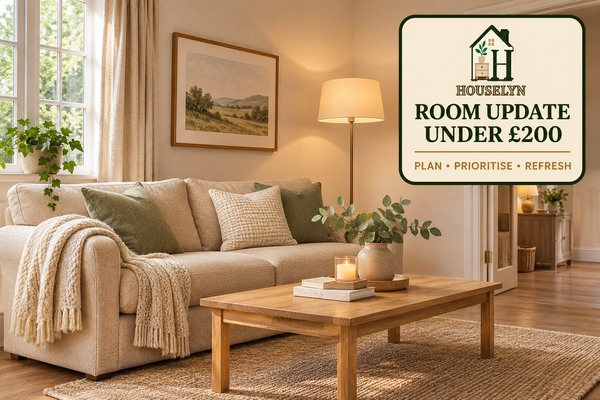
A room update under £200 can make a noticeable difference when the budget is concentrated rather than scattered. The goal is not to buy as many affordable things as possible. It is to work out which few changes will improve the largest part of the room while protecting the furniture, decor and finishes that are already doing their job.
That usually means looking past the first shopping list. A room that feels flat may need better lighting rather than more accessories. A seating area that feels disconnected may need stronger scale or placement rather than a new sofa. A surface that feels unfinished may simply need editing before anything else is added.
Houselyn approaches a room update under £200 as a sequence of decisions: protect what works, correct the strongest weakness, connect the room with the right layers, finish only where something is still missing, and stop when the room feels resolved.
HOUSELYN BUDGET PRINCIPLE
Small budgets lose impact when they are divided across too many unrelated purchases. The stronger approach is to identify the change that affects the most visible or useful part of the room first, then reassess what is still needed.
Keep useful furniture and decor in the plan before considering replacement.
Prioritise changes that influence a large visual area or everyday function.
Add smaller details only after the room's main relationships are working.
THE HOUSELYN £200 ROOM REFRESH FRAMEWORK
The £200 is a ceiling, not a target. If the room is solved before the budget is exhausted, the remaining money stays unspent.
CHAPTER 1
A room update under £200 works best when the money responds to a clear room problem. Before deciding how much to spend on lighting, textiles, wall decor or storage, work out what is actually making the room feel unfinished, dated or disconnected.
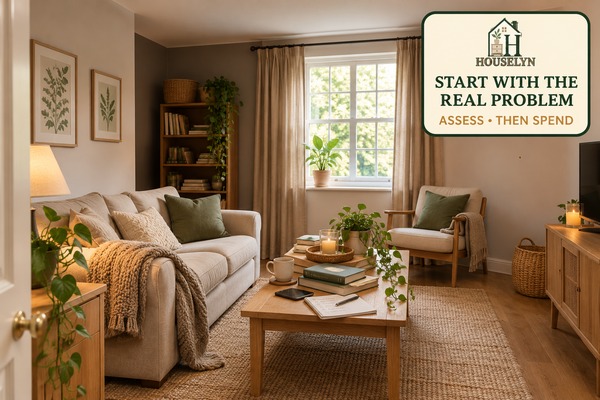
Many plans for a room update under £200 start with products instead of problems. A reader sees an empty wall and thinks “art,” notices a tired sofa and thinks “cushions,” or sees a crowded corner and thinks “storage.” Those ideas may eventually be useful, but they should not become purchases until the underlying room condition is clearer.
Step back and look at the room from the doorway. Notice where the eye stops, where the layout feels awkward and which areas disappear into shadow. A room update under £200 has limited room for trial and error, so every early decision should help explain what is genuinely missing.
BEFORE → AFTER THINKING
“The room feels boring, so I need new cushions, prints and accessories.”
“The room needs better evening light, clearer surfaces and stronger connection between the seating.”
Once the problem is named, the budget can start working intelligently. If the room is too dark, lighting deserves attention before accessories. If the furniture feels disconnected, layout or rug scale may matter more than wall decor. If the surfaces are crowded, editing may improve the room before any money is spent.
This is where a room update under £200 becomes less about shopping and more about sequencing. The strongest first move is usually the one that improves the largest visual or functional weakness, not the one that is easiest to add to a basket.
QUICK WIN
A phone photo often makes weak scale, clutter and disconnected furniture easier to notice than standing inside the room. Use that image to decide what a room update under £200 actually needs to solve first.
CHAPTER 2
A room update under £200 becomes much easier when the budget is not expected to replace the largest pieces in the room. Sofas, tables, storage furniture, chairs and lamps can often stay if they are still comfortable, functional and appropriate for the space.
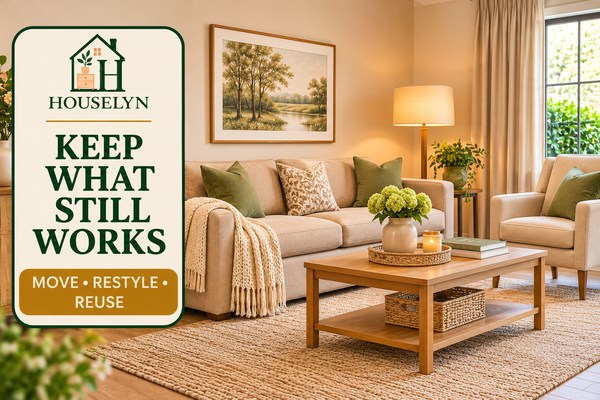
The largest objects naturally attract blame when a room feels tired. A beige sofa may suddenly seem dated, a side table may feel too ordinary or an old lamp may appear to be holding the room back. But a room update under £200 should test those assumptions before replacement becomes part of the plan.
Look first at the relationships around the object. A sofa can feel flat because the lighting is weak, the cushions are competing with one another or the rug does not connect the seating area. A useful table can feel awkward simply because too many objects are sitting on it. Changing the surrounding context may restore the piece without consuming the budget.
BEFORE → AFTER THINKING
“The sofa looks tired. I probably need a new one.”
“The sofa still works. The lighting, textile mix and furniture connection are making it feel weaker than it is.”
Repositioning can be surprisingly effective. Pull a chair into the conversation area, move a lamp closer to where light is needed, simplify the coffee table or remove one competing side piece. A room update under £200 gains more flexibility when the existing furniture is treated as an asset rather than an obstacle.
QUICK WIN
Take away half the cushions and decorative objects, move one furniture piece into a stronger position and reassess the room in daylight and evening light. That simple test can show whether a room update under £200 needs new products at all.
CHAPTER 3
A room update under £200 has more impact when the budget is concentrated on changes that influence a large part of the room. The strongest purchase is not necessarily the cheapest item or the biggest object. It is the one that solves an important problem and changes how the space looks, feels or functions.

It is easy to divide a room update under £200 into small purchases because each one feels manageable: cushions, candles, baskets, frames, ornaments and another decorative object for an empty surface. The problem is that several affordable additions can use a surprising share of the budget without correcting the reason the room still feels weak.
Look instead for visual reach. Lighting can change the atmosphere of an entire seating area. Curtains occupy a large vertical surface and can influence softness, height and colour balance. A correctly scaled rug can connect furniture that previously appeared to float independently. Each of those decisions can affect more of the room than another small accessory.
BEFORE → AFTER THINKING
“I can stretch the budget across cushions, candles, baskets, prints and several decorative pieces.”
“I will solve the strongest room problem first, then decide whether any smaller finishing pieces are still necessary.”
Imagine a living room with usable furniture but weak evening light, thin curtains and several small accessories already competing for attention. Buying more finishing decor would add objects without changing the atmosphere. A better lamp or a stronger window treatment may produce a clearer improvement because it addresses something the whole room is experiencing.
That does not mean every room needs a lamp, curtains or a rug. A room update under £200 should select only the category that answers the diagnosed problem. If the lighting already works, protect that money. If the existing rug is correctly sized, leave it alone. The purpose of prioritising is to remove unnecessary options as confidently as you identify useful ones.
PRIORITY CHECK
Compare each possible purchase by visual reach, everyday function and the severity of the problem it solves. If a lower-cost item adds decoration but leaves the main weakness untouched, it should not automatically outrank the stronger change.
Use the Decor Upgrade Priority CalculatorHOUSELYN RECOMMENDED ESSENTIALS
These are alternatives, not a three-item shopping list. Choose the category only when it solves the strongest problem you identified earlier.
Best for: dark seating areas, flat evening light and rooms relying too heavily on one ceiling light.
Why Houselyn recommends it: a secondary light source can change both atmosphere and function without requiring furniture replacement.
Avoid if: the room already has useful layered lighting and the real weakness is elsewhere.
Shop Current Floor Lamp OptionsBest for: windows that feel bare, visually short or disconnected from the rest of the room.
Why Houselyn recommends them: curtains cover a large visual area, so proportion and fabric can soften the room more effectively than several small decorative pieces.
Avoid if: the existing curtains already fit, hang well and support the room palette.
Shop Current Curtain OptionsBest for: seating that feels visually disconnected because the existing rug is absent or incorrectly scaled.
Why Houselyn recommends it: the right floor layer can connect several pieces at once, making the entire seating zone feel more intentional.
Avoid if: buying the correct scale would consume too much of the budget or the existing rug already works.
Shop Current Living Room RugsHouselyn buying rule: one well-chosen solution is stronger than three unnecessary purchases. Measure and assess the room before ordering.
CHAPTER 4
A room update under £200 can feel far more substantial when attention moves from small objects to the surfaces that occupy the most visual space. Walls, large artwork zones and reflective surfaces influence how complete, balanced and intentional the whole room appears.

A common room update under £200 mistake is to treat every empty area as a separate decorating opportunity. One small frame goes above the sofa, another object fills the console and several inexpensive pieces gradually spread across the room. Each addition may be attractive, yet the overall composition can still feel fragmented because the largest surfaces have never been resolved.
Start with proportion. A wide sofa may need one substantial artwork arrangement rather than a small isolated print. A dark corner may benefit from a mirror if it can reflect useful light or strengthen the wall composition. A plain wall may need colour, texture or simply better editing rather than another cluster of unrelated accessories.
BEFORE → AFTER THINKING
“The wall feels empty, so I will keep adding small prints and decorative pieces until it looks finished.”
“The wall needs one clearer focal relationship with the furniture below it, not more objects.”
The strongest solution may cost very little. Existing prints can be reframed or regrouped. One mirror can replace several smaller wall objects. A controlled wall treatment can create a focal plane without requiring the entire room to change. The point is to decide what the surface needs before deciding what to buy.
That makes a room update under £200 easier to control because the wall becomes a composition rather than a collection of purchases. Once one large visual relationship feels settled, nearby shelves, tables and accessories often need less decoration too.
QUICK SCALE CHECK
Step back far enough to see the whole wall, not just the empty patch. Compare the width and visual weight of the artwork, mirror or treatment with the sofa, console or bed that anchors the area.
Use the Wall Art Size CalculatorHOUSELYN RECOMMENDED ESSENTIALS
These are alternative ways to solve a large-surface problem. Choose the one that matches the wall rather than combining all three into another shopping list.
Best for: one suitable focal wall that needs colour, texture or definition without a full-room redecorating project.
Why Houselyn recommends this type: one controlled surface can create more visual change than several small accessories spread around the room.
Avoid if: the surface is unsuitable, the room already has a strong focal treatment, or tenancy rules do not permit the change.
Shop Current Wall Treatment OptionsBest for: a wall that needs stronger scale, useful reflection or a clearer focal element.
Why Houselyn recommends this type: one appropriately proportioned mirror can occupy a meaningful visual area without adding the busyness of several smaller decorative objects.
Avoid if: it will reflect clutter, an unattractive view or create an awkward relationship with existing artwork.
Shop Current Wall Mirror OptionsBest for: artwork, photographs or prints you already own but have never displayed with enough cohesion.
Why Houselyn recommends this type: better framing can upgrade existing material without requiring a completely new art collection.
Avoid if: the goal is simply to fill every gap. Plan the composition before purchasing the frames.
Shop Current Frame OptionsHouselyn buying rule: solve one wall deliberately before decorating several walls casually. Measure first and let scale lead the purchase.
CHAPTER 5
A room update under £200 can feel warmer and more complete without replacing the furniture. Once the larger room problems are under control, lighting quality, textile texture and repeated colour can change how the existing pieces relate to one another.

Textiles are tempting during a room update under £200 because they are easy to change and available at almost every price point. But adding more cushions or throws does not automatically make a room feel layered. The strongest result usually comes from editing first, then repeating a small number of colours and textures with purpose.
Lighting works in much the same way. A room can look calm in daylight but lose depth after sunset if every corner depends on one bright ceiling source. Before buying another lamp, check what can be improved through placement, bulb warmth or a better shade on a lamp you already own.
BEFORE → AFTER THINKING
Five unrelated cushions, a throw added simply because the sofa looks bare, and one cool overhead light doing all the work.
Fewer cushions repeat two established room colours, one textured throw adds softness, and warmer secondary light gives the seating area more depth.
Imagine a cream sofa with navy in the artwork, warm timber nearby and a small amount of muted green elsewhere in the room. The sofa does not need five new colours. Two or three cushion covers that repeat navy, cream or soft green can make the artwork, seating and surrounding decor feel connected. A textured throw can add depth without introducing another competing palette.
That same restraint helps a room update under £200 look more expensive than the individual purchases suggest. The eye reads repetition as intention. When colour, light and texture echo one another, the room feels composed rather than accumulated.
THE HOUSELYN LAYER CHECK
Does it improve a dark area or create a better evening atmosphere?
Does it repeat a colour that already belongs in the room?
Does it add useful softness or depth rather than more visual noise?
Will it actually be used, or is it filling space because the space is empty?
HOUSELYN RECOMMENDED ESSENTIALS
Buy these only where the existing room has earned the layer. The aim is to improve what you already own rather than replace usable pieces.
Best for: useful cushion inserts whose colours or patterns no longer support the room.
Why Houselyn recommends this type: changing the cover can refresh colour and texture while keeping an insert that still works.
Avoid if: the sofa already has enough cushions or the existing covers support the room palette.
Shop Current Cushion Cover OptionsBest for: seating that needs softness, tactile contrast or one repeated room colour.
Why Houselyn recommends this type: one useful textile can soften a large furniture surface while visually connecting nearby colours and materials.
Avoid if: another throw already performs the same visual and practical job.
Shop Current Throw OptionsBest for: an existing lamp with a useful base but a tired, damaged or poorly proportioned shade.
Why Houselyn recommends this type: updating the shade can change the appearance and diffusion of an existing lamp without buying an entirely new fitting.
Avoid if: the lamp itself is unsafe, damaged or unsuitable for the location.
Shop Current Lampshade OptionsHouselyn buying rule: use a new layer to connect something that already exists. Do not introduce a new colour, texture or object simply because it is inexpensive.
QUICK WIN
Choose two colours already visible in the artwork, rug, curtains or furniture and repeat them selectively. This gives a room update under £200 a deliberate palette without requiring an entirely new decorating scheme.
CHAPTER 6
A room update under £200 should become quieter as it approaches the finishing stage. Once lighting, scale, colour and the larger room relationships are working, the final task is not to fill every empty surface. It is to decide which spaces still need something and which are already doing useful visual work by remaining clear.

The finishing stage is where a room update under £200 can quietly drift off course. A shelf has one open section, the coffee table still has space and a wall feels calmer than expected. Those empty areas can start to look like unfinished tasks, especially when money remains in the budget.
But visual breathing room is part of the composition. A lamp feels more important when it is not surrounded by several small objects. Artwork reads more clearly when neighbouring wall space is not competing for attention. A coffee table can feel more considered with one useful grouping than with every corner occupied.
BEFORE → AFTER THINKING
“There is still space on the shelf, table and wall. The room must need more decor.”
“The strongest pieces already have enough support. The empty areas are helping the room feel calmer.”
Start by editing each surface down to what it needs to communicate. A coffee table may need one tray, a book and one small object rather than six separate pieces. A console may need a lamp, one framed item and enough clear surface to keep the arrangement useful. Shelves can mix storage, books and decor without turning every compartment into a display.
This is also where existing objects often become more useful. A vase moved from a crowded shelf may work better on a simple console. Books can create height under an object you already own. A basket that once looked decorative may become purposeful storage after clutter has been edited.
THE HOUSELYN EDITING TEST
Take one object away from the surface.
Look at the whole arrangement rather than the empty patch.
Adjust spacing, height and grouping using what remains.
Add something only if the composition genuinely became weaker.
QUICK WIN
Remove everything from a coffee table, shelf or console and return only the pieces that improve function, height, texture or visual balance. This can make a room update under £200 feel more polished without spending anything.
CHAPTER 7
A room update under £200 is only successful if the final total still respects the budget after delivery, fittings, small extras and last-minute additions are included. The goal is not to spend exactly £200. It is to make the room feel noticeably better without letting the project drift beyond the amount you chose.
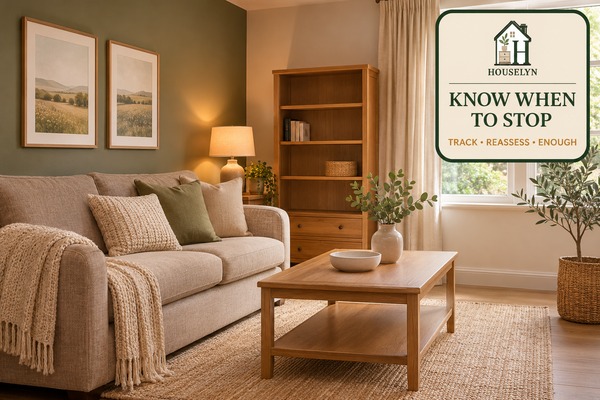
Budget drift often happens after the main decisions have already been made. A lamp needs a bulb. A wall treatment needs tools or preparation. A frame needs fittings. A delivery charge appears at checkout. None of those costs seems large on its own, but together they can push a room update under £200 beyond the limit.
Build those extras into the plan before the first order is placed. Keep a simple running total and update it whenever the project changes. If one category costs more than expected, rebalance the remaining plan instead of treating the overspend as unavoidable.
BEFORE → AFTER THINKING
“I have £36 left, so I should find something else to add.”
“The room feels balanced at £164. The remaining £36 stays unspent.”
THE HOUSELYN BUDGET DRIFT CHECK
What does the item itself cost?
Is shipping included or added later?
Does it need bulbs, hooks, rails, fixings or another supporting part?
Will the room need tools, cleaning, filling, measuring or surface preparation first?
Does one purchase create pressure for another purchase to make it work?
Is the completed change still worth the total amount it requires?
REALISTIC HOUSELYN EXAMPLE
Imagine that the main room problem was weak evening lighting and a disconnected textile palette. The existing furniture stayed. A better lighting solution was introduced, cushion covers were simplified, one useful textile layer connected the colours, and the coffee table was edited rather than restocked.
At that point, the room feels warmer, calmer and more connected. There is still money available, but another basket, ornament or wall piece would not solve a remaining problem. The strongest room update under £200 ends there.
HOUSELYN DECISION TOOLS
Use the budget planner to control where the money goes, then use the cost planner when you need to account for the broader cost of the room refresh.
BUDGET ALLOCATION
Divide the available budget between priorities, practical needs and finishing layers before purchases begin.
Plan the Decorating BudgetFULL COST CHECK
Look beyond individual product prices and account for the wider costs attached to the refresh.
Check the Full Refresh CostFINAL DECISION CHECK
What room problem would this purchase solve now?
If you cannot answer clearly, stop. That is often the point where a room update under £200 becomes a successful room refresh rather than a continuing shopping project.
THE HOUSELYN £200 ROOM REFRESH FRAMEWORK
A room update under £200 becomes easier to manage when every decision has a clear place in the sequence. The Houselyn framework is designed to stop the budget being scattered across unrelated purchases and keep attention on what will make the room feel genuinely better.
Protect furniture, lighting, textiles and decor that are still useful. A room update under £200 gains flexibility when the budget is not spent replacing pieces that already work.
Ask: What can stay exactly as it is?
Identify the strongest visual or functional weakness and direct the first meaningful spend there.
Ask: What one problem is affecting the most room?
Use placement, lighting, scale, repeated colour and texture to make existing elements feel as though they belong together.
Ask: What relationship still feels disconnected?
Add only the details still needed once the larger room relationships are working.
Ask: Is something genuinely missing, or is the space simply empty?
End the project when the room feels balanced and functional, even if part of the budget remains.
Ask: What problem would another purchase solve now?
FULL HOUSELYN WORKED EXAMPLE
Consider a living room with usable furniture, weak evening lighting, crowded surfaces and textiles that no longer feel connected. The first instinct is to create a broad shopping list because several areas appear unfinished.
The sofa is comfortable. The chair works. The coffee table is the right size. The side table is useful. Yet the room feels flat because the evening light is weak, the cushion colours compete, and too many small objects sit on the visible surfaces.
The original room update under £200 shopping list includes new cushions, wall art, baskets, a lamp, decorative objects and another throw.
Keep the sofa, chair, tables, existing artwork and useful lamp base. Remove the idea that every visible object needs replacing.
The room loses depth after sunset, so lighting becomes the first priority. The existing lamp is repositioned and its shade reviewed before another fitting is considered.
Instead of buying several new cushions, keep the existing inserts and use fewer covers that repeat colours already present in the artwork and surrounding room. One textured layer adds warmth without introducing another competing palette.
The coffee table is cleared and rebuilt with a smaller grouping. A crowded shelf is simplified. Existing objects are moved before anything new is considered.
After the lighting, textiles and editing are addressed, the room feels warmer and more connected. Some of the original shopping list is no longer necessary.
That is the point where a room update under £200 becomes more valuable: the budget has solved the room instead of simply funding the original list.
BEFORE → AFTER DECISION
“How much decor can I get for £200?”
“What are the few changes capable of making this particular room feel better?”
HOUSELYN PLANNING RESOURCES
Use these Houselyn tools and printables when the next decision needs more structure. Prioritise the strongest change, allocate the budget, check the full cost and keep the plan visible as the room develops.
INTERACTIVE TOOL
Compare possible improvements by room relevance, impact, need and timing before an easy purchase outranks a stronger room decision.
Decide What to Upgrade FirstINTERACTIVE TOOL
Protect the reserve, remove categories you already have and direct the available budget toward the room priorities that matter most.
Build the Decorating BudgetFREE 5-PAGE PRINTABLE
Assess the room, score possible upgrades and turn a long decorating wish list into a clear priority order before shopping begins.
Open the Priority WorksheetFREE 5-PAGE PRINTABLE
Set the project budget, protect essential spending, allocate category limits and track actual purchases against what remains.
Open the Budget PlannerFREE COST WORKSHEET
Record products, delivery, labour, installation, tools, fixings and preparation so the room plan reflects more than the headline product prices.
Open the Cost WorksheetHOUSELYN DOWNLOAD LIBRARY
Browse the complete Houselyn collection of free decorating planners, worksheets and checklists.
FREQUENTLY ASKED QUESTIONS
These questions cover the practical decisions that often come up once the decorating plan moves from ideas to actual spending.
Yes, if the budget is concentrated. A room update under £200 is more likely to feel successful when it improves one or two important room relationships—such as lighting, scale, textiles or wall composition—rather than being divided across many unrelated accessories.
Start with the problem that affects the largest useful or visible part of the room. If poor lighting is making the whole space feel flat, solve that before buying cushions. If furniture feels disconnected, look at layout or scale before adding wall decor.
Usually only when the furniture is genuinely unsuitable, damaged or no longer functional. A room update under £200 becomes easier to control when sofas, tables, chairs and storage that still work are kept and improved through better placement, lighting and styling.
It can be, especially when one wall or area needs a stronger visual foundation. But paint should solve a clear room problem rather than become an automatic first purchase. Account for preparation, tools and materials as well as the paint itself.
Editing clutter, repositioning furniture, improving lamp placement, simplifying cushion colours, reframing existing artwork and restyling surfaces can all help before major spending begins. The best change depends on what is making the room feel tired in the first place.
Use repetition and restraint. Repeat a limited colour palette, choose scale deliberately and leave breathing room around important pieces. A room update under £200 can look more considered when fewer items are clearly connected instead of many inexpensive pieces competing for attention.
Track the full cost of each decision, including delivery, fixings, bulbs, tools, preparation and any supporting items needed to make the purchase work. Keep a running total and rebalance the remaining plan whenever one category costs more than expected.
Stop. A room update under £200 does not become more successful by reaching exactly £200. If the room feels balanced, useful and connected at a lower total, the remaining money should stay unspent.
FINAL HOUSELYN PRINCIPLE
A successful room update under £200 is not measured by how many new things enter the room. It is measured by whether the space feels more useful, more connected and more intentional when the work is finished.
Keep the furniture that still earns its place. Correct the strongest problem before spreading money across smaller ones. Use light, scale, colour and texture to connect what you already own. Add finishing details only when the room still needs them.
And when the room feels resolved, stop. If a room update under £200 reaches that point before the full budget is spent, the remaining money is not evidence that something is missing. It is evidence that the plan worked.
The goal is not to prove how much you can buy for £200. It is to make the room noticeably better while buying only what the room has earned.
CONTINUE LEARNING
Continue with the room decision that still needs clarity rather than restarting the decorating process from the beginning.
DIAGNOSE THE ROOM
Look at scale, placement, visual weight, lighting, colour and clutter when the room feels wrong but the cause is difficult to identify.
Diagnose the RoomPLAN THE BUDGET
Allocate a fixed decorating budget around the areas most likely to improve the room instead of dividing the money evenly across categories.
Plan the BudgetDOWNLOAD & PLAN
Use Houselyn worksheets, planners and checklists to make decorating decisions visible before purchases or room changes begin.
Browse Free PrintablesMEASURE & DECIDE
Use calculators and planners for rugs, curtains, wall art, layouts, budgets, costs and decorating priorities before making the next move.
Explore the Free Tools
HOUSELYN KNOWLEDGE LIBRARY
Houselyn combines practical decorating guidance with calculators, planners, worksheets and checklists designed to reduce uncertainty before you move, replace or buy.
Better homes are built through thoughtful decisions, not constant replacement.
Affordable living room refresh ideas to improve your space with smarter layout, lighting, textiles, wall styling and targeted upgrades without replacing everything.
Cheap decor looks cheap when scale, styling and finishes feel disconnected. Learn how to make affordable decor look more intentional with Houselyn.