Affordable Living Room Refresh Ideas That Make the Room Feel New
Houselyn Budget Decorating Guide
Affordable living room refresh decisions become easier when you stop asking what you
should buy and start asking what is making the room feel tired. A room can often feel
noticeably better after a handful of targeted changes to layout, lighting, textiles,
wall balance and styling—even when the main furniture stays exactly where it is.
A living room refresh should not automatically begin with a new sofa, coffee table or
complete decorating scheme. In many homes, the better starting point is to identify the
few details creating the most visual drag, then improve those first.
That might mean removing unnecessary accessories, improving the furniture arrangement,
changing cushion covers, strengthening a dark corner with better lighting or replacing
one weak decorative element instead of the entire room.
Disclosure: Houselyn may earn a commission from qualifying purchases
made through selected affiliate links in this article, at no additional cost to you.
A successful refresh changes how the room feels before it changes how much you own.
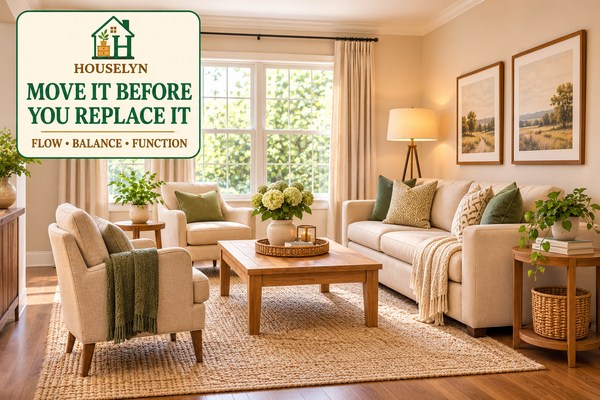
Refresh Before You Replace
A Living Room Can Feel New Without Becoming a Different Room
A tired living room is not always an outdated living room. Sometimes the problem is
visual accumulation: too many accessories, weak lighting, furniture that has drifted
into an awkward arrangement or textiles that no longer connect the room.
Keep What Still Works
Useful furniture should not be replaced simply because the room needs a visual
reset.
Change What the Eye Notices First
Layout, lighting, textiles and wall balance often create more impact than another
decorative purchase.
Stop When the Room Feels Balanced
A refresh should solve the weak points rather than become an open-ended shopping
project.
A successful living room refresh changes how the room feels while allowing most of what
you already own to remain useful.
Start by looking at the room from the doorway and from the main seating position.
Notice where the eye stops, which areas feel heavy or empty and whether the furniture
arrangement supports how the room is actually used.
Then separate the room into layers. Layout comes before accessories. Lighting comes
before decorative detail. Textiles can change colour and softness without replacing
furniture. Wall decor can restore visual balance when it is correctly scaled. Only
after those layers are working should a new purchase become the solution.
Chapter 1 — Diagnose Before You Buy
Start an Affordable Living Room Refresh With a Room Audit
The fastest way to waste money on a living room refresh is to shop before you know what
is actually making the room feel tired. Start by separating the room into its working
layers—layout, lighting, textiles, walls, surfaces, storage and visual clutter—so you can
see which parts still work and which ones are creating the most drag.
A room can feel dated even when the furniture itself is perfectly usable. A sofa may still
be comfortable, but weak cushion combinations can make it look flat. A good coffee table
may feel messy because too many objects sit on it. A room may seem dark because the
lighting is concentrated in one ceiling fixture rather than because the wall colour needs
changing.
The purpose of the audit is to identify those differences before a full makeover becomes
the default answer.
Look at the whole room before changing one object. The strongest refresh usually begins
with identifying which layer is weakening the space.
Take one photograph from the doorway and another from the main seating position. A photo
often makes imbalance easier to see because you are looking at the room as a flat
composition instead of moving through it.
Notice where the eye stops first. Look for dark corners, crowded surfaces, undersized wall
decor, furniture that blocks circulation and areas where several decorative objects are
competing for the same visual role.
Separate “Tired” From “Broken”
A tired-looking object does not always need replacing. A sideboard may simply need fewer
objects on top. A sofa may need refreshed textiles rather than new upholstery. Curtains
may need better positioning rather than replacement.
Replacement should be reserved for pieces that no longer function properly, are in poor
condition or remain visually weak after the surrounding room has been improved.
Check the Layout Before the Decor
Decorative changes cannot fully solve a furniture arrangement that makes the room awkward
to use. Check whether conversation feels natural, whether the main walkway is clear and
whether the sofa, chairs, coffee table and rug behave like one seating zone.
If the room feels fragmented, Chapter 3 will address repositioning in more detail. At this
stage, simply mark the layout as something to keep, adjust or reconsider.
Look at Lighting at Different Times of Day
A room that looks pleasant in daylight may feel flat after sunset. Notice whether all the
useful light comes from one ceiling fitting, whether corners disappear into shadow and
whether there is enough light near the main seating area.
Lighting problems are easy to misdiagnose as colour or decorating problems. Record them
separately so later purchases solve the right issue.
Use Keep, Adjust, Refresh and Replace in That Order
The order matters. Start with what can stay. Then identify what can improve through
movement or editing. Next consider softer refreshes such as textiles, lighting and styling.
Replacement should come last.
This prevents one weak detail from turning into a chain reaction. A room does not need a
new coffee table because the tabletop is cluttered, and it does not need a new sofa because
the cushions no longer relate to the rug.
Identify the Three Weakest Layers
After completing the audit, choose no more than three areas that are creating the biggest
visual or functional problem. These become the refresh priorities.
If layout, lighting and textiles score poorly, focus there first. Leave smaller issues
alone until those larger layers improve. The room may need far fewer purchases once the
main problems are corrected.
The audit tells you what deserves attention. The next step costs nothing: remove the
visual noise that is preventing the room's strongest pieces from being seen clearly.
Remove Visual Noise Before You Spend on New Living Room Decor
Once you know what is making the room feel tired, the next step is to remove what is
competing with the strongest parts of the space. Editing costs nothing, yet it can make
furniture, lighting and wall decor look more intentional before a single new item enters
the room.
Visual clutter is not always the same as physical mess. A room can be tidy and still feel
overloaded because too many decorative objects are trying to attract attention at once.
Multiple trays, cushions, framed photographs, candles, ornaments and small storage pieces
can gradually reduce the breathing room around the furniture.
Editing surfaces and removing duplicate decorative roles can make an existing living
room feel lighter before anything new is purchased.
The coffee table is often one of the first surfaces to become overloaded because it sits
in the centre of the seating zone. Remove everything first, then return only the items that
genuinely improve the table's function or visual balance.
A book stack, tray, bowl or small vase may be enough. If every object is decorative, the
surface can quickly feel staged rather than usable.
Reduce Cushion Quantity Before Buying New Covers
Sofas can look tired because the cushion mix is too busy rather than because the cushions
themselves are outdated. Remove extras and look at the sofa again before deciding what
needs refreshing.
The aim is to support comfort and colour without hiding the shape of the sofa under layers
of textiles.
Simplify Shelves and Consoles
Shelves and consoles tend to collect decorative duplicates: several small vases, multiple
candles, too many frames or objects that have no clear relationship to each other.
Keep stronger pieces, vary height carefully and allow sections of the surface to remain
empty. A calmer display can make the furniture itself look more substantial.
Control Visible Cables and Everyday Items
Chargers, remote controls, game accessories and device cables can make an otherwise
polished room feel unfinished. These items are functional, so the goal is not to pretend
they do not exist. Give them a practical home that keeps the main visual field calmer.
Do Not Replace Clutter With Decorative Storage Clutter
Storage baskets, boxes and trays are useful only when they solve a real storage problem.
Adding containers to every visible surface can create another layer of objects instead of
reducing visual noise.
Choose storage where everyday items genuinely need to be contained, and keep the solution
visually quieter than the clutter it replaces.
Leave Empty Surface on Purpose
A completely filled coffee table or console has nowhere for the eye to rest and nowhere
for everyday life to happen. Open surface is functional as well as visual.
The same principle applies to shelves. A few empty sections can make the objects you keep
look more intentional because they are no longer competing with constant decoration.
Remove Duplicate Decorative Roles
A lamp, vase and framed artwork may each contribute something different. Five small vases
may not. When several objects perform the same visual role, keep the strongest one or two
and allow them more space.
This is particularly useful in a budget refresh because the room may already contain
enough decor. Better editing can reveal that you need less new styling than expected.
Once the unnecessary visual weight is gone, furniture relationships become easier to
judge. Chapter 3 moves from editing to repositioning—using the sofa, chairs, rug, coffee
table and lighting more effectively before considering replacement.
Chapter 3 — Reposition Before You Replace
Refresh the Living Room Layout Before You Buy New Furniture
A room can feel noticeably fresher when the existing furniture starts working together
more effectively. Before replacing a sofa, chair, coffee table or lamp, test whether
repositioning can improve conversation, circulation, balance and the relationship
between the main pieces you already own.
Furniture often stays in the same place for years simply because that is where it was
first positioned. Over time, the room may change around it: a new television arrives,
storage increases, a chair is added or the way the family uses the space shifts.
A layout refresh gives you the chance to make the room respond to how it works now rather
than how it was arranged originally.
Repositioning existing furniture can improve conversation, circulation and balance
without adding a single new major piece.
Look first at the sofa and any armchairs. They should feel connected enough to support
conversation without blocking the main walking route through the room.
If chairs are pushed too far into corners or the sofa faces away from the rest of the
seating, the room may feel fragmented even when every individual piece is attractive.
Pull Furniture Away From the Walls When the Room Allows
Pushing every piece against a wall can create a large empty centre while making the
furniture feel disconnected. In rooms with enough space, moving a sofa or chair slightly
inward can help define a stronger seating zone.
This does not mean floating furniture in every room. In compact spaces, wall placement
may still be the most practical solution. The goal is to test the relationship rather than
follow one universal layout rule.
Check the Sofa and Rug as One Composition
A rug should help connect the seating area rather than appear as a separate island in the
centre of the floor. If the sofa, chairs and coffee table visually sit outside the rug,
the room can feel less grounded.
Before replacing the rug, experiment with its orientation and position. Sometimes the
existing rug has enough size but is placed too far forward or at the wrong angle.
Protect the Main Walking Route
A room can feel tired simply because moving through it requires constant adjustments.
Notice whether people have to walk around the coffee table awkwardly, squeeze behind a
chair or cut through the middle of a conversation zone.
Clear circulation makes the room feel calmer because the furniture starts supporting
everyday use rather than interrupting it.
Test the Coffee Table Distance
The coffee table should be close enough to use comfortably without restricting movement.
If it sits too far from the sofa, the room feels disconnected; if it sits too close,
circulation becomes awkward.
Move it before you replace it. A slightly different position may improve both function and
visual balance.
Reposition Lamps With the Seating
Floor and table lamps should support where people actually sit. If furniture moves but
lighting stays behind, the room may still feel incomplete.
Shift lamps so they contribute to reading, conversation and evening atmosphere rather
than simply occupying an empty corner.
Remove Furniture That Has Lost Its Job
Not every piece deserves to stay simply because it fits physically. An occasional chair
that is never used, an extra side table or a storage piece that creates a bottleneck can
make the living room feel heavier.
Removing one unnecessary piece can sometimes create more impact than adding a new one
because the remaining furniture gains clearer relationships and more breathing room.
Once the layout is functioning better, the next layer becomes easier to judge. Chapter 4
focuses on cushions, throws, curtains and texture—the softer elements that can change the
feeling of the room without changing the furniture itself.
Textiles can change how a living room feels without changing the main furniture at all.
Cushion covers, throws, curtains and the rug influence colour, softness, texture and
visual warmth, which makes them some of the most useful layers to review during an
affordable refresh.
The aim is not to replace every textile at once. Start with the pieces that occupy the
most visible space or that no longer connect with the room. A tired cushion mix may need
two new covers rather than six new cushions. Curtains may need better positioning rather
than replacement. A rug may need rotating before it needs changing.
Soft layers can change the colour, texture and comfort of an existing living room
without forcing the furniture itself to change.
If cushion inserts are still supportive, changing the covers can alter the sofa's colour
and texture for much less than buying a completely new set. This also makes it easier to
keep only the number of cushions the sofa actually needs.
Avoid making every cushion a different statement. A restrained mix usually works better:
one quieter base, one stronger texture and one controlled accent.
Use Texture to Add Depth Without Adding More Objects
Texture can make a neutral room feel warmer without requiring additional decorative
pieces. Linen-look fabric, woven surfaces, soft knits or subtle boucle-style texture can
create contrast through material rather than through extra colour or pattern.
This is especially useful after Chapter 2's editing stage because texture can add visual
richness while keeping the number of objects low.
Use a Throw as a Layer, Not a Disguise
A throw can introduce softness and colour, but it should not be used to hide an entire
sofa that is in poor condition. Fold or drape it naturally where it is useful, rather than
covering the furniture from end to end.
If the sofa itself is structurally sound and visually neutral, one well-chosen throw can
help connect it to newer cushions or a refreshed colour palette.
Check the Curtains Before You Replace Them
Curtains can make a room feel tired when they are hung too low, end awkwardly or bunch
around the window. Before buying new panels, check whether the existing curtains can be
rehung or adjusted to create a cleaner frame around the window.
If replacement is necessary, prioritise appropriate length, enough fabric width and a
colour or texture that supports the room without overwhelming it.
Do Not Replace the Rug Until You Test Its Position
A rug can appear too small or disconnected because of where it sits rather than because
of its actual dimensions. Reposition or rotate it first and check whether it can anchor
the seating zone more effectively.
If the rug remains clearly undersized, badly worn or visually disconnected after the
layout has improved, then replacement may become a reasonable targeted upgrade later in
the refresh.
Coordinate the Soft Layers Without Making Them Match
Cushions, curtains, throws and rugs should feel related, but they do not need identical
colours or patterns. Repeating one or two tones and varying texture usually creates more
depth than buying a perfectly matched set.
This also makes the room easier to update over time because one textile can change without
forcing every other layer to change with it.
Once the softer layers feel fresher, lighting and wall balance become easier to judge.
Chapter 5 looks at how a stronger lighting mix and better-scaled wall decor can change the
mood of the room without pushing the refresh into a full makeover.
Refresh Colour and Texture Without Replacing the Room
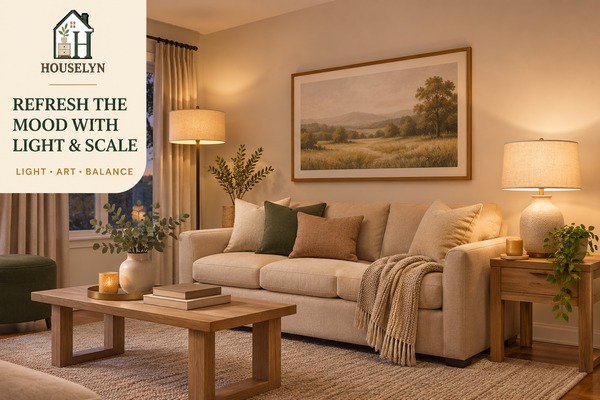
Use Better Lighting and Wall Decor to Change the Mood of the Room
Once the layout and textiles are working better, lighting and wall decor can change the
mood of the living room without changing its main furniture. These two layers affect how
the room feels from across the space: lighting controls warmth and depth, while wall decor
influences balance, scale and where the eye settles.
A room can feel tired when all the light comes from one ceiling fitting or when large walls
are decorated with pieces that are too small to hold the space. Before buying more
accessories, check whether the room simply needs stronger light at different heights and
better visual weight on the walls.
Layered lighting and correctly scaled wall decor can make an existing room feel warmer,
deeper and more balanced without replacing its furniture.
A single overhead light can illuminate the room without making it feel comfortable. Add
useful light closer to the seating zone so the room has more than one visual level after
dark.
A table lamp beside a sofa or a floor lamp near a reading chair can create a warmer pool
of light while supporting how the room is actually used.
Check Dark Corners Before You Change the Wall Colour
Corners can make a room feel heavy when they disappear into shadow. Before assuming the
paint colour is too dark, test whether a lamp or better-positioned light source can restore
depth and make the room feel more balanced.
Lighting should solve a real visual or functional problem. A lamp does not need to be
added to every empty corner.
Keep Bulb Colour Consistent Enough to Feel Deliberate
When one lamp looks noticeably cool and another looks strongly yellow, the room can feel
visually disconnected. Keeping the main evening light sources within a similar warm range
usually creates a calmer result.
Always use bulbs that meet the lamp or fitting manufacturer's specifications for base,
wattage and compatibility.
Review Wall Decor After the Furniture Has Moved
Repositioning furniture can change the relationship between artwork and the seating zone.
A print that looked centred before the layout changed may now feel disconnected from the
sofa or console below it.
Reassess the wall as part of the new composition. Move existing art where appropriate
before buying anything new.
Replace Several Weak Wall Pieces With One Stronger Treatment
A collection of small wall objects can make a living room feel busier without giving the
room enough visual weight. If several pieces are struggling to fill one large wall,
simplify before adding more.
One stronger artwork, a balanced pair or a more deliberate grouping can make the wall feel
fresher while reducing decorative noise.
Do Not Add a Lamp Just Because a Corner Is Empty
Empty corners are not automatically problems. Add lighting when the room needs more usable
illumination, when a dark area is weakening the visual balance or when the furniture
arrangement benefits from a stronger vertical element.
Otherwise, allowing the corner to remain open may give the room useful breathing space.
Let Wall Decor Support the Seating Zone
Art should feel related to the furniture beneath it. If a large sofa is paired with one
tiny frame floating high above it, the room can feel unfinished even when the rest of the
refresh is working well.
Correcting scale and placement can be more effective than adding another decorative
accessory somewhere else in the room.
Once the room is lighter, better balanced and visually connected, the remaining weak
points become much easier to identify. Chapter 6 focuses on spending selectively—using
one or two targeted upgrades instead of allowing the refresh to grow into a full makeover.
Chapter 6 — Upgrade the Weakest Detail
Use One or Two Targeted Upgrades Instead of Replacing Everything
After editing, repositioning, refreshing textiles and improving the lighting, the living
room should be much easier to judge. Any problem that remains is now more likely to be
specific: one worn finish, weak lamp shade, undersized artwork, awkward handle or
genuinely unsuitable rug rather than a room that needs complete replacement.
This is the point where spending can be useful, but only if the purchase solves a visible
or functional weakness. The aim is not to reward yourself for completing the earlier
stages with another shopping list. It is to invest selectively where the room still needs
help.
Small targeted upgrades have more impact when they solve the weakest remaining detail
rather than adding another decorative layer.
Early in a refresh, many elements can seem wrong at the same time because the room is
visually noisy. Once the layout, surfaces, textiles and lighting are calmer, the real
weakness becomes easier to isolate.
It may be a damaged finish on a side table, dated handles on a storage unit, a lamp shade
that no longer suits the base or a rug that genuinely cannot anchor the seating zone.
Address that specific weakness rather than reopening the whole room.
Prioritize What the Eye Sees Often
Highly visible details deserve more attention than small flaws hidden from normal viewing
positions. A worn coffee table surface may affect the centre of the room every day, while
a minor mark on the side of a rarely seen cabinet may not justify immediate spending.
Visibility matters because a small improvement in the right place can change how the
entire room is read.
Improve Function at the Same Time
A targeted upgrade becomes more valuable when it improves both appearance and use. New
handles may make a sideboard easier to operate as well as cleaner visually. A better lamp
shade may improve the light spread as well as the look of the lamp.
If an upgrade is purely decorative, ask whether the room already has enough decoration
before spending.
Restore Before You Replace Where Practical
Minor scratches or worn edges can sometimes be improved without replacing the furniture.
Cleaning, careful touch-up or simple maintenance may be enough when the underlying piece
remains sound.
Use any restoration product only where it is suitable for the material and finish, and
test it discreetly first. The goal is improvement, not disguising serious structural
damage.
Know When a Bigger Purchase Is Actually Justified
Budget decorating does not mean keeping every object indefinitely. If a rug is genuinely
too small, a coffee table repeatedly fails the room's function or a damaged piece cannot
be used safely, replacement can be the more sensible choice.
The difference is timing. By making the major purchase after the earlier refresh stages,
you can choose it for a specific reason rather than hoping it will somehow transform the
whole room.
Watch for Refresh Creep
Refresh creep happens when one justified purchase creates a chain of unnecessary ones:
a new lamp leads to a new side table, which leads to new artwork, which then seems to
require new cushions.
After every targeted upgrade, reassess the whole room before making another decision.
The first change may have solved more than you expected.
With the weak details addressed, the refresh should be nearly complete. Chapter 7 focuses
on the final discipline: rebalance the room, compare it with where you started and stop
before a successful refresh turns into an unnecessary full makeover.
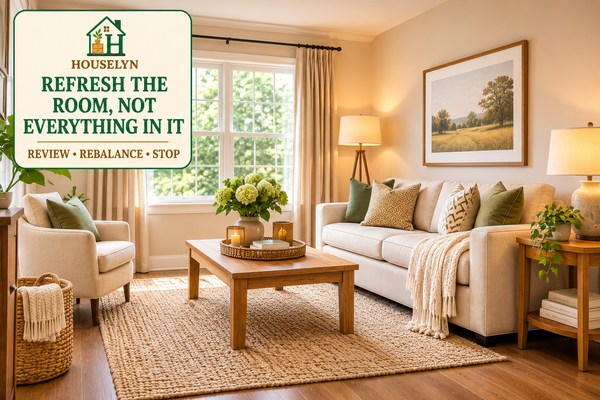
Stop the Living Room Refresh Before It Becomes a Full Makeover
A successful affordable living room refresh should reach a point where the room feels
lighter, more useful and more connected without requiring constant new purchases. The
final step is to stand back, compare the room with where it started and decide whether
anything genuinely still needs attention.
This stage matters because improvement can create momentum. Once the room begins to look
better, it is easy to keep changing things simply because the process feels productive.
That is how a targeted refresh can gradually become a much more expensive makeover.
A completed refresh should feel calmer, more functional and visually connected without
making the room look as though everything has been replaced.
Compare the Room With the Photograph You Took at the Start
Return to the doorway photograph from Chapter 1. Compare the composition rather than
individual objects. Is the room easier to read? Does the seating area feel clearer? Are
the main surfaces calmer? Does the lighting now support the room at different times of day?
This comparison helps you see whether the refresh has solved the original problems instead
of judging success by how many things changed.
Check Whether the Room Flows Better
Walk through the living room as you normally would. The route should feel easier after the
furniture changes, and frequently used seats, tables and lamps should remain accessible.
A room that looks improved but functions worse has not been successfully refreshed.
Check the Focal Point From the Doorway
The eye should have somewhere clear to settle. That might be the seating zone, a fireplace,
a window view or a well-scaled piece of wall art. Too many equally strong decorative
elements can weaken the refreshed room by recreating visual competition.
If the focal point is unclear, edit before you add. Removing one competing object may be
enough.
Check the Colour and Texture Balance
Look at cushions, throws, curtains, rug and wall art together. They should feel related
without becoming a matching set. If one accent colour appears everywhere, remove a
repetition rather than buying another coordinating object.
The refresh should feel connected through a few repeated ideas, not through identical
colours on every surface.
Protect the Negative Space You Created
Earlier editing may have opened part of a shelf, coffee table, wall or corner. Do not
automatically refill it once the refresh is nearly complete.
Negative space helps define the furniture and objects that remain. It is part of the
refreshed composition, not an invitation to shop again.
Do Not Add Something Only Because It Is Affordable
Low price is not the same as high value. An inexpensive object that duplicates something
already in the room can weaken the refresh even if the purchase barely affects the budget.
The final decisions should be stricter than the first ones because the room now has less
need for change.
Let the Room Keep Its Identity
A refresh should still feel like your living room. Existing furniture, personal objects
and familiar materials can remain part of the result. The purpose is to improve how those
elements work together, not erase every sign of the room that existed before.
Houselyn Principle: A Refresh Should Improve the Room Without Replacing Its Identity.
Better balance, stronger function and selective updates are enough when the room already
contains useful pieces worth keeping.
The full Houselyn refresh process is now complete:
Assess → Edit → Reposition → Refresh → Upgrade → Rebalance.
The next section turns that framework into a practical five-step action plan and answers
the most common questions about refreshing a living room without overspending.
Affordable Living Room Refresh FAQ
Common Questions About Refreshing a Living Room on a Budget
A living room refresh becomes easier when you separate what needs changing from what
simply needs editing, repositioning or restyling. These answers focus on the decisions
that help an existing room feel noticeably better without turning the process into a
complete makeover.
1. How Can I Refresh My Living Room on a Small Budget?
Start with changes that cost little or nothing. Edit clutter, reposition the furniture,
restyle the coffee table, move lamps and review the rug position before shopping.
After that, use a small budget on the layer that still looks weakest, such as cushion
covers, lighting or one stronger piece of wall decor.
2. What Should I Change First in a Tired Living Room?
Begin with a room audit rather than a purchase. Check layout, lighting, textiles,
walls, surfaces, storage and visible clutter. The first change should address the
issue creating the most visual or functional drag, not simply the easiest object to
replace.
3. Can I Refresh a Living Room Without Buying New Furniture?
Yes. Many rooms improve through editing, better furniture positioning, refreshed
cushion covers, improved rug placement, layered lighting and stronger wall balance.
Existing furniture only needs replacing when it is genuinely unsuitable, damaged or
unable to support the room's function.
4. How Can I Make My Existing Sofa Look Better?
First reduce excess cushions and check whether the sofa is being visually crowded.
Then refresh usable cushion inserts with coordinated covers, add one restrained throw
if useful and make sure the rug, side tables and wall decor around the sofa support
its scale rather than making it look isolated.
5. What Inexpensive Changes Make the Biggest Difference in a Living Room?
The highest-impact low-cost changes are often furniture repositioning, removing
decorative clutter, changing cushion covers, improving lamp placement, using warmer
compatible bulbs and correcting undersized or poorly positioned wall decor. The best
change is the one that solves the room's strongest weakness.
6. Should I Change the Rug During a Living Room Refresh?
Not automatically. Reposition or rotate the existing rug first and judge whether it
can anchor the seating area more effectively. Replacement becomes more reasonable if
the rug remains clearly too small, badly worn or visually disconnected after the
layout has been improved.
7. How Can Lighting Make a Living Room Feel Different?
Lighting changes how depth, colour and texture are perceived after dark. Adding useful
light near seating, reducing reliance on one ceiling fitting and keeping the main lamp
colours reasonably consistent can make an existing room feel warmer and more
intentional without changing the furniture.
8. How Do I Refresh Living Room Walls Cheaply?
Reassess what is already there before buying more. Move artwork if the furniture layout
has changed, group smaller pieces more deliberately or replace several weak wall items
with one stronger treatment. Better scale and placement often create more improvement
than simply adding another inexpensive decoration.
9. What Colours Work Well for an Affordable Living Room Refresh?
Start with the colours already present in the sofa, rug, curtains and larger furniture.
Keep a stable base, then introduce one restrained accent through cushions, throws or
art. The refresh does not need a completely new colour scheme if the existing palette
still works.
10. How Do I Refresh a Small Living Room Without Adding Clutter?
Prioritize editing and layout before accessories. Keep walking routes clear, remove
furniture that has lost its purpose and use fewer decorative objects with stronger
scale. Storage should solve visible everyday clutter rather than introduce more
containers into an already compact room.
11. How Much Should I Change at One Time?
Change one layer at a time so you can see what actually improves the room. Edit first,
then test the layout, then review textiles and lighting. Once those changes are visible,
you may discover that fewer purchases are required than you originally expected.
12. How Do I Know When My Living Room Refresh Is Finished?
Stop when the room flows better, feels calmer, has a clear focal point, uses lighting
more effectively and no longer contains obvious weak or distracting areas. If another
purchase would not solve a specific problem, the room probably does not need it.
Put the Refresh Into Practice
The Houselyn 5-Step Affordable Living Room Refresh
Work through the room in this order so lower-cost improvements have a chance to solve
the problem before replacement becomes the answer.
1
Photograph and Assess the Room
Take a doorway photograph and review layout, lighting, textiles, walls, surfaces,
storage and visual clutter. Identify the three areas creating the most drag.
Goal: Understand what actually needs attention before shopping.
2
Remove What Is Weakening It
Clear overloaded surfaces, reduce duplicate accessories, control visible everyday
clutter and protect useful negative space.
Goal: Let the strongest existing furniture and decor become visible
again.
3
Reposition What You Already Own
Test the sofa, chairs, rug, coffee table and lamps in stronger relationships before
considering replacement. Improve circulation and conversation first.
Goal: Make the existing room function better without a major
purchase.
4
Refresh the Most Visible Layers
Update only the textiles, lighting, wall styling or surfaces that still feel weak.
Keep the choices connected to the room rather than introducing a completely new
decorating scheme.
Goal: Change how the room feels while preserving useful furniture.
5
Upgrade Only the Remaining Weak Point
If one problem remains after the lower-cost stages, spend there deliberately.
Reassess the full room after each upgrade so one justified purchase does not become
a chain of unnecessary ones.
Goal: Put the budget where the improvement will actually show.
Conclusion
An Affordable Living Room Refresh Should Change the Feeling, Not Replace the Room
A living room does not need to look completely different to feel significantly better.
The strongest refreshes usually happen when you identify what is weakening the room,
protect what still works and improve the layers that have the greatest visual or
functional effect.
That means diagnosing before buying, removing unnecessary visual noise, testing the
furniture arrangement, refreshing textiles, improving lighting and wall balance, then
spending only where a genuine weakness remains.
This order matters because each stage can reduce the need for the next. Once clutter is
edited, the furniture may look better. Once the furniture is repositioned, the rug may
work more effectively. Once textiles and lighting improve, the room may need far fewer
decorative purchases than expected.
The framework is deliberately designed to make replacement the exception rather than the
starting point. Useful furniture can remain. Personal pieces can remain. The room can
retain its familiar character while becoming calmer, more functional and more visually
connected.
If the room now works better, feels calmer and no longer has an obvious unresolved weak
point, the refresh has done its job. The next purchase does not need to happen simply
because there is still money left in the budget.
Continue Learning
Build on Your Living Room Refresh
Continue with the Houselyn guides that support smarter budget decisions, stronger room
balance and more intentional decorating.
The Houselyn Editorial Team creates practical guides for improving the way homes look,
feel and function, with a focus on realistic decorating decisions, usable organization
systems and attainable interior styling.
Build a Home That Works Better and Feels More Intentional
Houselyn's Knowledge Library brings together practical guidance on home decor, room
planning, small-space living and organization so each improvement can support the next.
Use these guides to move beyond isolated decorating ideas and build rooms that are
comfortable, functional and visually connected.
Houselyn principle: better homes are built through thoughtful decisions,
not constant replacement.
Discover practical budget decorating ideas for improving your home with better priorities, affordable upgrades, thrifted finds, wall decor and smarter styling.
Use a smarter thrift store decorating plan to find quality secondhand pieces, judge condition and value, avoid clutter and make thrifted decor look intentional.